

How to check property legal status in Spain
Discovering a hidden debt, an unresolved mortgage, or an unlicensed extension on a property you have already committed to buying is one of the most costly surprises in any real estate transaction. For international buyers, the risk is amplified by unfamiliar procedures, language barriers, and legal systems that differ significantly from those in other countries. Knowing how to check property legal status in Spain before signing anything is not optional due diligence. It is the foundation of a secure purchase. This guide walks you through every step, from gathering essential documents to interpreting official records, using current 2026 procedures.
Table of Contents
- Key takeaways
- What you need before checking property legal status in Spain
- How to request and read the nota simple
- Cross-checking the Catastro and tax compliance
- Building permits, occupancy licences, and inspections
- Common mistakes when verifying property status
- My honest view on legal checks in Spain
- Work with a specialist property lawyer in Spain
- FAQ
Key takeaways
| Point | Details |
|---|---|
| NIE number is mandatory | Foreign buyers must obtain a NIE before finalising any property transaction in Spain. |
| Nota simple is the primary document | Request an up-to-date nota simple to confirm ownership, charges, and registration status. |
| Cross-check two official sources | Compare Land Registry and Catastro records to detect discrepancies that signal hidden risks. |
| Building permits matter | Verify licences and occupancy certificates, especially for renovated or off-plan properties. |
| Lawyers go beyond the notary | Independent legal advice uncovers risks that a notary is not required to investigate. |
What you need before checking property legal status in Spain
Before you can access any official property records, you need to have certain identifiers and documents in place. Attempting to verify ownership or request legal documents without them will result in delays that can cost you a deal.
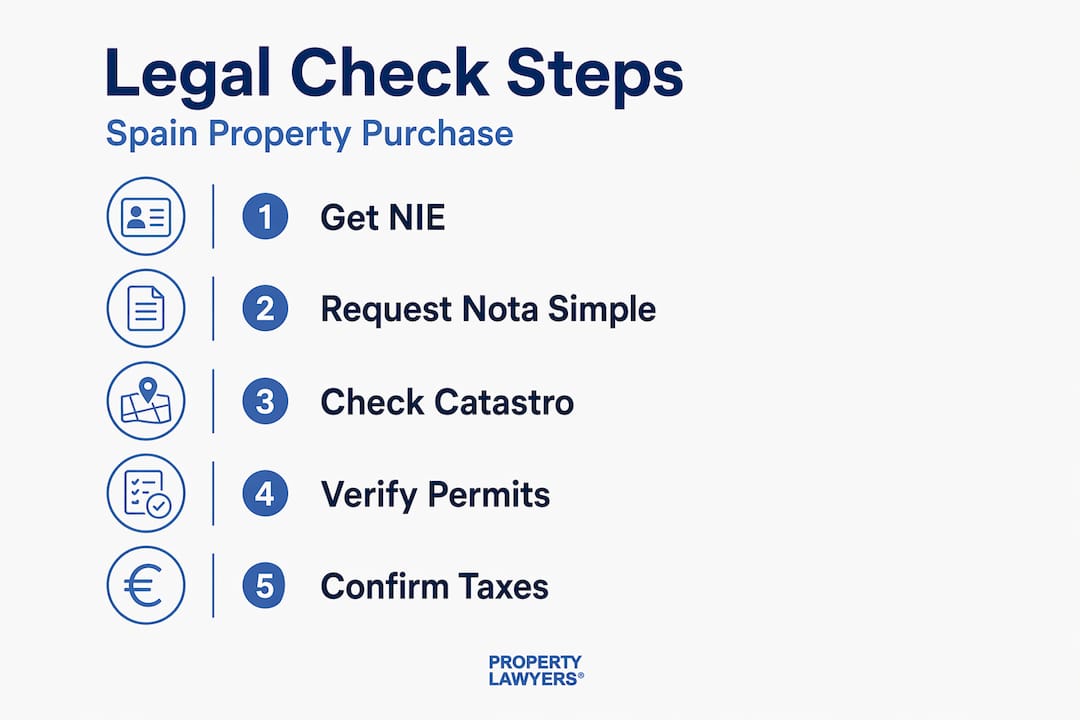
The single most important item is the NIE number (Número de Identidad de Extranjero). This is the tax identification number assigned to foreign nationals in Spain, and a NIE is mandatory for every stage of a property transaction, from signing a reservation contract to paying transfer tax. You apply using Form EX-15 at a Spanish consulate abroad or at a National Police station in Spain. Processing times vary by location, so plan ahead.
Beyond your NIE, you will need the following property identifiers to begin any title search or Spain property legal check:
- Full registered address of the property, as it appears in official records
- Catastral reference number, a unique code printed on IBI tax receipts and visible on the Catastro online portal
- Owner’s name or NIF/NIE number, which enables registry searches
- Land Registry volume, book, and folio numbers if available, which speeds up registration searches considerably
Pro Tip: Begin your NIE application as soon as you identify a property you are seriously considering. Many foreign buyers leave NIE applications too late, which delays bank appointments, notary signings, and tax filings at the worst possible time.
How to request and read the nota simple
The nota simple informativa is the cornerstone of any property search in Spain. It is the official extract issued by the Spanish Land Registry (Registro de la Propiedad) and provides a structured summary of the property’s legal standing.
Here is what a nota simple contains:
- Owner’s identity: the full name and tax identification number of the registered owner
- Property description: surface area, location, and type of property as recorded at registration
- Charges and encumbrances: mortgages, liens, easements, and legal annotations
- Embargo notes: any court orders or administrative charges attached to the property
- Co-ownership details: whether the property is held jointly or subject to any usufruct rights
The nota simple provides the most reliable snapshot of ownership, registration status, and existing charges available to a buyer. You can request it online through the official portal at www.registradores.org, which supports multilingual submissions including English. In-person requests are also accepted at any Land Registry office across Spain. The document is typically issued within one to three working days and costs a modest administrative fee.
There is one limitation you must understand clearly. The nota simple does not reveal unpaid community fees beyond two years, nor does it reflect building irregularities, urban planning infringements, or whether the property has a valid occupancy licence. It confirms legal title. It does not confirm physical or planning compliance.
Pro Tip: Always request a fresh nota simple as close to signing as possible. A nota simple obtained two months earlier may not reflect a recently registered mortgage or embargo. Visit the Land Registry guide for a detailed explanation of how to interpret each section.
Cross-checking the Catastro and tax compliance
The Catastro is Spain’s cadastral register, managed by the Ministry of Finance. It records the physical characteristics of every property: location, boundaries, surface area, and use. Crucially, it is a separate system from the Land Registry, and comparing both sources is one of the most effective ways to detect hidden liabilities or undeclared construction.
You can search the Catastro free of charge through the geoportal at www.catastro.hacienda.gob.es using the property’s catastral reference or address. The data is publicly accessible and displays physical boundaries alongside the official registered surface area.
Why discrepancies are serious warning signs
When the surface area recorded in the Land Registry differs significantly from the Catastro, it often signals an undeclared extension, an illegal modification, or a boundary dispute. Registry and cadastral data mismatches are among the most common red flags uncovered during due diligence on Spanish properties. A garage converted into a living room, a terrace enclosed without a licence, or an additional storey built without planning permission will often appear as a discrepancy between the two systems.
The comparison table below shows exactly what each source covers:
| Information type | Land Registry | Catastro |
|---|---|---|
| Legal owner’s identity | Yes | No |
| Mortgages and liens | Yes | No |
| Physical boundaries | No | Yes |
| Surface area | Registered area only | Measured area |
| Undeclared construction | Not directly | Often visible |
| Tax valuation (valor catastral) | No | Yes |
Beyond these two official sources, you should also verify outstanding IBI (Impuesto sobre Bienes Inmuebles) tax payments and any unpaid community fees. Unpaid IBI debts transfer to the new owner upon purchase. Since May 2026, municipalities may levy a surcharge of up to 150% on IBI for long-term vacant homes, meaning inherited tax obligations can be considerably larger than expected. Request written confirmation of IBI payment from the seller and ask the community administrator directly about any outstanding service charges.
Building permits, occupancy licences, and inspections
Ownership being legally registered does not mean a property was built, extended, or modified in accordance with Spanish planning law. This distinction matters enormously, particularly for resale value, insurability, and future renovation projects.
The key documents to verify in this area include:
- Licencia de obra (building licence): confirms the construction was approved by the local municipality
- Licencia de primera ocupación (first occupancy licence): confirms the property was built in accordance with the approved plans and is habitable
- Certificado de eficiencia energética (energy performance certificate): mandatory for any property sale in Spain
- Technical Inspection of Buildings (ITE): required for older buildings, confirming structural soundness
Verifying building and occupancy permits is especially important for off-plan properties, rural homes, and any property that has been extended or renovated. Illegal construction in Spain is not automatically legalised by the passage of time in all regions, and some regional authorities have actively pursued enforcement actions against buyers who purchased properties with irregular structures.
The practical consequence can be severe. A property with an unlicensed extension may be uninsurable in its current form, unmortgageable by a Spanish bank, or subject to a demolition order. These are risks that no nota simple will reveal on its own.
Pro Tip: Engage a qualified architect or technical surveyor before exchanging contracts on any property that has been extended or modified. A technical report costs a fraction of the potential liability. Property-lawyers can connect you with specialists experienced in identifying planning irregularities.
If you intend to let the property as a tourist rental, note that Spain’s tourist rental regulation has become increasingly localised following the overturning of the national register in 2026. Rental permissions now depend heavily on municipal and community rules, adding an additional layer of due diligence for investment buyers.
Common mistakes when verifying property status
Even well-prepared buyers make avoidable errors. The following are the most consequential mistakes encountered during real estate legal status verification in Spain.
- Delaying the NIE application: This single oversight regularly causes entire transactions to stall. Without a NIE, you cannot open a Spanish bank account, sign purchase deeds, or pay property transfer tax. The NIE process takes time, and assuming you can sort it in the final week before completion is a reliable route to expensive delays.
- Relying solely on the nota simple: The nota simple confirms legal title. It does not confirm physical compliance, planning status, or community financial health. Treating it as a complete clearance is a frequent and costly misunderstanding.
- Ignoring community fee debts: Under Spanish law, unpaid community fees from the current year and the previous three years transfer to the new owner. Always request a certificate from the community president or administrator confirming the property has no outstanding charges.
- Confusing the notary’s role with legal protection: A notary in Spain verifies that a transaction meets formal legal requirements. A notary does not protect a buyer’s commercial interests, investigate unpaid taxes, or check planning compliance. Buyers who rely on the notary alone, without independent legal representation, leave significant risks unexamined.
- Failing to act on discovered discrepancies: If a check uncovers a mismatch or irregularity, do not proceed on the seller’s verbal assurances. Require written resolution, corrected registry entries, or a corresponding price adjustment before exchanging any binding contract. The full due diligence checklist at Property-lawyers provides a structured framework for addressing these situations.
My honest view on legal checks in Spain
I have observed enough property transactions go wrong to say this plainly: the official documents are only part of the picture.
In my experience, buyers who complete a nota simple and stop there are leaving the most damaging risks unexamined. The document tells you who owns the property and what charges are registered. What it does not tell you is whether the swimming pool extension was ever approved, whether the seller owes three years of community fees, or whether the property sits in a zone that prohibits tourist rentals.
What I have found actually matters is the combination of documents plus professional scrutiny. A good independent lawyer does not simply collect paperwork. They cross-reference it, probe inconsistencies, and ask questions that buyers do not know to ask. I have seen transactions where a quick Land Registry and Catastro comparison revealed an undeclared second storey that the seller had never mentioned. That discovery saved the buyer from inheriting a demolition risk.
The importance of independent lawyers is not marketing language. It reflects the reality that independent legal advice is the only mechanism that reliably connects all the checks into a coherent risk assessment. Start the NIE application early. Request the nota simple promptly. Cross-check the Catastro. And then let a qualified lawyer do what official portals cannot: interpret what it all means for you specifically.
— Sophie
Work with a specialist property lawyer in Spain
Carrying out a thorough Spain property legal check requires accessing multiple official sources, interpreting technical documents, and knowing which questions to ask at each stage. That process is substantially more secure with professional legal guidance.

Property-lawyers connects international buyers with independent, English-speaking property lawyers across Spain who handle the full scope of legal verification. From obtaining your NIE and requesting the nota simple, to cross-checking Catastro data, reviewing building permits, and confirming tax compliance, the right lawyer manages every step. Find a trusted property lawyer in Spain through Property-lawyers and get expert guidance tailored to your specific purchase, location, and circumstances.
FAQ
What does checking property legal status in Spain involve?
Verifying the legal status of a Spanish property means confirming ownership through the Land Registry, reviewing charges and encumbrances via the nota simple, cross-checking physical details with the Catastro, and confirming tax and planning compliance.
How do I get a nota simple in Spain?
You can request a nota simple online through www.registradores.org or in person at any Land Registry office in Spain. The document is available in English and is typically issued within one to three working days.
Can I verify property ownership in Spain without a lawyer?
You can access the Land Registry and Catastro independently, but independent legal advice is strongly recommended to identify risks that official documents do not disclose, such as planning irregularities and unpaid community fees.
What is the difference between the Land Registry and the Catastro?
The Land Registry (Registro de la Propiedad) confirms legal ownership and registered charges. The Catastro records physical boundaries, surface areas, and tax valuations. Both must be consulted and compared during any property verification.
Do community fee debts transfer to the new owner in Spain?
Yes. Under Spanish law, unpaid community fees from the current year and the three preceding years transfer automatically to the new owner at the point of purchase. Always request a written certificate of no outstanding debts before signing.
Recommended
- Property in Spain: What about the military clearance? | Property Lawyers
- Legalisation of Properties in Spain (including Mallorca) | Property Lawyers
- Due Diligence Spain: Property Buying Checklist (2026)| Property Lawyers
- Cédula de Habitabilidad Spain — Certificate of Habitation Guide | Property Lawyers

Sophie Gutenberg is a legal content specialist focused on Spanish property law, real estate transactions, conveyancing, due diligence and tax issues affecting international property buyers in Spain. She works alongside qualified Spanish property lawyers .
