
If you sell a Spanish property while living abroad, the buyer must hold back 3% of the price and pay it to the Spanish Tax Agency on your behalf. That 3% is an advance on your capital gains tax, not the final bill: you settle the real amount, or claim money back, with a separate tax return. On top of that comes the municipal plusvalía, plus a handful of certificates the notary will ask for before anyone signs.
TL;DR:
- The buyer withholds 3% of the sale price and pays it to the Agencia Tributaria with modelo 211 within one month of completion.
- Non-residents pay capital gains tax at a flat 19% on the profit, declared on modelo 210. If the 3% retention exceeds the tax due, you can claim the difference back.
- The plusvalía municipal taxes the increase in land value. Since 2021 you can use the cheaper of two calculation methods, and nothing is due if you sold at a loss.
- When the seller is non-resident, the buyer is legally responsible for the plusvalía, so it is usually deducted at completion as well.
- An energy certificate, paid-up IBI and community fees, and in the Balearics a valid cédula de habitabilidad are needed to sign without delays.
When the seller is not tax resident in Spain, Spanish law obliges the buyer to withhold 3% of the agreed price at completion and pay it to the Agencia Tributaria using modelo 211, within one month of signing. If the buyer fails to do so, the property itself remains liable for the unpaid amount, which is why buyers’ lawyers never skip this step.
The retention applies whether you sell at a profit or at a loss. It is simply a guarantee for the Tax Agency. Make sure you receive a copy of the stamped modelo 211: you will need it to file your own return and, if relevant, to recover any excess.
Non-residents pay Non-Resident Income Tax (IRNR) at a flat 19% on the capital gain. The gain is the difference between two figures:
A simplified example: you bought for €400,000 and paid €40,000 in purchase costs. You sell for €600,000 with €20,000 in selling costs. Your gain is €580,000 − €440,000 = €140,000, and the tax at 19% is €26,600. The buyer already withheld 3% of €600,000, which is €18,000, so you pay the remaining €8,600 with modelo 210.
Keep every invoice. Improvements you cannot document with invoices and payment records will not reduce the gain. Most reliefs available to Spanish residents, such as reinvestment in a main home, do not apply in the same way to non-residents, so check your specific situation with a lawyer, especially if you were Spanish tax resident at some point. You will usually also need to report the sale in your country of residence, where a double taxation treaty normally lets you credit the tax paid in Spain.
The return for the gain is filed on modelo 210 within three months after the end of the one-month period the buyer has to pay the retention. In practice, that gives you roughly four months from completion.
The plusvalía municipal (Impuesto sobre el Incremento de Valor de los Terrenos de Naturaleza Urbana) is a local tax on the increase in value of the land the property stands on. It is set and collected by the town hall.
Since the 2021 reform, the gain can be calculated in two ways and you pay the lower result:
If you sold for less than you paid, no plusvalía is due, but you must prove it with the deeds. The tax is normally due within 30 working days of the sale. When the seller is non-resident, the buyer becomes the sustituto del contribuyente and is legally responsible for paying it, so the amount is usually retained from the price at the notary.
The buyer’s lawyer will also check that the registry and cadastral descriptions match reality. Pools, extensions or annexes built without permission are the most frequent problem, especially on rustic land.
Yes. You can grant a power of attorney to your lawyer, signed before a notary in your country and legalised with the Hague Apostille, or signed at a Spanish consulate. If it is not in Spanish, it will need a sworn translation. With it, your lawyer can sign the deposit contract and the completion deed, receive the funds and file your tax returns.
An independent lawyer can prepare the documents before you list, negotiate the deposit contract, calculate your tax in advance, sign on your behalf and recover any excess retention. Find a vetted, English-speaking property lawyer in the area where your property is located.
Yes. The buyer must withhold it in every sale by a non-resident. If there is no gain, you claim the full amount back through modelo 210.
A flat 19% on the capital gain, calculated as the sale price minus selling costs, less the purchase price plus purchase costs and documented improvements.
Legally, the buyer is responsible as substitute taxpayer, so the amount is normally deducted from the price at completion.
It varies, but several months is common. Filing modelo 210 promptly and having a Spanish bank account helps.
Yes, with a notarised and apostilled power of attorney, or one signed at a Spanish consulate.

Sophie Gutenberg is a legal content specialist focused on Spanish property law, real estate transactions, conveyancing, due diligence and tax issues affecting international property buyers in Spain. She works alongside qualified Spanish property lawyers .
Yes, many clauses banks wrote into Spanish mortgages can be declared void, and borrowers often recover the money they paid because of them. The two most common wins involve the cláusula suelo (floor clause) and mortgage formalisation costs wrongly billed to the buyer. Start by gathering your deed and receipts, then send a written complaint to your bank before anything else.
TL;DR:
- Courts often declare floor clauses void if banks did not clearly explain their financial impact, with refunds depending on the number of active years.
- Notarial costs and formalization fees charged entirely to borrowers are often deemed illegal and can lead to claims worth several thousand euros.
- Checking your mortgage deed, pre-contractual information, and payment history allows you to estimate potential recoveries before legal action.
- Filing an extrajudicial complaint first can prompt settlements, but court claims are necessary if the bank refuses resolution or if foreclosure proceedings are active.
- Engaging a qualified, English-speaking lawyer for a document review improves the chances of successful claims, especially for complex or large cases.
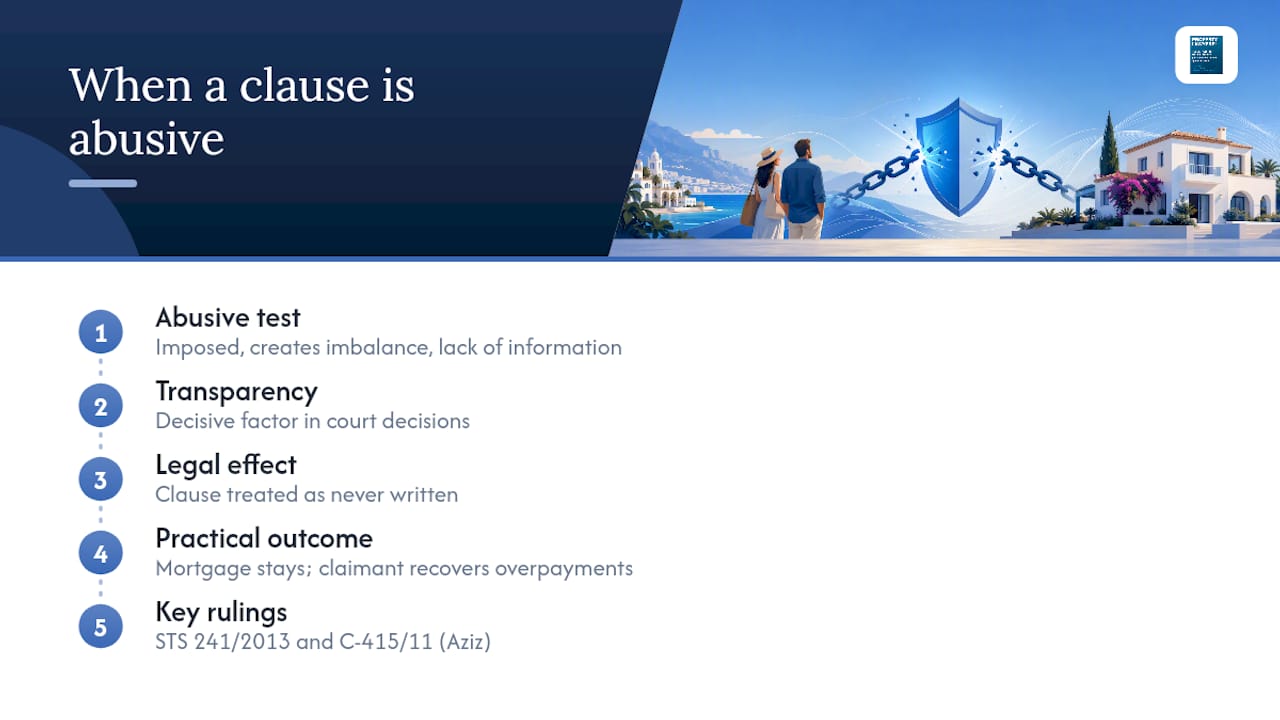
A clause becomes abusive when the bank imposed it without genuine negotiation, it created a significant imbalance between the parties, and the borrower never received clear, honest information about what it meant for their finances. That three-part test comes from EU Directive 93/13/CEE and Spain’s consumer protection law, the Real Decreto Legislativo 1/2007 (TRLGDCU). Transparency is the decisive factor courts return to again and again: a clause can be legal in principle and still fall if the bank buried it in small print or failed to explain its real cost.
When a Spanish court declares a clause abusive, the consequence is specific. The clause is treated as if it had never been written into the contract. The mortgage itself survives, minus that clause, and the borrower can usually claim back whatever they overpaid because of it.
Two rulings shaped how this works in practice. The Supreme Court’s STS 241/2013 on the cláusula suelo confirmed that a floor clause is void when the bank failed to make its financial impact genuinely understandable, even where the wording itself was not hidden. The Court of Justice of the European Union’s Aziz ruling (C‑415/11) went further, requiring Spanish judges to review mortgage contracts for abusive terms on their own initiative, even in cases where the borrower never raised the issue. That duty, known as control de oficio, is now built into article 552 of the Ley de Enjuiciamiento Civil (LEC).
Spanish courts have built up a fairly consistent list over the past decade. If your mortgage was signed before 2019, in particular, it’s worth checking your deed against each of these.
Before contacting anyone, you need paper. Spanish claims live or die on documentation, and the good news is most of it is easy to obtain.
Read your deed looking for blanket phrases like “all costs and expenses shall be borne by the borrower” with no breakdown of what those costs actually cover. That kind of catch-all language, offered with no itemised explanation, is a strong transparency red flag.
A rough calculation helps before you commit time to a claim. If your floor clause held your rate at, say, 3% while Euríbor sat near zero for several years, multiply the rate difference by your outstanding balance across those years to get a ballpark recoverable figure. It won’t be exact, but it tells you whether pursuing the claim is worth it.
Pro Tip: Note the exact date you signed the deed and the date, if any, you signed a later novation or restructuring. Those two dates often decide which prescription rules apply to your claim, so get them right before you approach anyone.
Spanish claims follow a fairly fixed sequence, and skipping the first step usually counts against you later.
A few practical points worth weighing before you commit to litigation:
Illustrative figures from published cases show mid-size mortgages recovering between roughly €1,500 and €15,000, depending on the clause and how many years it was in force. A long-running floor clause on a larger loan tends to sit at the higher end; a single overcharged formalisation cost sits nearer the lower end.
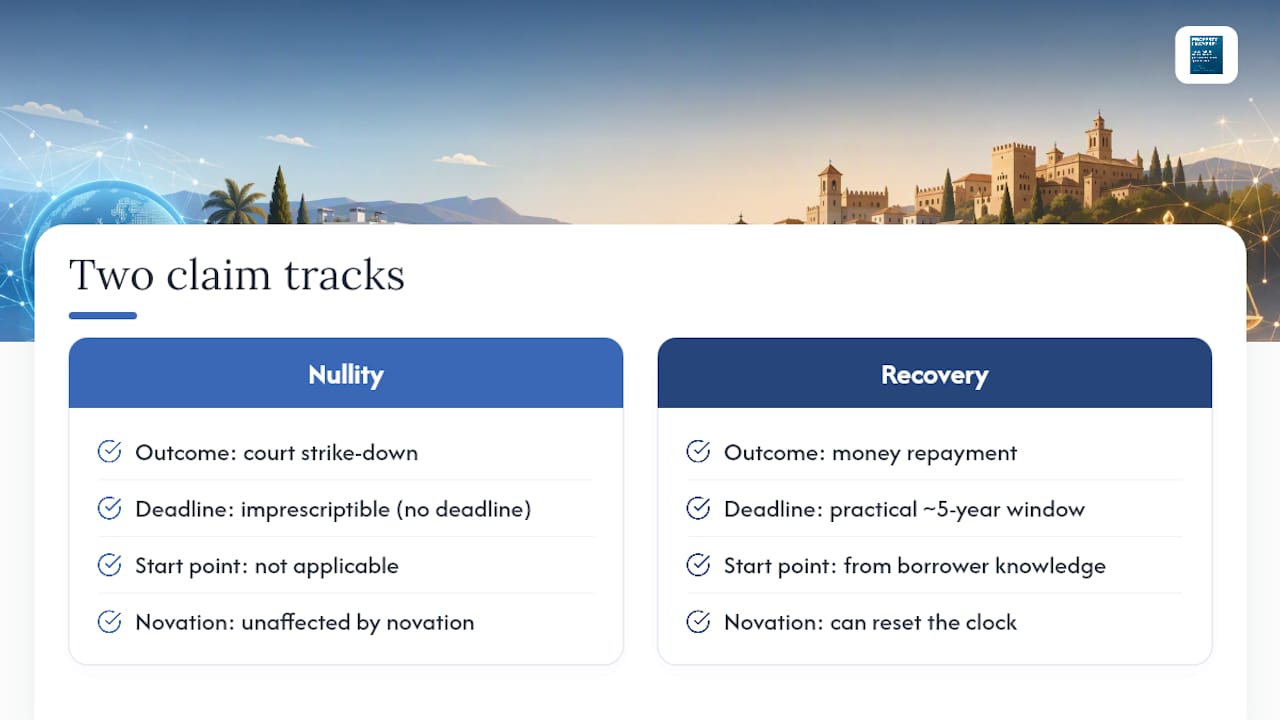
Timing matters, and it works differently for two separate actions. The right to have a clause declared null is generally treated as imprescriptible, meaning there’s no deadline to ask a court to strike it down. Recovering the money already paid is a different action, and Spanish courts have applied practical limitation periods, often discussed around a five-year window, calculated from when the borrower could reasonably have known the clause was abusive. That’s why the date on your novation or restructuring can matter so much: signing one sometimes resets the clock, and a poorly explained waiver inside it can be challenged in its own right.
A professional audit typically checks your FEIN, the signed offer, every clause in the deed, your cost invoices and your full payment history side by side, looking for the gaps between what you were told and what you actually paid. That cross-check is where most viable claims get discovered.
Hiring a lawyer becomes genuinely cost-effective once a foreclosure is active, the sums involved run into several thousand euros, or key documents are missing and need to be sourced from notaries or the registry. There are directories of English-speaking property lawyers across Spain, searchable by region, to help international buyers find someone who understands both the legal detail and the practical reality of dealing with Spanish banks.
The most common mistake is not gathering documents early. Borrowers often wait years, misplace the deed, or sign a bank’s novation without reading the waiver clause buried inside it. That single signature can quietly close a door that was otherwise open.
Realistically, many cases settle before reaching a judge, and the ones that do go to court succeed largely on the strength of the paperwork behind them, not on how compelling the borrower’s story sounds. If there’s one action worth taking today, it’s requesting your deed and your cost invoices. Everything else in a claim builds from those two documents.
— Sophie
Directories like this offer an alternative to guessing your way through a bank complaint alone: instead of drafting a claim letter with no legal backing, you can find an independent, English-speaking property lawyer who handles these disputes in your region.

The directory lets you search by area, so if your mortgage is with a bank branch in the capital, the Madrid solicitors and lawyers listing is a sensible starting point, and the broader directory of property lawyers across Spain covers other regions including Marbella, Málaga and the Balearics. A first consultation typically involves sending over your deed, FEIN and payment history so the lawyer can tell you, before you commit to anything, whether your clauses are worth pursuing and what sum is realistically recoverable. For non-resident buyers in particular, working with a lawyer who already understands non-resident Spanish mortgages reduces the risk of losing a valid claim to a procedural error or a missed deadline. Search the directory now and request an introduction to a lawyer in your area.
Aziz preliminary ruling dossier · Abogacía Española on abusive clauses · Orozco y Asociados catalogue · Rastreator claim guide · Interforo Abogados procedural guide
This article is general information, not a substitute for advice from a qualified lawyer. Consult a qualified legal professional about your own circumstances before acting on anything here.
The most commonly challenged clauses are the cláusula suelo, gastos de formalización wrongly billed to the borrower, disproportionate default interest, the comisión de apertura, upward-only rate rounding, aggressive early termination terms, IRPH-linked rates and foreign currency (multidivisa) clauses.
Default interest is generally considered abusive when it exceeds around two percentage points above the loan’s ordinary interest rate, a benchmark Spanish courts have applied consistently in recent rulings.
A clause is abusive when it was imposed without genuine negotiation, creates a significant imbalance against the borrower, and was not explained clearly enough for the borrower to understand its real financial impact before signing.
Start with a written extrajudicial complaint to your bank citing the specific clause and the amount you want refunded; if the bank refuses or stays silent, you can escalate to the Banco de España or file a judicial claim for nullity and restitution, and a specialist lawyer found through a directory like Property-lawyers.com can review your documents first to confirm the claim is worth pursuing.
Sophie Gutenberg is a legal content specialist focused on Spanish property law, real estate transactions, conveyancing, due diligence and tax issues affecting international property buyers in Spain. She works alongside qualified Spanish property lawyers .
For most buyers in Spain in 2026, a fixed-rate mortgage suits anyone who wants a predictable monthly bill and plans to stay put for years. Variable or mixed deals still make sense if you have financial breathing room and a shorter horizon. The Euribor and the European Central Bank’s recent moves are the real deciding factor, but your own plans for the property matter just as much as the market.
TL;DR:
- Fixed-rate mortgages in 2026 offer stability with key advantages for long-term stayers, despite higher initial costs compared to variable options.
- The convergence of fixed and variable starting rates near 3% makes fixed mortgages more attractive, especially when rates are expected to stay stable or rise.
- Variable mortgages benefit those expecting rates to fall or with income flexibility to handle potential increases, but they carry higher risk if Euribor spikes unexpectedly.
- Mixed mortgages suit buyers seeking short-term certainty before switching to variable, but require careful attention to switch dates and refinancing costs.
- Proper comparison requires reviewing the full cost via the FEIN, analyzing the TAE, and modeling various Euribor scenarios to avoid costly surprises.
The Euribor sits near the 3% mark heading into 2026, after the European Central Bank raised policy rates again in June 2026. That single decision rippled through mortgage pricing almost immediately, because Spanish banks reprice variable loans off the Euribor and adjust fixed offers based on where they expect rates to head next.
Banks have responded differently depending on the product. Fixed-rate pricing has held fairly steady, since lenders build in a margin for future uncertainty. Variable offers have become slightly cheaper at entry in some cases, as banks compete for the buyers who are willing to take on rate risk.
The number that matters: market analysis in 2026 points to a clear shift towards fixed mortgages as fixed and variable entry rates converge near 3%. When the gap between the two options narrows this much, the extra certainty of a fixed rate starts to look like a small price to pay.
That convergence is the whole story of 2026. In previous years, variable loans often started two or three percentage points cheaper than fixed ones, which made the trade-off obvious. Now the starting rates are close enough that many buyers are choosing certainty simply because there is little financial reason not to.
A fixed mortgage locks your interest rate for the entire term, sometimes 20 or 30 years. Your monthly payment stays exactly the same whether the Euribor rises, falls, or does nothing at all. That predictability is the entire appeal, and in a year when the ECB has shown it is still willing to move rates, it carries real weight.
The advantages are straightforward:
The trade-offs are just as real. Fixed rates typically start higher than variable ones, so you pay a premium for peace of mind. If the Euribor falls sharply after you sign, you will not benefit unless you renegotiate or refinance, which brings its own costs.
Before signing anything, check the TAE (the all-in annual cost, not just the headline rate), the exact term, and the early repayment penalty. Spanish banks cap these penalties by law, but the percentage still varies by lender and by how early you repay. Also look closely at any bonificaciones, the discounts banks offer for taking out linked products like life insurance or a salary account, because these can shift the real cost of the loan significantly.

Pro Tip: Ask your bank for a written breakdown of the rate with and without every bonificación. Some linked products cost more annually than the discount they generate, especially if you do not need the insurance or card being pushed.
A variable mortgage is priced as Euribor plus a fixed differential set by the bank, for example Euribor plus 0.60%. The rate is reviewed periodically, usually every six or twelve months, so your payment can move up or down each time the Euribor shifts.
The upside is obvious when rates fall: your payment drops without you doing anything. The downside is just as direct. If the Euribor climbs notably over the next two years, a borrower with a €150,000 loan could see a significant increase in their monthly payment, depending on the remaining term.
Key contract details to check on a variable offer:
Variable mortgages in 2026 tend to appeal to buyers who expect rates to fall over the medium term, or who have enough income flexibility to absorb a payment increase without strain. Investors buying to let in areas with strong rental demand, such as parts of the Costa del Sol, sometimes accept variable risk because rental income can offset a rate rise. For a deeper look at how revision periods and rate exposure work in practice, this guide to adjustable-rate mechanics is a useful reference, even though it is written for a different market.
A mixed mortgage fixes the rate for an initial period, commonly 5 to 15 years, then switches to variable for the remainder of the term. It is designed as a compromise: you get certainty when you need it most, then take on rate risk later, when in theory your income has grown and the loan balance has shrunk.
This structure works well if you expect to sell, remortgage, or pay off a large chunk of the loan before the fixed period ends. It suits buyers who want a lower starting rate than a full fixed deal but more predictability than a pure variable one.
Watch out for these traps:
Check the exact expiry date of the fixed tranche before signing, and ask what your rate would look like on day one of the variable period under today’s Euribor.
Comparing headline rates alone is one of the most common mistakes Spanish buyers make. A lower advertised rate can hide a higher real cost once linked products and fees are added.
Follow this sequence when reviewing any offer:
Once you have the real TAE for each offer, run three scenarios: your baseline monthly payment today, a moderate Euribor rise of around one point, and a sharp rise of two points or more. Compare how each mortgage type behaves under all three, not just the one that looks best right now.
Pro Tip: Treat any advertised rate that seems far below the market average as a signal to check the small print twice. It usually means the bank is compensating with a product you are being asked to take out alongside the loan.
Watch for marketing language that emphasises the lowest possible rate without mentioning the conditions attached to it. If a bank cannot give you a clear TAE figure within a few minutes, that is a red flag worth taking seriously.
Spain’s average new mortgage sits close to the figures reported in recent INE housing statistics, which is useful for building a realistic comparison. Using a representative €180,000 loan over 25 years, here is how the three mortgage types might compare under different Euribor paths.
These figures are illustrative, built to show the pattern rather than an exact quote. Adjust them to your own loan amount and term, and always ask your bank for a personalised amortisation table before comparing offers side by side.
Never sign a mortgage contract based on a sales conversation alone. The FEIN is the document that legally protects you, and Banco de España’s own guidance places it at the centre of any honest comparison between mortgage offers.
Before signing, check:
Get the binding offer in writing, ask your bank for a plain-language clause summary, and have a lawyer review the FEIN before you sign. This matters even more for non-resident buyers navigating a Spanish contract in a language and legal system that is not their own.
If you need certainty and plan to stay in the property for more than five years, fixed is the sensible default in 2026. If your income has flexibility and you are buying for a shorter horizon, variable or mixed can still work, provided you have actually run the sharp-rise scenario and know you can absorb it.
Whatever you choose, model the numbers before you fall in love with a rate, and get a lawyer to check the contract and closing costs together, since taxes and fees often change the real budget more than the mortgage type does.
— Sophie
Choosing between fixed, variable and mixed is only half the job. The other half is making sure the FEIN, the differential, and the penalty clauses actually say what the bank told you they say, and that is where an independent lawyer earns their fee. There are directories online that connect buyers with vetted, English-speaking real estate lawyers across Spain, so you are not left to interpret a Spanish mortgage contract alone or rely on the bank’s own advisor.
A local lawyer can review your FEIN line by line, flag any floor clause or unusual bonificación before you commit, and explain exactly what novación or subrogación would cost if you ever want to change terms. This matters most for non-resident buyers, complex financing structures, or any contract with clauses that feel unusually restrictive. Visit the real estate lawyer directory to find a qualified lawyer in your region and get your mortgage offer reviewed before you sign.
This article is general information, not a substitute for advice from a qualified financial advisor. Consult a qualified financial professional about your own circumstances before acting on anything here.
Variable can still work for buyers with income flexibility and a shorter ownership horizon.
A mixed mortgage fixes the rate for an initial period, often 5 to 15 years, then switches to variable. It suits buyers who want short-term certainty but expect to sell, remortgage, or pay down the loan before the fixed period ends.
The FEIN is the standardised pre-contractual document Spanish banks must provide, and Banco de España treats it as the authoritative way to compare the real cost of any mortgage offer. Always request it and have it reviewed before signing.
On a variable mortgage, rises in the Euribor typically add a significant amount to monthly payments on a mid-sized loan, depending on the outstanding balance and term. Running a moderate and a sharp-rise scenario before choosing shows you the real range.
A lawyer is not legally required to sign a mortgage, but reviewing the FEIN and contract clauses before committing is strongly advisable, particularly for non-resident buyers or contracts with linked products and penalty clauses. Some services connect buyers with independent lawyers across Spain for this kind of review.
Sophie Gutenberg is a legal content specialist focused on Spanish property law, real estate transactions, conveyancing, due diligence and tax issues affecting international property buyers in Spain. She works alongside qualified Spanish property lawyers .
Yes, if you’re selling, renting or advertising a home in Spain, you need a certificado energético (energy performance certificate). It rates the property from A to G and must be registered with your region before the listing goes live or the notary completes the sale. If you don’t have one yet, the practical next step is simple: find a qualified certificador, arrange an inspection, and get the certificate registered with your autonomous community.
TL;DR:
- Most properties in Spain need a registered energy performance certificate before selling, renting, or advertising to comply with legal requirements.
- The certificate’s rating depends on energy consumption and CO2 emissions, using recognized software and official guidelines for uniform comparison.
- Obtaining the certificate involves booking a qualified inspector, completing an on-site assessment, and registering the result with regional authorities, typically taking a few days.
- Costs vary by property size and type, with larger or more complex homes costing more, and validity lasts several years unless regional rules specify otherwise for low ratings.
- Improving the rating through low-cost or medium upgrades can boost market appeal, but planning inspections well in advance helps maximize renovation benefits.
A certificado energético vivienda is a standardised measure of how much energy a home consumes and how much CO2 it produces during normal use. Every dwelling gets a letter from A to G, with A marking the most efficient homes and G the least. Buyers see this letter on every property listing, much like the energy labels on fridges or washing machines.
The rating depends on two main figures set out in official MITECO guidance:
Both figures come from a standard calculation procedure, so a G-rated flat in Marbella and a G-rated flat in Barcelona are judged against the same benchmarks. A qualified technician runs the numbers through recognised software, and the result becomes the official label buyers rely on when comparing properties.
The current rules sit under Real Decreto 390/2021, which replaced the earlier framework from RD 235/2013. Together, these decrees created the certification system Spain uses today, and RD 390/2021 is the version your lawyer or certificador will cite if anyone questions the paperwork.
Three situations trigger the obligation:
Notaries can refuse to proceed with a sale if the seller can’t produce a valid certificate, which is why leaving this until the last minute causes real delays. There’s also a longer-term angle worth knowing. Spain’s regulatory direction points towards minimum efficiency targets over the coming years, with industry reporting and legislative context pointing to markers such as an E rating by 2030 and D by 2033. Owners of older properties with weak ratings should treat this as a reason to plan improvements sooner rather than later, not just a box to tick before a sale.
Getting the certificate isn’t complicated, but skipping a step can cost you time when you’re trying to close a sale. Here’s the order that works.
Most straightforward flats take a few days from booking to registration, though larger houses or buildings with unusual layouts can take longer if access is tricky or documents are missing.
Pro Tip: If your current certificate has expired or you can’t find the original, don’t assume you need to start from scratch. Check the geoportal first; many properties already have a certificate on file that simply needs renewing rather than reissuing.
Prices vary by property type and region, but as a general guide, a certificate for a standard flat tends to sit at the lower end of the market, while detached houses and larger properties cost more because the inspection takes longer. Whole apartment buildings cost more again, reflecting the extra common areas and shared systems involved.

Validity generally runs for several years from the date of registration, after which you’ll need a fresh inspection to keep advertising or selling legally. There’s one wrinkle worth flagging: properties rated G have occasionally faced shorter validity windows under certain regional rules, so it’s worth confirming directly with your local registry if your home falls into that band.
Registration fees also differ by autonomous community. Some charge a small administrative fee; others process registrations free of charge. Checking your regional energy agency’s current fee schedule before you commit saves an unwelcome surprise later.
The certificate isn’t just a letter and a number. It’s a structured document with several parts, and understanding them helps you use it properly when you’re selling or renting.
The energy label extracted from this document is what must legally appear in any advert, and MITECO’s updated recognised documents distinguish between labels for new-build projects, finished buildings and existing dwellings, so make sure your agent is using the correct version for your situation.
One section buyers pay close attention to is the recommended improvements list. It outlines specific upgrades, such as better insulation or a more efficient boiler, that would raise the rating. Sharp buyers use this list to estimate renovation costs and negotiate the asking price down, so it pays to know what’s in there before you list.
A better letter on the certificate can genuinely help a listing stand out, and some fixes cost very little.
Before spending on anything major, weigh the likely price uplift against the renovation cost. In many cases, sorting out the cheap fixes and being upfront about the rating works better commercially than a rushed insulation job before a sale.
Pro Tip: Get your certificate assessed months before you plan to list, not weeks. That gives you time to weigh which improvements are worth doing and which are better left as a negotiating point instead.
Buyers increasingly factor the energy rating into their offer, particularly in older stock across the Costa del Sol and the islands, where a lot of housing still sits in the E to G range. A stronger letter can support a firmer asking price and a faster sale, while a poor one gives buyers leverage to negotiate.
The practical move is to get the certificate sorted well before you market the property, and to weigh a handful of low-cost improvements against the price uplift they might bring. None of this replaces proper legal advice. A property lawyer can confirm the certificate is correctly registered and that nothing will hold up completion at the notary.
— Sophie
A practical step to avoid delays is to connect with a vetted, English-speaking property lawyer who can check your certificate before the notary appointment.
A certificate that’s registered but not linked to the right property reference, or one that’s expired without anyone noticing, can delay a sale by weeks. A local solicitor can confirm the paperwork matches what the notary expects, coordinate timing around the sale, and flag any other required documentation, such as a cédula de habitabilidad.
If you’re planning a sale or purchase anywhere from Marbella to Barcelona, find an English-speaking real estate lawyer in Spain and get your documents checked before you list.

This article is general information, not a substitute for advice from a qualified lawyer. Consult a qualified legal professional about your own circumstances before acting on anything here.
Yes. Under Real Decreto 390/2021, a valid certificate is required to sell, rent or advertise any residential property in Spain.
Hire a registered certificador who inspects the property, calculates the rating using recognised software, and registers the result with your autonomous community, after which it appears on the national geoportal.
Yes, the certificate itself remains mandatory, and the regulatory trend is moving towards stricter minimum ratings rather than removing the requirement, with markers pointing towards an E rating by 2030.
Costs vary by property size and type, with flats generally cheaper than houses and whole buildings costing more due to longer inspections; check with a registered certificador in your area for a current quote.
Validity generally runs for several years from the date of registration, after which you’ll need a fresh inspection to keep advertising or selling legally. There’s one wrinkle worth flagging: properties rated G have occasionally faced shorter validity windows under certain regional rules, so it’s worth confirming directly with your local registry if your home falls into that band.
Sophie Gutenberg is a legal content specialist focused on Spanish property law, real estate transactions, conveyancing, due diligence and tax issues affecting international property buyers in Spain. She works alongside qualified Spanish property lawyers .
Spain’s government has committed €7,000 million to the Plan Estatal de Vivienda 2026-2030, the operational arm of Ley 12/2023, to expand public housing and permanently protect it from resale into the private market. Backed by Real Decreto 326/2026, the plan reshapes rules for tenants, landlords and buyers across Spain. It changes how public housing is funded, who can access it, and what protections attach to it once built.
TL;DR:
- Nearly 40% of the €7 billion budget targets constructing new public housing that will remain permanently protected from resale.
- The plan emphasizes legal enforcement with anti-fraud measures ensuring housing funded with public money stays classified as protected for its full lifespan.
- Regional authorities are responsible for application calls and disbursement, with speed and priority depending on regional political will and financial capacity.
- Support schemes include up to €85,000 per dwelling for construction and acquisition, €300 monthly rental aid for young tenants, and €15,000 purchase grants for rural first-time buyers.
- Permanent protection rules under the new laws make it harder to de-protect or resell subsidized homes, requiring verification through public registries and strict compliance checks.
The Plan Estatal de Vivienda 2026-2030 is the government’s flagship housing programme for the second half of the decade, and it comes with a headline figure: €7,000 million in state funding, aimed squarely at growing the stock of public housing and slowing speculation in the rental and sales markets.
That split matters enormously for how fast (or slowly) the plan actually delivers homes on the ground, something we cover in more depth further down.
Three action lines carry the bulk of the budget:
What sets this plan apart from previous state housing programmes is a condition attached to nearly every euro spent: housing built or renovated with this money must remain permanently protected. The ministry has been explicit that this is a shift away from decades of Spanish housing policy, where publicly subsidised homes routinely lost their protected status after 10, 20 or 30 years and were sold on the open market. Under the 2026 plan, that door closes. Homes funded here stay part of the public housing pool for their useful life, which changes the long-term calculation for regional housing authorities and municipalities alike.
Two legal texts do the heavy lifting behind this plan, and understanding how they relate to each other clears up a lot of confusion.
Ley 12/2023, de 24 de mayo, the right-to-housing law, is the foundation. It establishes housing as a matter of state competence and sets out basic rights and obligations that apply across Spain. Several articles matter directly here:
The law remains in consolidated form through 2026, and most of the plan’s legal authority to demand permanent protection, rather than temporary protection, traces back to these enabling provisions.
Real Decreto 326/2026, published in the Boletín Oficial del Estado as BOE-A-2026-8872, is where the law becomes a working programme. This decree:
The distinction matters in practice. Ley 12/2023 tells Spain what housing rights and duties exist in principle. Real Decreto 326/2026 tells regional governments, developers and applicants exactly how to access the money, what strings are attached, and how compliance gets checked. Earlier state housing plans tended to attach protection periods that expired, and enforcement of those conditions was patchy at best. This decree links funding disbursement directly to permanent protection compliance, with anti-fraud mechanisms built into the text rather than left to regional discretion.
The plan’s practical measures break down into four broad categories, and the figures attached to each give a useful sense of scale.

Construction and acquisition support. The ministry’s own guidance references support of up to €85,000 per dwelling for construction or acquisition of housing destined for the public stock. That figure varies by region, project type and whether the unit goes to new-build construction or the purchase of existing property for conversion into protected housing.
Allocation across the three axes. Reporting on the plan’s approval indicates roughly 40% of the budget goes to expanding the public housing stock, around 30% to rehabilitation of existing buildings, and the remaining 30% to direct aid for tenants and buyers.
Statistic callout: Of the plan’s €7,000 million total, roughly 40% is earmarked for new public housing construction and acquisition, with rehabilitation and direct rental or purchase aid splitting the remainder.
Bono Alquiler and youth support. Rental assistance sits at the centre of the plan’s tenant-facing measures. The Bono Alquiler mechanism and related youth aid schemes offer support of up to €300 per month for younger tenants who meet income and residency criteria. There is also a targeted purchase aid, worth up to €15,000, aimed at first-time buyers in small rural municipalities, a measure designed to counter depopulation in areas where the housing crisis looks very different from Madrid or Barcelona.
Here is a simplified summary of the headline figures:
| Measure | Typical amount | Who it targets |
|---|---|---|
| Construction/acquisition support | Up to €85,000 per dwelling | Developers, municipalities, public bodies |
| Bono Alquiler / youth rental aid | Up to €300/month | Young tenants meeting income limits |
| Rural purchase aid | Up to €15,000 | First-time buyers in small municipalities |
Anti-fraud and blindaje (permanent protection) clauses. This is arguably the plan’s most significant legal innovation. The ministry describes the permanent protection condition, referred to as “blindaje”, as a structural safeguard against the practice of subsidised homes quietly re-entering the open market once their protection period lapsed. Under the new anti-fraud framework, housing built or acquired with plan funding must:
For anyone weighing up a property purchase in a region with a strong public housing sector, this is worth understanding early. Our guide to Spanish real estate law for 2026 buyers covers how protected status can affect resale rights and due diligence.
Turning €7,000 million of policy into finished homes depends on a chain of administrative steps, and the timeline is not instant.
Based on the pace of previous state housing plans and the technical meetings already scheduled between the ministry and regional housing departments, most industry observers expect the first substantial wave of regional calls to open through the second half of 2026, with full deployment continuing well into 2027 and beyond as convenios are renewed annually.
If you rent, own, or let property in Spain, this plan touches your situation more directly than most housing legislation manages to.
For tenants, the practical upside centres on access and priority. Renters who qualify under the plan’s income thresholds gain improved routes into protected housing stock, and priority admission criteria under Ley 12/2023 favour vulnerable households, including families at risk of eviction and young people struggling to leave the family home. The Bono Alquiler scheme’s monthly support figure gives many tenants a genuine buffer against rising private rents in cities such as Madrid, Barcelona and Málaga, where market rents have outpaced wage growth for years.
For landlords, the picture is more about compliance than direct benefit, unless you are letting into the protected segment yourself. Key points worth noting:
Practical dos and don’ts for landlords navigating this period:
Buyers looking at the wider market shift should also read our overview of how the Spanish property market works in 2026, which puts these reforms in the context of pricing and investor demand.
Applications run through the regions, not directly through the ministry, because the convenio structure means each autonomous community manages its own calls once state funding lands.
Where to look. Start with your regional housing department’s website, the body that signs the convenio and publishes the actual application windows. The Ministerio de Vivienda y Agenda Urbana’s national plan page acts as a central reference point and links out to regional portals as calls open.
What you will typically need:
Figures to calibrate expectations against:
None of these figures are automatic entitlements. Each depends on your region’s specific call terms, which can set tighter income bands or additional criteria than the national plan’s headline numbers suggest. Reading the actual convenio text for your community, not just the press summary, is the only reliable way to know what you are eligible for.
The 60/40 state-region funding split is not just an accounting detail. It is the single biggest variable in how quickly, and how well, this plan actually delivers.
Because regions must find 40% of the cost themselves and negotiate their own convenios, administrative capacity and political priorities at regional level shape outcomes far more than the national headline figure implies. Some points worth weighing if you live in, or are buying in, a specific region:
If you are researching areas such as Marbella, Mallorca or Ibiza with an eye on long-term investment, this regional variation is worth factoring into any timeline expectations around new protected housing supply nearby.
Before relying on any funding call, protection status, or eligibility figure tied to this plan, a short legal check can save considerable trouble later.
Documents worth preparing in advance include proof of income and residency, any existing housing registry numbers, and, if the property in question has any prior public housing history, its full deed and registry record. Red flags to watch in convenio or call terms include vague protection-duration wording, unclear resale restrictions, and missing anti-fraud verification steps that the national decree requires.
When to instruct a property lawyer: if you are appealing a rejected eligibility decision, disputing protected status on a property you are buying, or trying to confirm that a “protected” listing genuinely carries the permanent protection this plan demands rather than an older, expired designation.
Pro Tip: Check a property’s protection status directly in the Registro de la Propiedad (Land Registry) entry and the original deed of sale, not just the estate agent’s listing. Permanent protection under the 2026 plan should appear as a specific annotation tied to the funding scheme, and a qualified lawyer can confirm this in minutes rather than weeks.
For buyers weighing a purchase anywhere touched by these rules, our step-by-step buying guide and network of vetted property lawyers across Spain exist precisely for moments like this, where a technical detail in a public register can carry real financial weight.
For the legal text itself, the Real Decreto 326/2026 (BOE-A-2026-8872) is the definitive source on programme structure and beneficiary rules. The consolidated Ley 12/2023 text sets out the underlying rights framework. For plain-language summaries and updated figures, the Ministerio de Vivienda y Agenda Urbana’s plan page is the best starting point, while La Moncloa’s press materials give useful context on political rationale and timing.
The permanent protection clause, not the €7,000 million headline, is the part of this plan worth watching closely. Funding figures come and go with every state housing plan Spain has produced since the 1980s; what rarely changes is whether protected housing stays protected. This time, the legal architecture behind Ley 12/2023 and Real Decreto 326/2026 makes de-protection genuinely harder, not just theoretically restricted.
Where conventional coverage falls short is in treating this as primarily a construction story. A tenant in a region with an efficient housing department will see aid and protected housing arrive years before a tenant in a region still negotiating its convenio.
If you take one thing from this plan, prioritise checking protection status and regional call timelines over the national headline figures. That is where the real variation, and the real risk of disappointment, sits.
— Sophie
This article is general information, not a substitute for advice from a qualified lawyer. Consult a qualified legal professional about your own circumstances before acting on anything here.
The Plan Estatal de Vivienda 2026-2030 begins rolling out through regional convenios, with an expected wave of calls for construction, rehabilitation and rental aid opening through the second half of 2026 as regions finalise their funding agreements with the state.
Applications go through your autonomous community’s housing department once it has signed its convenio with the state, and eligibility depends on income limits, registry status and, for some schemes, vulnerability criteria set out in each regional call.
Ley 12/2023 has been in force since May 2023, but the Plan Estatal de Vivienda 2026-2030 that implements many of its funding provisions was approved under Real Decreto 326/2026, published in April 2026, with regional rollout following through the rest of the year.
Homes built or acquired with funding from the 2026 plan carry a permanent protection condition, meaning they cannot be sold into the open market or lose their protected status once their useful life as public housing begins, a stricter rule than the fixed-term protection periods used in earlier state housing plans.
Sophie Gutenberg is a legal content specialist focused on Spanish property law, real estate transactions, conveyancing, due diligence and tax issues affecting international property buyers in Spain. She works alongside qualified Spanish property lawyers .
A private property sale between individuals, a compraventa entre particulares, is entirely legal in Spain and happens every day in Marbella, Mallorca and beyond. Before you go further, do three things: request a nota simple, sign a written arras agreement, and instruct a Spanish property lawyer. Watch the tax split too: resale property triggers ITP, new build triggers IVA plus AJD, and buyers must withhold 3% when the seller is a non-resident.
TL;DR:
- Verifying the property’s ownership status requires requesting a continued nota simple to detect any new charges before paying a deposit.
- Buyers should complete all legal checks, including planning permissions and seller residency, before signing any private sale agreement.
- Expect to pay around 10% to 12% of the purchase price in total costs, including taxes, notary fees, registration, and gestoría charges.
- If the seller is a non-resident, the buyer must withhold 3% of the purchase price and file modelo 211 to avoid liability.
- Instructing a qualified, region-specific Spanish lawyer before signing the arras protects against undisclosed charges and legal pitfalls.
Buying directly from a private seller, without an estate agent managing the paperwork, means the responsibility for checks falls on you and your lawyer. The sequence below is the order that actually protects your money.
Each step depends on the one before it. Skipping the nota simple to “save time” is the single most common reason private sales in Spain go wrong.
The nota simple tells you who owns the property and what debts sit against it, but it is only the starting point. A private sale between individuals lacks the safety net an estate agency sometimes provides, so the checks below fall to you and your lawyer.
Private contracts, on their own, cannot confirm any of this. A signature on a deposit agreement does not verify legal title, and that gap is exactly where a Spanish property lawyer earns their fee, running the searches a private buyer cannot easily do alone.
Pro Tip: Ask your lawyer to request the nota simple in “continued” form if the sale will take more than a few weeks to close. It flags any new charges registered after your first check, which a one-off ordinary nota simple will not catch.
Costs differ sharply depending on whether you are buying a resale property or a new build, and getting this wrong at the budgeting stage is a frequent source of stress for foreign buyers.
Budget roughly 10% to 12% on top of the purchase price to cover tax, notary fees, registration and gestoría charges, a figure repeated across practical buying guides for foreign buyers in Spain.
One rule catches out more international buyers than any other: if the seller is a non-resident, the buyer must withhold 3% of the price and file it with Hacienda using modelo 211. Miss this and the liability can follow the buyer, not the seller.
Most private sales in Spain run from arras signing to full registration in two to four months, though mortgage financing or complex title issues can stretch that.
Selecting a lawyer for a private sale matters more than for an agency-managed one, because there is no agent double-checking paperwork on your behalf. Look for someone registered to practise in Spain, fluent in English, and genuinely familiar with your target region, since conveyancing quirks in Mallorca differ from those in Marbella or Barcelona.
Ask direct questions on your first call: who actually performs the nota simple and planning checks, what the total fee will be in writing, and how long searches typically take before completion. A lawyer who hesitates to answer any of these plainly is worth reconsidering.
Red flags are usually easy to spot once you know what to look for:
Pro Tip: Ask for two or three past client references from buyers in the same region as your target property, not just generic testimonials. A specialist real estate lawyer with genuine regional experience will have these ready without hesitation.
The mistake I see repeated most often in private sales isn’t legal complexity. It’s sequencing. Buyers get emotionally committed to a property, agree terms verbally, and only think about the nota simple after they’ve already paid a deposit. By then, if there’s an undisclosed charge on the title, the leverage has shifted entirely to the seller.
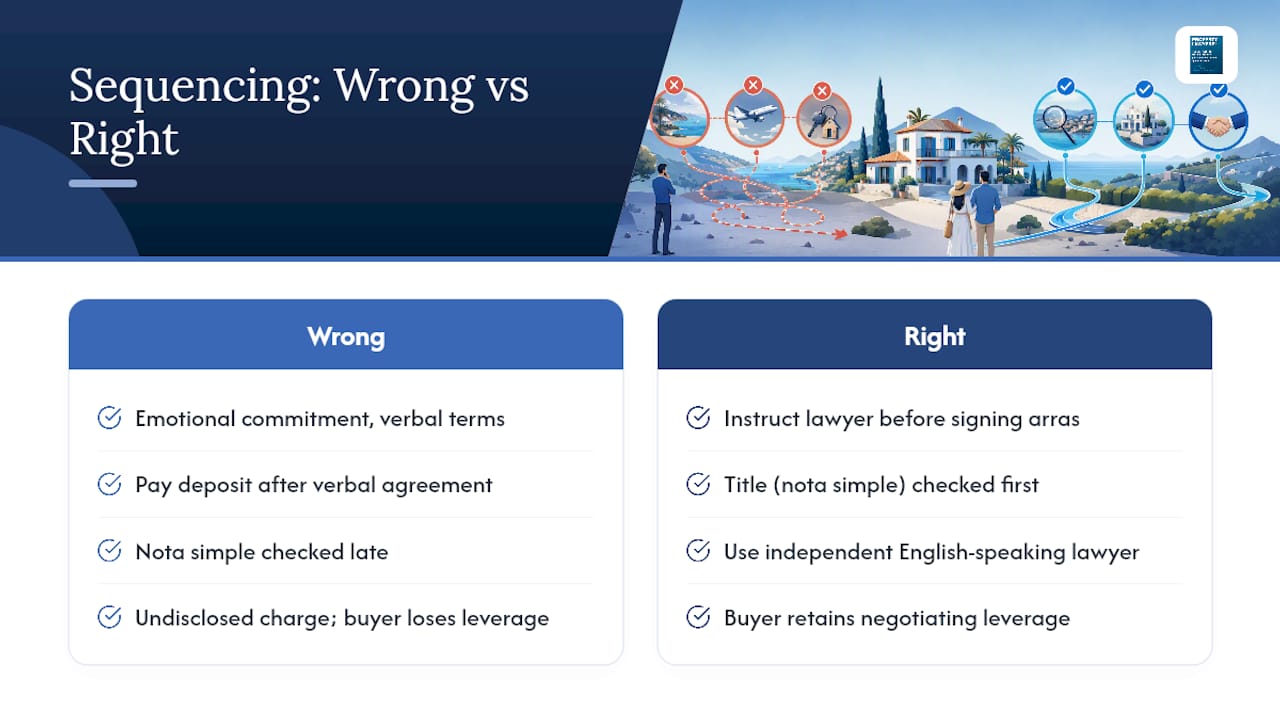
Instructing a lawyer before signing the arras, not after, is the single change that prevents most of the disputes I come across in this market. It costs little and changes everything about your negotiating position.
There are services that help international buyers find independent English-speaking lawyers across Spain, rather than relying on whoever the seller’s agent recommends. That independence is the point.
If you are about to sign anything, speak to a lawyer first.
— Sophie
Buying privately in Spain saves the agency commission, but it shifts every legal check onto you and whoever you instruct running them. You can use online directories to search by region, read lawyer profiles, and contact an English-speaking specialist directly, without going through a generic call centre.
Whether you’re negotiating a villa in Marbella or an apartment in Palma, start with the buying guide and lawyer directory to see who covers your region, or go straight to the Marbella lawyer listings if that’s your target area. If tax is your main worry right now, the property purchase tax guide breaks down what you’ll owe before you commit to a figure. Book an initial enquiry through any profile and get a written fee estimate before you sign the arras.
This article is general information, not a substitute for advice from a qualified lawyer. Consult a qualified legal professional about your own circumstances before acting on anything here.
Yes. Buying or selling property directly between individuals is entirely legal, provided the sale follows the same registry checks, tax filings and notary process as an agency-managed sale.
It’s a document from the Registro de la Propiedad showing the registered owner and any charges, mortgages or embargos on a property, and it’s the essential first check before paying any deposit.
Expect ITP of between 6% and 10% depending on the autonomous community, plus additional costs typically adding around 10% or more once notary, registration and gestoría fees are included.
The buyer must withhold 3% of the purchase price and file modelo 211 with Hacienda within one month of signing, as an advance against the seller’s tax liability.
It isn’t a legal requirement, but a Spanish property lawyer runs the title, planning and residency checks a private buyer cannot easily do alone, and Property-lawyers.com connects you with vetted, English-speaking specialists by region.
Sophie Gutenberg is a legal content specialist focused on Spanish property law, real estate transactions, conveyancing, due diligence and tax issues affecting international property buyers in Spain. She works alongside qualified Spanish property lawyers .
Spanish property sales recognise three types of arras: confirmatorias, penitenciales, and penales. Most residential deals use arras penitenciales, with a deposit around 10% of the price, because they let either party walk away under set penalties. Before you pay anything, have an English-speaking Spanish lawyer review the exact wording, since the type used changes what happens to your money entirely.
TL;DR:
- Arras penitenciales are the most common in Spanish residential property sales, typically involving a deposit close to 10%, but the amount is negotiable.
- Contract ambiguity about the type of arras can default to confirmatorias, which do not allow withdrawal without legal action, risking the buyer’s deposit.
- Explicitly stating the arras type, penalty calculation, and a financing condition in the contract can prevent disputes and protect the deposit if the mortgage falls through.
- A legal review before signing is essential to confirm property ownership, clear charges, accurate wording, and proper inclusion of all contractual conditions.
- Deposit funds generally go to the seller, but clarity on this and the contract’s exact terms is crucial to avoid losing money or facing multiple penalties.
Because the deposit contract becomes binding quickly, buyers should have the wording checked in the market where they are purchasing. Property Lawyers lists specialists for Mallorca, Marbella, Madrid, Barcelona and Ibiza.
Arras is a Spanish deposit contract signed between buyer and seller before completion, setting out a sum of money that guarantees the deal and defines what happens if either side backs out. Spanish law and market practice recognise three distinct types, and the one written into your contract determines your legal position completely.
Arras confirmatorias treat the deposit simply as part payment of the price, proof that both sides are committed. Neither party has a contractual right to walk away. If the seller fails to complete, the buyer can sue for the property itself or for damages; if the buyer fails to pay the balance, the seller has the same options. Say a buyer pays €20,000 on a €200,000 flat in Málaga under this type. If the seller then accepts a higher offer from someone else, the buyer can demand the sale goes ahead or claim compensation through the courts.
Arras penitenciales work differently: they build in a right to withdraw, at a price. Under Article 1454 of the Código Civil, if the buyer pulls out, they simply lose the deposit. If the seller pulls out, they must return double the amount received. This is the most common structure for residential purchases, largely because it gives both sides a known, capped cost for changing their mind. A buyer who deposits €15,000 on a Marbella villa and later decides not to proceed forfeits that €15,000, full stop. A seller who gets cold feet and refuses to sell must hand back €30,000.
Arras penales sit somewhere in between: they act as a penalty clause for breach, but they do not hand either party a clean right to cancel. The injured party can still demand completion of the sale on top of claiming the agreed penalty, which makes this type tougher on whoever breaks the agreement.
| Type | Purpose | Can either party withdraw? | Consequence for buyer | Consequence for seller |
|---|---|---|---|---|
| Confirmatorias | Deposit counts as part payment; proof of commitment | No automatic right | Can be sued for completion or damages | Can be sued for completion or damages |
| Penitenciales | Buys a right to cancel at a fixed cost | Yes, for a price | Loses the deposit | Must return double |
| Penales | Penalty clause for breach | No automatic right | Pays penalty and may still be forced to complete | Pays penalty and may still be forced to complete |
The table above covers the essentials, but two points routinely trip up foreign buyers. First, when a contract does not clearly state which type applies, Spanish courts default to treating it as confirmatorias, the type with no built-in exit route. If you are counting on being able to walk away, silence in the contract works against you.
Second, that 10% figure you’ll see quoted everywhere is a norm, not a rule. Guides from major banks confirm the three types exist in law, but the actual percentage is always agreed between the parties. Sellers in competitive markets like Ibiza sometimes push for more; buyers with strong bargaining positions can negotiate less.
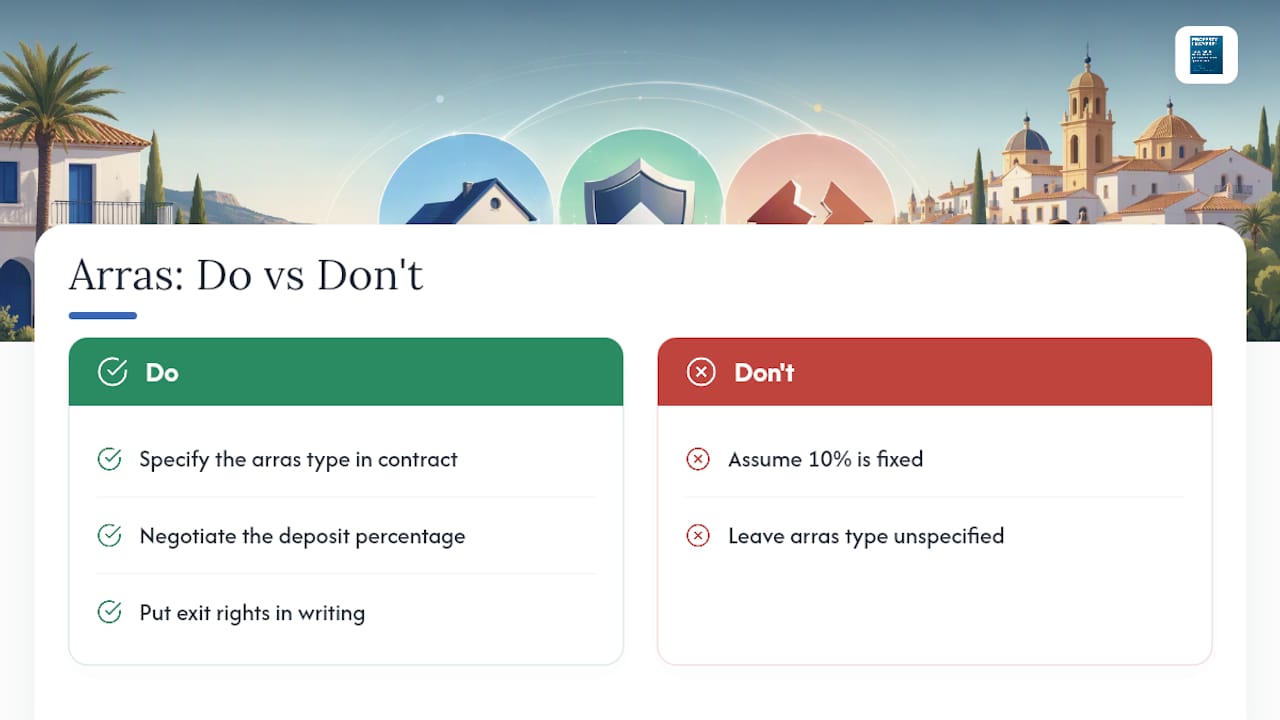
A well-drafted arras contract leaves nothing open to interpretation. Before signing, check that it covers:
Pro Tip: If you’re buying with a mortgage, never sign an arras contract without a financing clause. Without one, a declined mortgage application can cost you the entire deposit, even though the refusal was the bank’s decision, not yours.
Mortgage refusal is the single biggest cause of lost deposits among foreign buyers. If your arras contract includes an explicit financing condition, a declined mortgage lets you cancel without losing your money. Without that clause, you risk losing the deposit or facing a claim for the seller’s losses, even if the bank said no through no fault of your own.
Disputes over vague wording are the second common trap. When a contract does not name the type of arras or leaves the penalty calculation unclear, resolving the disagreement often needs formal legal steps rather than a quick phone call, and courts fill the gap with the confirmatorias interpretation by default. That is rarely what either party actually wanted.
Practical fixes are straightforward:
A lawyer reviewing your arras contract will typically check:
Foreign buyers sometimes confuse a simple reservation fee with a binding arras contract; the two are not the same thing, and only a lawyer reading the actual wording can tell you which one you are signing. This is exactly why instructing an independent, English-speaking Spanish lawyer before you pay anything matters, and why Property-lawyers exists to connect buyers with vetted professionals across the country.
Buyers under time pressure often accept whatever deposit terms a seller’s agent proposes, simply to secure the property. That instinct is understandable, but it is the wrong trade. Negotiate the deposit size and completion date before signing, not after, and treat legal review as the step that prevents an expensive mistake, not a delay that costs you the sale.
— Sophie
You’ve now seen how differently confirmatorias, penitenciales, and penales treat your deposit, and how much rides on the exact wording your seller’s agent hands you. This kind of service can be a practical shortcut past that risk: rather than searching for a solicitor cold or relying on the seller’s own lawyer, you can get connected to an independent, English-speaking property lawyer who works for you alone, not the other side of the table.
That independence matters most in the days before you sign an arras contract, when a single missing clause (no financing condition, no stated type, vague penalty wording) can cost you your entire deposit. If you have a draft arras contract in hand right now, or you are about to receive one on a property in Marbella, Barcelona, or anywhere else in Spain, get it checked before you pay. Start by browsing property lawyers across Spain and requesting a review before your deposit leaves your account.
For the legal text itself, see Article 1454 of the Código Civil on BOE. For plain-language guidance, BBVA’s explainer on arras contracts and idealista’s guide to arras types are both reliable. For a deeper walkthrough tailored to buyers, read Property-lawyers’ guide to the contrato de arras in Spain.
This article is general information, not a substitute for advice from a qualified lawyer. Consult a qualified legal professional about your own circumstances before acting on anything here.
The three types recognised in Spanish practice are confirmatorias (deposit as part payment, no automatic exit), penitenciales (a paid right to withdraw), and penales (a penalty clause without a clean cancellation right).
Neither is universally better: confirmatorias suit buyers and sellers who are certain about the deal, while penitenciales suit those who want flexibility to walk away at a known, capped cost, which is why they dominate residential sales.
Arras penitenciales are the most common structure in Spanish residential property sales, largely because the fixed penalty under Article 1454 of the Código Civil gives both parties clarity if either side changes their mind.
The Código Civil specifically addresses arras penitenciales in Article 1454, setting out that a withdrawing buyer loses the deposit and a withdrawing seller must return double; it does not separately codify confirmatorias or penales, which come from case law and contract practice instead.
Around 10% of the purchase price is common market practice, though the exact figure is negotiated between buyer and seller rather than fixed by law.
Sophie Gutenberg is a legal content specialist focused on Spanish property law, real estate transactions, conveyancing, due diligence and tax issues affecting international property buyers in Spain. She works alongside qualified Spanish property lawyers .
Tanteo and retracto give certain people the legal right to buy a property on the same terms already agreed with a third party. Tanteo works before a sale completes; retracto works after. These rights most often surface in rented flats and subsidised housing, so if you have received a notice, or you are selling a property with a sitting tenant, check the deadline immediately and speak to a lawyer before it expires.
TL;DR:
- The right of tanteo allows tenants and certain co-owners to purchase a property before a sale completes, while retracto lets them undo the sale after it occurs, both within strict timeframes.
- Proper proof of notice, such as notarial acts or registered mail, is essential, and missing or defective notices can shift the remedy from tanteo to retracto, with later discovery restarting deadlines.
- Regional procedures, especially in Barcelona and Valencia, impose specific steps and deadlines that sellers must follow to avoid delays or invalidation of the right.
- Mortgage processing times often exceed exercise periods, requiring buyers to consider bridging finance or pre-approvals to match the short deadline to act.
- Always check the Land Registry for registered rights and ensure notices contain full sale details to prevent disputes or claims from later buyers.
Tanteo lets a qualifying person step in and buy a property before the sale to a third party goes through, matching the agreed price and conditions. Retracto is the same right exercised after completion, effectively undoing the sale and putting the rightholder in the buyer’s place. Spanish courts have described both as ways of granting an “acquisition preference” rather than a veto over the sale itself, according to academic analysis in Indret.
The law creates these rights for specific reasons: to protect tenants from losing their home to an unknown buyer, to stop co‑owners being forced into partnership with a stranger, or to prevent public housing leaking into the private market at inflated prices. There is also a private version, known as conventional tanteo or retracto, agreed by contract rather than imposed by statute. A conventional right binds the parties who signed it, but only a statutory right, or a conventional one properly registered at the Land Registry, reliably protects the holder against a later buyer who claims no knowledge of it.
Not everyone gets this protection. The right belongs to specific categories of people, defined by law or contract.
If you rent your home, co‑own a flat with siblings, or bought a VPO property in Barcelona or Valencia, one of these categories probably applies to you.
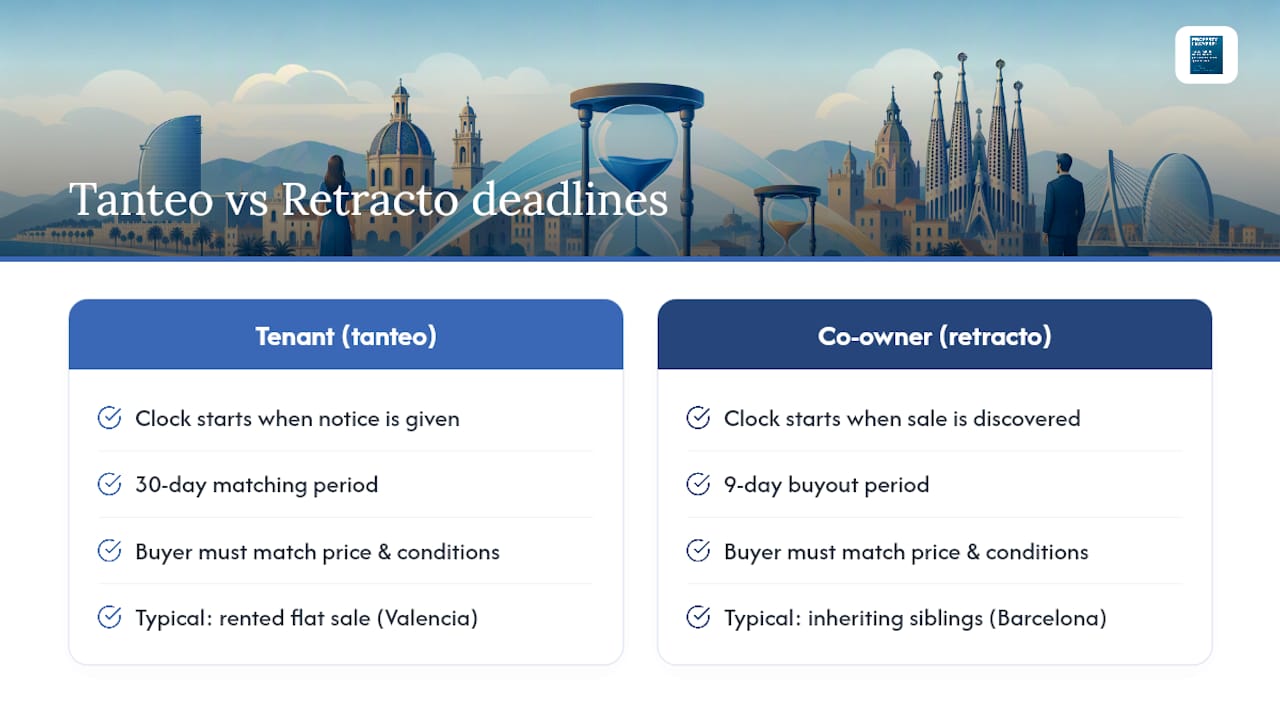
The Código Civil sets out the general framework for retracto, including the nine‑day exercise period for co‑owners under article 1524, while the Ley de Arrendamientos Urbanos (LAU), article 25, governs the tenant’s right of tanteo and retracto in residential lettings. Beyond these national rules, autonomous communities and city councils layer on their own procedures for protected or subsidised housing, which is where most confusion happens.
The distinction between legal and conventional rights matters in practice. A legal right exists automatically because a statute grants it; a conventional one only exists because a contract created it, and it binds third parties only when registered at the Land Registry. The registrador de la propiedad checks these entries before completing a transfer, which is why registration is never a formality to skip.
Municipal and regional pages, such as Barcelona’s Habitatge service, publish the specific procedure for their own housing stock, and these often add steps the Código Civil never mentions.
Deadlines are short, and missing one usually closes the door for good. The starting point is always the day after the seller gives proper notice, known in Spanish practice as notificación fehaciente, meaning notice that can be proven in court.
Notice must be provable, which is why sellers typically use a notarial deed, a burofax with acknowledgement of receipt, or registered post with proof of delivery. A phone call or an informal email will not stand up if the case reaches a judge.
Pro Tip: If you receive a notice you were not expecting, do not assume the deadline is flexible. Request the full sale contract in writing on day one, and get a lawyer to check the notice was validly served before you decide whether to act.
Barcelona operates a municipal tanteo and retracto scheme covering certain categories of housing, and the Ayuntamiento’s Habitatge service publishes exactly how and where to notify the council of an intended sale, plus the timeframe the council has to respond. Sellers of qualifying properties in the city need to factor this step into their completion timetable, since skipping it can delay or unravel a sale.
The Valencian Community regulated the Generalitat’s own acquisition preference over certain protected housing in 2020, and subsequent amendments have adjusted how authorisations and exercise periods work, according to the Generalitat Valenciana’s housing pages. In practice, this means notaries in Valencia may ask for proof that the administrative authorisation was obtained before they will complete certain sales. Always check the relevant regional housing authority page before assuming a national rule covers your case.
Each side of the transaction has a different job to do, and getting it wrong tends to cost more than getting advice early.
Sellers who cut corners on notice content are the most common source of disputes. A notice that understates the price, for example, gives the rightholder grounds to challenge the sale later.
Exercising tanteo or retracto means matching the agreed price within a fixed, short deadline, and mortgage lenders rarely move that fast. Banks typically need weeks to process a full mortgage application, valuation included, which creates a real mismatch against a 9 or 30‑day exercise window, a point worth flagging for anyone considering the right.
Practical workarounds exist. Bridging finance, a payment plan agreed directly with the seller, or a fast‑track pre‑approval from a lender who already knows your finances can all close the gap. Budgeting for property purchase tax at the same time avoids a nasty surprise once the deal completes. A lawyer who coordinates the notary, the lender, and the seller’s deadline in parallel is usually what makes an exercise of the right actually deliverable within the time allowed.
This guide draws on statutory sources, municipal procedure pages, and academic legal analysis rather than generic advice. For related reading on protected housing status, see the rental licences archive. [Sophie’s professional credentials and experience in property law will be detailed here.]
A seller who sells without giving proper notice, or who gives notice with incorrect terms, does not make the sale bulletproof. The rightholder’s remedy simply shifts from tanteo, exercised before completion, to retracto, exercised after it. This is the entire point of having two related rights rather than one: the law does not let a seller dodge the obligation just by moving quickly.
If a tenant discovers after completion that the landlord sold the flat without ever sending a valid notice, the tenant can still exercise retracto within the statutory period, counted from the moment they actually learn of the sale and its terms, typically through the Land Registry entry or a formal communication. The same principle applies to co‑owners who find out a fellow owner sold their share to an outsider without offering it to them first.
Defective notice, meaning notice that was sent but understated the price, omitted conditions, or went through an unprovable channel, produces the same outcome. Courts treat an incomplete or unverifiable notice as no notice at all for the purpose of starting the clock, so the deadline effectively never began running until proper notice is given, or discovery occurs.
For sellers, the practical risk is significant. A successful retracto claim unwinds the sale after the fact, forcing the original buyer to hand the property to the rightholder against reimbursement of the price paid. That is disruptive for everyone involved, including any lender who advanced a mortgage on the assumption the sale was final. It is one of the strongest reasons a seller should never treat notification as a box‑ticking exercise, and should always keep hard proof, such as a burofax receipt or notarial certificate, of exactly what was communicated and when.
Most disputes fall into a handful of recurring patterns, and recognising which one applies to you speeds up the whole process considerably.
A landlord decides to sell a rented flat in Valencia to a property investor. Because a tenant occupies the flat under a standard residential lease, the landlord must notify the tenant of the sale terms before completing with the investor. If the tenant wants the flat, they have 30 days to match the offer.
Three siblings inherit a flat in Barcelona from their parents. One sibling wants to sell their third to an outside buyer instead of offering it to the other two first. The other siblings can exercise retracto within nine days of learning about the completed sale, buying out the share on the same terms the outside buyer agreed.
A family bought a VPO flat in Valencia at a subsidised price years ago and now wants to sell at market value. Before that sale can proceed, the Generalitat’s housing department may need to be notified, since the administration holds tanteo and retracto specifically to prevent subsidised stock being resold above the protected ceiling.
A smallholding farmer in a rural part of Spain sells a narrow strip of land bordering a neighbour’s plot. The neighbouring landowner, as colindante, may have a retracto right over that specific sale under the rural retracto rules in the Código Civil, though this scenario is far less common in urban property markets like Barcelona or Málaga.
Each scenario shares the same underlying logic: someone with a recognised legal connection to the property gets first refusal, and the deadline clock starts the moment proper notice is given or the sale is discovered.
Tanteo and retracto were designed with real estate in mind, and the vast majority of practical cases in Spain involve flats, houses, or land. The statutory versions found in the LAU and in the Código Civil’s rural retracto provisions apply specifically to immovable property, reflecting the underlying policy goal, which is protecting people’s housing and land relationships, not general commerce.
Movable property can still carry a conventional tanteo or retracto right, but only if the parties wrote it into their contract. There is no general statutory right of first refusal over the sale of a car, a boat, or business equipment in the way there is for a rented flat or a co‑owned parcel of land. If you want that protection over movable assets, it has to be negotiated and documented, and it will only bind a later buyer if that buyer had notice of the clause, since there is no land registry equivalent for most personal property.
This distinction matters practically for property buyers because it explains why registration is central to real estate transactions but largely irrelevant to sales of goods. A registered conventional retracto over a flat protects the rightholder against any future buyer, informed or not, because the Land Registry entry gives constructive notice to the world. A similar clause in a contract for the sale of furniture protects the rightholder only against the specific buyer who agreed to it, and offers little defence if that buyer resells to someone unaware of the arrangement.
For anyone buying real estate in Spain, the practical lesson is to always check the Land Registry entry for any recorded tanteo or retracto before signing, since a registered right can follow the property regardless of who currently holds title.
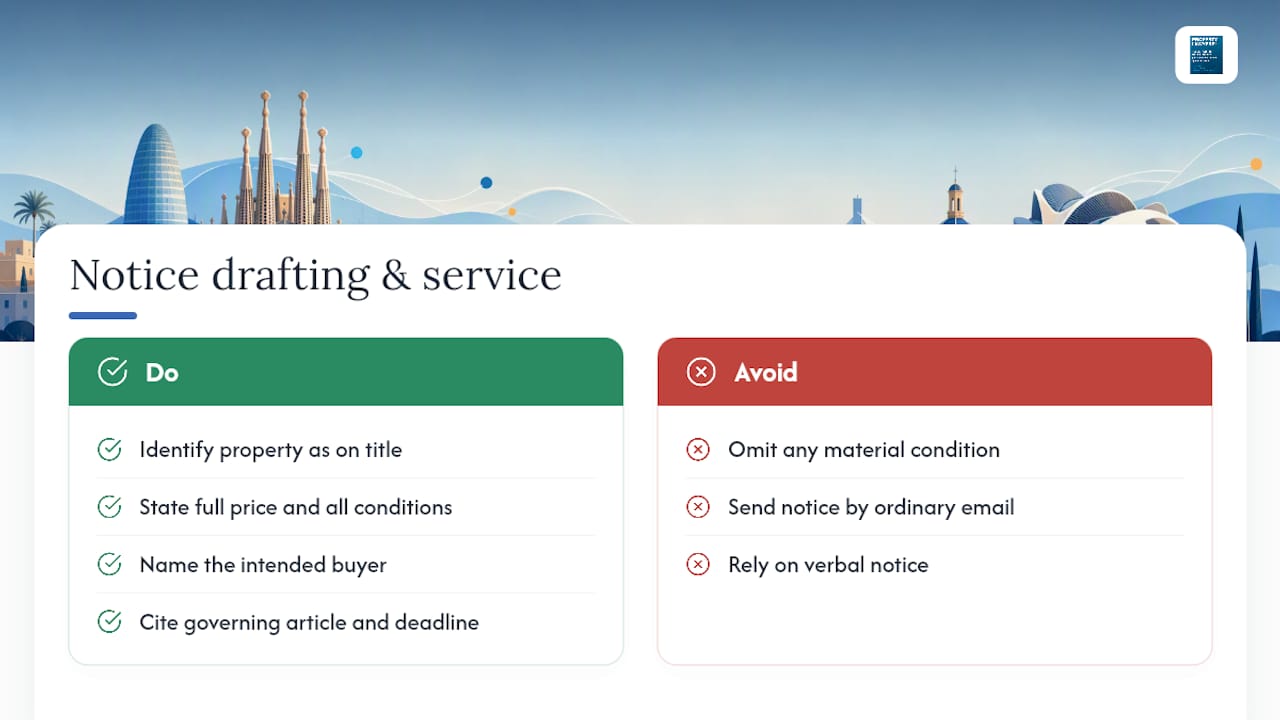
Getting the notice right protects the seller from a later retracto claim, and getting it wrong invites exactly that outcome. The notice needs several elements to count as legally sound under Spanish practice.
First, identify the property precisely, using the same description that appears on the title deed and Land Registry entry. Second, state the full agreed price and every material condition of the sale, including payment terms, any furniture included, and the proposed completion date. Omitting a condition, even one that seems minor, gives the rightholder grounds to argue the notice was incomplete.
Third, identify the intended buyer, since some rightholders need this information to assess the transaction properly. Fourth, state clearly that this is a formal notification under the relevant article, whether that is article 25 of the LAU for a tenancy or the applicable Código Civil provision for a co‑ownership sale, and specify the exact deadline the rightholder has to respond.
The delivery method is just as important as the content. Three channels are widely accepted as fehaciente, meaning legally provable: a notarial act, where a notary formally delivers the notice and certifies the fact; a burofax with certified content and acknowledgement of receipt, sent through Correos; or registered post with a signed delivery receipt. An ordinary email or a verbal conversation, however well‑intentioned, will not satisfy a court if the rightholder later disputes ever receiving proper notice.
Sellers should keep every piece of proof indefinitely, not just until completion. A retracto claim can surface months or years after a sale, once the rightholder discovers what happened, so the burden of proving notice was correctly given can resurface long after the transaction feels finished.
When a rightholder believes they were denied a valid tanteo or retracto, or a seller believes a claim is unfounded, the dispute typically ends up before the civil courts, since Spanish law treats this as a private property matter rather than an administrative one, except where a public administration itself holds the right.
The rightholder bringing a retracto claim generally needs to act within the statutory period, counted from valid notice or from actual discovery of the sale if notice was defective or absent. Filing later than that risks the court dismissing the claim as time‑barred, regardless of how strong the underlying grounds are. This is why lawyers usually advise documenting the date of discovery carefully, since it becomes central to the case if the timing is challenged.
If the court upholds the claim, the remedy is specific: the rightholder steps into the buyer’s position, paying the same price and accepting the same conditions originally agreed, and the original buyer is reimbursed. The court does not award damages instead of the property in most cases, because the entire purpose of the right is substitution, not compensation.
Where a public administration’s tanteo or retracto over subsidised housing is contested, the case can involve both civil courts and administrative review, since the Constitutional Court has recognised the public interest basis for these rights over VPO stock, which strengthens the administration’s position when a dispute arises. Given the procedural complexity, and the strict deadlines involved on both sides, anyone facing a contested claim benefits from involving a lawyer at the earliest possible stage rather than after a court date is already set.
A successful exercise of retracto affects more than the seller and the original buyer. It unwinds the transaction and can pull in anyone who acquired rights over the property in the meantime, which is why third‑party protection matters as much as the rightholder’s own claim.
If the original buyer had already taken out a mortgage to fund the purchase, that lender’s security is directly affected when a rightholder successfully substitutes into the transaction. In practice, the rightholder typically needs to either take on the existing mortgage arrangement or the original buyer’s lender needs to release its charge as part of unwinding the sale, which is one reason lenders scrutinise any property with a recorded tanteo or retracto before advancing funds.
Subrogation, where a new party takes over an existing legal position, comes up specifically because the rightholder is stepping into a deal someone else negotiated, on the terms that other person agreed. If the original buyer had already registered the purchase at the Land Registry, unwinding that entry to substitute the rightholder involves its own formal process, and any registered charges or subsequent transactions layered on top complicate matters further.
This is precisely why buyers should always check for a recorded conventional tanteo or retracto, or confirm whether statutory rights apply, before completing a purchase, rather than discovering the risk after money has changed hands. A property lawyer checking the registry entry before signing is a far cheaper safeguard than untangling a retracto claim after the fact.
Three mistakes come up again and again. Always get provable proof of notice, never rely on a phone call or a casual email. Act inside the deadline; asking for “a bit more time” carries no legal weight once the clock has started. And always confirm VPO status before assuming a straightforward sale, since subsidised housing rarely behaves like the open market. When the deadline is short and the money is significant, a specialist local lawyer earns their fee many times over.
— Sophie
Tanteo and retracto cases move fast, and the biggest risk for most buyers, tenants, and sellers is not knowing which rule applies until the deadline has already started ticking. Property-lawyers is the directory that puts you in touch with vetted, independent, English‑speaking real estate lawyers across Spain, including specialists familiar with Barcelona’s municipal procedures and the Valencian Community’s regional rules.
Rather than searching for a lawyer from scratch under time pressure, you can browse profiles by region and get matched with someone who already understands the local notice requirements and court procedure that apply to your case. If you have received a notice, want to check whether a property carries a registered right, or simply need someone to review a sale before you sign, find a vetted property lawyer through the directory today.
This article is general information, not a substitute for advice from a qualified lawyer. Consult a qualified legal professional about your own circumstances before acting on anything here.
Tanteo is exercised before a sale completes, letting the rightholder buy first; retracto is exercised after completion, letting the rightholder undo the sale and take the buyer’s place.
Under LAU article 25, a tenant generally has 30 days from the day after receiving fehaciente notification to exercise the right.
No. If notice was never given or was defective, your remedy shifts from tanteo to retracto, and the deadline typically starts from when you actually discover the sale.
No, it applies only when a specific statutory or contractual condition exists, such as a tenancy, co‑ownership, VPO status, or a registered conventional right.
Property-lawyers connects buyers, sellers, and tenants with vetted, English‑speaking property lawyers across Spain through its regional directory.
Sophie Gutenberg is a legal content specialist focused on Spanish property law, real estate transactions, conveyancing, due diligence and tax issues affecting international property buyers in Spain. She works alongside qualified Spanish property lawyers .
Simple contract reviews start around €150 to €400, while full conveyancing packages commonly land between €500 and €3,000, and sometimes higher for expensive or complex deals. Spanish VAT (IVA) at 21% almost always applies on top. Before anything else, ask for a written quote that spells out exactly what’s included.
TL;DR:
- Lawyer fees for property transactions in Spain typically range from €150 to €400 for simple contracts, up to €1,500 for full due diligence, plus 21% VAT.
- Fees vary based on the billing model, with fixed fees being cheaper for lower-value properties and percentage fees growing at higher prices, especially above €300,000.
- A lawyer’s work includes due diligence, contract review, notary coordination, and sometimes tax filings, with costs influenced by property complexity, party involvement, and urgency.
- Each side generally pays for their own lawyer, and it is essential to get a detailed, written scope of work before instructing a lawyer.
- Taxes and notary fees often surpass legal costs in total expenses when buying or selling property in Spain.
Lawyer fees for a Spanish compraventa vary more by billing model than by region, though location plays a part too. Three structures dominate the market:
Full-service conveyancing fees often sit between 1% and 2% of the property price plus VAT, according to typical market figures for the Spanish legal sector. At the lower end, a basic contract review can cost as little as €150 to €400, while full due diligence alone often runs €500 to €1,500, based on pricing bands reported across Spanish legal advisories.
Location matters too. Fees in Madrid and Barcelona tend to run 10% to 15% higher than in smaller provinces, reflecting higher overheads and demand for bilingual specialists in those cities. Marbella, Mallorca and Ibiza often sit closer to the city-level end of the scale too, given the extra due diligence that holiday-home purchases sometimes require.
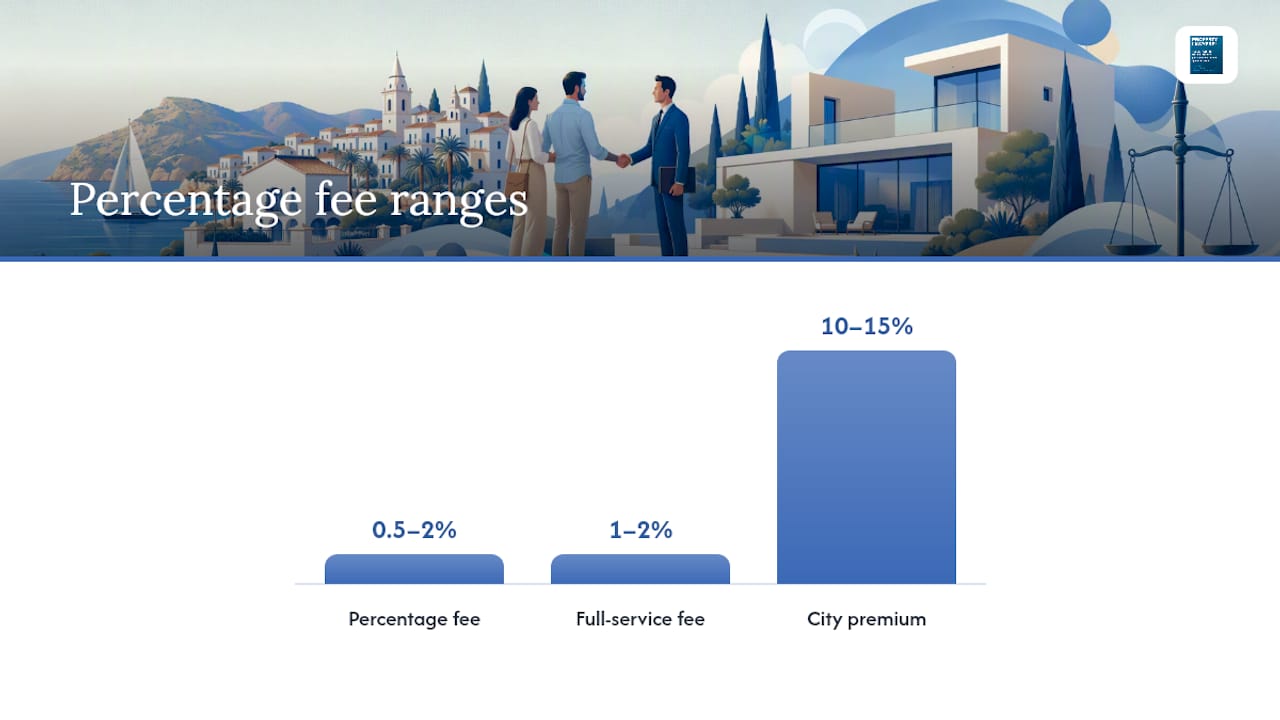
A property lawyer’s fee in a Spanish compraventa isn’t just a signature on a contract. It typically bundles together several distinct pieces of work:
An independent lawyer’s due diligence is not something the notary does. The notary in Spain is a neutral public official, responsible for formalising the deed, not for protecting the buyer’s specific interests. That protective role belongs to your own lawyer, which is precisely why paying for one matters, especially if you’re buying from abroad.
Fee quotes vary because the underlying legal work varies. A few factors consistently move the price:
Pro Tip: Ask your lawyer to flag, in writing, any factor from your specific case (inheritance, mortgage, non-resident seller) that could push the fee above the initial estimate. A good lawyer will tell you upfront rather than surprise you later.
Numbers help more than percentages in the abstract. Here’s how the two most common models compare across three typical property values, assuming a full-service package (due diligence, contract review, notary coordination, and completion support), excluding tax filing unless stated:
| Property price | Fixed-fee estimate (excl. IVA) | 1% fee (excl. IVA) | Total with 21% IVA (fixed) | Total with 21% IVA (1% model) |
|---|---|---|---|---|
| €150,000 | €1,200 | €1,500 | €1,452 | €1,815 |
| €300,000 | €1,800 | €3,000 | €2,178 | €3,630 |
| €600,000 | €2,500 | €6,000 | €3,025 | €7,260 |
These figures sit within the ranges reported by Spanish property fee surveys, but they’re illustrative rather than guaranteed. On lower-value properties, a fixed fee is usually cheaper than a percentage model. On higher-value deals, the gap widens fast, which is why many lawyers switch to fixed or capped fees above a certain threshold. Always ask which model applies before assuming the percentage quoted is final.
In most Spanish transactions, each side hires and pays their own lawyer. There’s no fixed national rule forcing one party to cover both, though customs shift slightly by region and by how a deal is negotiated.
A verbal estimate isn’t worth much once a dispute arises over what was included. Before instructing a lawyer, get this in writing:
Watch for open-ended hourly quotes with no cap, and vague scope descriptions that don’t name specific tasks. Well-drafted engagement letters list searches, debt checks, and tax filings explicitly, precisely so nothing gets added later as a surprise extra.
Pro Tip: If two quotes look identical in price but one lists specific tasks (registry search, cargas check, notary attendance) and the other just says “full service”, ask the vague one to itemise. The itemised quote is usually the safer bet, even at a similar price.
Lawyer fees are only one line in the total cost of buying or selling in Spain. Depending on the transaction, you’ll also typically face:
Taken together, taxes and notary costs usually dwarf legal fees as a share of the total bill. That’s worth remembering when a lawyer’s quote feels like the biggest number on the table. It rarely is.
Fees vary with transaction complexity and location. Compare lawyers serving Mallorca, Marbella, Madrid, Barcelona and Ibiza rather than judging a quote on headline price alone.
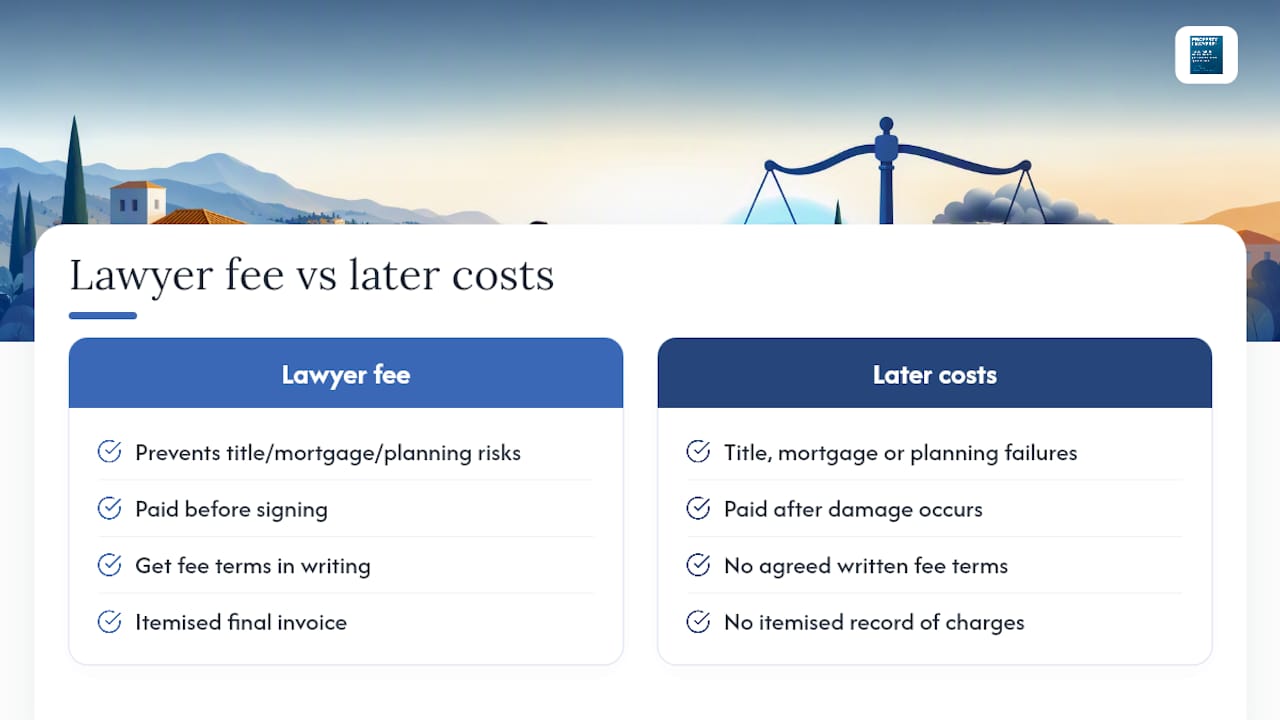
Treating legal fees purely as a cost misses the point. The real comparison is against what a bad title search, an unresolved mortgage, or a planning breach could cost you later, and that’s usually far more than any lawyer’s invoice. Independent legal advice exists to catch exactly those risks before you sign anything binding.
Getting fee terms in writing, with an itemised invoice at the end, remains the simplest protection buyers have when comparing quotes across different firms or regions. It also makes it far easier to hold a lawyer accountable if the scope of work changes midway through a transaction.
— Sophie
Comparing quotes without a benchmark leaves you guessing whether €1,200 or €3,000 is fair for your specific deal. Property-lawyers gives you a shortcut. As an online directory of property lawyers, it lets you browse profiles by region, city, and specialism, so you’re comparing like-for-like fee structures rather than apples to oranges.
Before requesting quotes, it’s worth reading the full fee guide so you know which questions to ask and which inclusions to expect. If you’re buying in the capital, the Madrid lawyer directory is a direct starting point for local quotes; for other regions, the national buying guide connects you with lawyers across Marbella, Mallorca, Ibiza, and beyond. Request a fee estimate today and get your written scope of work before you sign anything.
A basic contract review can cost €150 to €400, while a full due diligence and completion package often runs €900 to €1,800 for a standard purchase.
Each party typically hires and pays their own lawyer; there’s no fixed rule requiring one side to cover both, though customs vary slightly by region.
Yes, legal fees in Spain usually carry 21% IVA, which should appear as a separate line on the invoice.
Yes, a notary is a neutral official who formalises the deed but doesn’t perform the independent due diligence that protects your specific interests as a buyer.
Sophie Gutenberg is a legal content specialist focused on Spanish property law, real estate transactions, conveyancing, due diligence and tax issues affecting international property buyers in Spain. She works alongside qualified Spanish property lawyers .
Yes, non-residents can get a mortgage in Spain, but the terms are noticeably tighter than what a Spanish resident would be offered. Expect a loan covering roughly 50% to 70% of the property’s value, a larger deposit than you might have budgeted for, and a documentation process that rewards early preparation. Get your NIE sorted and your paperwork translated before you fall in love with a villa in Marbella or an apartment in Palma.
TL;DR:
- Non-residents in Spain can expect to receive loans covering only 50% to 70% of property value, requiring a deposit of 30% to 50%.
- Key documents include a NIE or passport, proof of income, tax residency, recent bank statements, and source-of-funds proof, often needing translation and apostillation.
- The mortgage process takes roughly six to ten weeks, with delays caused by missing paperwork or translations, and involves property valuation and notarization.
- Choosing a lender or broker carefully is crucial, as most offer more conservative terms than for residents, and cross-border enforcement is more complex.
- Hiring a Spanish property lawyer early streamlines due diligence, verifies property legal status, and ensures the lender’s documentation holds up before submitting a mortgage application.
Before you contact a Spanish bank or broker, gather the basics so you are not scrambling later. Lenders want to see who you are, what you earn, and where your money comes from.
Pro Tip: Open a Spanish bank account before you formally apply. Many banks now offer remote account opening for non-residents, and having a local account already in place speeds up every stage that follows.
Non-resident financing commonly ranges between 50% and 70% loan-to-value, compared with up to 80% for Spanish residents. That gap is the single biggest number to plan around.
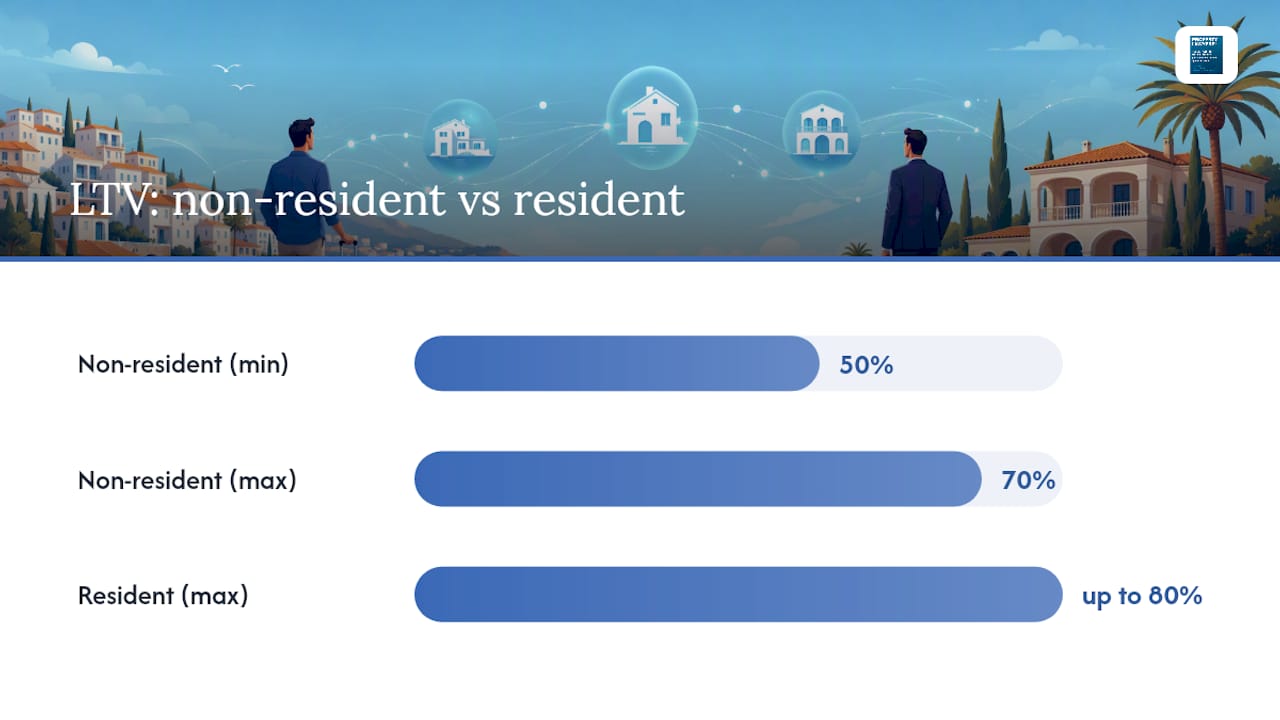
The mortgage process for non-residents follows a fairly predictable sequence, though each stage can stretch if paperwork is missing.
Realistically, allow between six and ten weeks from first enquiry to completion, longer if translations or valuations are delayed. Banks and brokers increasingly offer remote feasibility checks, which can cut out an early trip to Spain, but the notary signing itself still requires either your presence or a power of attorney arranged through your lawyer.
Spanish banks work from a fairly fixed list of documents, and missing one item is the most common cause of delay for foreign applicants.
Non-resident applicants often need documents translated by a sworn translator (traductor jurado) and sometimes apostilled, and these costs are normally paid by the applicant. Sworn translation fees vary by document length and language pair, so ask your lawyer or the bank for an estimate early rather than after you have already submitted a file.
Loan-to-value is the number that shapes everything else in your budget. Most non-residents are offered between 50% and 70%, meaning a deposit of 30% to 50% of the purchase price, well above the 10% to 20% many resident buyers put down.
Practical checklists suggest taxes and fees together commonly add 10% to 15% on top of the purchase price, varying by autonomous community and whether the property is new or resale. Combine that with your deposit, and a sensible rule of thumb is to have 40% to 65% of the purchase price available in cash before you start seriously viewing properties in Ibiza, Málaga, or Barcelona.
Several types of lender operate in the non-resident space, and picking the wrong one costs time you did not budget for.
Banks assess non-resident applications more conservatively because the property itself commonly becomes the primary guarantee, and cross-border enforcement is harder if things go wrong. Treat any lender or broker who is vague about LTV, fees, or the valuation process as a warning sign rather than a minor inconvenience.
A mortgage offer is only half the picture. Before any bank releases funds, someone needs to confirm the property is legally clean, and that is not a job for the buyer alone. A Spanish property lawyer checks the nota simple for outstanding charges or embargoes, verifies planning permissions and licences, and confirms the seller genuinely has the right to sell.

Lawyers also handle the practical side non-residents struggle with from abroad: obtaining your NIE, registering you for tax purposes, verifying the traceability of your funds, and liaising directly with the bank or broker so nothing gets lost between languages. This matters more than it sounds. Property-lawyers publishes detailed guides on non-resident tax obligations and on how to verify property debts before buying, both of which feed directly into the documents your lender will want to see.
If you are weighing up whether to bring in legal support before or after your mortgage application, the honest answer is before. A directory lets you search for an English-speaking lawyer by region, whether that is Marbella, Mallorca, or Barcelona, so you are not relying on a recommendation from the seller’s own agent.
Most guides to buying in Spain treat the mortgage and the legal work as two separate errands, first the bank, then the lawyer. That sequencing is backwards. The buyers who move fastest through completion are the ones who instruct a lawyer before they submit a mortgage application, not after they have a FEIN in hand.
The conventional advice to “get pre-approved, then find a lawyer” ignores that your lawyer’s due diligence, the nota simple, the debt checks, the planning history, often surfaces information your lender will ask about anyway. Running both in parallel saves weeks, not days.
What gets underestimated is currency exposure. Buyers fixate on the interest rate and forget that a non-euro income repaying a euro loan is a second, quieter variable running alongside it for the next twenty years. Fix what you can control early: your deposit, your documentation, your legal representation. The rate you get on day one matters less than most buyers assume.
— Sophie
Mortgage brokers and bank international desks can sort your financing, but they will not check whether the property has undeclared debts, unlicensed extensions, or a title that is not as clean as it looks. This directory connects you with vetted, English-speaking property lawyers across Spain, so the legal groundwork behind your mortgage application actually holds up.
After you get in touch through the directory, expect a short scoping call to confirm what you need, whether that is due diligence on a specific property, help with your NIE, or full conveyancing support, followed by a fee estimate and a match with a lawyer working in your target region. If you are buying with financing already lined up, it is worth reading the guide on buyer due diligence in Spain first. Then search the directory of property lawyers in Spain by region and get matched with someone who already knows how non-resident mortgage files work.
For official guidance, see the Spanish consumer authority’s practical housing information. For cost tables and typical ranges, the non-resident mortgage guide is a solid practical reference. Property-lawyers’ own 10 steps before buying guide rounds out the buyer’s checklist, and a due diligence specialist’s property checklist offers a useful comparison for investors.
This article is general information, not a substitute for advice from a qualified financial advisor. Consult a qualified financial professional about your own circumstances before acting on anything here.
There is no single best product. It depends on your income currency, deposit size, and whether you value a shorter approval process over the lowest possible rate, which is why comparing offers through a broker or several international desks tends to beat picking the first bank you approach.
No single bank suits every buyer. Larger national banks with dedicated international desks are usually the easiest starting point for English-speaking applicants, but a broker can compare several lenders’ non-resident terms far faster than you can alone.
Several major Spanish banks, including large national players, offer non-resident mortgage products, though exact terms, LTV, and fees vary by applicant profile and property location. Confirm current terms directly with the bank or through a broker before assuming eligibility.
Yes. Non-euro income is accepted by most lenders, but expect closer scrutiny of your payslips and tax returns, and factor in that currency fluctuations can affect your real repayment cost over time even though the loan itself stays in euros.
Most non-residents need a deposit of 30% to 50% of the purchase price, reflecting the 50% to 70% loan-to-value range typically offered, on top of purchase taxes and fees of roughly 10% to 15%.
Sophie Gutenberg is a legal content specialist focused on Spanish property law, real estate transactions, conveyancing, due diligence and tax issues affecting international property buyers in Spain. She works alongside qualified Spanish property lawyers .