
Gazumping in Spain: what property buyers must know
If you are buying property in Spain and you are worried about gazumping, you are probably applying a concept from the UK market that does not translate cleanly to Spanish law. Understanding what is gazumping in Spain property terms requires a different legal lens entirely. The term itself originates in England and Wales, where the absence of a binding contract until exchange creates a specific vulnerability. Spain operates under a different framework, and knowing exactly where your risks lie under Spanish law is far more useful than assuming the same rules apply.
Table of Contents
- Key takeaways
- What is gazumping in Spain property transactions?
- The arras contract: types, deposits, and obligations
- The escritura pública: what it does and does not do
- Practical steps to protect yourself in Spain
- UK vs Spain: a side-by-side comparison
- My perspective on how buyers approach this issue
- How Property-lawyers can help you buy with confidence
- FAQ
Key takeaways
| Point | Details |
|---|---|
| Gazumping is a UK concept | It relies on the absence of a binding contract before exchange, which works differently in Spain. |
| The arras contract is central | Spain’s contrato de arras creates binding obligations far earlier than the notarial deed stage. |
| Three arras types carry different risks | Penitenciales, confirmatorias, and penales arras have materially different consequences for buyers and sellers. |
| Reservation agreements are not arras | Non-binding reservation agreements leave international buyers exposed in ways many do not anticipate. |
| Legal review before signing is critical | Engaging an independent lawyer before committing any deposit significantly reduces financial exposure. |
What is gazumping in Spain property transactions?
Gazumping is the practice where a seller accepts a higher offer from a new buyer after already agreeing a sale with someone else. In England and Wales, this is entirely legal because no binding contract exists until contracts are formally exchanged. A buyer in England can spend months on surveys and legal due diligence only to lose the property to a higher bidder at any point before that exchange. Estate agents are legally obliged under the Estate Agents Act 1979 to pass on all offers to sellers, including new higher ones received after a sale is agreed.
Spain does not have this exact phenomenon. The Spanish property purchase process involves a private preliminary contract, the contrato de arras, that creates legally binding obligations on both buyer and seller before the notary deed is signed. Once that contract is in place, a seller who simply accepts a higher offer and walks away faces real financial penalties. This is the fundamental structural difference.

However, this does not mean Spain is entirely free of risk. The period before the arras contract is signed does carry genuine exposure. A seller can accept a higher offer from another party right up until the arras is executed. That pre-arras window is where something analogous to UK-style real estate gazumping can occur in the Spanish context.
There is also the matter of informal reservation agreements, which are commonly used in the Spanish market but carry very different legal weight. Buyers who treat these as equivalent to the arras contract often face unexpected consequences.
The arras contract: types, deposits, and obligations
The contrato de arras is a private preliminary agreement signed between buyer and seller before the final notarial deed. This contract typically involves a deposit of around 10% of the agreed purchase price, and it creates binding obligations on both parties. It is the mechanism that makes property gazumping in the conventional UK sense largely unworkable once it is signed.
Spanish law recognises three distinct types of arras, and the differences between them are significant:
| Type | Buyer withdraws | Seller withdraws |
|---|---|---|
| Penitenciales (Art. 1454 Civil Code) | Loses the deposit paid | Must repay double the deposit received |
| Confirmatorias | Buyer may be sued for full performance | Seller may be sued for full performance |
| Penales | Subject to agreed penalty clause | Subject to agreed penalty clause |
The most common type for residential purchases is the arras penitenciales, which gives both parties a known cost of exit. For this type to apply, the contract must explicitly invoke Article 1454 of the Civil Code. If it does not, a court may treat the deposit as confirmatorias, meaning either party could face a lawsuit demanding completion rather than simply a financial penalty.
Pro Tip: Always confirm in writing that your arras contract specifically references Article 1454 of the Spanish Civil Code. Without this wording, your right to exit by forfeiting or doubling the deposit is not guaranteed.
Suspensive conditions can be included in the arras contract to protect buyers. Mortgage approval, a clean title search, and the absence of registered charges or embargoes are all common conditions. Deposits paid into escrow through a lawyer’s client account, rather than directly to the seller, offer materially better protection if a dispute arises before completion.
The arras contract is where the real commercial and legal commitment takes place. In Spain, buyers should treat the arras signing as the moment of genuine commitment, not the later notary appointment.
The escritura pública: what it does and does not do
The escritura pública, or notarial deed, is the formal legal instrument that transfers ownership of a Spanish property. Spain’s escritura pública is signed before a notary public and then registered at the land registry, at which point the buyer officially becomes the legal owner.
What the escritura does is significant:
- It combines the contract of sale, transfer of title, and the basis for land registry registration into one instrument.
- It is witnessed and authenticated by a notary, giving it public faith in Spanish law.
- It triggers the payment of the remaining purchase price and any associated taxes.
- It is the point from which the property officially changes hands in the eyes of the state.
What it does not do is create the original commitment between buyer and seller. That commitment was created at the arras stage. By the time parties reach the escritura, they are generally performing obligations already set out weeks or months earlier.
For international buyers, a common misconception is that signing before a notary provides some form of additional protection against the seller changing their mind. In practice, if a seller attempts to withdraw between the arras and the escritura, the arras contract terms govern what happens. The role of the escritura is to complete the transaction, not to initiate the legal commitment.
This matters because buyers who focus too heavily on the notary stage and too little on the arras contract terms sometimes enter the critical preliminary agreement without adequate legal review. That is a costly error.
Practical steps to protect yourself in Spain
International buyers face a specific set of risks when purchasing property in Spain, many of which stem from unfamiliarity with how the pre-contract stage works. The following steps address the most common points of exposure.
-
Understand the difference between a reservation agreement and an arras contract. Reservation agreements can be non-binding and refundable, unlike the arras contract. Paying a reservation fee does not give you the same legal protection as signing a properly drafted arras. Many developers and estate agents present reservation agreements as a standard first step, but they do not prevent the property from being sold to another buyer.
-
Have the arras contract reviewed by an independent lawyer before signing. The wording determines your legal position entirely. An incorrectly drafted arras may give you far fewer rights than you expect.
-
Include suspensive clauses for your key conditions. If your purchase depends on securing a Spanish mortgage or on receiving a clean property registry report, include these as conditions that allow you to recover your deposit if unmet.
-
Use escrow for your deposit. Paying a 10% deposit directly to a seller who then defaults puts you in a litigation position. A lawyer’s client account provides a buffer and clearer recourse.
-
Consider exchange rate risk. If you are purchasing in euros from a sterling or dollar-based account, include appropriate provisions or seek FX advice. Price increases due to currency movement can feel like price renegotiation, and some contracts lack adequate protections in this regard.
-
Conduct due diligence before signing. Check the Land Registry (Registro de la Propiedad) for charges, embargoes, or outstanding mortgages on the property before committing any deposit.
Pro Tip: Do not rely on the seller’s estate agent to explain your legal rights. Their obligation is to the seller. An independent legal adviser acting exclusively for you is the only party whose advice you can fully trust.
Real risk management in Spanish property transactions is about contract enforceability, not assumptions drawn from other legal systems.
UK vs Spain: a side-by-side comparison
The table below summarises the key differences between the UK and Spanish systems, particularly around the risk of a seller withdrawing or accepting a higher offer.
| Feature | England and Wales | Spain |
|---|---|---|
| When a binding contract exists | On exchange of contracts | On signing the arras contract |
| Gazumping risk period | From offer acceptance until exchange | From interest shown until arras signed |
| Seller withdrawal consequence | No legal remedy before exchange | Double deposit returned (penitenciales) |
| Buyer withdrawal consequence | No legal remedy before exchange | Deposit forfeited (penitenciales) |
| Deposit at commitment stage | Typically 10% on exchange | Typically 10% at arras stage |
| Final transfer instrument | Transfer deed and completion | Escritura pública before notary |
| Key buyer protection mechanism | Lock-out agreements, exchange speed | Correct arras wording, suspensive clauses |
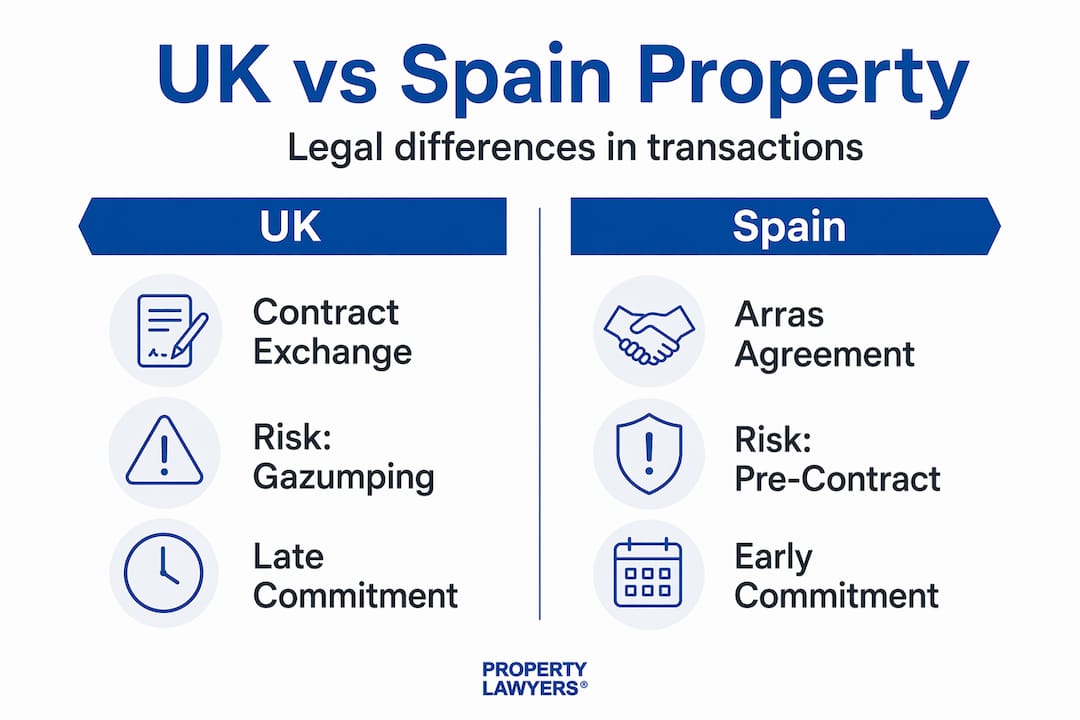
The practical takeaway is clear. In Spain, the legal commitment happens earlier, and the consequences of withdrawal are more immediately defined. This is better for buyers in many respects, but only if the arras contract is correctly drafted and explicitly specifies the type of arras and any applicable conditions.
My perspective on how buyers approach this issue
I have spent years working across Spanish property transactions with international buyers, and one pattern repeats itself with uncomfortable consistency. Buyers arrive with a well-developed sense of the risks they faced at home, whether that is UK-style gazumping or another country’s equivalent, and they apply that mental model to Spain. The result is misplaced confidence or misplaced fear, neither of which protects them.
What I have found is that the buyers who fare best are not the ones who worry about gazumping in the abstract. They are the ones who focus relentlessly on the specific wording of their arras contract. I have seen buyers lose significant deposits simply because the contract did not reference Article 1454, and when the seller defaulted, the buyer faced a costly court process rather than a straightforward double-deposit return.
The uncomfortable truth is that international buyers often assume reservation deposits carry the same weight as arras contracts. They do not. A reservation agreement is frequently just a holding arrangement, and it creates very little legal protection against the seller changing their mind or accepting a better offer before the arras is signed.
My advice is consistent. Engage a fully independent Spanish property lawyer before you pay anything. Not after you have agreed the price, not when you are reviewing the arras. Before any money moves. The cost of legal review at that stage is negligible compared to the cost of getting it wrong.
— Sophie
How Property-lawyers can help you buy with confidence
Buying property in Spain as an international buyer involves specific legal steps that carry real financial consequences if mishandled. Property-lawyers connects you with trusted, independent real estate lawyers across Spain who specialise in guiding international buyers through every stage of the purchase process.

From reviewing your arras contract and negotiating suspensive conditions to conducting full due diligence and managing deposit handling, the solicitors listed on Property-lawyers act exclusively in your interests. Whether you are buying in Madrid, the Costa del Sol, or the Balearics, find your Spanish property lawyer through our directory before signing any contract or committing any deposit. You can also explore the Property-lawyers homepage for a full overview of services available to international buyers across Spain.
FAQ
What is gazumping in Spain property?
Gazumping, as it exists in the UK, does not directly apply to Spain. Once a contrato de arras is signed, the seller is legally bound and faces financial penalties for withdrawing. The risk period exists before the arras contract is executed.
Can a seller accept a higher offer in Spain?
A seller can accept a higher offer before the arras contract is signed. After signing, a seller who withdraws on the basis of a better offer must return double the deposit received under arras penitenciales terms.
What is the difference between gazumping and gazundering?
Gazumping is when a seller accepts a higher offer after agreeing a sale. Gazundering is when a buyer lowers their offer at the last moment before contracts are signed. Both are possible in England and Wales before exchange; in Spain, the arras contract limits both risks once it is in place.
How does an arras contract protect buyers in Spain?
The arras contract creates a binding preliminary agreement. Under penitenciales terms, if the seller withdraws, they must pay double the deposit. Suspensive clauses can also allow buyers to recover their deposit if key conditions such as mortgage approval are not met.
Do I need a lawyer to sign an arras contract in Spain?
You are not legally required to use a lawyer, but the consequences of a poorly drafted arras contract can be severe. Independent legal advice before signing is strongly advisable, particularly for international buyers unfamiliar with Spanish property law.
Recommended
- Property Buying Guide Spain: Legal Advice for Foreign Buyers
- Legal Glossary – Buying Property in Spain | Property Lawyers
- Why Property Lawyers in Spain Should Position Themselves Where International Buyers Are Searching | Property Lawyers
- Why You Need a Property Lawyer and Tax Adviser Before Buying in Spain

Sophie Gutenberg is a legal content specialist focused on Spanish property law, real estate transactions, conveyancing, due diligence and tax issues affecting international property buyers in Spain. She works alongside qualified Spanish property lawyers .
