

Spanish timeshare law explained: what UK buyers must know
TL;DR:
- Spanish timeshare law provides a mandatory cooling-off period and strictly prohibits advance payments during that time. The 2025 reforms expanded the legal definition of timeshare and introduced a five-year limit on certain invalidity claims for contracts signed after 1999. Buyers should act promptly, preserve all documents, and consult a specialist lawyer before the cooling-off period expires to challenge invalid contracts or recover payments.
Spanish timeshare law gives you a mandatory cooling-off period and an absolute ban on advance payments during that window. Those two protections are the most important things to know before you sign anything. Organic Law 1/2025 tightened the rules further, clarifying how a property must be identified in a contract and introducing new time limits on certain invalidity claims.
If you have already signed a contract or paid money, here is what to do right now:
- Stop any further payments immediately and do not agree to new charges.
- Preserve every document — the signed contract, marketing brochures, receipts, and all emails.
- Note the exact dates you signed and when any money left your account.
- Do not return the standard withdrawal form without reading it carefully first.
- Contact a specialist Spanish timeshare lawyer before the cooling-off period expires.
The official legislation is published on the BOE. Garrigues, one of Spain’s leading law firms, has published detailed commentary on the 2025 changes. Property-lawyers connects UK buyers with vetted, English-speaking Spanish lawyers who handle exactly these situations.
Pro Tip: If you were not given a standard withdrawal form at the time of signing, your cooling-off period may be extended significantly if the withdrawal form was not provided — do not assume it has already expired.
Table of Contents
- What counts as a timeshare or long-term holiday product in Spain?
- Key legal rules every UK buyer should understand
- What changed in 2025 and why it matters for your contract
- How to cancel, challenge, or reclaim money: a step-by-step guide
- What to look for in a Spanish timeshare lawyer
- Common scams and red flags to watch for
- Your immediate action checklist
- Rights and obligations of timeshare owners under Spanish law
- How timeshare properties are registered in Spain
- Tax obligations for timeshare owners in Spain
- How Spanish consumer protection law applies to timeshare contracts
- How Spain compares with other popular timeshare destinations
- Key takeaways
- Why the 2025 reforms matter more than most buyers realise
- Property-lawyers can connect you with the right Spanish lawyer
- Where to read more: official sources and legal commentary
- FAQ
What counts as a timeshare or long-term holiday product in Spain?
Law 4/2012 covers four types of contract, and the definitions are broader than most buyers expect.
| Contract type | Plain-English description | Covered by Law 4/2012? |
|---|---|---|
| Timeshare (aprovechamiento por turno) | Right to use accommodation for set periods each year, lasting more than one year | Yes |
| Long-term holiday product | Right to discounts or benefits on accommodation, lasting more than one year | Yes |
| Resale contract | A professional helps you buy or sell a timeshare right | Yes |
| Exchange contract | You join a scheme to swap your timeshare use with others | Yes |
The law also covers cruise ships, caravans, and river boats — not just apartments or villas. Organic Law 1/2025 broadened the definition further to include rights that are purely personal or contractual in nature, not just registered property rights. This matters because some sellers marketed products as “membership” or “club” arrangements to avoid earlier regulations.
One point that catches buyers out: a timeshare does not give you ownership of the property. The contract grants a right to use, not a title deed. Any marketing that implies otherwise is misleading, and Spanish property contracts cannot lawfully use the word “multipropiedad” (multi-ownership) or any term containing the word “property.”
Pro Tip: If a seller describes the product as an “investment” or uses the word “ownership,” ask for the exact legal description of the right being transferred before you sign.
Key legal rules every UK buyer should understand
The protections under Spanish timeshare regulations are clear and non-negotiable.
- cooling-off period. You can withdraw from any covered contract within 14 calendar days, without giving any reason and at no cost to you.
- Extended cooling-off if information is missing. If you were not given the standard withdrawal form, your cooling-off period extends to one year and 14 days. If you did not receive full pre-contractual information, it extends to three months and 14 days.
- Absolute ban on advance payments. No deposit, guarantee, or reservation of funds is permitted until the cooling-off period has fully expired. This applies to timeshare contracts, long-term holiday products, and exchange contracts.
- Contract must identify the property. The specific accommodation must be described clearly. Vague or “floating” week arrangements — where no particular unit is identified — are a common ground for invalidity under Spanish law.
- Pre-contractual information in your language. The seller must provide all required information in English (or your EU language of choice) before you sign.
- Duration limits. Contracts cannot be perpetual. Courts have consistently held that open-ended or unlimited-duration timeshares are void.
Statistic: Consumers who paid money during the first three months of a contract that is later declared void may be entitled to recover double the sums paid in certain circumstances, based on Supreme Court decisions.
What changed in 2025 and why it matters for your contract
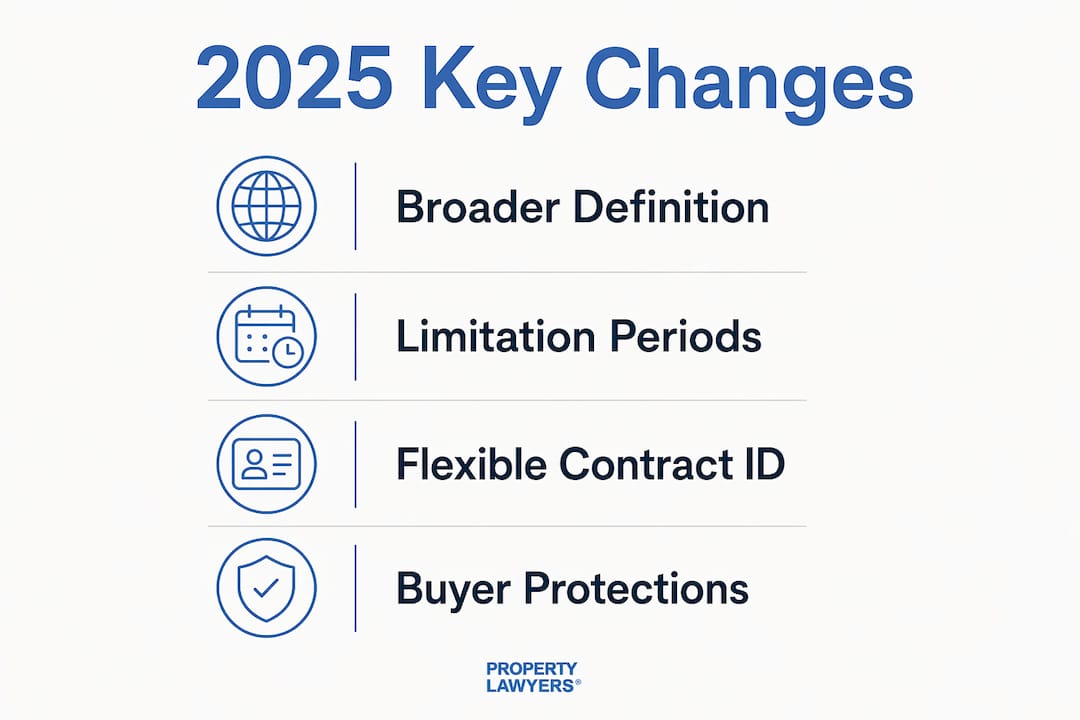
Organic Law 1/2025, which came into force on 2 January 2025, made four significant changes to Law 4/2012.
| Change | What it means in practice |
|---|---|
| Broader definition of timeshare | Personal or obligational rights now explicitly covered, closing a loophole used by club-style products |
| Flexible asset identification | A property can now be identified via a booking process or other means, not just a fixed unit description |
| Pre-existing regimes confirmed | Timeshare systems registered before 1998 remain valid; some may lawfully run for a long duration or indefinitely |
| New limitation periods | Invalidity claims for contracts signed on or after 5 January 1999 are now subject to a five-year prescription period for specific grounds |
The Supreme Court had already established important precedents before 2025. In cases involving perpetual contracts and unidentified properties, the Court found agreements void and ordered restitution of the purchase price. Those rulings remain relevant: the 2025 reforms did not remove remedies for genuinely defective contracts — they simply imposed time limits on bringing certain claims.
For UK buyers, for contracts signed after 1999, certain claims are now subject to limitation periods, so prompt action is advised. Acting promptly matters.
How to cancel, challenge, or reclaim money: a step-by-step guide
The Spanish timeshare claims process follows a clear sequence. Here is what to do.
- Stop payments and preserve all evidence — contract, receipts, marketing materials, emails, and notes of any phone calls.
- Identify which route applies to you:
- Within the cooling-off period: exercise your right of withdrawal in writing, on paper or a durable medium.
- After the cooling-off period: consider a contractual rescission claim or an invalidity claim based on vague property description, perpetual duration, or missing pre-contractual information.
- If you paid upfront or were pressured: a consumer law claim may also be available.
- Instruct a specialist Spanish lawyer to review the contract and advise on the strongest ground for challenge.
- Your lawyer sends a formal letter to the seller or developer, setting out the basis for the claim and requesting restitution.
- Negotiation or court proceedings follow. Many claims settle without going to court, but some require a Spanish court action.
Typical timelines: an initial lawyer response within one to two weeks; negotiation lasting two to six months; court proceedings, if needed, taking one to two years depending on the court and complexity.
Pro Tip: If the other side offers a settlement, have your lawyer confirm in writing that it covers all sums paid, any interest, and legal costs before you accept. Partial settlements can waive further claims.
What to look for in a Spanish timeshare lawyer
Choosing the right lawyer makes a real difference to the outcome. Use this checklist.
- Bilingual in English and Spanish, with written communication available in English throughout.
- Specific experience with Law 4/2012 and timeshare invalidity claims, not just general property law.
- Registered with a Spanish regional bar association (Colegio de Abogados).
- Experience of court proceedings in Spain, not just letter-writing.
- Clear, written explanation of fees before you instruct — whether fixed fee, no-win/no-fee, or a contingency arrangement.
Your lawyer will need a power of attorney (poder notarial) to act on your behalf in Spain, certified translations of key documents, and a full evidence bundle including the contract, receipts, and any marketing materials. Ask upfront what the initial consultation costs and what a full claim would involve.
Property-lawyers maintains a directory of vetted, English-speaking Spanish property lawyers by region, including Marbella, Mallorca, Ibiza, Málaga, Barcelona, and Madrid. You can find a Spanish property lawyer and request an initial consultation directly through the site.
Common scams and red flags to watch for
The timeshare sector attracts a specific type of fraud. These are the warning signs.
- Upfront resale fees. A resale company that asks for payment before completing a sale or terminating your contract is acting illegally. Fees are only permitted after a sale completes or the contract ends.
- Pressure to sign during the cooling-off period. Any seller who urges you to waive your withdrawal rights or sign additional documents within the 14-day window is breaching the law.
- Floating or vague property descriptions. If the contract does not name a specific unit or describe a clear booking process, it may be void for uncertainty.
- Promises of investment returns. Timeshares are not regulated investments. Any guarantee of rental income or capital growth is a red flag.
- Requests for deposits or guarantees before cooling-off expires. This is an absolute legal prohibition, not a grey area.
If you are approached by a resale company claiming it can exit your timeshare for an upfront fee, do not pay. Report the approach to the Centro Europeo del Consumidor en España and seek independent legal advice.
Your immediate action checklist
Seven things to do today if you are concerned about a Spanish timeshare:
- Stop all direct debits or standing orders related to the timeshare.
- Photograph or scan the signed contract and every page of the marketing pack.
- Download and save all emails from the seller or developer.
- Write down dates and amounts of every payment made.
- Note the names and contact details of anyone who sold or advised you.
- Request the standard withdrawal form if you have not received one.
- Contact a specialist Spanish timeshare lawyer — Property-lawyers can refer you to an English-speaking lawyer in your region (Marbella, Mallorca, Madrid, and beyond).
Pro Tip: Act before the cooling-off period expires. Once it passes, your options narrow and the claims process becomes more complex and costly.
Rights and obligations of timeshare owners under Spanish law
As a timeshare owner in Spain, you hold a right to use — not a right of ownership. That right entitles you to exclusive use of the accommodation during your allocated period each year, along with access to communal services and facilities. You cannot structurally alter the property or its furnishings.

Your obligations include paying annual maintenance fees and any applicable taxes. Failure to pay maintenance fees can result in the developer suspending your access rights. You are also bound by the community rules of the resort or development.
You may transfer or sell your timeshare right, subject to the terms of the contract and any restrictions in the registered scheme. If you withdraw from the main timeshare contract within the cooling-off period, any linked exchange or resale contract is automatically cancelled at no cost to you.
How timeshare properties are registered in Spain
Timeshare rights over immovable property in Spain must be registered in the Property Registry (Registro de la Propiedad). The developer or promoter is responsible for constituting the timeshare regime by public deed before a notary, and that deed must be registered before any rights are sold to consumers.
The registered deed sets out the duration of the scheme, the description of each unit, the allocated periods, and the rules governing the community. Buyers should ask for confirmation that the scheme is properly registered before signing. A Spanish property lawyer can verify registration status and check the deed for any restrictions or encumbrances.
Notaries in Spain will not authorise the sale of a timeshare right unless the underlying regime is correctly registered. If a seller cannot produce evidence of registration, treat that as a serious warning sign.
Tax obligations for timeshare owners in Spain
Owning a timeshare in Spain carries tax obligations even if you are not a Spanish resident. Non-residents are subject to Spanish non-resident income tax (IRNR) on the deemed rental value of the property during periods it is not actually rented out. The applicable rate and calculation method depend on your country of residence and any applicable double-taxation treaty with Spain.
If you do rent out your timeshare allocation, the rental income is taxable in Spain. You may also be liable for local property tax (IBI) depending on the structure of the scheme. For a full breakdown of what you owe as a foreign owner, the property taxes guide for foreign owners on Property-lawyers covers the current rules in detail.
Transfer tax (Impuesto de Transmisiones Patrimoniales) may apply when you acquire a timeshare right, depending on whether the transaction is treated as a property transfer or a service. Your lawyer should confirm the applicable tax treatment before you complete.
This article provides general information only, not legal or tax advice. Confirm your specific position with a qualified Spanish lawyer or tax adviser.
How Spanish consumer protection law applies to timeshare contracts
Spanish timeshare regulations sit within a broader consumer protection framework. The General Law for the Defence of Consumers and Users (Real Decreto Legislativo 1/2007) applies alongside Law 4/2012, giving buyers additional remedies where a seller acts unfairly or provides misleading information.
The consumer protection rules are mandatory. A seller cannot contract out of them, and any clause that purports to waive your statutory rights is void. This applies even if the contract is governed by a non-Spanish law or signed outside Spain, provided the seller operates in Spain or targets Spanish consumers.
Advertising for timeshare products must not be misleading and must include the key terms of the offer. Any promotional event — a “presentation” or “holiday club preview” — that leads to a contract signing is covered by the same pre-contractual information obligations as a formal sales process.
How Spain compares with other popular timeshare destinations
Spain has some of the strongest timeshare consumer protections in Europe, largely because it implemented the 2008 EU Timeshare Directive and then went further with its own national rules. The 2025 reforms reinforced that position.
Portugal and Greece also implemented the EU Directive, giving buyers broadly similar cooling-off rights and advance payment bans. However, neither has the same depth of Supreme Court case law on perpetual contracts and floating weeks that Spain has developed since 2012.
Outside the EU, destinations such as the United States, Mexico, and the Caribbean operate under very different frameworks. US timeshare law varies by state and generally offers weaker consumer protections than Spain. Mexico’s consumer protection agency (PROFECO) handles complaints but enforcement is less consistent. The Canary Islands, as part of Spain, fall under the same Spanish rules — a point worth confirming if your timeshare is in Tenerife or Gran Canaria.
For UK buyers specifically, post-Brexit status does not remove the protections under Spanish law. Law 4/2012 applies based on where the seller operates and where the property is located, not the buyer’s nationality.
Key takeaways
Spanish timeshare law gives UK buyers a mandatory cooling-off period and an absolute ban on advance payments — and the 2025 reforms added time limits on certain invalidity claims while keeping remedies for defective contracts firmly in place.
| Point | Details |
|---|---|
| Cooling-off period | You have 14 calendar days to withdraw; extended if the withdrawal form or pre-contractual information was not provided. |
| Advance payment ban | No deposit, guarantee, or reservation of funds is lawful until the cooling-off period expires. |
| 2025 reforms | Organic Law 1/2025 clarified asset identification rules and introduced a five-year limit on certain invalidity claims for post-1999 contracts. |
| Void contracts | Perpetual or floating-week contracts may be void; successful claims can result in restitution of the purchase price. |
| Property-lawyers | Use Property-lawyers to find a vetted, English-speaking Spanish timeshare lawyer by region for an initial consultation. |
Why the 2025 reforms matter more than most buyers realise
The conventional view is that the 2025 changes made things harder for buyers by introducing limitation periods. That reading is too simple. Garrigues, whose commentary on the reforms is the most authoritative available, frames the changes as a move towards legal certainty — and legal certainty cuts both ways.
The new flexible identification rules actually help buyers whose contracts describe a booking process rather than a fixed unit. The confirmation of pre-existing regimes protects owners in long-established schemes who had genuine uncertainty about their status. And the limitation periods, while real, apply only to specific grounds of challenge — they do not extinguish claims based on the advance payment ban, missing pre-contractual information, or the absolute prohibition on perpetual contracts.
The buyers most at risk are those who wait. A five-year prescription period sounds generous, but gathering evidence, instructing a lawyer, and progressing a claim through Spanish courts takes time. If you have a contract you are uncertain about, the right moment to seek advice is now, not after the deadline has quietly passed.
Property-lawyers can connect you with the right Spanish lawyer
Finding a specialist timeshare lawyer in Spain from the UK is not straightforward. Property-lawyers makes it simpler by connecting you directly with vetted, independent, English-speaking Spanish lawyers who have experience with Law 4/2012 claims, invalidity actions, and consumer protection disputes.
The directory covers all major regions: Marbella, Mallorca, Ibiza, Málaga, Barcelona, and Madrid. Lawyers listed on the platform are independent — they work for you, not the developer or resort. You can request fee structures upfront, and many lawyers offer an initial consultation to assess your position before you commit to a full instruction.
To find a lawyer in your region or to get a referral for a timeshare dispute, visit the Spain property lawyers page and submit your enquiry. A specialist will be in touch to discuss your options.
Where to read more: official sources and legal commentary
- BOE (Boletín Oficial del Estado) — the official Spanish state gazette, where Law 4/2012 and Organic Law 1/2025 are published in full. The primary source for statutory wording.
- Centro Europeo del Consumidor en España — Ministerio de Consumo — practical consumer guidance in English on timeshare rights, resale scams, and how to make a complaint.
- Garrigues blog — timeshare legislative changes (2025) — authoritative legal commentary on the four changes introduced by Organic Law 1/2025, written by one of Spain’s leading law firms.
- Lexology — Organic Law 1/2025 analysis — detailed Spanish-language analysis of the 2025 amendments for those who want the technical detail.
- Property-lawyers.com — use the directory to verify that any lawyer you instruct is independent, English-speaking, and experienced in Spanish timeshare law.
Keep copies of all official forms and correspondence. If a lawyer or resale company is cited in any commentary, use Property-lawyers to verify their credentials independently before instructing them.
FAQ
What is the cooling-off period for a Spanish timeshare?
The standard cooling-off period is 14 calendar days, during which you can withdraw from the contract without giving any reason. If the seller did not provide the standard withdrawal form, your cooling-off period extends to one year and 14 days.
Can a seller ask for a deposit during the cooling-off period?
No. Spanish law imposes an absolute ban on advance payments, deposits, guarantees, or any reservation of funds until the cooling-off period has fully expired. Any seller who requests payment during this window is acting unlawfully.
What makes a Spanish timeshare contract void?
Contracts can be void if they are perpetual in duration, if the property is not clearly identified (including “floating week” arrangements), or if required pre-contractual information was not provided. Perpetual contracts and vague property descriptions have been ruled invalid by courts.
How long do I have to bring a timeshare invalidity claim in Spain?
Following the 2025 reforms, certain invalidity claims for contracts signed on or after 5 January 1999 are subject to a five-year prescription period. Other grounds, such as the advance payment ban, are not subject to the same limit. A specialist lawyer can advise on which time limit applies to your contract.
How does Property-lawyers help with timeshare disputes?
Property-lawyers is a directory of vetted, English-speaking Spanish property lawyers. You can use the Spain lawyers directory to find a specialist in your region — Marbella, Mallorca, Madrid, and others — and request an initial consultation to assess your options.
Recommended
- Spanish off-plan property law explained for buyers
- Gazumping in Spain: what property buyers must know
- Spanish real estate law: a buyer’s guide for 2026

Sophie Gutenberg is a legal content specialist focused on Spanish property law, real estate transactions, conveyancing, due diligence and tax issues affecting international property buyers in Spain. She works alongside qualified Spanish property lawyers .
