

Spanish property contracts explained: a buyer’s guide
TL;DR:
- The Spanish contrato de arras is a legally binding private agreement that commits both parties to a property transaction before the final notary deed. Its proper designation and precise clauses, including the type of arras and suspensive conditions, are crucial to protect buyers from financial risks. Reviewing this contract with an independent lawyer and securing deposits in escrow are essential steps to prevent costly disputes and ensure a secure purchase process.
The Spanish property contract, formally known as the contrato de arras, is the legally binding private agreement that commits both buyer and seller to a property transaction before the final notary deed is signed. Understanding what is in a Spanish property contract explained clearly can mean the difference between a protected purchase and a costly dispute. This agreement sets out the agreed price, deposit amount, completion deadline, and the financial consequences if either party withdraws. For international buyers, getting to grips with this document before signing is not optional. It is the foundation of the entire transaction.
What is a Spanish property contract and why does it matter?
The contrato de arras formalises the deal between buyer and seller before the escritura pública (the public notary deed) is signed, making it the primary private contract in Spain’s property purchase process. It is not a formality. Once signed, both parties are financially and legally committed to the transaction on the terms stated.
This contract typically arrives after initial due diligence and before the notary appointment. It secures the property off the market, locks in the agreed price, and defines what happens if either side fails to complete. For foreign buyers who may be unfamiliar with Spanish real estate contract details, this document deserves the same level of scrutiny as the final deed itself.
The contrato de arras also serves a practical purpose: it gives both parties time to finalise mortgage arrangements, complete legal checks, and prepare for completion, all within a defined and agreed timeframe.
What types of Spanish property contracts exist and how do they differ?
Spanish law recognises three distinct types of arras contracts, and the differences between them carry significant financial consequences.
Arras penitenciales are the most common type used in residential property sales. Under Article 1454 of the Spanish Civil Code, penitential arras function as a pre-agreed price of withdrawal. If the buyer withdraws, they forfeit the deposit. If the seller withdraws, they must return double the deposit amount. This type gives both parties a clear and defined exit route.
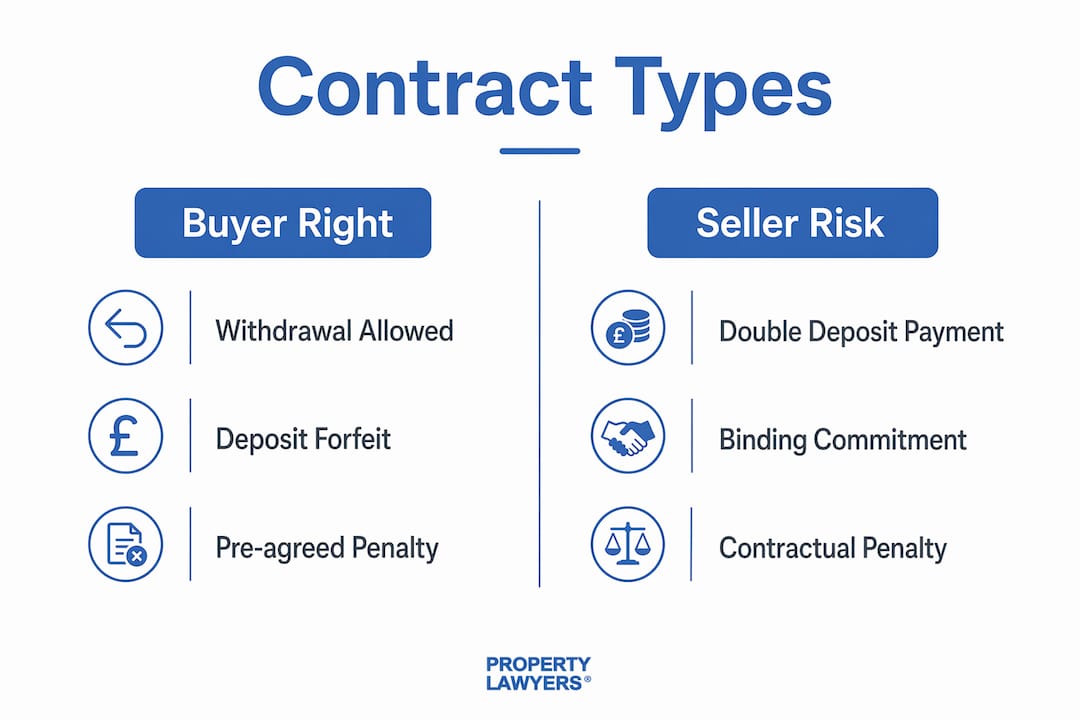
Arras confirmatorias do not grant either party the right to withdraw simply by forfeiting or doubling the deposit. Instead, they confirm the obligation to complete. If one party withdraws, the other can pursue legal enforcement of the contract or claim damages through the courts. This is a far more binding arrangement.
Arras penales sit between the two. They confirm the obligation to complete but also set a pre-agreed penalty for breach, which may or may not substitute for full performance depending on how the clause is drafted.
The table below summarises the key differences:
| Type | Right to withdraw | Consequence for buyer | Consequence for seller |
|---|---|---|---|
| Arras penitenciales | Yes | Loses deposit | Returns double the deposit |
| Arras confirmatorias | No | Legal enforcement or damages | Legal enforcement or damages |
| Arras penales | Limited | Pre-agreed penalty applies | Pre-agreed penalty applies |
If the contract does not clearly specify the arras type, courts may default to arras confirmatorias, which bind both parties to complete or face legal enforcement without an easy right to withdraw. This can expose buyers to significant financial risk, including loss of deposit plus damages and potential forced completion.
Pro Tip: The term “arras” alone is not sufficient. The contract must expressly state “arras penitenciales” or reference Article 1454 of the Spanish Civil Code to make the intended withdrawal rights legally enforceable.
What essential clauses does a Spanish property contract include?
A well-drafted Spanish purchase contract includes the parties’ full details, precise property identification with cadastral references, the agreed price, deposit amount, completion deadline, and the consequences of withdrawal. Each of these elements requires careful attention.
The deposit in Spanish property contracts commonly amounts to 10% of the agreed purchase price. Some transactions use a two-stage approach: a smaller reservation fee paid first to take the property off the market, followed by the full 10% on signing the arras contract. Buyers should confirm exactly how their deposit is structured before committing any funds.
Must-have clauses for buyer protection
- Suspensive conditions: Clauses that allow the contract to be rescinded without penalty if specific conditions are not met, such as mortgage approval, a clean title search, or urban planning compliance. Properly drafted suspensive clauses allow buyers to reclaim their deposit if financing falls through or a legal issue with the property emerges.
- Precise property identification: The contract must include the full cadastral reference, registered address, and a description of what is included in the sale, such as fixtures, fittings, and any furnishings agreed upon.
- Completion deadline: A clear date by which the escritura must be signed. Vague or open-ended deadlines create room for disputes.
- Withdrawal consequences: Explicit wording on what happens if either party fails to complete, including the financial penalties and whether legal action can be pursued.
- Currency clause: For buyers purchasing in a currency other than euros, a clause addressing exchange rate risk or fixing the price in euros protects against unexpected cost increases between signing and completion.
Pro Tip: Always request that the contract includes a clause allowing you to withdraw and recover your deposit if the property title search reveals embargoes, unpaid community fees, or planning irregularities. Without this, you may lose your deposit even if the property has serious legal problems.
Negotiation points buyers often overlook
Sellers and their agents frequently present a standard contract that favours the seller’s position. Buyers have the right to negotiate the inclusion of suspensive conditions, the length of the due diligence period, and the precise wording of withdrawal clauses. A qualified Spanish property lawyer will identify where the draft contract falls short and propose amendments before you sign.
How does the Spanish property contract fit into the buying process?
Understanding where the contrato de arras sits within the broader purchase timeline helps buyers plan their finances and legal checks effectively. The 10 important steps when buying property in Spain follow a logical sequence that buyers should follow without skipping stages.
- Property search and offer: The buyer identifies a property and makes a verbal or written offer, which the seller accepts in principle.
- Reservation agreement: A small reservation fee (typically €3,000 to €10,000) is paid to take the property off the market while due diligence begins. This is a separate, shorter document and is not the arras contract.
- Due diligence: The buyer’s lawyer conducts legal property checks covering title, debts, planning compliance, community fees, and any encumbrances. This typically takes one to two weeks.
- Arras contract signing: Once due diligence is satisfactory, the contrato de arras is signed and the full deposit (usually 10%) is paid.
- Mortgage arrangement: If the buyer requires financing, the bank valuation and mortgage approval process runs in parallel with or after the arras signing.
- Notary completion (escritura): The final public deed is signed before a notary, the balance of the purchase price is paid, and legal ownership transfers to the buyer.
- Land Registry registration: After completion, the deed is submitted to the Land Registry. Registration can take two to eight weeks depending on location and case specifics.
Notaries authenticate the public deed and verify legality but do not act as the buyer’s legal counsel or negotiator. The buyer’s lawyer performs due diligence on title, debts, planning compliance, community fees, rental restrictions, taxes, and contract review before signing. This distinction is one that many foreign buyers misunderstand, sometimes with expensive consequences and costs of buying in property Spain.
Regarding deposit funds, paying the deposit into a lawyer’s escrow account rather than directly to the seller provides maximum protection for the buyer’s funds. Direct deposits to sellers risk difficulties recovering funds in case of withdrawal or seller insolvency, potentially leading to lengthy court proceedings.
What risks do buyers face with Spanish property contracts?
Contract risk is also shaped by the property and local market. Buyers can find independent legal support for transactions in Mallorca, Marbella, Madrid, Barcelona and Ibiza.
Legal disputes often arise not over the concept of arras itself but over the interpretation of contract clauses around withdrawal, delays, and conditional obligations. Clear, precise contractual wording on deadlines, deposit forfeiture, conditions, and breach consequences is the primary defence against costly disputes.
Common risks to watch for
- Ambiguous arras type: A contract that simply says “arras” without specifying the type may be interpreted as arras confirmatorias by a court, removing the buyer’s right to walk away by forfeiting the deposit.
- Missing suspensive conditions: Without clauses covering mortgage approval or clean title, buyers who cannot complete for legitimate reasons may still lose their deposit.
- Unclear deadlines: Contracts without firm completion dates create uncertainty and can be exploited by either party to delay or avoid completion.
- Inaccurate property description: If the contract does not precisely identify the property, disputes over what is included in the sale (garage spaces, storage rooms, furnishings) are common.
- No escrow arrangement: Deposits paid directly to sellers or developers without escrow protection are at risk if the seller becomes insolvent or refuses to return funds.
Pro Tip: Before signing any contract, ask your lawyer to confirm in writing that the property title is clean, that there are no outstanding debts registered against the property, and that the arras type is correctly specified. These three checks alone prevent the majority of contract disputes.
Buyers should also be aware that the type of arras clause is decisive for risk. Contracts must clearly specify the arras nature, include protections such as deadlines, conditions for refund, accurate property description, and full disclosure by the seller. Treating the pre-purchase deposit contract with the same caution as the final deed is not excessive. It is prudent.
Key takeaways
A Spanish property purchase is secured or jeopardised at the contrato de arras stage, making precise contract wording, correct arras type specification, and independent legal review the three non-negotiable protections for any buyer.
| Point | Details |
|---|---|
| Arras type must be explicit | Contracts must state “arras penitenciales” or cite Article 1454 to protect withdrawal rights. |
| Deposit is typically 10% | A two-stage deposit (reservation fee then full 10%) is common in Spanish transactions. |
| Suspensive conditions protect buyers | Clauses covering mortgage approval and clean title allow deposit recovery if conditions are unmet. |
| Notaries do not advise buyers | Only the buyer’s own lawyer reviews contracts, conducts due diligence, and negotiates protections. |
| Escrow deposits reduce risk | Holding the deposit with a lawyer rather than the seller protects funds if the deal collapses. |
Why I always tell buyers to read the contract before they fall in love with the property
After years of working with international buyers across Spain, the pattern I see most often is this: buyers spend months researching areas, visiting properties, and comparing prices, then spend less than an hour reviewing the contract before signing. That imbalance is where most problems begin.
The single most common misunderstanding I encounter is the belief that the notary will catch any problems with the contract. The notary’s role is to authenticate the deed and verify legal formalities. Substantive risk review, the kind that catches ambiguous arras wording, missing suspensive conditions, or undisclosed purchase costs, is the lawyer’s responsibility. Many buyers do not realise this until something goes wrong.
My practical advice is straightforward. Pay your deposit into your lawyer’s escrow account, not directly to the seller or developer. Insist on suspensive conditions covering mortgage approval and a clean title search. And read the contract in full before you sign, with a qualified Spanish property lawyer at your side. The cost of proper legal advice at this stage is a fraction of what a disputed deposit or a forced completion can cost you later. Careful contract negotiation does not slow down a purchase. It protects it.
— Sophie
Get expert legal support for your Spanish property purchase
Buying property in Spain is one of the most significant financial decisions you will make, and the contract stage is where your legal protection is either built or left exposed.

Property-lawyers connects international buyers with trusted, independent real estate lawyers in Spain who specialise in contract review, due diligence, and full purchase support. Every lawyer in the directory is experienced in working with foreign buyers and communicates in English. Whether you need a contract reviewed before signing or full legal representation from offer to completion, Property-lawyers helps you find the right specialist for your transaction across any region of Spain.
FAQ
What is the contrato de arras in Spain?
The contrato de arras is the primary private contract used in Spanish property transactions, signed before the final notary deed. It commits both buyer and seller to the agreed terms and sets out the financial consequences if either party withdraws.
How much deposit is required for a Spanish property contract?
The deposit in a Spanish property contract commonly amounts to around 10% of the agreed purchase price. Some transactions use a smaller reservation fee first, with the full 10% paid on signing the arras contract.
What happens if the seller withdraws from the contract?
Under arras penitenciales, if the seller withdraws from the contract, they are legally required to return double the deposit amount to the buyer. This protection only applies if the contract explicitly specifies this type of arras.
Do I need a lawyer to sign a Spanish property contract?
A notary does not act as the buyer’s legal adviser and will not review the contract for your protection. Appointing an independent Spanish property lawyer to review the contract, conduct due diligence, and negotiate clauses is the only way to ensure your interests are protected before you sign.
What are suspensive conditions in a Spanish property contract?
Suspensive conditions are clauses that allow the contract to be cancelled without financial penalty if specific circumstances arise, such as failure to obtain mortgage approval or discovery of a legal problem with the property title. Without these clauses, buyers may lose their deposit even if the deal collapses through no fault of their own.
Recommended
- Spanish real estate law: a buyer’s guide for 2026
- Gazumping in Spain: what property buyers must know
- Why translate Spanish property documents: a clear guide

Sophie Gutenberg is a legal content specialist focused on Spanish property law, real estate transactions, conveyancing, due diligence and tax issues affecting international property buyers in Spain. She works alongside qualified Spanish property lawyers .
