

Spanish real estate law: a buyer’s guide for 2026
TL;DR:
- Spanish real estate law governs property ownership, transactions, and rights across Spain, with recent updates in 2026 affecting taxation and reporting.
- Buyers must follow a precise legal process, from obtaining an NIE and engaging an independent lawyer to signing the notarial deed, to ensure secure ownership.
- Understanding community obligations, regional taxes, and avoiding common legal pitfalls is essential for successful property investment in Spain.
Spanish real estate law is the body of legal rules and procedures that governs property ownership, transactions, and rights across Spain, rooted primarily in the Spanish Civil Code and supplemented by Royal Decrees, regional legislation, and the Horizontal Property Act (Ley de Propiedad Horizontal). For international buyers, understanding this framework is not optional. It determines whether your purchase is legally secure, financially sound, and free from hidden liabilities. This guide covers the full scope of property laws in Spain, from the first contract you sign to the annual taxes you owe as an owner, with particular attention to the legislative changes introduced in 2026.
What are the essential legal steps to buy property in Spain?
Buying property in Spain follows a defined legal sequence. Skipping any step creates risk, and the consequences of errors can include losing your deposit, inheriting a property’s debts, or purchasing a home with unresolved planning violations.
The process runs as follows:
- Obtain your NIE (Número de Identificación de Extranjero). This foreigner identification number is required for every legal and financial transaction in Spain, including opening a bank account and signing contracts. Apply at a Spanish consulate in your home country or at a National Police station in Spain.
- Engage an independent lawyer. Your lawyer must be independent of the estate agent and the developer. This is the single most important decision you will make. A conflict of interest at this stage is the root cause of most buyer disputes.
- Request the Nota Simple from the Land Registry. This document confirms the legal owner, the property’s description, and any charges, mortgages, or embargoes registered against it. Your lawyer should obtain this before any money changes hands.
- Sign a reservation contract and pay a holding deposit. This removes the property from the market. The amount is typically €3,000 to €10,000 and is usually non-refundable if you withdraw without legal cause.
- Sign the Contrato de Arras (private purchase contract). This is the binding preliminary agreement. Under Spanish law, if the buyer withdraws, they forfeit the deposit. If the seller withdraws, they must return double the deposit paid. The arras contract sets the completion date, price, and conditions.
- Complete at the notary and register the deed. The escritura pública (public deed) is signed before a notary, who verifies the transaction but does not act as your legal adviser. The deed is then registered at the Land Registry, which formally transfers ownership.
A resale property transaction typically takes 6 to 10 weeks from offer to completion. Off-plan purchases take considerably longer, typically 18 to 36 months, depending on the developer’s construction schedule. This distinction matters for financial planning and mortgage arrangements.
Pro Tip: Ask your lawyer to obtain an updated Nota Simple within 24 hours of signing the arras contract. Property charges can be registered at any time, and a document obtained weeks earlier may not reflect the current legal position.

How do ownership forms and community laws affect buyers?
Spain recognises several forms of property ownership, each carrying distinct legal obligations. Understanding which applies to your purchase determines your rights, your costs, and your exposure to community decisions.
Plena propiedad (freehold) is the most complete form of ownership. You hold the land and the building outright, subject only to planning law and taxation. Most urban apartments and villas are sold on this basis.
Leasehold arrangements exist but are far less common than in the United Kingdom. They typically arise in specific historic or commercial contexts and require careful legal scrutiny before purchase.
Comunidad de propietarios (community of owners) applies to any building or urbanisation where areas such as lifts, gardens, pools, and entrance halls are shared. The Horizontal Property Act mandates that all owners share governance and costs of communal areas in proportion to their ownership percentage. This is not optional. Failure to pay community fees results in a registered debt against your property.
Key implications of community ownership include:
- Renovation restrictions. Structural changes and external alterations generally require community approval and, in many cases, a municipal building licence.
- Noise and use rules. Communities can set rules on noise, pet ownership, and use of communal facilities through majority vote.
- Short-term rental restrictions. Communities of owners can restrict tourist rentals by a three-fifths majority vote. This directly affects investors planning to let on platforms such as Airbnb.
- Debt inheritance. Unpaid community fees from a previous owner attach to the property, not the person. You can inherit up to three years of unpaid fees if your lawyer does not verify the community account status before completion.
“Buyers frequently underestimate the legal weight of community governance. A community can pass resolutions that fundamentally alter how you use your property, from banning short-term lets to mandating expensive communal repairs. Review the community minutes for the past three years before you commit.”
What taxes and fees must buyers budget for?
Total buying costs above the purchase price generally range from 10 to 15%, covering taxes, notary fees, Land Registry fees, and legal costs. This figure varies by region and property type, and it is one of the most consistently underestimated aspects of buying property in Spain.
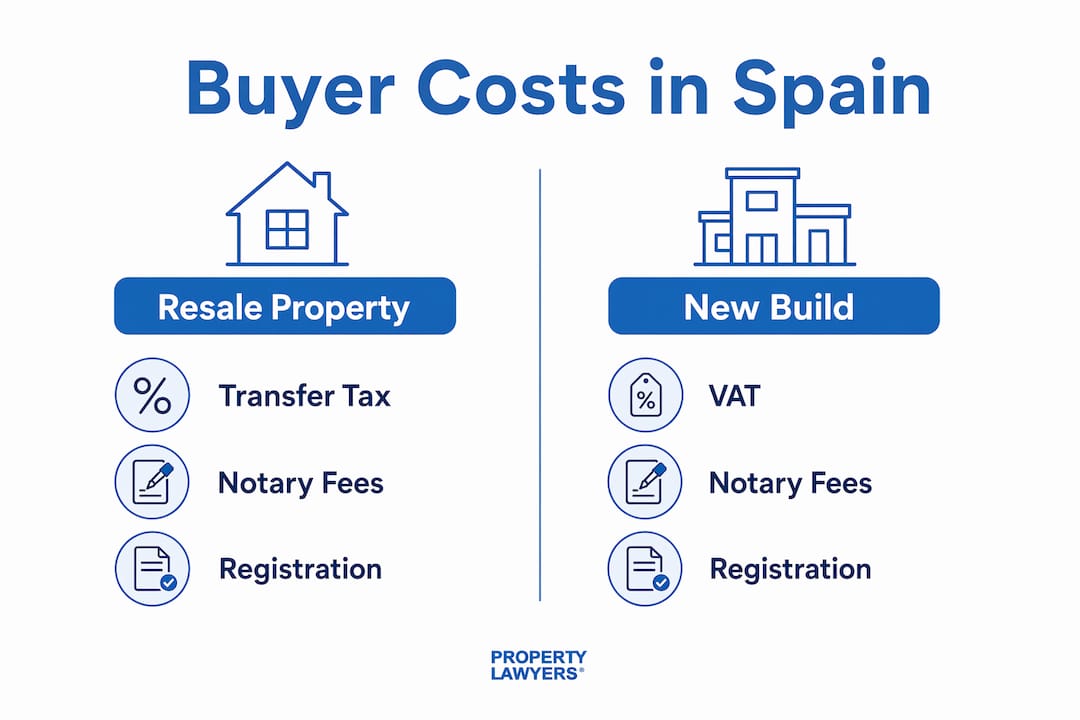
| Cost | Resale property | New build |
|---|---|---|
| Transfer Tax (ITP) | 6–10% (varies by region) | Not applicable |
| VAT (IVA) | Not applicable | 10% (21% for land/commercial) |
| Stamp Duty (AJD) | 0.5–1.5% | 0.5–1.5% |
| Notary fees | €600–€1,200 approx. | €600–€1,200 approx. |
| Land Registry fees | €400–€900 approx. | €400–€900 approx. |
| Legal fees | 1–2% of purchase price | 1–2% of purchase price |
Annual ownership costs add a further layer of obligation. The IBI (Impuesto sobre Bienes Inmuebles) is the Spanish equivalent of council tax, levied by the local municipality. Non-resident owners must also file a non-resident income tax return annually, even if the property is not rented out. The basura tax covers refuse collection and is charged separately in most municipalities.
Royal Decree-Law 2/2026 introduces emergency housing measures and tax reforms that change calculation methods and reporting obligations for property investors. The Comunidad Valenciana has also introduced regional variations that affect ITP rates for certain buyer categories. These changes mean that tax advice obtained even 12 months ago may no longer be accurate.
Pro Tip: Budget for 12% above the purchase price as a working figure, then ask your lawyer for a precise cost breakdown specific to the region and property type you are buying. Regional variations in ITP alone can shift your total costs by several thousand euros.
What are the common legal pitfalls in Spanish property transactions?
The most costly mistakes in Spanish real estate transactions are almost always preventable with proper due diligence. The following are the issues that cause the greatest problems for buyers.
- Relying on the estate agent’s recommended lawyer. An agent-referred lawyer may have a commercial relationship with the agent or developer. Independent legal advice is the only way to verify property status, planning permissions, and debts without a conflict of interest.
- Confusing the Land Registry and the Catastro. The Land Registry legally confirms ownership, whereas the Catastro serves tax and administrative purposes. Discrepancies between the two are common and can cause disputes over boundaries, built area, and legal status. Your lawyer must cross-reference both.
- Purchasing without verifying planning permission. Illegal builds are a documented problem in parts of Spain, particularly in rural areas and along certain coastal zones. A property built without a valid licence, or one that exceeds its permitted footprint, can be subject to demolition orders. Always obtain the Certificado de Final de Obra (certificate of completion) and verify it against the building licence.
- Overlooking registered debts. Mortgages, community fee arrears, and tax debts can all be registered against a property. The Nota Simple reveals registered charges, but your lawyer should also request a certificate from the community of owners confirming no outstanding fees.
- Underestimating mortgage constraints for non-residents. Spanish lenders typically offer loan-to-value ratios of 60 to 70% for non-residents, compared with up to 80% for Spanish residents. Mortgage pre-approval must be secured before signing the arras contract, as the deposit is at risk if financing falls through without a specific financing condition clause.
Pro Tip: In rural areas or where boundary disputes are possible, commission a topographic survey before signing the arras. Conflicts over property boundaries frequently arise when cadastral and registered boundaries differ, and resolving them after purchase is expensive and time-consuming.
For a structured approach to verification, the due diligence checklist published by Property-lawyers covers the key steps for confirming legal status before exchange.
Key takeaways
Spanish real estate law requires buyers to complete a defined legal sequence, budget for 10 to 15% in additional costs, and conduct thorough due diligence to avoid inheriting debts, planning violations, or community liabilities.
| Point | Details |
|---|---|
| Legal sequence is fixed | Follow the NIE, Nota Simple, arras, and notary steps in order to protect your deposit and ownership rights. |
| Budget beyond the price | Total acquisition costs run 10 to 15% above the purchase price, varying by region and property type. |
| Community law has real teeth | The Horizontal Property Act creates binding obligations on costs, renovations, and rental use from day one of ownership. |
| Due diligence prevents loss | Cross-referencing the Land Registry and Catastro, and verifying planning permissions, prevents the most common and costly buyer errors. |
| 2026 tax reforms require fresh advice | Royal Decree-Law 2/2026 changes reporting obligations for investors; advice from previous years may no longer apply. |
What I have learned from watching buyers navigate Spanish property law in 2026
The buyers who come through the process well are not necessarily the most experienced. They are the ones who engage a lawyer before they fall in love with a property, not after. Once you have emotionally committed to a purchase, it becomes psychologically harder to walk away from a due diligence finding that should stop the transaction.
What I find genuinely concerning in 2026 is the pace of legislative change. Royal Decree-Law 2/2026 is not a minor adjustment. It reshapes how rental income is taxed and how certain transactions are reported, and it arrived with limited transition time. Buyers who relied on advice given in 2024 or early 2025 are operating with an outdated picture. The abolition of the Golden Visa on 3 April 2025 is another example. Many investors were still planning around residency-by-investment assumptions months after the scheme closed.
The other pattern I observe repeatedly is buyers treating the notary as their legal protector. The notary’s role is to authenticate the transaction and verify its formal legality. They are not reviewing the property’s planning history, the community’s financial health, or the accuracy of the Catastro record. That work belongs to your independent lawyer, and it cannot be delegated to anyone with a financial interest in the sale completing.
Spain remains an excellent market for property investment and lifestyle purchases. The legal framework is well-developed and, when followed correctly, provides strong protection for buyers. The risks are real but manageable with the right professional support engaged at the right time.
— Sophie
How Property-lawyers can support your Spanish property purchase

Buying property in Spain without specialist legal support exposes you to risks that are entirely avoidable. Property-lawyers connects international buyers with vetted, independent real estate lawyers in Spain who specialise in due diligence, contract review, and tax compliance for foreign purchasers. Every lawyer in the directory operates independently of estate agents and developers, which is the foundation of genuinely protective legal advice.
Whether you are purchasing a resale apartment in Madrid, a villa on the Costa del Sol, or an off-plan development in Valencia, Property-lawyers can match you with a specialist who understands the regional regulations that apply to your transaction. For buyers in the capital, Madrid solicitors with direct experience of local planning and community law are available through the directory. From arras contracts to notary completion and post-purchase tax registration, the right lawyer handles every stage so you do not have to.
FAQ
Do foreigners face restrictions when buying property in Spain?
No nationality-based restrictions apply to buying property in Spain as of 2026. The Golden Visa programme was abolished on 3 April 2025, meaning property purchase no longer grants automatic residency rights.
What is the difference between the arras contract and the reservation contract?
A reservation contract removes the property from the market for a short period, typically with a small holding deposit. The arras contract is the binding preliminary purchase agreement that commits both parties legally, with the deposit forfeited by the buyer or doubled by the seller if either withdraws without legal cause.
How do I check whether a property has debts or legal issues?
Your lawyer should obtain the Nota Simple from the Land Registry, a certificate from the community of owners confirming no fee arrears, and verification of any outstanding IBI or local tax debts. The legal status check process should be completed before signing the arras contract.
What taxes do non-resident property owners pay annually in Spain?
Non-resident owners pay IBI (municipal property tax), the basura (refuse) tax, and an annual non-resident income tax return, even if the property is unrented. Regional rates and calculation methods vary, and the 2026 reforms have altered reporting obligations for investors.
How long does a property purchase in Spain take to complete?
A resale property transaction typically completes in 6 to 10 weeks from the point of offer acceptance. Off-plan purchases take significantly longer, generally 18 to 36 months, subject to the developer’s construction programme.
Recommended
- The Changing Profile of Foreign Buyers in Spain in 2026
- Land Registry Spain — Registro de la Propiedad Guide for Buyers | Property Lawyers
- Building defects law in Spain: buyer’s guide 2026
- Property Buying Guide Spain: Legal Advice for Foreign Buyers

Sophie Gutenberg is a legal content specialist focused on Spanish property law, real estate transactions, conveyancing, due diligence and tax issues affecting international property buyers in Spain. She works alongside qualified Spanish property lawyers .
