
Spain’s 10-year structural guarantee for new-build property
TL;DR:
- The Seguro Decenal is a mandatory 10-year insurance protecting new-build buyers in Spain against structural defects. It starts at the Acta de Recepción, not the purchase date, and must be active before property registration. Buyers should verify its presence and the insurer’s validity to avoid costly risks and ensure legal protection.
When you buy a new-build property in Spain, the law gives you a powerful protection most buyers never fully understand: a mandatory 10-year structural warranty, known as the Seguro Decenal. This insurance covers serious defects that threaten the stability of the building, and without it, the developer cannot legally register or sell the property. Understanding how it works before you sign anything could save you from a very costly mistake.
What is the structural guarantee on Spanish new-build property?
The Seguro Decenal is a mandatory structural insurance that every developer must take out before a new residential building can be registered at the Land Registry. It is established under the Ley de Ordenación de la Edificación (LOE), Spain’s Building Planning Law, enacted on 5 November 1999. The guarantee exists to protect buyers if serious structural faults emerge after completion.
This is not optional paperwork. Without a valid Seguro Decenal certificate, the notary will not sign the final deed of sale, and the property cannot change hands legally.
Key facts at a glance:
- Covers structural defects that compromise the building’s mechanical stability
- Mandatory for all residential new-builds sold after the LOE came into force in 1999
- Must be in place before the property is registered at the Land Registry
- Protects buyers even if the developer goes out of business
- Remains valid for a full decade from the date of official handover
What does the 10-year structural warranty actually cover?
The Seguro Decenal covers the fundamental load-bearing elements of the building. These are the components whose failure could make the structure unsafe or uninhabitable.
Structural elements covered:
- The warranty covers key load-bearing elements such as foundations, pillars, beams, load-bearing walls, and floor slabs
Typical defects the warranty addresses:
- Ground subsidence causing the structure to shift or crack
- Major cracks in walls, beams, or pillars that threaten stability
- Collapsing roofs due to structural failure
- Retention wall failures linked to unstable foundations
The warranty does not cover aesthetic defects, poor workmanship on non-structural elements, damage from lack of maintenance, or defective fixtures. A cracked tile or a draughty window falls outside its scope entirely. The Seguro Decenal is specifically for serious, life-threatening structural failures, not general building quality issues.
How long does the warranty last, and when does the clock start?
Spain’s new-build warranty system operates on three separate timescales:
- 1 year for finishing defects (cosmetic issues, fixtures, fittings)
- 3 years for habitability defects (damp, insulation failures, plumbing)
- 10 years for structural defects affecting the building’s stability
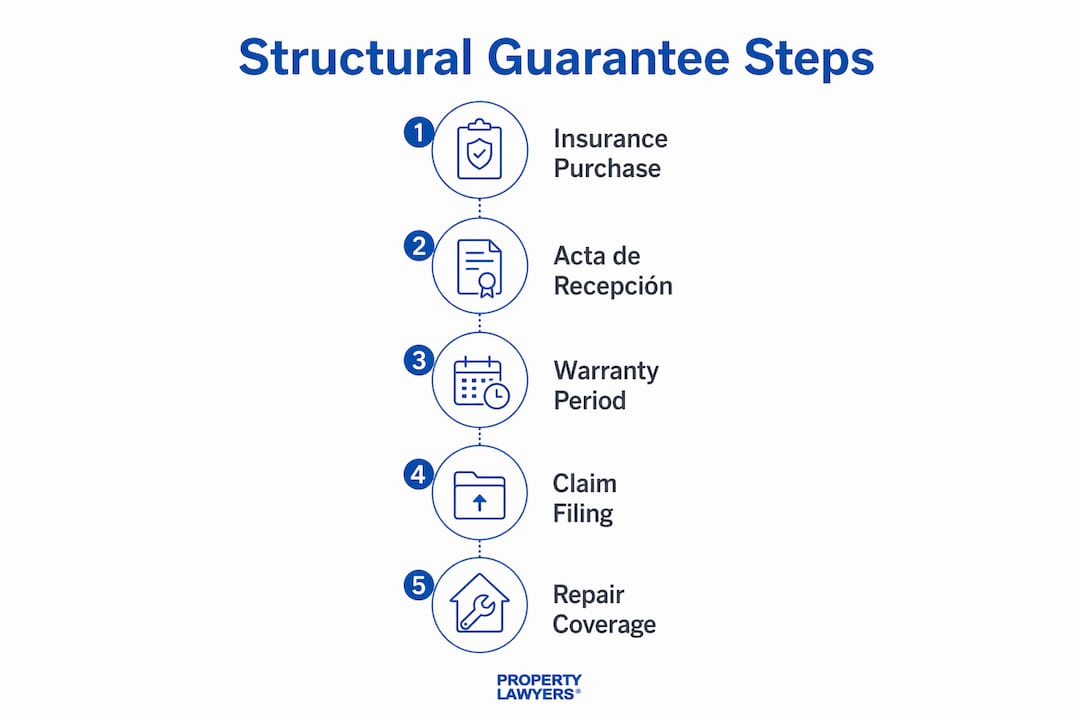
The 10-year period begins at the Acta de Recepción, the formal document signed when the developer officially hands the building over from the construction company. This is not the same as the date you personally receive your keys or sign your purchase contract.
In practice, the warranty clock starts before most buyers complete their purchase. If a development takes two years to sell out after the Acta de Recepción is signed, buyers who purchase late in that period inherit a warranty that is already running. You could effectively receive eight years of coverage rather than ten. Always ask your lawyer to confirm the exact Acta de Recepción date before exchanging contracts.
Claims must be filed within the relevant warranty window. Missing the deadline under Ley 38/1999 can invalidate your rights entirely, regardless of how serious the defect is.
How do you make a claim under the structural warranty?
Making a successful claim requires acting promptly and documenting everything carefully.
Steps to follow:
- Identify the defect and gather photographic evidence as soon as it appears
- Obtain a written technical report from an independent architect or structural engineer confirming the defect is structural
- Notify the developer in writing, keeping copies of all correspondence
- Contact the insurance company that issued the Seguro Decenal policy directly
- Submit your technical report, photographs, and written notifications to the insurer
- If the insurer disputes the claim, engage a specialist property lawyer to pursue it formally
The role of the Technical Control Office (OCT) is worth understanding here. During construction, an independent OCT oversees each phase of the build and issues reports that the insurer relies on to validate the final policy. If the OCT flagged concerns during construction that were not resolved, this can complicate a later claim. Your lawyer can request the OCT reports as part of due diligence before you complete.
Pro Tip: Request a copy of the Seguro Decenal policy and the OCT reports before you sign the final deed. If the developer cannot produce them, do not proceed. A reputable developer will have both ready without hesitation.

Once a claim is validated, the insurer is legally obliged to cover the cost of repairs, regardless of whether the original developer still exists as a company.
Who is protected, and what are the developer’s obligations?
The Seguro Decenal primarily protects buyers of new-build residential properties. Resale buyers do not automatically benefit from the same structural insurance protections. When you buy a resale property, you inherit the building’s maintenance history without any guarantee that structural insurance is still active or was ever properly arranged.
Developers carry clear legal obligations under the LOE:
- Secure the Seguro Decenal before applying for the final building declaration (Declaración de Obra Nueva)
- Provide proof of the insurance certificate during the legal completion process
- Include the insurance details in the Libro del Edificio (Building Book) handed to the buyer
Without this insurance certificate, a new-build cannot be legally sold or registered. This legal barrier means that, unlike in some other countries, buyers in Spain have a structural safety net built directly into the registration process. You have the right to demand proof of the guarantee before completion, and your lawyer should verify it independently.
One important nuance: self-builders who construct a property for their own use are initially exempt from the Seguro Decenal. However, if they decide to sell within ten years of completion, they must obtain the insurance before doing so. Without it, they become personally liable to the buyer for any structural defects.
What UK buyers specifically need to know
UK buyers purchasing new-build property in Spain face a few additional considerations that are easy to overlook.
The structural warranty and the deposit guarantee are two entirely separate protections. The Aval Bancario (bank guarantee) protects your stage payments during construction if the developer fails to complete. The Seguro Decenal protects the physical building after completion. Both are mandatory, but they serve completely different purposes. Confusing the two is one of the most common mistakes international buyers make.
On deposit protection, the GOV.UK guidance for buying property in Spain is clear: your bank guarantee must be individual, not a collective guarantee covering the whole development. A collective guarantee does not give you the same level of personal protection. Under Ley 57/1968, developers must refund all deposits plus 6% annual interest if the project fails to complete.
Key practical points for UK buyers:
- Confirm the Acta de Recepción date to understand how much warranty coverage remains
- Verify the Seguro Decenal is active with a reputable, authorised insurer before signing
- Request an individual Aval Bancario certificate in your name for every stage payment
- Do not assume a resale property carries the same structural protections as a new-build
- Check the Libro del Edificio is complete and includes the insurance documentation
- Engage an independent Spanish property lawyer before paying any reservation deposit
Pro Tip: Ask your lawyer to search the Land Registry entry for the property. The Seguro Decenal details should appear there. If they do not, treat it as a red flag and investigate before proceeding.
For buyers considering new-build investment in Mallorca or other Balearic Islands locations, the same rules apply. The Balearic Islands have seen strong construction activity in recent years, and the Seguro Decenal is a standard requirement across all residential developments there.
Property-lawyers connects international buyers with independent, English-speaking property lawyers across Spain. Whether you are buying in Marbella, Barcelona, or the Balearics, a specialist lawyer will verify your structural warranty, check your deposit guarantee, and protect your investment at every stage. Visit Property-lawyers to find a trusted solicitor in your chosen area.
Key takeaways
The Seguro Decenal is a legally mandatory 10-year structural insurance that protects new-build buyers in Spain against serious defects affecting the building’s stability, and no developer can legally complete a sale without it.
| Point | Details |
|---|---|
| Warranty duration | 10 years for structural defects, 3 years for habitability, 1 year for finishing defects. |
| When the clock starts | The 10-year period begins at the Acta de Recepción, not your personal purchase date. |
| What is covered | Foundations, pillars, beams, load-bearing walls, and floor slabs only. |
| Developer obligation | The Seguro Decenal must be active before the property can be registered or sold. |
| Deposit protection | The Aval Bancario is a separate, individual guarantee protecting stage payments. |
FAQ
What is the 10-year structural guarantee in Spain?
The Seguro Decenal is a mandatory insurance policy under the Ley de Ordenación de la Edificación (LOE) that covers serious structural defects in new-build residential properties for 10 years from the date of official handover.
How much does the Seguro Decenal cost for buyers?
The cost of the Seguro Decenal is borne by the developer, not the buyer. It is a legal requirement the developer must fulfil before the property can be registered or sold.
What are the main risks when buying new-build property in Spain?
Key risks include the warranty clock starting before your purchase date, relying on a collective rather than individual deposit guarantee, and buying from a developer who has not properly secured the Seguro Decenal. An independent lawyer can verify all three before you commit.
How long does a habitation certificate last in Spain?
The licencia de primera ocupación (first occupation licence) does not expire in the same way as a warranty, but it must be in place before you can legally occupy the property. It confirms the building meets habitability standards at the time of completion.
Does the structural warranty transfer to a new owner on resale?
Yes. The Seguro Decenal remains valid for the full 10-year period from the Acta de Recepción, regardless of how many times the property changes hands. A buyer purchasing a resale property within that window inherits the remaining coverage.
Recommended
- Spanish off-plan property law explained for buyers
- Buying new build in Spain: the legal process explained
- Building defects law in Spain: buyer’s guide 2026
- Property law in Spain: a 2026 guide for buyers

Sophie Gutenberg is a legal content specialist focused on Spanish property law, real estate transactions, conveyancing, due diligence and tax issues affecting international property buyers in Spain. She works alongside qualified Spanish property lawyers .
