

How foreign buyers are protected under Spanish law
TL;DR:
- Spanish property law protects foreign buyers through land registration, ensuring ownership rights once registered properly. Notaries certify the deed but do not conduct extensive due diligence or advocate for buyers, which highlights the importance of independent legal representation. Mandatory requirements like obtaining an NIE and thorough pre-purchase checks are essential to mitigate risks and secure a safe investment in Spain.
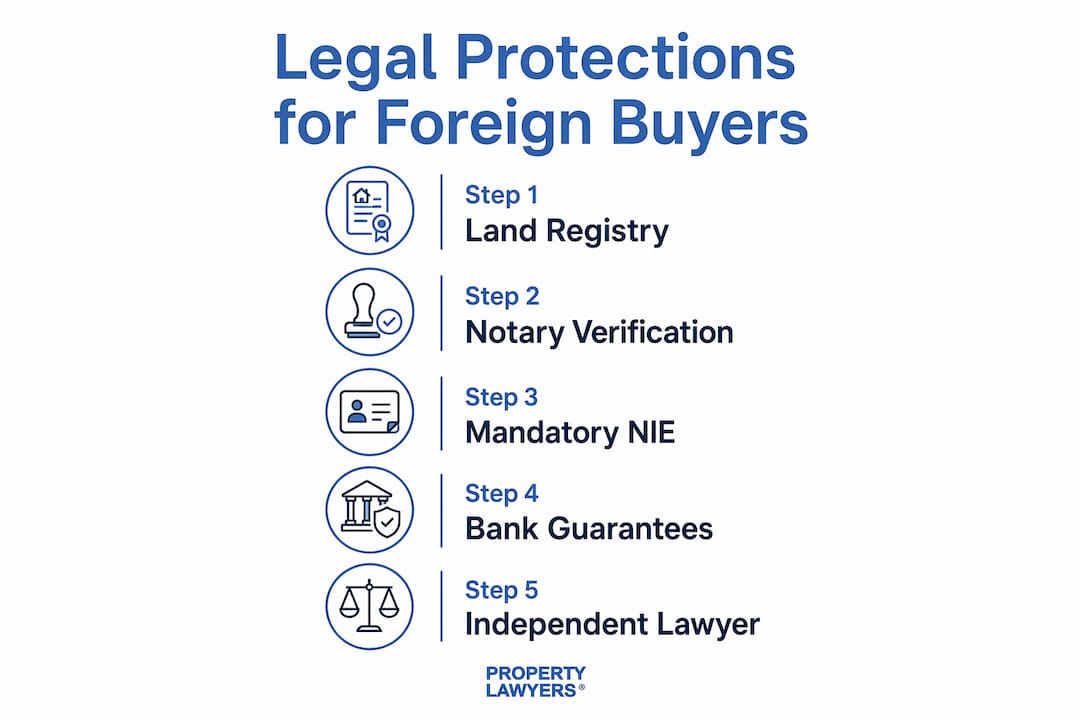
Legal protection for foreign buyers in Spain is anchored in the principle of fe pública registral, a foundational doctrine of Spanish property law that guarantees ownership rights once a purchase is correctly registered in the Land Registry. This protection, codified in Article 34 of the Ley Hipotecaria (Spain’s Mortgage Law), means that a buyer who acquires property in good faith from the registered owner is shielded against any unrecorded claims or hidden disputes. Understanding how foreign buyer protection under Spanish law works in practice requires examining the Land Registry, the notary’s role, mandatory identification requirements, and the due diligence steps that sit firmly in the buyer’s hands.
How does Spanish law protect foreign buyers in property transactions?
Spain’s property protection system for foreign buyers rests on three pillars: the Land Registry, the public notary, and independent legal due diligence. Each plays a distinct role, and confusing them is the most common and costly mistake foreign investors make.

The Land Registry (Registro de la Propiedad) is the definitive public record of property ownership in Spain. Under Article 34 of the Ley Hipotecaria, buyers who purchase in good faith from the registered owner are protected against unrecorded claims, ensuring ownership security. This principle, known as fe pública registral, means the registry’s records are legally authoritative. If a claim or debt does not appear in the registry, it cannot be enforced against a good-faith buyer after registration.
Registration also creates legal effect against third parties. An unregistered purchase leaves the buyer exposed to competing claims from creditors or other parties. Once registered, that risk is extinguished. This is why completing registration promptly after signing the deed is not optional. It is the act that activates your legal protection under Spanish property law.
Key protections conferred by registration include:
- Ownership security against unrecorded third-party claims
- Priority rights over subsequent buyers or creditors who register later
- Legal presumption of ownership, which simplifies future sales or mortgage applications
- Protection against seller fraud, provided the buyer acted in good faith
Pro Tip: Request a Nota Simple from the Land Registry before signing any contract. This document confirms the current registered owner, any mortgages, and any charges or embargoes on the property.
What is the role of the notary in protecting foreign property buyers?
The notary is a neutral public official appointed by the Spanish state. Their role is widely misunderstood by foreign buyers, and that misunderstanding creates real financial risk.
A Spanish notary performs the following functions:
- Verifies the identity of all parties signing the deed
- Confirms tax compliance, including payment of applicable property transfer taxes
- Certifies the legal execution of the deed, making it a public document
- Reads and explains the deed contents to the parties present
What the notary does not do is equally important. Notaries verify identity and legality but do not check property title defects, planning compliance, or debts. They do not advocate for the buyer’s interests. They do not investigate whether the property has outstanding community fees, illegal extensions, or planning violations. That responsibility rests entirely with the buyer’s independent lawyer.
Notary fees are regulated by law, typically ranging from €800 to €1,400 depending on the property price. These fees cover deed formalisation only. They are separate from the cost of private legal due diligence, which you should budget for independently.
There is persistent confusion among foreign buyers about the notary’s neutral role. Many buyers assume that because a notary is present, their interests are protected. They are not. The notary’s duty is to the transaction, not to either party.
Pro Tip: Never attend a notary signing without your own independent lawyer present or having reviewed the deed in advance. A bilingual lawyer can identify contractual risks that the notary has no obligation to flag.
What mandatory legal requirements must foreign buyers comply with in Spain?
Foreign buyers face specific legal obligations before they can complete a property purchase in Spain. Meeting these requirements is not bureaucratic formality. Each one serves a protective function for both buyer and seller.
The core obligations are:
- NIE (Número de Identificación de Extranjero): All foreign buyers must obtain an NIE before completing a purchase. Without it, you cannot sign a deed before a notary, open a Spanish bank account, or pay property taxes. The NIE is your tax identification number in Spain and is required for every legal and financial step in the transaction. Property-lawyers provides a detailed guide on obtaining your NIE to help you prepare before you begin searching for property.
- Spanish bank account: Most property purchases require payment via a Spanish bank cheque drawn on a local account. Opening this account requires your NIE and proof of identity.
- Proof of funds origin: Spanish law requires buyers to prove the legal source of funds under anti-money laundering regulations. Non-EU buyers face stricter scrutiny. You will need to provide bank statements, tax returns, or other documentation demonstrating that purchase funds are legitimately sourced.
- Tax identification for ongoing obligations: Property ownership in Spain creates ongoing tax obligations, including annual non-resident income tax and local property tax (IBI). Your NIE links all of these to your identity.
Preparing these documents before you identify a property saves significant time and prevents delays at the critical contract stage. Your lawyer can advise on the specific documentation required based on your nationality and the source of your funds.
How can foreign buyers mitigate risks through due diligence and legal representation?
Due diligence failures cause most property disputes involving foreign buyers in Spain. Skipping checks on title, planning permissions, or debts is the primary driver of post-purchase conflicts. Comprehensive pre-purchase investigations are the most effective preventative measure available.
A thorough due diligence process covers the following areas:
- Title verification: Confirming the seller is the registered owner and that no competing claims exist
- Debt and charge searches: Identifying any mortgages, embargoes, or unpaid community fees attached to the property
- Planning compliance: Verifying the property has all required licences and that no illegal construction exists
- Urban classification: Confirming the land classification and any development restrictions that affect the property’s use or value
- Utility connections: Checking that water, electricity, and drainage are legally connected and in the buyer’s name post-completion
Legal experts emphasise that signing contracts before completing these checks is the most frequent cause of post-purchase disputes. A reservation contract or deposit paid before due diligence is complete transfers risk to the buyer immediately.
Independent lawyers versus developer or seller lawyers
The distinction between independent legal counsel and a lawyer introduced by the developer or seller is critical. A lawyer acting for the developer has a conflict of interest. Their duty is to their client, not to you. Always appoint a lawyer who acts solely on your behalf and has no commercial relationship with the selling party.
Remote purchases via Power of Attorney
Foreign buyers can appoint a legal representative via a notarised Power of Attorney to manage the entire purchase process without travelling to Spain. This arrangement is common practice for overseas investors and covers due diligence, contract signing, and registration. Property-lawyers provides full guidance on buying remotely via Power of Attorney for buyers who cannot attend in person.
| Approach | Protection level | Key risk |
|---|---|---|
| Independent lawyer appointed by buyer | High | None if lawyer is genuinely independent |
| Lawyer introduced by developer | Low | Conflict of interest; buyer interests secondary |
| No lawyer, notary only | Very low | No due diligence; buyer fully exposed |
| Power of Attorney with independent lawyer | High | Requires careful selection of trusted representative |
How does Spanish law protect foreign buyers in off-plan property purchases?
Off-plan purchases carry specific risks because buyers commit funds before a property exists. Spanish law addresses this directly through mandatory financial guarantees.
The legal framework requires developers to provide a bank guarantee (aval bancario) or insurance policy covering all staged payments made by buyers. This obligation derives from Ley 57/1968 and its successor, Ley 20/2015. The guarantee means that if the developer becomes insolvent or fails to complete the project, the buyer can recover all deposits paid.
Spanish Supreme Court rulings have held banks liable if they allow developers to receive deposits into accounts without valid guarantees in place. This is a significant protection. It means the bank itself can be pursued for refunds, not just the developer.
Strict enforcement of bank guarantees is the defining factor between a secure and a risky off-plan investment. Buyers should verify the following before committing any funds:
- The developer holds a valid building licence before any payment is made
- A bank guarantee or insurance policy is in place and covers each staged payment
- The guarantee is issued in the buyer’s name and is enforceable independently
- The contract specifies a completion date and the consequences of delay
- All payments are made to a dedicated account covered by the guarantee
Property-lawyers has a detailed resource on off-plan property protections that explains how to verify guarantees and what to do if a developer fails to provide them.
Key takeaways
Foreign buyers in Spain are legally protected through the Land Registry’s fe pública registral principle, mandatory NIE requirements, regulated notary involvement, and independent due diligence, with off-plan purchases carrying additional safeguards under Ley 20/2015.
| Point | Details |
|---|---|
| Land Registry protection | Registration under Article 34 of the Ley Hipotecaria shields good-faith buyers from unrecorded claims. |
| Notary limitations | The notary certifies the deed but does not conduct buyer-side due diligence or advocate for your interests. |
| NIE is mandatory | Without an NIE, foreign buyers cannot complete a purchase, pay taxes, or open a Spanish bank account. |
| Due diligence prevents disputes | Skipping title, debt, and planning checks is the primary cause of property disputes for foreign buyers. |
| Off-plan guarantees are enforceable | Bank guarantees under Ley 20/2015 protect staged payments, and Spanish courts hold banks directly liable. |
Why the notary myth costs foreign buyers more than they realise
I have seen the same misunderstanding repeat itself across hundreds of transactions. A buyer arrives at the notary’s office believing they are protected because a public official is overseeing the process. They sign. They pay. And then, weeks or months later, they discover an unpaid community debt, an illegal extension, or a planning violation that the notary had no obligation to flag.
The Spanish legal system is genuinely well-designed for property buyers. The Land Registry protection is strong. The off-plan guarantee framework, when enforced, is among the most buyer-friendly in Europe. But the system assumes you have done your homework before you arrive at the notary’s desk. It does not do that homework for you.
What I find most reassuring about foreign investments in Spain, compared to several other European markets, is the clarity of the Land Registry’s legal effect. Once you are registered, your ownership is robust. The problem is almost always what happens before registration, specifically the due diligence gap between signing a private contract and completing the deed.
My practical advice: appoint your lawyer before you find your property, not after. A good independent lawyer will review the Nota Simple, check for planning compliance, and advise on the contract terms before you commit a single euro. That sequence protects you. Reversing it does not.
How Property-lawyers connects you with trusted legal experts in Spain

Property-lawyers is a directory connecting international buyers with independent, English-speaking real estate lawyers across the country. Whether you are purchasing a resale apartment in Madrid, a villa on the Costa del Sol, or an off-plan development in Valencia, the right legal representation makes the difference between a secure investment and a costly dispute.
Every lawyer in the Property-lawyers network specialises in Spanish property law and works exclusively for buyers, with no commercial ties to developers or sellers. From NIE applications and due diligence to Power of Attorney arrangements and registration, our lawyers manage the entire process on your behalf. Find your specialist property lawyer in Spain and protect your investment from the outset.
FAQ
What is fe pública registral and why does it matter?
Fe pública registral is the legal principle under Article 34 of Spain’s Ley Hipotecaria that protects good-faith buyers who register their purchase in the Land Registry. It means unrecorded claims cannot be enforced against you once registration is complete.
Does the notary protect foreign buyers in Spain?
The notary certifies the deed and verifies identities but does not conduct due diligence or act in the buyer’s interests. Foreign buyers must appoint an independent lawyer to carry out property checks and protect their position.
Is an NIE required to buy property in Spain as a foreigner?
Yes. All foreign buyers must obtain an NIE before completing a property purchase in Spain. Without it, you cannot sign a deed, pay property taxes, or open a Spanish bank account.
What happens if an off-plan developer goes bankrupt in Spain?
Under Ley 20/2015, developers must provide a bank guarantee covering all staged payments. If the developer fails, buyers can claim a full refund directly from the guaranteeing bank, which Spanish courts have held liable in these cases.
Can I buy property in Spain without travelling there?
Yes. A notarised Power of Attorney allows a legal representative to manage the entire purchase on your behalf, including due diligence, contract signing, and registration, without you needing to be present in Spain.
Recommended
- Spanish off-plan property law explained for buyers
- Property law in Spain: a 2026 guide for buyers
- Spanish real estate law: a buyer’s guide for 2026
- Benefits of property law specialisation in Spain

Sophie Gutenberg is a legal content specialist focused on Spanish property law, real estate transactions, conveyancing, due diligence and tax issues affecting international property buyers in Spain. She works alongside qualified Spanish property lawyers .
