

Spanish land registry search: a guide for international buyers
TL;DR:
- The Spanish property register is the official record of ownership and charges affecting real estate in Spain.
- International buyers should request a Nota Simple for initial due diligence and a certified extract before completing a purchase.
The Registro de la Propiedad is Spain’s official public land register, and the quickest way to check who owns a property is to order a Nota Simple from the Sede Registradores portal. This single document shows the current registered owner, the property’s physical description, and any mortgages or legal charges recorded against it. For UK and international buyers purchasing in Marbella, Mallorca, Ibiza, Málaga, or Barcelona, understanding the Spanish land registry search process is the single most important step in due diligence before paying any deposit.
Here is what you need to do immediately:
- Order a Nota Simple from sede.registradores.org using the property’s IDUFIR/CRU code, registry coordinates, or owner name.
- Ask the seller or agent for the IDUFIR (the unique property identifier) before signing anything.
- Have an independent English-speaking property lawyer review the extract for cargas (charges) and anotaciones (annotations).
- If you are close to completion, request a certified extract rather than a Nota Simple.
Property-lawyers connects international buyers with vetted, English-speaking property lawyers across Spain who handle these checks every day.
Table of Contents
- What does the Registro de la Propiedad actually record?
- Nota Simple, certified extracts, and the escritura pública: which do you need?
- How do you search the Spanish land registry?
- How to request a Nota Simple: costs, steps, and timescales
- How to read a Nota Simple: key sections and red flags
- What the Registry does not show — and why that matters
- How a property lawyer helps with registry checks
- Key takeaways
- What UK buyers often get wrong about the Spanish registry
- Property-lawyers: find a vetted English-speaking lawyer in Spain
- Useful sources and official portals
- FAQ
What does the Registro de la Propiedad actually record?
The Registro de la Propiedad is a state institution supervised by Spain’s Ministerio de Justicia. Its core function is to record and publish legal ownership of property and any rights or burdens attached to it. The governing legal principle is fe pública registral (public registry faith): rights that are properly registered are legally protected, and rights that are not registered generally cannot be enforced against a new buyer.
The Registry holds four main categories of information:
- Titularidad (ownership): who owns the property, in what proportion, and under what legal title (sole ownership, joint ownership, usufruct, etc.).
- Descripción física (physical description): the property’s boundaries, surface area, location, and cadastral reference number.
- Cargas (charges): mortgages, easements, court embargos, and other encumbrances registered against the title.
- Anotaciones preventivas (preventive annotations): provisional entries such as pending litigation, inheritance proceedings, or court orders that could affect ownership.
The Colegio de Registradores (the professional body for Spanish registrars) supervises the day-to-day operation of individual registry offices. Spain is divided into mortgage districts, each with its own local Land Registry office. You can learn more about the role of the registrador de la propiedad and what encumbrances they record on the Property-lawyers site.

Nota Simple, certified extracts, and the escritura pública: which do you need?
Buyers typically encounter three documents during a Spanish property purchase. They are not interchangeable.
| Document | What it is | Legal weight | When to use it |
|---|---|---|---|
| Nota Simple | Informational extract from the Registry | Informational only — not legal proof | Initial due diligence, checking ownership and cargas before making an offer |
| Certificación registral (certified extract) | Official certified copy issued by the registrar | Full legal evidential weight | Required by banks for mortgages, by notaries at completion, and before final payment |
| Escritura pública (notarial deed) | The signed deed of sale or mortgage executed before a notary | Constitutes the legal transfer of title | Signed at completion; must be submitted to the Registry for inscription |
A Nota Simple is the right starting point for most buyers. It is available online within hours and costs €9.02 plus VAT. The critical caveat: it is purely informational and only reflects the Registry’s status at the exact moment it was issued. New cargas or embargos can be registered the following day, so a Nota Simple obtained weeks before completion may already be out of date.
A certified extract carries full legal evidential weight and is what your bank or notary will insist upon at the mortgage or completion stage. It costs €30.01 plus VAT per property when requested in person, and must be obtained by written request to the relevant registry office. Your lawyer can handle this on your behalf.
The escritura pública is the deed itself. It does not come from the Registry; it is prepared by a notary and then submitted to the Registry for inscription after completion.
How do you search the Spanish land registry?
A registry search is national, but the legal interpretation of planning, licences and local charges depends on where the property sits. For local support, see specialists in Mallorca, Marbella, Madrid, Barcelona and Ibiza.
There are four practical methods. The one you use depends on what information you already have.

Method 1: Search by IDUFIR or CRU (most reliable)
The IDUFIR (Identificador Único de Finca Registral) or its newer equivalent, the CRU (Código Registral Único), is a unique numeric code assigned to each registered property in Spain. It is the most reliable search identifier because it pinpoints one specific property with no ambiguity.
- Ask the seller or their agent for the IDUFIR/CRU before paying any deposit.
- Go to sede.registradores.org.
- Select “Land Registry Excerpt” and enter the CRU/IDUFIR in the search field.
- Pay the fee (approximately €9.02 plus VAT) by credit card.
- Receive the Nota Simple, usually within a few hours.
Pro Tip: If the seller cannot or will not provide the IDUFIR, that is itself a warning sign. Ask your lawyer to obtain it directly from the registry using the property address or the seller’s NIE.
Method 2: Search by datos registrales (registry coordinates)
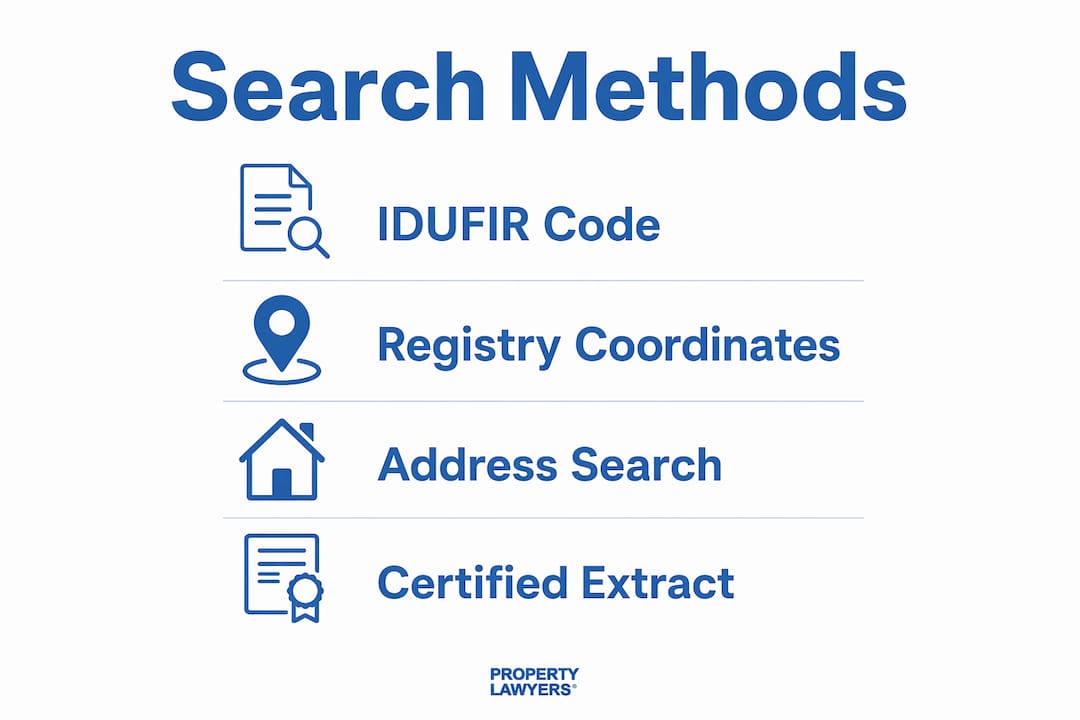
Older properties, particularly rural fincas in areas like inland Málaga or parts of Mallorca, may not yet have an IDUFIR assigned. In these cases, you can search using the traditional registry coordinates: tomo (volume), libro (book), folio (page), and finca (property number), together with the province, municipality, and registry office.
These details appear on the seller’s existing Nota Simple or escritura. Give them to your lawyer or enter them directly on the Sede Registradores portal under “Registration data.”
Method 3: Search by owner name and DNI/NIE
You can request a location excerpt by entering the owner’s full legal name and their Spanish identification number (DNI for Spanish nationals, NIE for foreigners). This search returns all properties registered in that person’s name within the territory you specify.
- Useful when you have the seller’s identity but no registry coordinates.
- Narrow the search by selecting the relevant province or registry office.
- Note that this search covers all registered rights in the owner’s favour, not just full ownership.
Method 4: Search by address or cadastral reference
If you only have the property address, start with the Sede Catastro to find the cadastral reference number. The Catastro is a fiscal mapping database maintained by the Ministry of Finance; it records physical property data for tax purposes but is not a substitute for a legal title check. Once you have the cadastral reference, you can use it on the Sede Registradores portal or give it to your lawyer to locate the correct registry entry.
For properties where the address is unclear or the registry office is unknown, the Registradores geoportal provides an interactive map to locate the correct local registry office by drawing a boundary around the property on screen.
How to request a Nota Simple: costs, steps, and timescales
Where to order
- Online via Sede Registradores (sede.registradores.org): the official portal, available 24 hours a day. Pay by credit card; no subscription required.
- In person at the local registry office: useful when you need to speak to a registrar or when a search requires additional clarification.
- Via the official translation service (buyingahouse.registradores.org): the Colegio de Registradores offers an English-language extract and translation service specifically for international buyers. The extract is issued in Spanish and then translated by the Colegio’s own team.
- Third-party services: commercial providers offer the same PDF with added translation or formatting, typically at a higher price. Always verify you are using an authorised channel.
Costs
A Nota Simple ordered online via the official Sede Registradores portal costs €9.02 plus VAT per property. The official English translation service from the Colegio de Registradores costs an additional €30 plus VAT. A certified extract (certificación registral) costs €30.01 plus VAT when requested in person. Private providers charge mark-ups on top of these official fees.
Turnaround
A Nota Simple ordered online is typically available quickly. A certified extract requires a written request and is processed by the registrar; turnaround times can vary depending on complexity and completeness of data. If you are using the translation service, allow additional time for the translation to be completed after the extract is issued.
What you will need to place a request
- IDUFIR/CRU (preferred), or
- Registry coordinates (province, municipality, registry office, property number), or
- Owner’s full name and DNI/NIE, or
- Property address and cadastral reference
How to read a Nota Simple: key sections and red flags
A Nota Simple is structured in four main parts. Here is what each one tells you.
Identification data: The opening section names the registry office, the property’s finca number, tomo, libro, folio, and the IDUFIR/CRU. Cross-check the finca number and IDUFIR against any documents the seller has provided. A mismatch here means you may be looking at the wrong property entirely.
Titularidad (ownership): This section names the registered owner or owners, their identification numbers, the percentage share each holds, and the nature of their title. Check that the person selling to you is actually listed here. If the seller is not the registered owner, or if there are multiple owners without a power of attorney authorising one to sell, stop and take legal advice before proceeding.
Cargas (charges and encumbrances): This is the section most buyers focus on. It lists mortgages, court embargos, easements, usufruct rights, and any other registered burdens. A mortgage listed here must be discharged before or at completion; it does not disappear automatically when you buy. An embargo (court order freezing the property) is a serious red flag that requires immediate legal review.
Anotaciones preventivas (preventive annotations): These are provisional entries that signal pending legal proceedings. Common examples include inheritance disputes, compulsory purchase proceedings, or court orders. They do not necessarily block a sale, but they must be understood and resolved before you complete.
Common red flags to watch for:
- Seller not listed as the registered owner.
- A mortgage that the seller claims is already paid but has not been formally cancelled in the Registry.
- One or more court embargos against the property.
- Multiple co-owners with no power of attorney authorising the sale.
- A significant discrepancy between the registered surface area and the Catastro figure (common in rural properties and older apartments).
- Anotaciones preventivas relating to litigation or fiscal debt.
Pro Tip: Request a freshly issued Nota Simple within 48 hours of signing a reservation contract or private purchase agreement. The Registry’s status can change daily, and an extract that is even a few weeks old may not reflect new charges.
Cross-check the registered surface area against the Catastro figure at sedecatastro.gob.es. Discrepancies in area or permitted use are common and must be reconciled before completion. You can read more about property law in Spain and how these checks fit into the broader purchase process on the Property-lawyers site.
What the Registry does not show — and why that matters
The Registro de la Propiedad is authoritative for what it records, but it does not capture everything that could affect your purchase.
The Registry’s gaps include:
- Unregistered private agreements: a private rental contract or informal right of way agreed between neighbours may not appear in the Registry but could still be enforceable.
- Planning and urban irregularities: illegal extensions, unlicensed pools, or properties built without planning permission are not recorded by the Registry. These require separate checks with the local ayuntamiento (town hall) and planning department.
- Fiscal debts: outstanding community fees, local property taxes (IBI), or utility debts do not appear in the Registry unless a formal embargo has been registered.
- Off-registry easements: some traditional rights of way or water rights in rural areas may exist under local custom without ever having been registered.
When should you insist on a certified extract rather than a Nota Simple? At any point where money is changing hands in significant amounts: before paying a substantial deposit, before mortgage completion, and certainly before the notarial signing. Your lawyer should obtain a certified extract as close to the completion date as possible.
Independent legal review is not optional for international buyers. While a Nota Simple is straightforward to obtain, interpreting cargas, annotations, and provenance clauses correctly requires a specialist. Inheriting a hidden liability because a charge was misread or overlooked is a risk no buyer should take. See the Land Registry Spain guide on the Property-lawyers site for a fuller explanation of how the Registry protects buyers.
This article provides general information only and is not legal advice. Always confirm the current legal position with a qualified Spanish property lawyer for your specific situation.
How a property lawyer helps with registry checks
An English-speaking property lawyer does far more than translate documents. Here is what a specialist handles on your behalf during a registry-focused due diligence:
- Obtaining up-to-date extracts: your lawyer requests a certified extract directly from the registry office, ensuring it is current and legally valid.
- Interpreting cargas and anotaciones: a specialist identifies which charges must be discharged before completion and which annotations require further investigation.
- Verifying seller identity and powers of attorney: if the seller is acting under a power of attorney, your lawyer confirms it is valid, current, and covers the sale.
- Checking tax clearances: outstanding IBI (local property tax) and community fee debts are confirmed and cleared.
- Representing you at the notary: your lawyer attends the notarial signing, reviews the escritura before you sign, and handles fund transfers.
- Post-completion inscription: after signing, the deed must be submitted to the Registry for inscription. Your lawyer manages this process and confirms the title is registered in your name.
Questions to ask when choosing a property lawyer in Spain:
- Do you have experience with properties in this specific municipality or region (e.g. Marbella, Mallorca, Ibiza)?
- What are your fees for a full registry search and conveyancing, and what is included?
- How do you approach registry searches — do you obtain a certified extract before completion?
- What is your typical turnaround for due diligence once instructed?
- Do you communicate in English throughout, including written reports?
- Can you provide references from previous international clients?
Property-lawyers maintains a vetted network of independent, English-speaking property lawyers across Spain, with region filters covering Mallorca, Ibiza, Marbella, Málaga, Barcelona, and beyond. You can browse profiles and request an introduction through the lawyer finder. For a practical overview of what an abogado does at each stage of a purchase, the role of an abogado guide is a useful starting point.
Key takeaways
The Registro de la Propiedad is Spain’s definitive legal record of ownership, and a Nota Simple ordered from Sede Registradores is the fastest way to verify who owns a property and what charges are registered against it.
| Point | Details |
|---|---|
| Order a Nota Simple first | Use sede.registradores.org — costs €9.02 plus VAT and is usually available within hours. |
| IDUFIR/CRU is the best search tool | Ask the seller for this unique code before paying any deposit; it eliminates ambiguity in the search. |
| Nota Simple is time-sensitive | It reflects the Registry only at the moment of issue; request a fresh one within 48 hours of any contract signing. |
| Certified extract before final payment | A certificación registral (€30.01 plus VAT in person) carries full legal weight and is required by banks and notaries. |
| Use Property-lawyers for legal referrals | Property-lawyers connects you with vetted, English-speaking property lawyers across Spain for registry checks and full conveyancing. |
What UK buyers often get wrong about the Spanish registry
The most common mistake UK buyers make is treating the Nota Simple as a final clearance document rather than a starting point. They receive it, see no mortgage listed, and assume the property is clean. What they miss is that an annotation entered the following morning, or a private agreement that was never registered, can still create serious problems after completion.
There is also a persistent confusion between the Catastro and the Registro. The Catastro is a fiscal tool; it tells you the tax value and physical dimensions of a property for municipal purposes. The Registro is the legal record. In Mallorca and rural Málaga particularly, discrepancies between the two are common, especially for older properties where boundaries were never formally updated. A property might show 180 square metres in the Catastro and 150 in the Registry. That gap needs to be explained and, where necessary, corrected before you buy.
In Barcelona, buyers sometimes encounter properties with multiple co-owners from inheritance situations, where not all heirs have formally accepted or renounced their share. The Registry may show the deceased original owner alongside a note about pending inheritance proceedings. This is resolvable, but it requires a lawyer who knows the local registry office and the relevant inheritance procedure.
The practical behaviours that protect you are simple: always insist on a fresh certified extract before signing the final deed, never pay a substantial deposit without written confirmation that all registered cargas are discharged or will be discharged at completion, and verify the seller’s identity and authority to sell before any money moves.
Property-lawyers: find a vetted English-speaking lawyer in Spain
Ordering a Nota Simple is straightforward. Knowing what to do when it shows an embargo, an unresolved mortgage, or a discrepancy with the Catastro is a different matter entirely.
Property-lawyers connects international buyers with independent, English-speaking property lawyers across Spain. Whether you are buying in Marbella, Mallorca, Ibiza, Málaga, or Barcelona, the directory lets you filter by region, review lawyer profiles, and request an initial consultation. Every lawyer in the network is vetted and experienced in working with UK and international clients.
The next step is simple: visit the Spanish property purchase guide to understand the full buying process, then use the buyer’s legal guide to find a lawyer who covers your area. If you are ready to speak to someone now, submit a brief property query through the directory and a matched lawyer will be in touch.
Useful sources and official portals
- Sede Registradores: the official portal for ordering Nota Simple extracts and certified extracts online; also hosts the English-language translation service for international buyers.
- Sede Catastro: the Spanish cadastre for locating cadastral references, property maps, and physical descriptions; useful for cross-checking Registry data.
- Ministerio de Justicia — Registro de la Propiedad: official government page explaining the Registry’s legal framework and procedural rules.
- Registradores Geoportal: interactive map for locating the correct local registry office when you have an address but no registry coordinates.
- European e-Justice Portal — Spain Land Register: authoritative EU-level overview of the Spanish Land Registry, including fees and access procedures.
- Property-lawyers: Nota Simple guide: plain-English explanation of what a Nota Simple shows and how to use it during due diligence.
- Property-lawyers: Land Registry Spain guide: detailed client resource on the Registry’s importance and how to secure clean title.
- Ben Cook Real Estate: buying a house in Spain: practical, regionally focused buying guide for UK and international buyers, covering market steps alongside legal requirements.
FAQ
Does Spain have an official land registry?
Yes. The Registro de la Propiedad is Spain’s official public land register, supervised by the Ministerio de Justicia. It records ownership, mortgages, easements, court embargos, and other rights affecting registered properties across the country.
How do you search the Spanish land registry?
You can search via the Sede Registradores portal using the property’s IDUFIR/CRU code, registry coordinates (tomo, libro, folio, finca), the owner’s name and DNI/NIE, or a property address combined with a cadastral reference from the Catastro.
How do you find out who owns a property in Spain?
Order a Nota Simple from sede.registradores.org — it costs €9.02 plus VAT and names the registered owner, their identification number, and the nature of their title. A certified extract provides the same information with full legal evidential weight.
How do you read a Spanish land registry extract?
A Nota Simple has four sections: identification data (registry office, finca number, IDUFIR), titularidad (owner name and share), cargas (mortgages and charges), and anotaciones preventivas (provisional legal entries). Check that the seller matches the registered owner and that all cargas are either cleared or will be discharged at completion.
When do you need a certified extract rather than a Nota Simple?
A certified extract (certificación registral) is required by banks for mortgage approval and by notaries at completion. It costs €30.01 plus VAT in person and carries full legal evidential weight. Always obtain one, through your lawyer, as close to the completion date as possible.
Recommended
- Land Registry Spain — Registro de la Propiedad Guide for Buyers | Property Lawyers
- Property law in Spain: a 2026 guide for buyers
- Spanish real estate law: a buyer’s guide for 2026
- Spanish property purchase process: a guide for buyers

Sophie Gutenberg is a legal content specialist focused on Spanish property law, real estate transactions, conveyancing, due diligence and tax issues affecting international property buyers in Spain. She works alongside qualified Spanish property lawyers .
