

Role of registrador de la propiedad in Spain
TL;DR:
- The registrador de la propiedad in Spain is responsible for legally qualifying, recording, and guaranteeing property ownership and encumbrances.
- Registration is voluntary but highly recommended to protect against third-party claims, and the registrar must qualify deeds within 15 working days.
The registrador de la propiedad in Spain is a public official responsible for legally qualifying, recording, and guaranteeing real estate ownership and encumbrances through the Registro de la Propiedad (Land Registry). The role of registrador propiedad Spain sits at the heart of every property transaction, acting as a legal gatekeeper who certifies that deeds comply with Spanish law before they enter the public record. The General Directorate of Legal Security and Public Faith (DGSJFP) oversees the entire registry system, setting the interpretive standards that every registrar must follow. For international buyers, understanding this role is not optional. It is the foundation of safe property ownership in Spain.
What duties does the registrador perform in real estate transactions?
The registrador’s primary duty is to review and legally qualify every property deed submitted for registration. This qualification process is not a rubber stamp. The registrar examines whether the deed complies with Spanish civil law, whether the parties have legal capacity, and whether the transaction is free from prior encumbrances or conflicting claims.

The qualification process follows a strict statutory timetable. Once a deed is presented, the registrar has 15 working days to qualify and register it. If defects are found, a qualification note is issued, temporarily suspending registration until the issues are resolved. That 15-day window is a legal obligation, not a guideline.
The core functions of the registrador include:
- Legal qualification of deeds. The registrar checks that every submitted deed meets the formal and substantive requirements of Spanish property law.
- Registration of transactions. Once qualified, the deed is entered into the Registro de la Propiedad, creating a public, legally binding record of ownership.
- Maintaining the public registry. The registrar keeps the registry accurate and up to date, recording mortgages, liens, easements, and other encumbrances.
- Issuing the nota simple. The registrar’s office produces the nota simple, a document summarising ownership and charges that any buyer or lender can request before a transaction.
- Preventing double sales. By recording each transaction, the registrar ensures the same property cannot be sold twice to different buyers without detection.
Registration is voluntary under Spanish law, but strongly recommended for legal protection against third-party claims and hidden charges. An unregistered owner has no public protection against a subsequent buyer who registers in good faith.
Pro Tip: Request a nota simple before signing any purchase contract. It reveals the registered owner, any mortgages, and all encumbrances on the property in a single document.
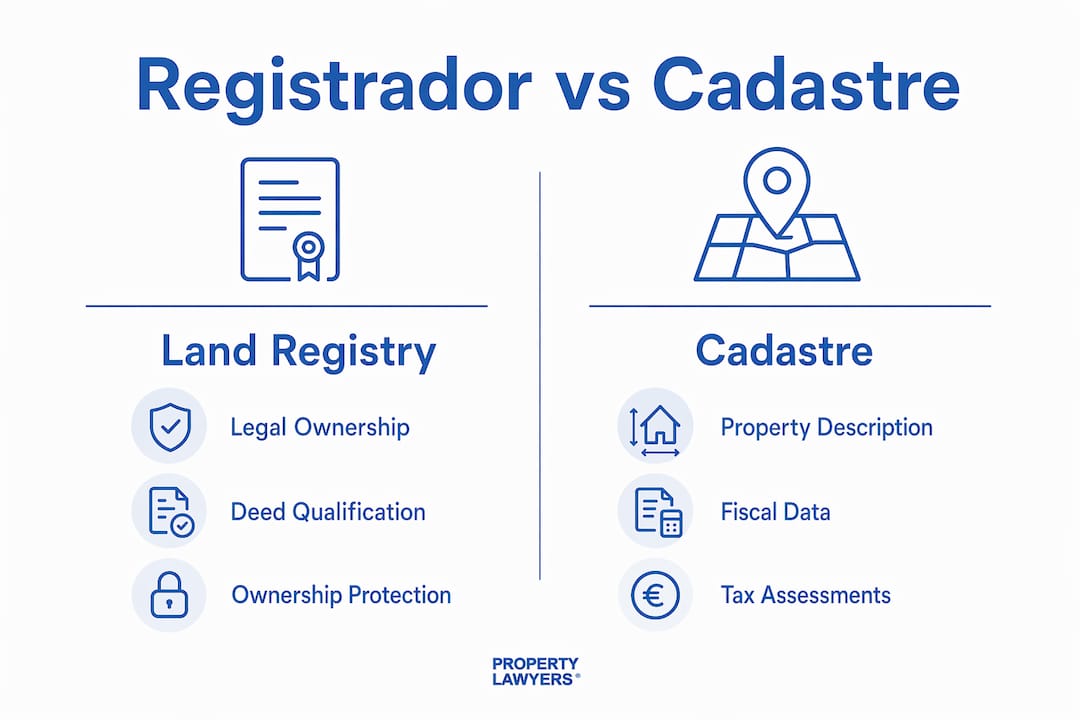
How does the registrador’s role differ from the Cadastre?
The registrador and the Cadastre serve entirely different purposes, and confusing them is one of the most common mistakes international buyers make. The registrar certifies legal ownership. The Cadastre records the physical description and fiscal value of a property for tax purposes.
The legal supremacy of the Land Registry over the Cadastre is clear in Spanish law. When ownership is disputed, the registered public deed in the Registro de la Propiedad prevails over any Cadastre record. The Cadastre cannot confirm who legally owns a property. Only the Land Registry can do that.
| Feature | Land Registry (Registrador) | Cadastre |
|---|---|---|
| Primary purpose | Legal ownership certification | Physical and fiscal identification |
| Legal authority | Prevails in ownership disputes | Advisory in ownership conflicts |
| Managed by | Registrador de la propiedad | Spanish Tax Agency (AEAT) |
| Key document | Nota simple | Certificado catastral |
| Buyer relevance | Confirms legal title and charges | Confirms physical boundaries and tax value |
The registrador acts as gatekeeper of ownership legitimacy, while the Cadastre is mostly fiscal and descriptive. A property can appear in the Cadastre without being registered in the Land Registry, leaving the owner legally exposed. Buyers who rely solely on Cadastre records to verify ownership take a significant legal risk.
What legal limits does the registrador have, and how can decisions be challenged?
The registrador’s qualification authority is broad but not unlimited. Spanish law defines clear boundaries on what a registrar can and cannot refuse to register. A 2026 DGSJFP resolution confirmed that registrars cannot arbitrarily block the registration of final judicial rulings or valid deeds. That resolution has practical force: it means a registrar who refuses a court-ordered registration without legal justification can be overruled on appeal.
When a registrar finds a problem with a deed, they issue a negative qualification note. Common causes include:
- Incomplete documentation, such as missing tax payment certificates or absent identity documents.
- Technical non-compliance with deed formalities required by Spanish notarial law.
- Conflicts with existing registered rights, such as a prior mortgage or an unresolved embargo.
- Errors in the property description that do not match the existing registry entry.
A negative qualification does not mean the transaction is permanently blocked. It means the documentation needs correction or clarification. Legal intervention at this stage is frequently decisive.
If you believe a refusal is unjust, the appeal route is clear. The DGSJFP resolves appeals against negative qualifications and sets nationwide interpretive criteria that all registrars must apply. An appeal to the DGSJFP often results in the refusal being overturned and registration being ordered.
Pro Tip: If you receive a negative qualification note, do not attempt to resolve it without legal advice. An experienced property lawyer can identify whether the registrar’s objection is valid or challengeable, saving you weeks of delay.
Why is timely registration crucial despite its voluntary legal status?
Registration is technically voluntary under Spanish law, but the practical consequences of delay can be severe. The first-in-time principle governs priority in the Land Registry. The first deed presented for registration takes precedence over any later claim to the same property. A buyer who delays registration after signing a notarial deed leaves a window open for a competing claim.
The risks of delayed registration are concrete:
- Loss of priority. If another deed for the same property is submitted before yours, that party gains registered priority regardless of who signed first.
- Exposure to double sales. An unscrupulous seller could attempt to sell the same property twice. Only the registered buyer is protected.
- Inability to mortgage. Banks require a registered title before granting a mortgage. An unregistered property cannot be used as security.
- Complications in future sales. An unregistered title creates legal uncertainty that will surface in any subsequent transaction, causing delays and additional costs.
Buyers also face a 30 working day deadline to settle applicable taxes after signing a deed. Tax payment is a prerequisite for registration. Missing this deadline creates a tax penalty and further delays the registration process. The two deadlines, tax payment and registration, are linked in practice even though the law treats them separately.
Registration also protects against unrecorded liens and hidden encumbrances that could otherwise bind a new owner. A registered buyer benefits from the public faith principle: the registry is presumed accurate, and a good-faith registered buyer is protected even if the seller’s title later proves defective.
How can buyers best navigate interactions with the registrador?
The most useful first step for any buyer is obtaining a nota simple before committing to a purchase. The nota simple is a public document that summarises the registered owner, the property description, and all recorded charges. It is available online through the Spanish Association of Registrars portal or in person at the relevant registry office, and is accessible in multiple languages.
Understanding what happens after a deed is submitted helps buyers manage expectations. The registrar has 15 working days to qualify the deed. During that period, three outcomes are possible:
- Registration confirmed. The deed is entered into the registry without objection.
- Qualification note issued. Registration is suspended pending correction of identified defects.
- Registration refused. The registrar issues a formal refusal, which can be appealed to the DGSJFP.
Most buyers encounter the second outcome at some point. A qualification note is not a crisis. It is a formal legal communication that requires a specific response, usually the submission of additional documents or a corrected deed.
Independent legal advice is the most reliable way to avoid registration problems before they arise. A specialist property lawyer reviews the deed before submission, identifies potential qualification issues, and liaises directly with the registrar’s office. The benefits of specialist legal support in Spain are well established for international buyers who are unfamiliar with local registry procedures.
Pro Tip: Always instruct your lawyer to check the registry entry against the Cadastre record before signing. Discrepancies in property descriptions between the two systems are common and must be resolved before registration.
Key takeaways
The registrador de la propiedad is Spain’s legal gatekeeper for property ownership, and registering your deed promptly with the Registro de la Propiedad is the single most effective step you can take to protect your investment.
| Point | Details |
|---|---|
| Registrador’s core role | The registrar legally qualifies deeds and maintains the public ownership record in Spain. |
| 15-day qualification window | The registrar must qualify and register a deed within 15 working days of submission. |
| Registry beats Cadastre | In ownership disputes, the Land Registry always prevails over Cadastre records. |
| Timely registration matters | Delaying registration risks losing priority to a competing claim under the first-in-time rule. |
| Appeals are available | Unjust refusals can be challenged via the DGSJFP, which frequently overturns negative qualifications. |
Why the registrador’s role matters more than most buyers realise
Having worked with international buyers navigating Spanish property transactions for many years, I have seen the same mistake repeated: buyers treat registration as an administrative formality rather than a legal priority. They sign the notarial deed, feel the transaction is complete, and then delay instructing anyone to handle the registry submission.
The registrador’s qualification process is genuinely rigorous. A negative qualification note is not unusual, and it is not a sign that something has gone badly wrong. What matters is how quickly and competently it is addressed. I have seen straightforward qualification issues drag on for months simply because the buyer tried to resolve them without legal support, submitting incorrect documentation repeatedly.
The appeal route via the DGSJFP is underused. Many buyers accept a registrar’s refusal as final when it is not. The DGSJFP exists precisely to correct unjust or inconsistent qualification decisions, and its resolutions carry authority across all registrars in Spain. Knowing this route exists changes the dynamic considerably.
My strongest advice is to treat registration as part of the transaction itself, not as an afterthought. Instruct a lawyer before you sign, not after a problem appears. The cost of professional support at the registration stage is a fraction of the cost of resolving a disputed title or a lost priority claim later.
— Sophie
How Property-lawyers can help with registration in Spain
Navigating the registrador’s qualification process is straightforward with the right legal support. Property-lawyers connects international buyers with independent, English-speaking property lawyers across Spain who handle deed submission, qualification notes, and DGSJFP appeals as a matter of routine.

Whether you are buying a resale apartment in Madrid, a new-build villa on the Costa del Sol, or a rural property in Andalucía, the registration process carries the same legal weight. A specialist lawyer from the Property-lawyers directory will review your deed before submission, manage the 15-day qualification period, and resolve any issues with the registrar directly. Protecting your title from day one is the clearest way to secure your investment in Spain.
FAQ
What is a registrador de la propiedad in Spain?
A registrador de la propiedad is a public official who legally qualifies and registers property deeds in the Registro de la Propiedad. The role certifies ownership and records all encumbrances, providing legal certainty for buyers and lenders.
Is property registration compulsory in Spain?
Registration is voluntary under Spanish law, but it is effectively necessary for legal protection. An unregistered owner has no defence against a subsequent buyer who registers in good faith, and banks require registration before granting a mortgage.
What is a nota simple and how do I get one?
A nota simple is a public document summarising the registered owner, property description, and all recorded charges. It is available online through the Spanish Association of Registrars portal or in person at the local Land Registry office.
What happens if the registrador refuses to register my deed?
The registrar issues a negative qualification note explaining the grounds for refusal. You can correct the identified defects and resubmit, or appeal the decision to the DGSJFP, which has authority to overturn unjust refusals.
How long does the registration process take in Spain?
The registrar has 15 working days from the date of deed submission to qualify and register it. If a qualification note is issued, the timeline extends until the defects are resolved and the corrected documentation is resubmitted.
Recommended

Sophie Gutenberg is a legal content specialist focused on Spanish property law, real estate transactions, conveyancing, due diligence and tax issues affecting international property buyers in Spain. She works alongside qualified Spanish property lawyers .
