

Role of an abogado in Spanish property transactions
TL;DR:
- An abogado is an independent legal adviser who conducts due diligence, negotiates contracts, and protects the buyer throughout Spanish property transactions. Their role is essential before signing the reservation or arras contract to prevent legal risks and ensure proper protections are in place. Independent abogados offer unbiased advice, unlike notaries or estate agents, and continue to assist with post-completion issues.
An abogado is defined as the buyer’s independent legal adviser in a Spanish property transaction, responsible for due diligence, contract negotiation, and legal risk management throughout the purchase process. This role is distinct from the notary, who authenticates the deed as a neutral public official, and from the estate agent, who acts in a commercial capacity. For international buyers purchasing property in Spain, the role of abogado in a property transaction in Spain is the single most important legal safeguard available. Understanding what this role covers, and what it does not, is the foundation of a secure purchase.
What does an abogado do that a notary or estate agent cannot?
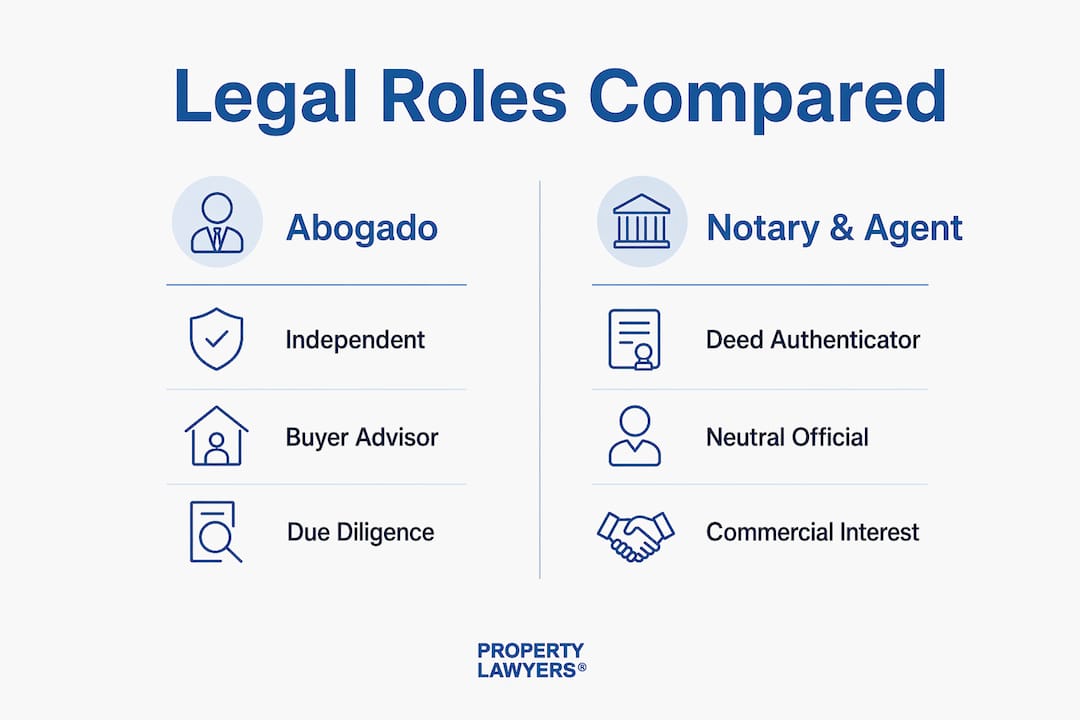
The notary is a neutral public official who authenticates the deed but does not act as the buyer’s legal adviser or conduct buyer-side due diligence. The notary verifies that the formalities of the escritura are correct and that both parties have signed. That is the full extent of the notary’s obligation to you as a buyer.

The estate agent, meanwhile, facilitates the sale with a commercial interest in completing the transaction. Agents do not conduct legal checks, review title history, or advise on contract risk. Relying on an estate agent for legal protection is one of the most common and costly mistakes international buyers make in Spain.
The abogado fills the gap that both roles leave open. A Spanish property lawyer works exclusively for the buyer, conducting title searches, reviewing planning permissions, checking for embargoes and outstanding debts, and negotiating contract terms before any funds are committed. The notary process only certifies what has already been agreed. The abogado’s work determines whether what has been agreed is legally sound.
The table below clarifies the distinct responsibilities of each party:
| Role | Represents | Legal advice | Due diligence | Contract negotiation |
|---|---|---|---|---|
| Abogado | Buyer exclusively | Yes | Yes | Yes |
| Notary | Neither party | No | No | No |
| Estate agent | Seller/commercial interest | No | No | No |
Pro Tip: Always confirm in writing that your abogado is independent of the estate agent and the seller before signing any engagement letter. This single step eliminates the most common source of conflicts of interest in Spanish property transactions.
How does an abogado manage due diligence and contract risk?
A Spanish buyer’s lawyer runs due diligence and manages contract risk, acting exclusively for the buyer and ensuring all legal checks are completed before committing funds. This is not a formality. It is the mechanism by which hidden liabilities, illegal extensions, and disputed ownership are identified before they become your problem.
The due diligence process coordinated by an abogado typically covers the following areas:
- Land Registry search (Registro de la Propiedad): Confirms the seller’s legal title and reveals any mortgages, embargoes, or charges registered against the property.
- Planning compliance: Verifies that all structures on the property have the correct building licences and that no outstanding enforcement orders exist.
- Tax and financial review: Checks for unpaid community fees, local rates (IBI), and any outstanding utility debts that could transfer to the buyer on completion.
- Technical inspections: Advises on the need for independent surveys, particularly for older properties or rural land where boundary disputes are more frequent.
Once due diligence is underway, the abogado’s attention turns to the arras contract, the preliminary deposit agreement that typically requires the buyer to commit 10% of the purchase price. The abogado advises on suspensive conditions within this contract that allow the deposit to be refunded if legal issues arise during checks. Without these clauses, a buyer who discovers a planning irregularity after signing the arras has no legal route to recover the deposit. The contrato de arras is therefore one of the most consequential documents in the entire transaction, and the abogado’s role in negotiating its terms is not optional.
Pro Tip: Ask your abogado to include a specific suspensive condition tied to the satisfactory completion of the Land Registry search. This is the most frequently overlooked protection in standard arras contracts prepared by estate agents.
How can international buyers use power of attorney with an abogado?
Power of attorney, known in Spain as poder notarial, enables international buyers to authorise their abogado to act during signing and due diligence, often requiring Apostille authentication if signed abroad. This mechanism is widely used by buyers from the United Kingdom, Ireland, Scandinavia, and other countries who cannot travel to Spain for every procedural step.
International buyers frequently grant power of attorney early in the process, making the abogado’s early diligence and contract negotiation critical since the buyer entrusts essential decisions remotely. This is precisely why the independence and competence of the abogado matters so much before any power of attorney is granted.
When granting a poder notarial, buyers should take the following precautions:
- Scope the authority carefully. A general power of attorney grants broad authority. A specific power of attorney limited to the identified property and defined transaction steps is safer and more appropriate.
- Use an Apostille-certified document. If the power of attorney is signed outside Spain, it must be authenticated with an Apostille under the Hague Convention before a Spanish notary will accept it.
- Retain copies of all instructions. Written instructions to your abogado, confirmed by email, create a clear record of what you have authorised and what decisions require your direct approval.
- Verify your abogado’s registration. Confirm that your lawyer is registered with the relevant Spanish Bar Association (Colegio de Abogados) before granting any authority to act on your behalf.
For a detailed explanation of how this process works in practice, Property-lawyers provides a dedicated guide on buying property remotely using a Spanish power of attorney.
Why does abogado independence matter for buyer protection?
Many international buyers mistakenly rely solely on the notary or estate agent, exposing themselves to legal and financial risks that an independent abogado helps avoid. The word “independent” carries specific legal weight here. An abogado who is employed by, or commercially connected to, the estate agent selling the property cannot provide unbiased legal advice to the buyer. This conflict of interest is more common than buyers realise, particularly in coastal areas where property agencies sometimes offer in-house legal services.
An independent abogado also differs fundamentally from a gestoría. A gestoría provides administrative services only, covering tax filings, registration paperwork, and bureaucratic submissions. A gestoría cannot provide legal advice, review contracts for risk, conduct due diligence, or represent you in a dispute. Buyers who engage a gestoría believing they have legal protection are, in practice, unprotected.
To select a genuinely independent property lawyer in Spain, consider the following:
- Verify the lawyer’s registration with the local Colegio de Abogados independently, not through the estate agent’s referral.
- Confirm in writing that the lawyer has no commercial relationship with the selling agent or developer.
- Request a clear fee agreement before engagement, covering due diligence, contract review, and completion.
- Ask whether the lawyer has experience with international buyers and is able to communicate in your language.
The reasons to hire a lawyer independently of the selling agent are well-documented, and the financial consequences of not doing so can far exceed the cost of proper legal representation.
What does an abogado do after the property purchase completes?
The abogado’s role does not end at the escritura signing. The notary’s role ends there. The notary certifies the deed and has no further obligation to either party. The abogado, by contrast, continues to protect the buyer’s interests through the post-completion period.
The key post-purchase responsibilities of a Spanish property lawyer are as follows:
- Latent defects claims. Latent defects claims expire six months after delivery of the property under Article 1490 of the Spanish Civil Code. This is a short window, and buyers who discover hidden structural or legal defects after completion must act quickly. The abogado advises on whether a claim is viable and manages the process within the statutory deadline.
- Registration and tax formalities. After completion, the property must be registered in the buyer’s name at the Land Registry and the relevant transfer taxes must be paid within the prescribed deadlines. The abogado coordinates these steps to avoid penalties.
- Enforcing contract warranties. Where the seller has given contractual warranties, the abogado monitors compliance and takes action if those warranties are breached.
- Resolving post-completion disputes. Boundary disputes, community charge arrears discovered after completion, and planning enforcement notices are all matters the abogado can address on the buyer’s behalf.
The abogado’s effective protection of the buyer comes from front-loading risk controls before the deed is signed, since the notary only authenticates the final deed and is not empowered to renegotiate or review risk. Post-completion support is the continuation of that protection, not a substitute for it.
Key takeaways
An abogado is the only party in a Spanish property transaction who acts exclusively for the buyer, combining legal due diligence, contract negotiation, and post-completion protection in a single independent role.
| Point | Details |
|---|---|
| Abogado vs notary | The notary authenticates the deed but provides no buyer-side legal advice or due diligence. |
| Arras contract protection | Suspensive conditions in the arras contract are the primary mechanism for protecting the buyer’s deposit. |
| Power of attorney | A scoped poder notarial allows international buyers to authorise their abogado to act remotely with legal safeguards. |
| Independence is non-negotiable | An abogado connected to the selling agent cannot provide unbiased legal advice; always verify independence. |
| Post-completion role | Latent defects claims expire six months after delivery, making ongoing abogado involvement after signing the deed worthwhile. |
Why I always recommend engaging an abogado before the reservation stage
In my experience working with international buyers across Spain, the most damaging mistakes happen before the arras contract is signed, not after. Buyers who engage an abogado only at the escritura stage have already committed funds, accepted contract terms, and in some cases signed away their right to a deposit refund. By that point, the abogado’s leverage is severely limited.
The buyers I have seen navigate Spanish property transactions most successfully are those who instructed their lawyer before making any offer. The abogado reviewed the reservation contract, identified the need for suspensive conditions, and conducted preliminary title checks before a single euro changed hands. That early involvement costs nothing extra in legal fees and prevents the kind of post-commitment discoveries that lead to protracted disputes.
I would also caution buyers against treating the power of attorney as a convenience tool rather than a legal instrument. Granting broad authority to a lawyer you have not properly vetted, simply to avoid travelling to Spain, is a significant risk. Take the time to verify registration, request references, and confirm independence in writing. The due diligence checklist published by Property-lawyers is a practical starting point for understanding what your abogado should be doing on your behalf before you grant any authority to act.
The abogado’s value is not in the paperwork. It is in the questions they ask before you commit.
— Sophie
Find a trusted abogado for your Spanish property purchase
Property-lawyers connects international buyers with vetted, independent Spanish property lawyers who specialise in real estate transactions across Spain. Every lawyer in the directory is independent of estate agents and developers, ensuring that the legal advice you receive is genuinely on your side. Services cover contract review, due diligence coordination, arras negotiation, and power of attorney assistance for buyers purchasing remotely. Whether you are buying in Madrid, Valencia, or along the Costa del Sol, Property-lawyers provides access to English-speaking legal professionals who understand both Spanish property law and the specific concerns of international buyers.
FAQ
What is the role of an abogado in a Spanish property transaction?
An abogado acts as the buyer’s independent legal adviser, conducting due diligence, reviewing and negotiating contracts, and managing legal risk from the reservation stage through to post-completion. Unlike the notary, the abogado works exclusively in the buyer’s interest.
Is hiring an abogado legally required when buying property in Spain?
Hiring an abogado is not a legal requirement in Spain, but it is strongly advisable. The notary does not provide legal advice or conduct buyer-side checks, meaning buyers who proceed without a lawyer have no independent legal protection.
How does a poder notarial work for international property buyers?
A poder notarial (power of attorney) authorises the abogado to sign documents and manage procedural steps on the buyer’s behalf. If signed outside Spain, it must be authenticated with an Apostille before it is accepted by a Spanish notary.
What is the difference between an abogado and a gestoría in Spain?
An abogado is a qualified lawyer who provides legal advice, conducts due diligence, and can represent clients in court. A gestoría handles administrative filings only and cannot provide legal advice or protect buyers in a dispute.
When should I instruct an abogado when buying property in Spain?
Instruct an abogado before signing any reservation contract or paying any deposit. The arras contract commits significant funds and the abogado’s ability to negotiate protective conditions depends on being involved before that document is signed.
Recommended
- Real Estate Lawyers in Spain | Find the best property solicitors in Mallorca & Ibiza
- Why hire a lawyer when buying property in Spain
- Lawyer fees for Spanish property deals explained

Sophie Gutenberg is a legal content specialist focused on Spanish property law, real estate transactions, conveyancing, due diligence and tax issues affecting international property buyers in Spain. She works alongside qualified Spanish property lawyers .
