
How Spanish wills protect property buyers
A Spanish will is a legally binding testamentary document executed before a Spanish notary that determines how your Spanish assets are distributed after death. For international property buyers, it is the single most effective tool for securing property rights, avoiding inheritance delays, and controlling which law governs your estate. Understanding how Spanish wills protect property buyers means understanding the intersection of EU succession law, Spanish forced heirship rules, and the critical choice-of-law clause known as professio iuris. The legal framework begins with EU Succession Regulation 650/2012, commonly called Brussels IV, which has governed cross-border inheritance across EU member states since 2015.
How Spanish wills protect property buyers under EU succession law
Brussels IV establishes a single foundational rule: Spanish authorities apply the law of the deceased’s habitual residence at death by default. For a British buyer who retires to Málaga and dies there, Spanish succession law applies to their entire estate unless their will states otherwise. This matters enormously because Spanish law includes forced heirship provisions that can override your intentions entirely.

The regulation applies to all EU member states except Denmark and Ireland. For non-EU nationals such as Americans or Australians, Brussels IV still governs how Spanish courts handle the succession of Spanish-situated property, making it directly relevant regardless of your nationality.
Key points about how Brussels IV affects international buyers:
- Default rule: Spanish law applies if you are habitually resident in Spain at death.
- Choice-of-law exception: You may elect the law of your nationality instead, but only through an express clause in your will.
- Scope: The regulation covers movable and immovable assets, meaning your Spanish property falls within its reach.
- Non-EU nationals: Spanish courts still apply Brussels IV principles to determine which law governs Spanish-situated assets.
Pro Tip: If you split your time between Spain and another country, document your habitual residence carefully. Courts look at where you spend the majority of your time, where your children are schooled, and where you pay taxes. Ambiguity here can trigger costly legal disputes.
What is the choice-of-law clause and why does it matter?
The professio iuris clause is a formal declaration within your Spanish will that selects the law of your nationality to govern your succession instead of Spanish law. Article 22 of Regulation 650/2012 mandates that this choice be made expressly and in writing within the testamentary document itself. A vague or implied preference carries no legal weight.
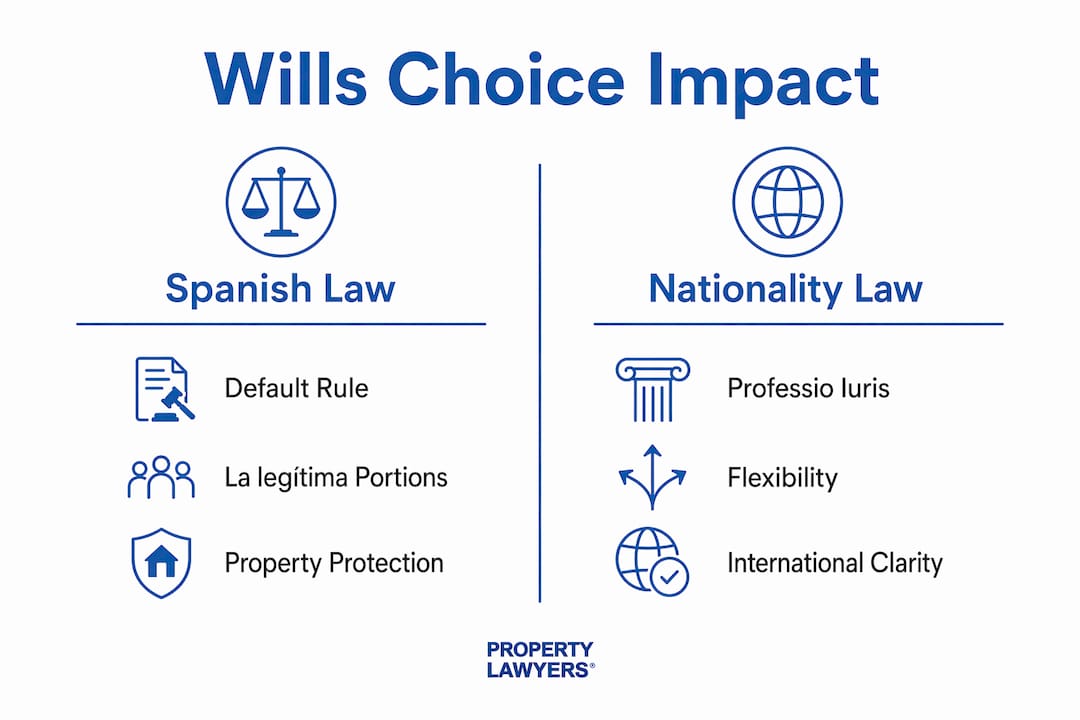
For buyers from the United Kingdom, the United States, Australia, or other common law countries, this clause is transformative. Common law systems generally allow full testamentary freedom, meaning you can leave your estate to whomever you choose. Spanish law does not offer that freedom by default.
The consequences of omitting or poorly drafting this clause are significant:
- Spanish forced heirship rules apply automatically, reserving two-thirds of your estate for your children regardless of your wishes.
- Your surviving spouse may receive only a usufruct right rather than outright ownership of the property.
- Beneficiaries outside the forced heir categories, such as a partner, a charity, or a close friend, may receive nothing.
- Heirs may face protracted legal disputes if the distribution you intended conflicts with what Spanish law mandates.
- The entire succession process becomes more complex and expensive, particularly if your home-country will contradicts Spanish law.
Professional advisers agree that the professio iuris clause is the single most important drafting decision in a Spanish will. A correctly worded clause aligns your succession with your actual wishes and removes the uncertainty that arises when two legal systems collide.
Pro Tip: The choice-of-law clause must reference your nationality at the time of signing the will. If you hold dual nationality, you may choose either country’s law, but you must specify which one clearly. Consult a lawyer who understands both legal systems before making this election.
How do Spanish forced heirship rules affect property succession?
Spanish forced heirship, known as la legítima, divides the estate into three portions under the Spanish Civil Code. Children receive two-thirds of the estate as protected shares, with the surviving spouse holding usufruct rights over a portion depending on who else survives. The remaining one-third is freely disposable.
The three portions work as follows:
| Portion | Spanish term | Who receives it |
|---|---|---|
| Strict forced share (one-third) | Legítima estricta | Divided equally among all children |
| Improvement share (one-third) | Mejora | Children or grandchildren, at testator’s discretion |
| Free disposal (one-third) | Libre disposición | Anyone the testator chooses |
The practical impact on property buyers is direct. If you own a villa in Valencia and die without a valid choice-of-law clause, your children collectively inherit two-thirds of that property whether you intended it or not. Your surviving spouse does not inherit outright ownership. Instead, they receive a usufruct right that allows them to use and occupy the property but not sell it without the consent of the bare owners, who are the children.
This structure surprises many international families. A British couple who assume the surviving spouse will simply inherit the Spanish home outright may find that their children hold bare ownership and must agree to any future sale. Practitioners note that many wills fail to address usufruct and bare ownership coordination, causing practical restrictions on heirs’ ability to manage or sell inherited Spanish property.
By contrast, English law, Scottish law, and most US state laws allow you to leave your entire estate to your spouse. A valid professio iuris clause electing UK or US law removes the legítima constraint entirely for eligible testators, restoring full testamentary freedom over your Spanish assets.
What are the practical benefits of a Spanish will for property buyers?
The administrative benefits of holding a Spanish will are substantial and often underestimated. Without a Spanish will, heirs must provide formal proof of a foreign will in Spain, a process that requires sworn translations, apostille certification, and often a legal opinion on the content and validity of foreign law. Each step adds months to the process and significant cost.
A Spanish will removes these obstacles because it is already registered in Spain. After death, heirs request the certificate of last wills (certificado de actos de última voluntad) from the Registro General de Actos de Última Voluntad. This certificate identifies whether a will exists and which notary holds the authorised copy. Heirs then obtain that copy and proceed directly to the inheritance formalities.
The contrast with intestate succession is stark. Without any valid will, heirs must complete a formal declaration of intestate heirs (Declaración de Herederos Abintestato), a court-supervised process that adds considerable time and complexity before property can be transferred. The Registro General de Actos de Última Voluntad certificate is an early step; the critical phase involves obtaining the authorised copy from the notary to proceed with property registration.
Key practical benefits of holding a Spanish will include:
- No sworn translations required: The will is already in Spanish and legally valid in Spain.
- No apostille process: A Spanish notarial will does not require authentication for use in Spanish courts.
- Faster property registration: Heirs can transfer title at the Land Registry more quickly when succession documents are already in order.
- Lower overall costs: Eliminating translation, apostille, and foreign law opinion fees reduces the financial burden on your estate.
- Timing efficiency: Signing a Spanish will at the same time as your property purchase adds minimal cost and effort while providing lasting protection.
Many buyers also hold Spanish inheritance tax obligations that interact directly with the succession process. A well-drafted will can be coordinated with tax planning to minimise the overall burden on heirs.
Common pitfalls when drafting a Spanish will
The most frequent mistake international buyers make is assuming their home-country will covers their Spanish property. Many buyers mistakenly believe a will in their home country suffices, but Spain’s procedural requirements mean a Spanish will significantly eases inheritance. Relying solely on a foreign will creates delays, additional costs, and the risk that Spanish courts apply default rules that contradict your intentions.
Other common pitfalls include:
- Vague choice-of-law wording: A clause that does not explicitly name the applicable national law may be disregarded by Spanish authorities.
- Failure to update after life changes: Marriage, divorce, the birth of children, or a change in habitual residence all affect how your will should be drafted. A will signed in 2015 may no longer reflect your circumstances or intentions in 2026.
- Ignoring usufruct complications: The spouse’s usufruct structure in Spanish succession can restrict the surviving spouse’s ability to sell or remortgage the property without the children’s agreement.
- No coordination between jurisdictions: If your Spanish will and your home-country will address the same assets, conflicts can arise. Both documents should be drafted with awareness of each other.
- Omitting specific asset references: A will that clearly identifies the Spanish property by its Land Registry reference leaves no room for ambiguity during succession.
Pro Tip: Review your Spanish will every three to five years or after any significant change in your family situation, financial position, or country of residence. A brief review with a qualified Spanish lawyer costs far less than resolving a disputed succession.
Key takeaways
A Spanish will is the most direct legal mechanism for protecting your property investment in Spain and ensuring your assets pass to the people you choose, on your terms.
| Point | Details |
|---|---|
| EU law governs succession | Brussels IV applies Spanish law by default unless your will contains an express choice-of-law clause. |
| Professio iuris is critical | A correctly worded clause lets common law nationals bypass Spanish forced heirship and retain testamentary freedom. |
| Forced heirship limits freedom | Spanish law reserves two-thirds of your estate for children; the surviving spouse receives usufruct, not ownership. |
| Spanish wills reduce delays | Heirs avoid sworn translations, apostilles, and intestate declarations, speeding up property transfer significantly. |
| Regular review is necessary | Life changes, residence shifts, and family developments all require will updates to maintain effective protection. |
Why I believe the choice-of-law clause is the most overlooked protection in Spanish property law
Having worked with international property buyers across Spain for many years, I see the same pattern repeatedly. Buyers invest considerable time and money in due diligence on the property itself, checking for embargoes, planning permissions, and community debts. Then they sign the escritura, celebrate, and never think about what happens to that property after they die.
The professio iuris clause is, in my view, the most underused legal protection available to international buyers. It costs almost nothing to include when the will is drafted, yet it can save families from years of legal dispute and tens of thousands of euros in unnecessary costs. I have seen cases where a surviving spouse could not sell a Spanish property for over two years because the bare ownership was held by adult children from a previous relationship, none of whom agreed on the sale price. A properly drafted will with a choice-of-law clause and clear usufruct provisions would have prevented the entire situation.
My advice to every international buyer is this: sign your Spanish will on the same day you complete your property purchase, or as close to it as possible. The notary is already involved, the legal costs are minimal, and the protection is immediate. Proactive estate planning is not morbid. It is the most responsible thing you can do for the people you leave behind.
— Sophie
How Property-lawyers can help you draft a Spanish will
Drafting a Spanish will correctly requires expertise in both Spanish succession law and the legal system of your home country. Getting the choice-of-law clause right, addressing usufruct and bare ownership clearly, and coordinating with your home-country estate plan are tasks that demand qualified legal support.
Property-lawyers connects international buyers across Spain with trusted, independent English-speaking property solicitors who specialise in cross-border succession and Spanish wills. Whether you are purchasing a property in Marbella, Mallorca, or Valencia, the lawyers in the Property-lawyers directory can draft your Spanish will as part of the purchase process, saving you time and protecting your investment from day one. For buyers who also need guidance on succession and inheritance documentation, the directory includes specialists across all major Spanish regions.
FAQ
Do I need a Spanish will if I already have a will at home?
A home-country will does not remove the need for a Spanish will. Without one, your heirs must provide sworn translations, apostilles, and legal opinions on foreign law before Spanish courts can act, adding months of delay and significant cost.
What is the professio iuris clause in a Spanish will?
The professio iuris clause is an express declaration in your will selecting the law of your nationality to govern your succession. Under Article 22 of EU Regulation 650/2012, this choice must be stated clearly in writing or it carries no legal effect.
How does Spanish forced heirship affect my property?
Spanish forced heirship reserves two-thirds of your estate for your children under the Spanish Civil Code, with your surviving spouse receiving usufruct rights rather than outright ownership. A valid choice-of-law clause can override these rules for nationals of common law countries.
How long does inheritance take without a Spanish will?
Without a Spanish will, heirs must complete a formal intestate declaration process before any property can be transferred. This adds considerable time and complexity compared to succession based on a registered Spanish will.
When should I sign a Spanish will?
The most practical time to sign a Spanish will is at the same time as your property purchase. The notary is already engaged, costs are minimal, and your property rights are protected from the moment you take ownership.
Recommended
- Spanish Inheritance Tax and Wills for Foreign Property Owners | Property Lawyers
- Real Estate Lawyers in Spain | Find the best property solicitors in Mallorca & Ibiza
- Benefits of property law specialisation in Spain

Sophie Gutenberg is a legal content specialist focused on Spanish property law, real estate transactions, conveyancing, due diligence and tax issues affecting international property buyers in Spain. She works alongside qualified Spanish property lawyers .
