
Régimen matrimonial in Spain: property rights explained
TL;DR:
- A matrimonial property regime in Spain governs property ownership, management, and division between spouses.
- Understanding and formalizing this regime prevents disputes and ensures property rights align with intentions.
A régimen matrimonial in Spain is the legally recognised system that governs how property is owned, managed, and divided between spouses. Understanding your matrimonial property regime is not optional if you own or plan to buy property in Spain. The rules determine what belongs to you, what belongs to your spouse, and what happens to assets on divorce or death. Spain recognises three primary regimes, each with distinct regional defaults, and the choice you make, or fail to make, has lasting consequences for your property rights.
What is régimen matrimonial in Spain and why does it matter?
A matrimonial property regime is the legal framework that sits beneath every property transaction a married couple makes in Spain. Without knowing which regime applies to you, you cannot fully understand your ownership rights. Spain matrimonial property laws recognise three primary regimes, each with different rules on what counts as shared and what remains private.
The three regimes are:
- Sociedad de gananciales (community of property): assets and debts acquired during the marriage are shared equally between spouses.
- Separación de bienes (separation of assets): each spouse owns, manages, and is solely responsible for their own property and debts.
- Participación en ganancias (participation in profits): a hybrid regime where spouses manage assets separately during the marriage but share in the economic gains upon dissolution.
The default regime across most of Spain is sociedad de gananciales. However, regional defaults differ significantly. Catalonia, the Balearic Islands, Valencia, Aragon, and Navarra apply separación de bienes as the default. The participación en ganancias regime is rarely used in practice.
What counts as private versus communal property?

Under sociedad de gananciales, assets acquired before marriage, inheritances, and gifts received by one spouse remain private property. This distinction matters enormously. Without proper documentation, private assets can be misclassified as communal during a dispute or divorce. Keeping clear records of when and how you acquired each asset is the first line of defence.
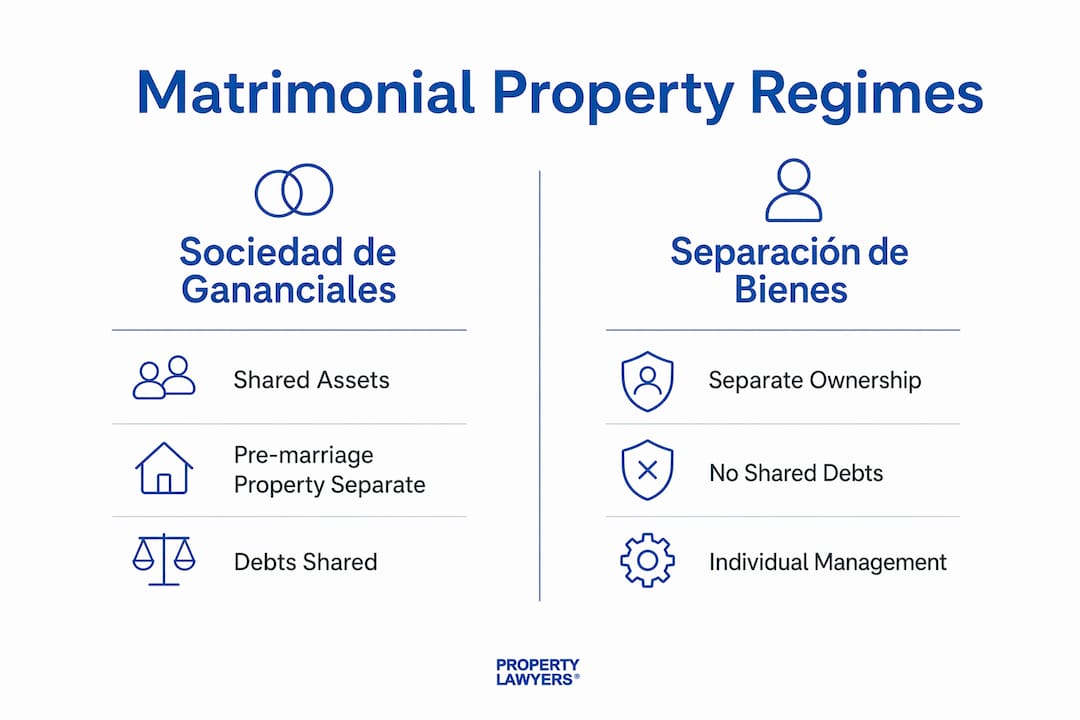
Under separación de bienes, each spouse retains full ownership of everything they own, regardless of when it was acquired. There is no automatic sharing of assets or debts. This regime is simpler to administer but requires each spouse to fund their own property purchases independently.
Pro Tip: If you are buying property in a region where separación de bienes is the default, confirm which regime applies before signing any purchase contract. Regional rules override the national default.
How do prenuptial agreements work in Spain?
A capitulaciones matrimoniales is the formal legal agreement through which couples choose, modify, or confirm their matrimonial property regime. These agreements must be executed as a public deed before a Spanish notary to be legally valid. Without notarisation, the agreement has no legal effect.
The process for creating or changing a regime through capitulaciones matrimoniales involves the following steps:
- Both spouses agree on the regime they wish to adopt or confirm.
- A Spanish notary drafts the capitulaciones matrimoniales as a public deed.
- Both spouses sign the deed before the notary.
- The agreement is registered in the Civil Registry and, where relevant, in the Property Registry.
- The new regime takes effect from the date of registration.
Capitulaciones matrimoniales can be signed before or during the marriage. This flexibility is particularly valuable for international couples who may need to align their Spanish property arrangements with expectations from their home country. Couples can also change their regime during the marriage if their circumstances change.
The agreement must not violate Spanish public policy or the principle of spousal equality. Any clause that places one spouse at a significant legal disadvantage risks being declared void by a Spanish court.
Pro Tip: International couples should use capitulaciones matrimoniales to formally state which country’s law governs their property regime. This prevents costly disputes if you own assets in more than one country.
What does EU Regulation 2016/1103 mean for your property?
EU Regulation 2016/1103 determines which country’s law governs the matrimonial property regime for marriages after 29 january 2019. This regulation applies directly to couples with connections to more than one EU member state. It is the primary legal framework for international couples buying property in Spain.
The regulation sets out a clear hierarchy for determining applicable law:
- The couple’s own choice of applicable law takes priority, provided it is made formally.
- If no choice is made, the law of the couple’s first common habitual residence applies.
- If the couple never shared a common habitual residence, the law of the country most closely connected to the marriage applies.
- As a final fallback, the law of the country where the marriage took place governs the regime.
This hierarchy has direct consequences for property ownership in Spain. A British couple who married in the United Kingdom, lived in Germany, and then moved to Spain may find that German law governs their property regime unless they formally choose otherwise. EU Regulation 2016/1103 makes the formal choice of applicable law one of the most important legal steps an international couple can take.
Owning property in Spain does not confer residency or living rights. These are entirely separate legal matters. Foreign buyers frequently misunderstand this, treating property ownership as a route to residency. Property law and immigration compliance must be managed independently.
What should couples know about property ownership in practice?
The default position in Spain is that spouses own property in equal shares if no specification is provided at the time of purchase. To avoid this default, spouses must explicitly state their intended ownership percentages in the public deed (escritura) and provide evidence of their matrimonial regime. Failing to do so can create serious complications during divorce or inheritance proceedings.
Practical steps every couple should take when buying property in Spain:
- State the exact ownership percentage for each spouse in the property title deed.
- Provide documentary evidence of your matrimonial regime, whether Spanish or foreign.
- Keep records of financial contributions made by each spouse to the purchase price.
- Document any assets that are private in origin, such as inherited funds used for a deposit.
- Confirm whether your regime is governed by Spanish law or a foreign law under EU Regulation 2016/1103.
Spanish courts and notaries prioritise registered ownership and formal regime documentation over individual financial contributions during property disputes. This is a critical difference from the UK legal system, where courts have wider discretion to consider financial needs. In Spain, what is registered is what counts. Undocumented contributions are very difficult to recover.
Separating private and communal assets through proper documentation is the most reliable way to protect your individual interests under the community of property regime. If you used inherited money to fund a property purchase, record that fact formally at the time of purchase. Waiting until a dispute arises is almost always too late.
Pro Tip: Ask your Spanish notary to record the source of funds for each spouse at the time of purchase. This single step can prevent years of legal dispute if the marriage later dissolves.
For couples considering the tax implications of property ownership, understanding Spanish inheritance and wills alongside your matrimonial regime gives a complete picture of your exposure.
Key takeaways
The matrimonial property regime you operate under in Spain directly determines your ownership rights, your liability for debts, and the division of assets on divorce or death.
| Point | Details |
|---|---|
| Three regimes recognised | Spain recognises sociedad de gananciales, separación de bienes, and participación en ganancias, each with different ownership rules. |
| Regional defaults vary | Catalonia, the Balearic Islands, Valencia, Aragon, and Navarra default to separación de bienes, not the national community of property default. |
| Formal agreements required | Capitulaciones matrimoniales must be signed before a notary to validly choose or change a matrimonial property regime. |
| EU rules apply from 2019 | EU Regulation 2016/1103 governs applicable law for international couples married after 29 january 2019. |
| Document ownership at purchase | Stating ownership shares and evidencing your regime in the escritura prevents the automatic 50/50 default and protects both spouses. |
Why I always tell international couples to sort this before they buy
Many international couples I speak with assume their home country’s marital property rules apply automatically in Spain. They do not. Spanish law focuses on registered ownership and formal regime documentation, not on the financial needs or contributions of individual spouses. That is a fundamental shift from how property disputes are resolved in the UK, where courts have broad discretion.
The couples who face the most difficulty are those who bought property in Spain without ever formalising their regime choice. They assumed the purchase would be straightforward. Years later, during a divorce or after a death, they discover that the registered position does not reflect what they intended. Correcting that is expensive and slow.
My strongest advice is to sign capitulaciones matrimoniales before completing any Spanish property purchase. This formal agreement is not just for wealthy couples or those with complex assets. It is the clearest way to record your intentions and protect both spouses under Spanish law. The notary fee is modest. The cost of not doing it can be enormous.
If you are already a property owner in Spain and have never addressed your matrimonial regime formally, you can still act. Couples can modify their regime at any time by signing capitulaciones matrimoniales with a notary. There is no deadline. The only risk is waiting.
— Sophie
How Property-lawyers can help you protect your property rights
Navigating Spanish matrimonial property law requires qualified legal advice, particularly when cross-border connections or significant assets are involved. Property-lawyers connects international buyers and property owners with trusted, independent real estate lawyers across Spain who specialise in exactly these situations.
A specialist lawyer can review or draft capitulaciones matrimoniales, advise on which regime applies to your specific circumstances, and ensure your ownership shares are correctly recorded in the escritura. For couples buying in Spain for the first time, working with a qualified real estate lawyer in Spain from the outset avoids the most common and costly mistakes. Property-lawyers makes it straightforward to find the right legal expert for your situation, wherever in Spain you are buying.
FAQ
What is the default matrimonial property regime in Spain?
The default regime across most of Spain is sociedad de gananciales, meaning assets and debts acquired during the marriage are shared equally. In Catalonia, the Balearic Islands, Valencia, Aragon, and Navarra, the default is separación de bienes.
Can couples change their matrimonial property regime after marriage?
Yes. Couples can change their regime at any time during the marriage by signing capitulaciones matrimoniales before a Spanish notary. The change takes effect once registered in the Civil Registry.
Does EU Regulation 2016/1103 affect British couples buying in Spain?
EU Regulation 2016/1103 applies to marriages after 29 january 2019 and determines which country’s law governs the property regime for couples with cross-border connections. British couples should seek legal advice to confirm which law applies and whether a formal choice should be made.
What happens to property ownership if no regime is specified at purchase?
Spanish law defaults to 50/50 ownership between spouses if no ownership percentages are stated in the public deed. Couples should explicitly declare their intended shares and provide evidence of their matrimonial regime at the time of purchase.
Does owning property in Spain give residency rights?
No. Owning property in Spain does not confer any right to reside in the country. Residency and property ownership are governed by entirely separate legal frameworks, and foreign buyers must manage immigration compliance independently.
Recommended
- Escritura Spain — The Spanish Property Title Deed Explained | Property Lawyers
- Non-Resident Property Tax Spain — Annual Obligations Explained | Property Lawyers
- Succession and inheritance in Spain | Property Lawyers
- Civil in spain: understanding the legal system in 2026

Sophie Gutenberg is a legal content specialist focused on Spanish property law, real estate transactions, conveyancing, due diligence and tax issues affecting international property buyers in Spain. She works alongside qualified Spanish property lawyers .
