

Burofax in Spain: legal definition and how it works
TL;DR:
- A burofax is a certified postal service in Spain that provides legally recognized proof of content, sender, recipient, and delivery outcome. It is widely used for formal notifications in legal and contractual situations, with its evidentiary strength depending on the certification options selected and proper sending procedures. Correct preparation and timing are crucial for its effectiveness in court and to meet procedural deadlines.
A burofax is a certified postal notification service in Spain that provides legally recognised proof of the content sent, the sender’s identity, the recipient’s details, the date of dispatch, and the outcome of delivery. Correos, Spain’s national postal operator, administers the service and acts as an impartial intermediary. That impartial role is precisely what gives a burofax its weight in Spanish courts and legal proceedings. Understanding what is burofax Spain legal means understanding how this single document can determine the outcome of a dispute, a contract termination, or a formal demand.
What is burofax Spain legal: definition and evidentiary value
A burofax is defined as a certified postal service in which Correos certifies the content of the communication, the identity of the sender and recipient, the date and time of dispatch, and the result of the delivery attempt. This certification is what separates a burofax from an ordinary letter or a standard email. An email can be deleted, altered, or disputed. A burofax cannot.
Spanish Civil Procedure Law, known as the Ley de Enjuiciamiento Civil, recognises certified postal correspondence as valid documentary evidence in civil proceedings. Article 161 of that law confirms that courts accept such documents without requiring additional witness testimony. That means a burofax can stand alone as proof in a courtroom.
The burofax name has historical roots. It derives from a certified telegram sent by fax between Correos offices. Today the process is entirely digital, but its legal validity remains unchanged. The service’s official standing through Correos is what courts continue to recognise.
Correos acts as an impartial evidentiary intermediary. That role is the reason a burofax carries legal weight beyond a simple letter or email. No private party can alter the record once Correos has certified it.
How does a burofax work legally in Spain?
The process follows a clear sequence. You submit the document to Correos, either in person at a branch or through an authorised online platform. Correos certifies the content, seals it, and dispatches it to the recipient. The operator then records the outcome of the delivery attempt.
- Submission. You provide the full text of your communication and the recipient’s address. Correos registers the content at this point.
- Certification. Correos issues a dispatch receipt confirming the date, time, and content of what was sent.
- Delivery attempt. Correos attempts delivery to the recipient’s address.
- Outcome recording. The operator records whether the recipient signed for the document, refused it, or was unavailable.
The evidentiary value at each stage is distinct. The dispatch receipt proves you sent a specific document on a specific date. The delivery record proves what happened when it arrived. Courts treat these as separate pieces of evidence, and both matter.
Pro Tip: Always request a certified copy of the content alongside your dispatch receipt. Without it, you can prove you sent something, but you cannot prove exactly what you sent.
Burofax is not regulated as a specific legal form in Spanish law. It gains its legal effect from the underlying legal relationship and the content of the notification itself. That means the burofax is a tool, not a guarantee. The legal outcome still depends on what you say in it and whether you have chosen the right certification options.
What are the main certification options and their legal impact?
When you send a burofax, you choose from several certification options. Each option adds a layer of evidentiary protection. Selecting the wrong combination can weaken your legal position significantly.
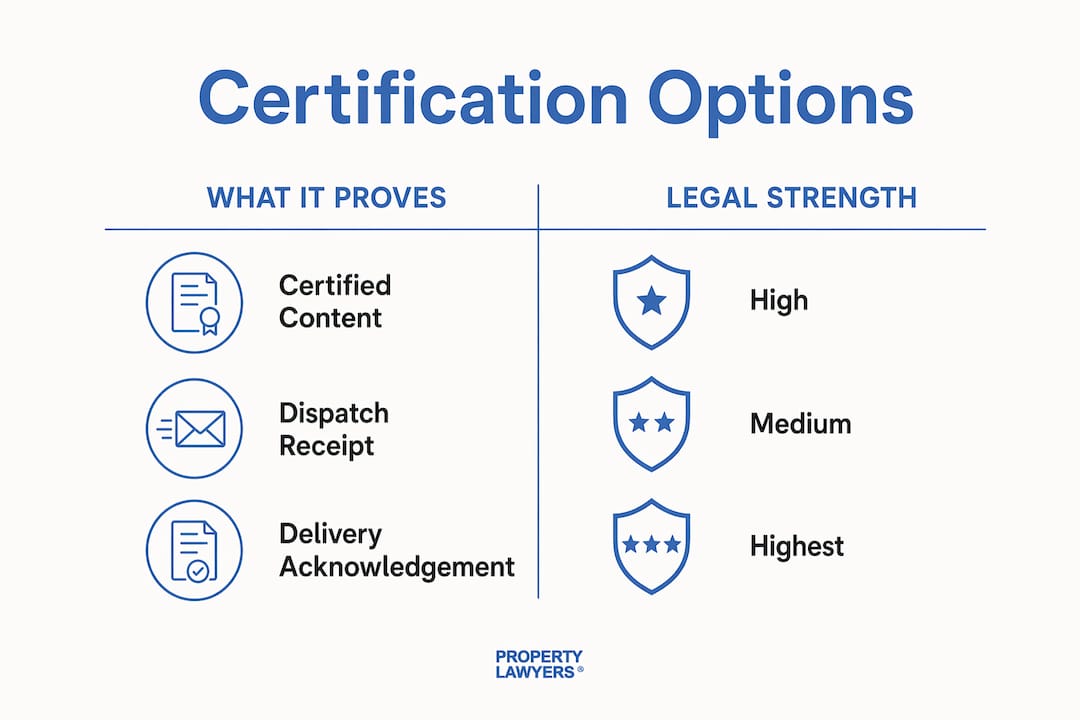
| Certification option | What it proves | Legal strength |
|---|---|---|
| Certified copy of content | Exact text of the document sent | High: prevents content disputes |
| Dispatch receipt | Date and time of sending | Medium: proves timing, not content |
| Delivery acknowledgement | Signed receipt or recorded refusal | High: proves recipient’s knowledge |
| Refusal record | Documented refusal or non-collection | Medium: admissible but weaker than signed receipt |
The delivery acknowledgement, known in Spanish as acuse de recibo, provides the strongest legal proof in court. It records either a signed receipt from the recipient or a documented refusal. Courts value proof of the recipient’s actual knowledge over mere proof of dispatch.
Omitting the certified copy of content is a common and costly error. Sending without content certification weakens your evidence because the actual message can then be disputed. Proving dispatch without proving the exact text shifts the focus of any dispute away from the substance of your claim.
Pro Tip: Select all three options: certified copy of content, dispatch receipt, and delivery acknowledgement. The combined cost is modest compared to the legal risk of omitting any one of them.
Operational nuances matter here. How refusal or non-receipt is recorded affects the proof and legal weight of the notification. A recipient who refuses to sign is not the same as a recipient who was simply absent. Your solicitor should advise you on which outcome is most likely and how to plan for it.
When is a burofax used in Spain?
Burofax is used across a wide range of legal and contractual situations. The common thread is the need to prove that a formal notification was made and that the other party had the opportunity to receive it.
- Contract termination. When ending a lease, a service contract, or a commercial agreement, a burofax creates a dated record of the termination notice.
- Payment demands. Creditors use burofax to issue formal payment warnings before initiating legal proceedings. This demonstrates good faith and establishes a clear timeline.
- Security deposit returns. Tenants in Spain frequently use burofax to demand the return of their rental deposit under tenancy law, creating evidence of the formal request.
- Pre-litigation notices. Before filing a claim in court, many procedural rules require or strongly favour a prior formal notification. A burofax satisfies this requirement.
- Consumer and labour disputes. Individuals asserting rights against a company or employer use burofax to create a formal, dated record of their complaint or demand.
- Landlord communications. Landlords use burofax to notify tenants of rent increases, property inspections, or lease terminations in compliance with Spanish tenancy law.
The common uses include tenancy deposit claims and formal warnings before litigation. Each of these situations shares the same underlying need: a document that proves what was said, when it was said, and to whom.
How long does a burofax take and when does legal notification begin?
Delivery timing matters because many legal deadlines run from the date of notification, not the date of sending. Getting this wrong can invalidate a claim or cause you to miss a procedural deadline.
| Scenario | Typical timeframe | Legal notification point |
|---|---|---|
| Delivery within mainland Spain | 2–5 business days | Date of signed receipt |
| Recipient refuses delivery | Recorded at attempt | Date of refusal |
| Recipient fails to collect | Recorded after holding period | Depends on procedural rules |
| International delivery | Varies; additional formalities required | Depends on applicable law |
Typical delivery time for burofax within mainland Spain ranges between 2 and 5 business days from sending. This is standard market practice, not a statutory rule. You cannot rely on logistical timing alone when planning for legal deadlines.
The legal effect timing depends on when notification is considered effective under the relevant procedural rule. Some rules run from the date of dispatch. Others run from the date of receipt or the date on which the recipient had access to the document. No single universal standard applies across all proceedings.
If the recipient refuses or fails to collect, the postal operator’s records are still admissible as proof of a serious attempt to notify. However, a refusal record does not automatically equal the legal effect of a signed receipt. The specific procedural context determines which standard applies.
Practitioner advice stresses aligning burofax options with procedural requirements and deadlines. Send your burofax well in advance of any deadline, and confirm with your solicitor which event triggers the legal notification clock.
Common pitfalls and how to avoid them
Most errors with burofax are avoidable. They fall into a small number of categories, and each one can be addressed with straightforward preparation.
- Incorrect recipient address. You must double-check the recipient address before sending. Correos cannot redirect a burofax after dispatch, and an undelivered notification may have no legal effect.
- Omitting content certification. Sending without a certified copy of the content leaves the substance of your message open to challenge. Always include this option.
- Failing to save the dispatch receipt. The dispatch receipt is your primary evidence of timing. Store it securely alongside the certified copy of content and any delivery acknowledgement.
- Sending too close to a deadline. Delivery takes 2–5 business days. Sending a burofax the day before a legal deadline is a serious procedural risk.
- Ignoring refusal or non-collection. If the recipient refuses or fails to collect, obtain the operator’s record immediately. Do not assume the notification has no legal effect.
- Using the wrong address for a legal entity. For companies, the registered address is the correct address for legal notifications, not a trading address or a branch office.
Pro Tip: Treat proof of dispatch and proof of receipt as two separate evidentiary elements. File them together, but understand that courts may treat them differently depending on the procedural rule in question.
For property matters in Spain, legal documentation verification follows the same principle: every document must be correct, complete, and preserved from the outset.
Key takeaways
A burofax is the most reliable certified notification tool available in Spain, but its legal strength depends entirely on selecting the right options and sending it correctly.
| Point | Details |
|---|---|
| Burofax legal definition | A certified postal service by Correos providing court-admissible proof of content, sender, recipient, and delivery outcome. |
| Strongest certification combination | Always select certified copy of content, dispatch receipt, and delivery acknowledgement together. |
| Delivery timing | Mainland Spain delivery takes 2–5 business days; legal notification timing depends on the applicable procedural rule. |
| Refusal is not a barrier | A documented refusal or non-collection is admissible evidence, though weaker than a signed receipt. |
| Common fatal error | Omitting content certification means the exact message can be disputed, undermining your entire claim. |
My view on burofax: what practitioners get wrong
The most common misunderstanding I encounter is treating a burofax as a formality rather than a strategic legal document. People send it because they have been told they should, without thinking carefully about what they need to prove and to whom.
The certified copy of content is the element that most people underestimate. Dispatch receipts are easy to obtain and easy to understand. But the content certification is what actually anchors your legal claim. Without it, you have a timestamp with no substance attached.
The second misunderstanding concerns refusal. Many people assume that if the recipient refuses to accept the burofax, the notification fails. That is not correct. A documented refusal is evidence that the recipient was aware a formal notification existed and chose not to receive it. Courts take a dim view of that behaviour. It does not automatically mean your notification is valid in every procedural context, but it is far from worthless.
The third issue is timing. I have seen well-prepared burofax communications arrive too late to meet a procedural deadline simply because the sender did not account for the 2–5 business day delivery window. Send early. The legal clock does not wait for the postal system.
If you are dealing with a property dispute, a tenancy matter, or a formal demand in Spain, a burofax is one of the most powerful tools available to you. Use it correctly, and it will support your position clearly. Use it carelessly, and it will give the other side an opening to challenge your evidence. The difference between the two outcomes is almost always in the preparation, not the sending.
— Sophie
Legal support for burofax matters in Spain
Sending a burofax correctly requires more than visiting a Correos branch. The certification options you choose, the address you use, and the timing of your notification all carry legal consequences.

Property-lawyers connects individuals in Spain with independent, English-speaking solicitors who handle certified notifications, property disputes, tenancy matters, and formal legal demands. Whether you need guidance on a single burofax or support through a wider legal process, the right legal specialist can ensure your notification is procedurally sound and strategically effective. Property-lawyers works with trusted solicitors across Spain, including specialist lawyers in Madrid and other major regions, so you can find the right professional for your specific situation.
FAQ
What is a burofax in Spain?
A burofax is a certified postal notification service operated by Correos that provides legally recognised proof of the content sent, the sender, the recipient, and the delivery outcome. Spanish courts accept it as documentary evidence under the Ley de Enjuiciamiento Civil.
Is a burofax legally binding in Spain?
A burofax is not itself a contract or a binding order. It is a certified record of a formal notification. Its legal effect depends on the content of the message and the underlying legal relationship between the parties.
How do you send a burofax in Spain?
You submit the document to Correos in person or through an authorised online platform, selecting your certification options. Correos certifies the content, dispatches it, and records the delivery outcome.
What is the difference between a burofax and registered mail?
Registered mail confirms that a sealed item was dispatched and received, but does not certify the content. A burofax certifies the exact text of the document, making it significantly stronger as evidence in legal proceedings.
What happens if the recipient refuses a burofax?
The postal operator records the refusal. That record is admissible in court as evidence of a formal notification attempt. Refusal does not automatically invalidate the notification, though its precise legal effect depends on the applicable procedural rule.
Recommended
- Benefits of bilingual legal services in Spain
- Notary Process Spain (2026) — What Happens at the Escritura Signing
- Escritura Spain — The Spanish Property Title Deed Explained | Property Lawyers

Sophie Gutenberg is a legal content specialist focused on Spanish property law, real estate transactions, conveyancing, due diligence and tax issues affecting international property buyers in Spain. She works alongside qualified Spanish property lawyers .
