

Property valuation in Spain: what buyers must know
TL;DR:
- Property valuation in Spain, known as tasación, is an official appraisement conducted by a certified expert to determine a property’s market value for mortgage approval. The process involves physical inspection, legal review, and market comparison, and the appraisal directly influences the loan amount a bank will provide. Understanding this process helps buyers negotiate better, avoid surprises, and ensure proper legal and financial planning.
Property valuation in Spain is an official appraisal, known as a tasación, conducted by an accredited expert called a tasador to establish the reliable market value of a property for mortgage financing and investment decisions. The process is not optional for buyers seeking a mortgage. Spanish banks require a certified tasación before approving any loan, and the resulting figure directly determines how much they will lend. Understanding the property valuation Spain process protects you from financial surprises and gives you a firmer footing when negotiating a purchase.
The tasador must be an architect, technical architect, or specialised engineer employed by a firm certified by the Bank of Spain. This is not a formality. The Bank of Spain maintains a register of approved valuation companies, and only reports from these firms are accepted by lenders. The tasación covers a physical inspection, a review of legal documents, and a comparative market analysis. Each stage feeds into a formal written report that becomes the cornerstone of your mortgage application.
What are the key steps in the Spain property appraisal process?
The valuation follows a defined sequence. Each step builds on the last, and delays at any stage can push back your mortgage approval.
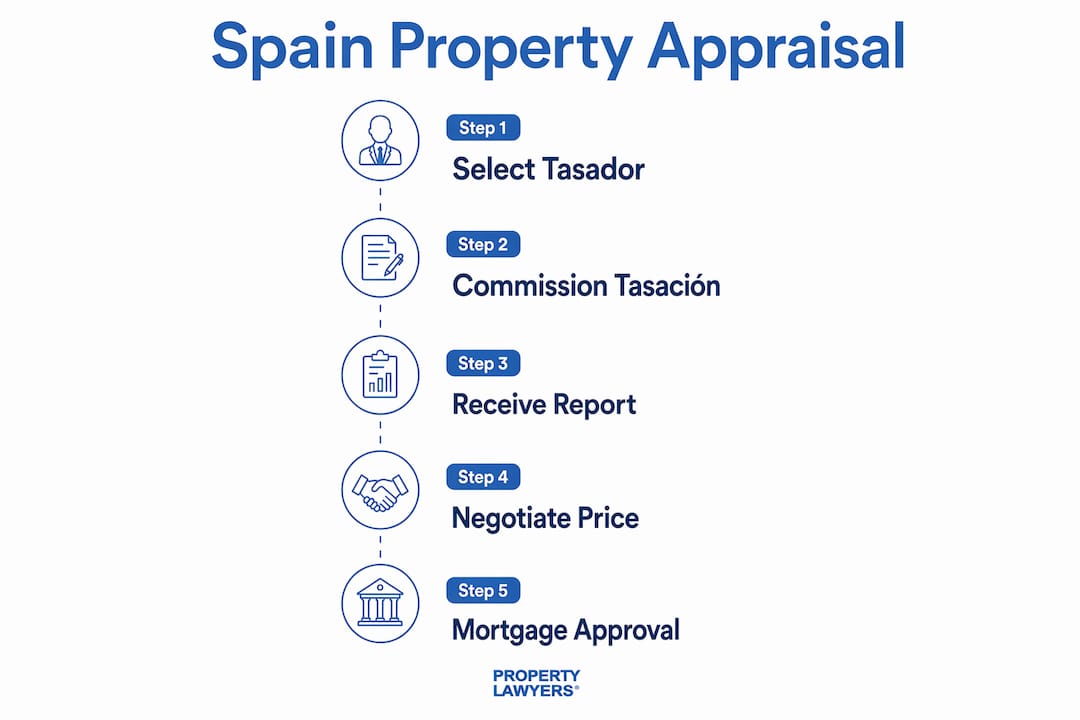
- Commission the valuation. You engage a Bank of Spain certified valuation firm directly. Buyers have the right to choose any approved firm independently, even if your bank suggests one. Choosing your own firm from the approved list can prevent rejection and align the report with lending expectations.
- Physical site inspection. The tasador visits the property in person. They assess the structural condition, measure the usable surface area, check for any illegal extensions, and confirm the property complies with local urban planning regulations. Nothing is estimated remotely.
- Legal document review. The appraiser examines the nota simple and the cadastral reference. The nota simple confirms ownership, encumbrances, and any registered charges. The cadastral reference verifies the official land registry description matches the physical reality.
- Comparative market analysis. The tasador compares the property against at least six similar properties recently sold in the same area. This is the most technically demanding part of the process. It requires access to actual transaction data, not just asking prices.
- Report preparation. The appraiser compiles findings into a formal written report. The report states the valuation figure, the methodology used, and any conditions or limitations. This document is valid for six months from the date of issue.
- Delivery and cost. The official valuation costs between €400 and €600 plus VAT, paid by the buyer. The process typically completes within 2–14 days after the site visit.
Pro Tip: Commission the tasación before signing a reservation contract. Knowing the official figure in advance lets you structure your offer and financing with full information.
How does the valuation affect your mortgage in Spain?
The tasación figure is the single number that governs what a Spanish bank will lend you. The bank calculates your mortgage against the lower of two figures: the agreed purchase price or the official appraisal value. If the tasación comes in below the purchase price, the bank lends against the lower figure. You cover the gap from your own funds.
Loan-to-value limits differ by buyer status:
- Residents purchasing a primary home: banks lend up to 80% of the official valuation.
- Non-residents: banks restrict lending to 60–70% of the official valuation.
- In both cases: the loan is calculated against the appraisal, not the market price if it is higher.
This creates a specific risk called the valuation gap. Suppose you agree to pay €350,000 for a property and the tasación returns €320,000. Your bank lends 70% of €320,000, which is €224,000. You must fund the remaining €126,000 yourself, including the gap between the appraisal and the agreed price. Valuation gaps are not rare, and they catch buyers off guard when they have already committed to a purchase price.
Pro Tip: If the tasación comes in lower than the agreed price, use the report as a negotiation tool. Sellers are often willing to adjust the price when presented with an official certified figure.
The timing of the valuation matters too. Delays in commissioning the report can postpone mortgage approval and disrupt the entire purchase schedule. Start the process as early as possible.
What property valuation methods are used in Spain?
Spanish appraisers use different methods depending on the property type and purpose. Understanding these methods helps you interpret the report and question any figure that seems out of step with the market.
| Valuation method | Best suited for | Key limitation |
|---|---|---|
| Comparative market approach | Standard residential sales | Relies on actual transaction data, which is not always publicly available in Spain |
| Depreciated replacement cost | New builds or unique properties | Can overstate value if construction costs are high relative to local demand |
| Administrative cadastral value | Tax calculations only | Frequently below market value and not used for mortgage purposes |
The comparative market approach is the standard method for most residential purchases. A combination of methods tailored to the property type yields the most accurate result, but the comparative approach prevails for typical residential sales.
The cadastral value is a separate administrative figure set by local authorities for tax purposes. It is not the same as the tasación and is not used by banks. Confusing the two is a common mistake among foreign buyers.
Actual transaction prices in Spain are not publicly transparent. Buyers should not rely solely on online listing prices to estimate value. Market prices often close 5–15% below asking prices, meaning listing prices alone can mislead investment decisions. Experienced investors cross-check the official valuation with rental yields to assess whether the asset makes financial sense beyond the mortgage calculation.
Pro Tip: Ask your tasador which method they applied and why. A good appraiser will explain their reasoning clearly. If the report relies heavily on properties from a different neighbourhood or property type, query the comparables used.
What risks should buyers watch for during the valuation process?
The Spain property appraisal process carries specific risks that disproportionately affect foreign buyers who are unfamiliar with how the system works.
- Signing a reservation contract without a financing contingency. Many buyers commit to a reservation contract before the tasación is complete. If the official appraisal comes in lower than the agreed price, they face a financing shortfall or lose their deposit. Including a financing contingency clause in any reservation contract is the most direct protection against this outcome.
- Relying on the tasación as a market value indicator. The official tasación is an administrative tool designed to control bank risk, not to reflect precise market value. Treating it as a definitive market price can lead to poor investment decisions. The tasación and the true market value of a property are related but not identical.
- Choosing an uncertified appraiser. Any valuation report not produced by a Bank of Spain approved firm will be rejected by lenders. Verify the firm’s certification before commissioning the report.
- Ignoring the dual reality of Spanish property prices. Property value in Spain has a dual reality: a fluctuating market value and a rigid tasación used by banks. Foreign investors who misunderstand this distinction face financial distress when their financing falls short.
- Overlooking legal document discrepancies. If the nota simple or cadastral reference contains errors or inconsistencies, the tasación may be delayed or the report may flag conditions that affect the valuation. Reviewing legal property status before commissioning the valuation saves time and avoids complications.
Pro Tip: Always instruct an independent legal adviser to review the tasación report alongside the purchase contract. The report may contain conditions or caveats that affect your legal position, not just your financing.
Key takeaways
The property valuation Spain process is a legally required appraisal that directly determines your mortgage limit, your financial exposure, and your negotiating position as a buyer.
| Point | Details |
|---|---|
| Tasación is mandatory for mortgages | Spanish banks only lend against a certified appraisal from a Bank of Spain approved firm. |
| LTV limits vary by residency status | Non-residents borrow 60–70% of the appraisal; residents can access up to 80% for a primary home. |
| Valuation gaps are a real financial risk | If the appraisal is lower than the agreed price, you fund the difference from your own resources. |
| Choose your own certified appraiser | Buyers are entitled to select any approved firm independently, which can prevent bank rejection. |
| Cadastral value is not the same as tasación | Administrative values are used for tax purposes only and are not accepted by lenders. |
Why buyers consistently underestimate the valuation process
I have spoken with a significant number of foreign buyers who treated the tasación as a box-ticking exercise. They assumed the official figure would simply confirm what they had already agreed to pay. That assumption is where things go wrong.
The tasación is not designed to validate your purchase price. It is designed to protect the bank. Those two objectives often produce the same number, but not always. When they diverge, the buyer absorbs the cost. The buyers who navigate this well are the ones who commission the valuation early, read the report carefully, and use the figure as a reference point for the entire transaction, not just the mortgage application.
There is also a tendency among international buyers to conflate the tasación with a general market assessment. It is not. The comparative market approach used by tasadores relies on actual completed sales, and in Spain, those figures are not publicly available in the way they are in the UK or the United States. A tasador with strong local knowledge and access to real transaction data produces a more reliable report than one working from listing prices alone. Asking your legal adviser to recommend a certified firm with a track record in your target area is worth the extra effort.
The valuation report is also a negotiation document. If it comes in below the asking price, you have an official, certified basis for requesting a price reduction. Sellers understand what a tasación is. Use it.
— Sophie
How Property-lawyers can support your valuation and purchase
Interpreting a tasación report correctly requires more than reading the headline figure. The report may contain conditions, caveats, or legal observations that affect your purchase contract, your financing structure, and your long-term ownership rights.
Property-lawyers connects international buyers with independent, English-speaking real estate lawyers in Spain who review valuation reports in the context of the full transaction. They identify financing contingency gaps in reservation contracts, verify that the appraiser is Bank of Spain certified, and flag any legal discrepancies between the tasación and the property’s registered status. Whether you are buying in Madrid, the Costa Brava, or the Balearic Islands, Mallorca and Ibiza, Property-lawyers helps you connect with a qualified legal professional who understands both the valuation process and its implications for your investment.
FAQ
What is a tasación in Spain?
A tasación is the official property valuation required by Spanish banks before approving a mortgage. It is conducted by a certified appraiser employed by a Bank of Spain approved firm.
How much does a property valuation cost in Spain?
An official tasación typically costs between €400 and €600 plus VAT, paid by the buyer, and the report is valid for six months from the date of issue.
Can I choose my own valuation firm in Spain?
Yes. Buyers have the legal right to select any Bank of Spain certified appraisal firm independently, even if the lender suggests a preferred provider.
What happens if the valuation is lower than the purchase price?
The bank lends against the lower figure. You must cover the difference between the appraisal and the agreed price from your own funds, or renegotiate the purchase price with the seller.
Is the cadastral value the same as the official mortgage valuation?
No. The cadastral value is an administrative figure used for tax calculations. It is separate from the tasación and is not accepted by banks for mortgage lending purposes.
Recommended
- Plusvalía Municipal Tax in Spain — What Sellers Need to Know | Property Lawyers
- Property Purchase Tax in Spain — What Buyers Must Pay | Property Lawyers
- Property law in Spain: a 2026 guide for buyers
- Gazumping in Spain: what property buyers must know

Sophie Gutenberg is a legal content specialist focused on Spanish property law, real estate transactions, conveyancing, due diligence and tax issues affecting international property buyers in Spain. She works alongside qualified Spanish property lawyers .
