

Modelo 720 Spain: the expat’s guide to foreign asset declaration
Modelo 720 is Spain’s annual informative declaration of assets held abroad. If you are a Spanish tax resident with foreign holdings worth more than €50,000 per asset category, you are almost certainly required to file it. The Agencia Tributaria (AEAT) describes it as an informative tax return on assets and rights located abroad. It does not create a tax bill on its own, but failing to file can trigger serious consequences.
Your immediate next steps:
- Visit the AEAT Form 720 page to confirm current requirements
- Gather your 31 December bank, brokerage, and property statements
- Note the filing window: 1 January to 31 March of the year following the reporting year
Key takeaways
Modelo 720 is an informative declaration, not a tax: Spanish tax residents with foreign assets exceeding €50,000 per block must file annually between 1 January and 31 March, with penalties now governed by the general LGT regime following the 2022 reforms.
| Point | Details |
|---|---|
| €50,000 threshold per block | Each of the three asset blocks is assessed independently; never aggregate across blocks. |
| Filing window: 1 January to 31 March | File online via AEAT Sede Electrónica; no paper option exists. |
| Re-file only when a block grows by €20,000 | A previously declared block only needs updating if its value rises by more than €20,000 or an asset is disposed of. |
| Modelo 720 is informative, not a tax return | Income from declared assets must still be reported separately on IRPF and, where relevant, wealth tax. |
| Property-lawyers for legal support | Property-lawyers connects you with vetted, English-speaking Spanish tax lawyers to help with filing and compliance. |
Table of Contents
- 1. Who must file Modelo 720?
- 2. Exactly what do you need to declare?
- 3. Thresholds, valuation rules, and when you need to file again
- 4. How to file Modelo 720 online via AEAT
- 5. Penalties and practical risks after the 2022 reforms
- 6. How to correct, cancel, or file late
- 7. How Modelo 720 interacts with IRPF and wealth tax
- 8. UK expat checklist: residency, Brexit, and filing from the UK
- Property-lawyers connects you with English-speaking Spanish tax lawyers
- Sources
- FAQ
1. Who must file Modelo 720?
Spanish tax residents are obliged to file. That means individuals who spend 183 or more days in Spain during a calendar year, or whose primary economic interests (business, investments, family) are centred in Spain. The obligation also applies to certain legal entities and permanent establishments registered in Spain.
Common expat scenarios:
- UK citizens living full-time in Spain — if you have settled in Spain post-Brexit and meet the residency tests, Modelo 720 applies to you exactly as it does to Spanish nationals. Brexit changed your immigration status, not your tax obligations.
- Seasonal or part-time residents — spending fewer than 183 days in Spain generally means you are not a Spanish tax resident, so Modelo 720 would not apply. However, if your main economic interests are in Spain, AEAT may still consider you resident.
- Beckham regime holders — individuals taxed under Spain’s special expatriate tax regime (Ley Beckham) are taxed as non-residents under IRNR rather than IRPF, so they are generally not subject to Modelo 720 during the period the regime applies.
- Diplomats and consular staff — AEAT’s FAQ on obliged contributors confirms that certain public officials treated as IRPF taxpayers under Article 10 of the tax law remain liable even when posted abroad.
If you are unsure about your residency status, the safest approach is to consult a Spanish tax adviser before the March deadline.
2. Exactly what do you need to declare?
According to AEAT’s own FAQ, the three reporting blocks are separate legal obligations, but all three are declared using the same Modelo 720 form. The threshold is assessed independently for each block, so you could be obliged to file for one block but not another.
Block 1: Bank accounts held abroad
- Current accounts, savings accounts, and fixed-term deposits at foreign banks
- Joint accounts (each holder declares their share)
- Examples: a Barclays account in the UK, a savings account in Ireland
Block 2: Securities, rights, insurance, and income from abroad
- Shares, bonds, and funds held at foreign brokerages
- Life insurance policies with a cash surrender value
- Annuities or income rights with a foreign source
- Examples: an ISA or stocks-and-shares account held with a UK broker, a foreign pension fund with a surrender value
Block 3: Real estate and rights over real estate abroad
- Ownership of property outside Spain
- Usufruct rights or other real rights over foreign property
- Examples: a buy-to-let flat in London, a holiday home in France
A note on cryptocurrency: AEAT has introduced a separate form, Modelo 721, for virtual assets held abroad. Crypto is no longer declared on Modelo 720, so check AEAT’s current guidance if you hold digital assets.
Documentation to gather for each block:
- Block 1: Year-end bank statements showing balances as at 31 December
- Block 2: Broker or insurer statements showing valuations as at 31 December
- Block 3: Title deeds and a valuation or purchase price record
3. Thresholds, valuation rules, and when you need to file again
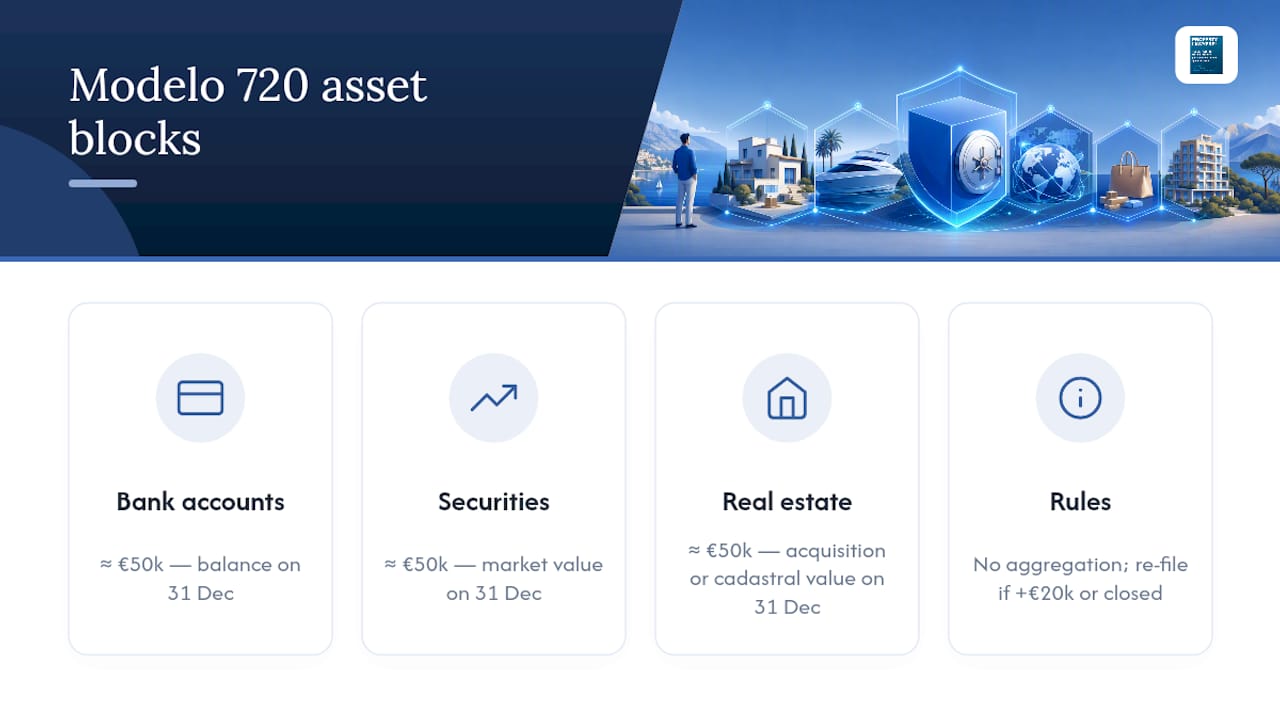
The core rule is straightforward: each of the three blocks has an independent threshold, generally recognized to be around fifty thousand euros. If the total value of your assets within any single block exceeds this threshold as at 31 December, you must file for that block. Assets in different blocks are never aggregated for this purpose.

The valuation reference date is 31 December of the reporting year. For bank accounts, you use the balance on that date. For securities, you use the market value. For property, you typically use the acquisition value or cadastral value, depending on how the asset was acquired.
Exchange rates matter. Convert all foreign-currency values to euros using the official ECB rate published for 31 December of the reporting year. Keep a record of the rate you used.
Once you have filed for a block, you only need to file again for that block if its value increases by more than €20,000 compared with the last declared figure, or if you close or dispose of a previously declared position. A small fluctuation in value does not trigger a new obligation.
Pro Tip: Keep a simple spreadsheet updated each 31 December showing the balance or value of every foreign asset, the exchange rate used, and the euro equivalent. This takes minutes annually and makes filing, corrections, and audits far less stressful.
4. How to file Modelo 720 online via AEAT
Modelo 720 is filed exclusively online through AEAT’s Sede Electrónica. There is no paper option. The BOE order approving Modelo 720 sets the filing period as 1 January to 31 March of the year following the reporting year.
Step-by-step filing process:
- Obtain a valid digital identity. You need one of: a DNIe (Spanish electronic ID), a recognised digital certificate, or registration with Cl@ve (AEAT’s PIN-based identification system). UK residents can apply for a digital certificate through AEAT’s accredited certification authorities.
- Access the filing portal. Go to the AEAT Modelo 720 e-filing interface or navigate via the AEAT Sede Electrónica. You can file using the on-screen form or by uploading a pre-prepared XML file.
- Complete each applicable block. Enter asset details for every block where your holdings exceed €50,000. For each asset, you will need the country of location, the institution’s name and address, account or reference numbers, and the 31 December valuation.
- Attach supporting codes where required. Some entries require IBAN, ISIN codes (for securities), or cadastral references (for property).
- Validate and submit. The system runs a validation check before submission. Correct any flagged errors, then submit.
- Save your confirmation. AEAT generates a CSV (verification code) on successful submission. Save the PDF confirmation and the submitted XML file. These are your proof of filing.
Pro Tip: Do not wait until late March. AEAT’s system can experience high traffic near the deadline. Filing in January or February gives you time to resolve any technical issues without pressure.
5. Penalties and practical risks after the 2022 reforms
The penalty position changed significantly after the Court of Justice of the European Union (CJEU) ruled that Spain’s original Modelo 720 penalty regime was disproportionate and incompatible with EU law. Spain reformed the penalties in 2022, replacing the old punitive fines with the general penalty framework under the General Tax Law (Ley General Tributaria, LGT).
Under the old regime, penalties for non-declaration could be enormous and assets could be treated as unjustified gains with no limitation period. That approach no longer applies.
Under the current framework, the practical risks are:
- Monetary fines under the general LGT regime for late or incorrect filing
- Income re-assessment if AEAT identifies undeclared foreign income within the standard four-year limitation period
- AEAT information requests and audits triggered by mismatches between Modelo 720 data and IRPF or wealth tax returns
- Increased scrutiny for large undeclared balances or significant discrepancies with data received through the OECD’s Common Reporting Standard (CRS)
The reform reduced the legal risk considerably, but non-compliance still carries real financial consequences. For large or complex portfolios, professional advice is worth the cost.
6. How to correct, cancel, or file late
Voluntary late filing before AEAT contacts you is always preferable to waiting for a formal request. AEAT accepts corrections and late submissions through the same telematic service used for original filings.
Steps to correct or file late:
- Access the AEAT filing portal using your digital certificate or Cl@ve credentials.
- Select the relevant tax year and choose the amendment or complementary declaration option.
- Edit only the sections that require correction. You do not need to re-enter data that was correctly declared.
- Submit and save the new CSV confirmation. Keep both the original and the amended confirmation on file.
- Retain supporting documents. Bank statements, broker valuations, and property records dated 31 December are your evidence base for any AEAT query.
Pro Tip: Keep printed or PDF copies of every year-end statement alongside your exchange-rate calculations. If AEAT raises a query years later, having a clear paper trail makes resolution straightforward and reduces the risk of escalation.
If AEAT has already issued a formal information request before you file, the process becomes more complex. At that point, voluntary disclosure still tends to reduce escalation risk compared with non-response, but you should involve a qualified Spanish tax lawyer to manage the correspondence.
7. How Modelo 720 interacts with IRPF and wealth tax
Modelo 720 is an informative declaration. It does not itself create a tax liability. Filing it does not mean you owe tax on the assets declared. What it does is give AEAT a clear picture of your foreign holdings, which they then cross-reference against your other returns.
Income generated by those assets must still be reported separately:
- Dividends and interest from foreign accounts or securities belong on your annual IRPF return (Declaración de la Renta)
- Rental income from a foreign property is also reported on IRPF
- Capital gains on the sale of foreign assets are reported on IRPF in the year of disposal
Foreign property declared on Modelo 720 may also affect your wealth tax in Spain position, since wealth tax is calculated on worldwide assets for Spanish tax residents.
AEAT uses data from the OECD’s Common Reporting Standard (CRS), under which foreign banks and brokers automatically report account information to Spanish tax authorities. This means AEAT often already holds data on your foreign accounts before you file. Consistency between your Modelo 720 and your IRPF return is not optional; discrepancies are a primary trigger for audits.
If you own property in Spain as well as abroad, you may also have obligations under Modelo 210 for Spanish-source income, which is a separate return entirely.
8. UK expat checklist: residency, Brexit, and filing from the UK
UK citizens living in Spain must follow Spanish residency tests. Brexit did not remove Modelo 720 obligations for those who are Spanish tax residents. If you spend more than 183 days a year in Spain or your main economic interests are there, you are a Spanish tax resident and Modelo 720 applies.
Key practical points for UK-based filers:
- UK bank and brokerage accounts count. A Barclays current account, an ISA, a stocks-and-shares account, or a UK pension with a cash surrender value may all fall within Block 1 or Block 2 depending on their nature and value.
- Valuation is at 31 December. Use the ECB euro/sterling exchange rate for that date to convert sterling balances to euros.
- Modelo 720 and HMRC obligations are separate. You may still have UK reporting duties depending on your UK tax status. These are entirely independent systems with different thresholds and deadlines.
- US persons living in Spain face a similar issue: FBAR/FinCEN obligations and Modelo 720 are separate systems with different thresholds and reference dates. Do not conflate them.
Practical workflow for UK-based preparers:
- Request year-end statements (31 December) from every UK bank, broker, and insurer where you hold assets
- Note the balance or value in sterling and convert to euros using the ECB rate for 31 December
- Total the euro values within each of the three blocks independently
- If any block exceeds €50,000, prepare to file for that block
- Deliver documents to a Spanish tax adviser or an English-speaking solicitor listed on Property-lawyers’ adviser directory
When to consult a specialist: large portfolios, trust structures, company shareholdings, or any situation involving multiple jurisdictions warrant professional advice. The US-Spain tax treaty guidance is also worth reviewing if you have US connections, as treaty provisions can affect how certain assets are treated.
For non-resident property tax obligations that sit alongside or instead of Modelo 720, the rules differ significantly, and a qualified adviser can map out which forms apply to your specific situation.
An editorial perspective on Modelo 720 for UK expats
Most people who come to Spain to buy property or retire focus on the purchase process, the legal checks, and the taxes due at completion. Modelo 720 tends to arrive as a surprise in year two or three, once residency has settled in and the first tax season arrives. The form itself is not complicated. What catches people out is the combination of three independent thresholds, the strict 31 December valuation date, and the assumption that because no tax is immediately due, the form is optional. It is not.
The 2022 reforms removed the most punitive aspects of the old regime, which is genuinely good news. But AEAT’s cross-matching with CRS data means the authority often knows more about your foreign accounts than you might expect. Voluntary, accurate, and timely filing is the only sensible approach. For anyone with a portfolio above the thresholds, a one-off conversation with a qualified English-speaking Spanish tax lawyer costs far less than resolving a late-filing penalty or an audit.
Property-lawyers connects you with English-speaking Spanish tax lawyers
Navigating Modelo 720 alongside a property purchase or a recent move to Spain is exactly the kind of situation where having the right legal contact makes a practical difference. Property-lawyers connects international buyers and residents with vetted, independent, English-speaking solicitors and tax advisers across Spain, from Madrid to Marbella.

Whether you need a lawyer in Madrid to handle your first Modelo 720 filing or a specialist across the coast to review a complex foreign portfolio, the Property-lawyers directory of real estate lawyers in Spain lets you find and contact the right professional directly. All listed lawyers are independent, English-speaking, and experienced with international clients. This article is general information, not legal advice. For guidance specific to your situation, contact a qualified Spanish tax lawyer.
Find a Madrid solicitor or search by region across Spain to get personalised help with your Modelo 720 obligations.
Sources
- Form 720. Informative Tax Return. Declaration on assets and rights located abroad
- Orden HAP/72/2013 and BOE consolidated text approving Modelo 720
This article is general information, not a substitute for advice from a qualified financial advisor. Consult a qualified financial professional about your own circumstances before acting on anything here.
FAQ
What is Modelo 720 in Spain?
Modelo 720 is Spain’s annual informative declaration of assets and rights held abroad, filed by Spanish tax residents with foreign holdings exceeding €50,000 in any of the three asset blocks. It does not itself create a tax liability but is used by AEAT to cross-check income and wealth tax returns.
Do I need to complete Modelo 720 as a UK expat in Spain?
Yes, if you are a Spanish tax resident — meaning you spend more than 183 days a year in Spain or your main economic interests are there — Modelo 720 applies regardless of your nationality. Brexit did not change this obligation.
Do I need to declare my UK pension on Modelo 720?
A UK pension with a cash surrender value may fall within Block 2 (securities, rights, insurance, and income). Whether it meets the €50,000 threshold depends on the policy’s surrender value as at 31 December. A defined-benefit pension with no surrender value is generally not declarable, but specialist advice is recommended for complex pension arrangements.
What are the penalties for not filing Modelo 720 in Spain?
Following the 2022 reforms triggered by the CJEU ruling, penalties now fall under Spain’s general tax law (LGT) regime, with standard limitation periods. The old disproportionate fines and imprescriptibility rules no longer apply, but late or incorrect filing can still result in monetary fines and potential income re-assessment within the four-year limitation period.
What is the deadline for filing Modelo 720?
The filing window runs from 1 January to 31 March of the year following the reporting year, as set by the BOE order approving the form. Filing is done exclusively online through AEAT’s Sede Electrónica.
Recommended
- Modelo 210 Spain — Non-Resident Income Tax Return Guide | Property Lawyers
- Property Taxes in Spain — Full Guide for Foreign Owners (2026) | Property Lawyers
- Non-Resident Tax in Spain — Property Owners Guide | Property Lawyers
- Non-Resident Property Tax Spain — Annual Obligations Explained | Property Lawyers

Sophie Gutenberg is a legal content specialist focused on Spanish property law, real estate transactions, conveyancing, due diligence and tax issues affecting international property buyers in Spain. She works alongside qualified Spanish property lawyers .
