

Importing goods and vehicles to Spain: expat guide
Yes, you can bring your household goods and personal effects to Spain duty-free and VAT-free when you move, provided you meet the transfer-of-residence rules set by the Agencia Tributaria (Aduanas) under Regulation (EC) No. 1186/2009. Vehicles follow a separate track governed by the Dirección General de Tráfico (DGT). Understanding import and export in Spain for personal moves is very different from commercial trade — the rules, forms, and deadlines are specific to individuals relocating.
Your three immediate actions:
- Obtain your NIE (Número de Identificación de Extranjero) before anything else.
- Register on the padrón municipal (empadronamiento) at your local town hall.
- Prepare a detailed Spanish-language inventory (Annex I) of every item you are shipping, with acquisition dates and estimated values.
What qualifies for exemption:
- Furniture, household linens, and appliances you have owned and used for at least 6 months
- Personal clothing and everyday items
- Excluded: alcohol, tobacco, commercial goods, and vehicles (separate process)
Property-lawyers can connect you with an English-speaking Spanish lawyer who handles exactly this paperwork.
Key takeaways
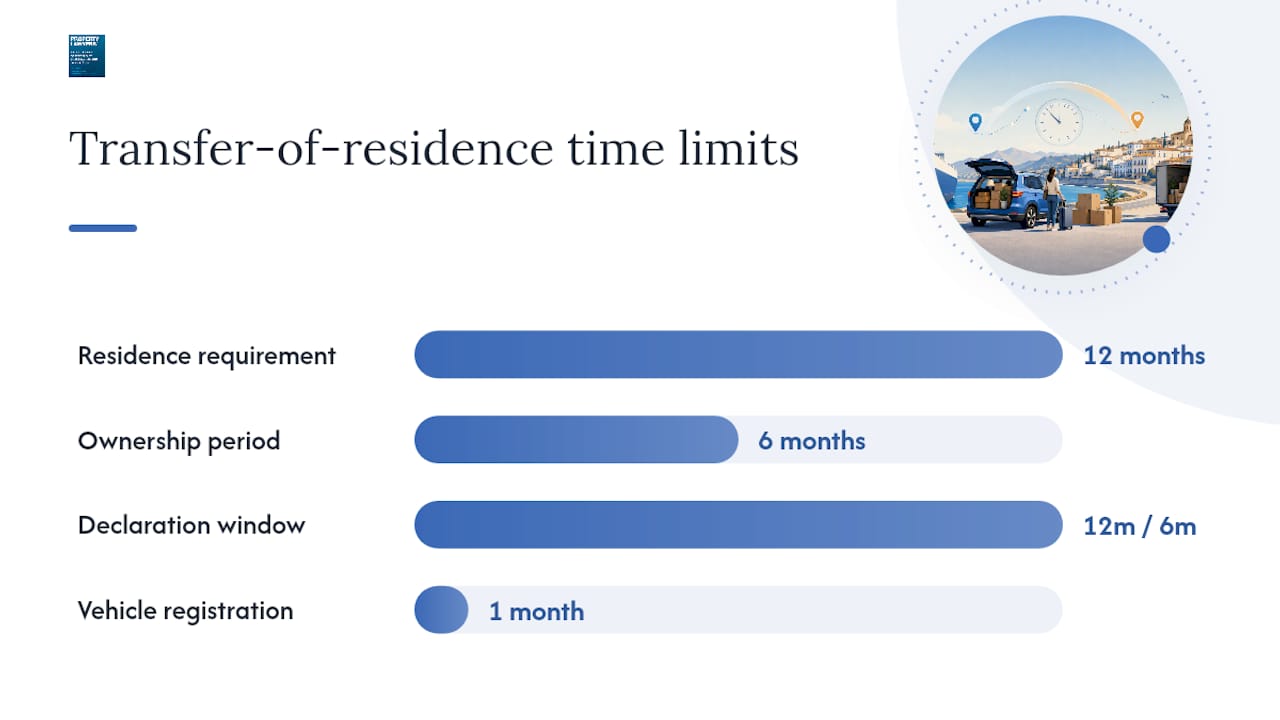
Qualifying for the transfer-of-residence exemption requires 12 months’ prior residence outside the EU, at least 6 months’ ownership of goods, correct DUA/H1 codes, and a vehicle declaration filed separately from household effects.
| Point | Details |
|---|---|
| Residence requirement | You must have lived outside the EU for at least 12 months before moving to Spain. |
| Ownership period | Goods must have been owned and used for at least 6 months to qualify for exemption. |
| Declaration window | Import within 12 months of establishing residence, or up to 6 months before with code 9CR and a guarantee. |
| Vehicles are separate | Cars use their own customs entry, IEDMT Form 576, ITV inspection, and DGT registration within one month. |
| Property-lawyers | Find vetted, English-speaking lawyers across Spain to handle customs, vehicle, and property steps together. |
Table of Contents
- What are the time limits for importing goods duty-free?
- How do you complete the customs declaration (DUA/H1)?
- What does “personal use” actually mean to customs?
- What happens if your documents are incomplete?
- Do the rules differ for the Canary Islands?
- What does the full import timeline look like?
- Common pitfalls that cause delays or fines
- What does it cost if the exemption does not apply?
- Should you use a customs broker or freight forwarder?
- What can you do if customs rejects your exemption claim?
- What most guides get wrong about moving to Spain
- Property-lawyers helps you find the right legal support
- Sources
- FAQ
What are the time limits for importing goods duty-free?
The window is generous but firm. You may import your removal goods within a flexible window around the date you officially establish residence in Spain, with specific requirements such as lodging a financial guarantee and using customs code 9CR on your declaration. After you arrive, you have up to about a year from the date you establish residence to complete the import.
NI 08/2026 — the current Agencia Tributaria guidance note — also requires that you have lived outside the EU for at least 12 months continuously before the move. Miss either deadline and the exemption is lost; standard import duties and VAT apply instead.
How do you complete the customs declaration (DUA/H1)?
The import declaration for personal effects uses form DUA/H1. The key codes to enter are:
- Commodity code: 9905000000 (personal effects, transfer of residence)
- Customs regime: 40.00 (despacho a consumo — dispatch to consumption)
- Additional code 101: VAT exemption
- Additional code C01: customs duty franchise
- Additional code 9CR: if you are declaring before establishing residence (with guarantee)
Your Annex I inventory — listing every item, its value, and acquisition date — must accompany the declaration. Accepted proofs of prior residence include deeds, tax domicile documents, utility bills, and a consular baja consular stamp. Most customs offices also want sworn Spanish translations of foreign-language documents.
What does “personal use” actually mean to customs?
Customs officers apply a straightforward test: do these goods look like they belong to someone moving home, or do they look like stock? Items still in original manufacturer packaging raise immediate flags. So does an unusually large quantity of identical products. Recent purchases — bought in the weeks before shipping — are scrutinised closely, particularly electronics and appliances.

Pro Tip: Take dated photographs of items in your home before packing, and keep original purchase receipts. This single step resolves most personal-use disputes at the border.
What happens if your documents are incomplete?
Customs can still release your goods provisionally if you provide a financial guarantee. Codes 9AI and 9IV are used on the declaration when justification is pending. You typically have a limited period — often around 10 days, though a longer period may be agreed — to supply the missing paperwork. Fail to do so and the guarantee is called in, meaning you pay the full duties and VAT that the exemption would have covered.
Do the rules differ for the Canary Islands?
Yes, significantly. The Canary Islands sit outside the EU VAT area. Regulation (EC) No. 1186/2009 still governs customs duty relief, but the VAT-equivalent treatment follows Canarian fiscal rules rather than mainland Spanish law. For vehicle registration tax, Law 38/1992 on Special Taxes (IEDMT) applies across all Spanish territory, including the islands, though exemption conditions for transfer of residence still apply when met.
What does the full import timeline look like?
A typical move from outside the EU to mainland Spain runs as follows:
- Weeks before departure: Obtain NIE, register empadronamiento, compile Annex I inventory, gather residence proofs.
- At origin port: Freight forwarder lodges pre-arrival notification; you or your customs broker prepare the DUA/H1.
- On arrival in Spain: Customs examines declaration and documents; goods released (or held pending guarantee).
- Within 12 months of residence date: All shipments must clear customs under the exemption.
- Vehicle (separate track): Customs clearance first, then ITV inspection, then IEDMT payment or exemption claim via Form 576 (or Forms 05/06 where prior recognition applies), then DGT registration. Residents must register a vehicle within one month of becoming resident.
For EU-origin vehicles, the DGT may issue temporary green plates valid for up to 60 days while registration is processed.
Common pitfalls that cause delays or fines
The mistakes that cost expats the most time and money are predictable and avoidable:
- Incomplete Annex I: A vague list (“miscellaneous household items”) is routinely rejected. Every item needs a description, value, and acquisition date.
- Missing the 12-month residence-abroad requirement: If you moved back to an EU country for a period before relocating to Spain, you may not qualify.
- Shipping a vehicle on the same declaration as household goods: Vehicles must use a separate customs entry; mixing them invalidates both claims.
- Selling or lending exempted goods within 12 months: Doing so triggers retrospective taxation and penalties.
- Booking ITV too late: ITV stations in popular expat areas (Málaga, Mallorca, Alicante) can have waiting times of several weeks. Book as soon as the vehicle arrives.
What does it cost if the exemption does not apply?
If you do not qualify for the transfer-of-residence exemption, standard import costs apply. For vehicles from outside the EU, customs duty is typically 10% of the vehicle’s value, plus IVA at 21% — and homologation may also be required. IEDMT (the vehicle registration tax under Law 38/1992) is calculated on the vehicle’s fiscal value and varies by CO₂ emissions and engine size; exemption is possible for qualifying transfers of residence via Form 576.
A customs broker’s fee for handling a full removal typically runs from a few hundred euros upwards, depending on shipment size and complexity.
Should you use a customs broker or freight forwarder?
For most expats, yes. A licensed Spanish customs agent (agente de aduanas) can file the DUA/H1 electronically, apply the correct codes, and communicate directly with Aduanas on your behalf. A freight forwarder handles the physical logistics; many offer combined services. When choosing one, confirm they have experience specifically with transfer-of-residence declarations — it is a distinct specialism from commercial import procedures.
Aligning your property purchase documents with your customs file saves significant time, since deeds and utility bills serve both purposes. A relocation guide covering common moving mistakes can also help you sequence the steps correctly.
What can you do if customs rejects your exemption claim?
If Aduanas denies your exemption or misclassifies your goods, you have a formal right of appeal. The first step is a recurso de reposición (administrative appeal) filed directly with the customs office that issued the decision, normally within one month. If that is unsuccessful, you may escalate to a reclamación económico-administrativa before the Tribunal Económico-Administrativo Regional (TEAR). Throughout this process, keep every original document, the DUA/H1 reference number, and any written correspondence from customs. A Spanish lawyer or gestor with customs experience is strongly advisable at this stage.
What most guides get wrong about moving to Spain
The standard advice — “keep your receipts and file on time” — is correct but incomplete. The detail that catches people out most often is the vehicle track. Expats assume that because their car is included in the removal, it falls under the same household-goods exemption. It does not. Vehicles are excluded from commodity code 9905000000 entirely and require their own customs entry, their own IEDMT declaration, and a separate ITV appointment.
The second overlooked point is the 12-month post-import restriction. Selling a sofa or lending a car to a friend within the first year after importing under the exemption can trigger a tax demand for the full duties and VAT that were waived. Customs authorities do check, particularly for vehicles.
One practical rule covers both risks: treat your customs file as a living document. Keep it updated with ITV certificates, DGT registration confirmation, and any correspondence with Aduanas. If a question arises six months later, you will have everything in one place.
Property-lawyers helps you find the right legal support
Moving to Spain involves more paperwork than most buyers expect, and the customs and vehicle registration steps sit alongside your property purchase, NIE application, and tax registration. Getting one wrong can delay all the others.
Property-lawyers is Spain’s leading directory of vetted, English-speaking property lawyers, covering every region from Málaga and Marbella to Mallorca and Barcelona. A good lawyer or gestor can check your eligibility for the transfer-of-residence exemption, prepare your DUA/H1, handle sworn translations, and liaise with Aduanas or the DGT on your behalf. Before you make contact, gather your NIE, empadronamiento certificate, Annex I inventory, vehicle deregistration document, Certificate of Conformity (CoC), and purchase invoices. Find a Spanish property lawyer who covers your area and can advise on both your property purchase and your customs obligations in one conversation.
Sources
- Administracion
- NI 08/2026 — Note on customs duty and VAT exemption for transfer of residence — Agencia Tributaria (PDF)
- Transfer of residence: customs franchises and VAT exemptions — Agencia Tributaria
- What are the rules for bringing my furniture when moving to Spain? — The Local
This article is general information, not a substitute for advice from a qualified lawyer. Consult a qualified legal professional about your own circumstances before acting on anything here.
FAQ
Can I import household goods duty-free when moving to Spain?
Yes, provided you have lived outside the EU for at least 12 months and have owned the goods for at least 6 months. File a DUA/H1 with commodity code 9905000000 and the relevant additional codes.
Does my car qualify for the same exemption as my furniture?
No. Vehicles are excluded from the household-goods exemption and require a separate customs declaration, an ITV inspection, IEDMT payment or exemption via Form 576, and DGT registration within one month of becoming resident.
What if I ship my goods before I officially move to Spain?
You can import up to 6 months before establishing residence by using additional code 9CR on the DUA/H1 and lodging a financial guarantee with customs.
What happens if customs rejects my exemption claim?
File a recurso de reposición with the issuing customs office within one month. If unsuccessful, escalate to the Tribunal Económico-Administrativo Regional (TEAR). Keep all original documents and your DUA/H1 reference number.
Do the Canary Islands follow the same import rules as mainland Spain?
Customs duty relief under Regulation (EC) No. 1186/2009 still applies, but the Canary Islands use IGIC instead of IVA, so the VAT-equivalent treatment differs from the mainland.
Recommended
- Property Buying Guide Spain: Legal Advice for Foreign Buyers
- How to set up business in Spain: 2026 guide
- 10 important steps before buying property in Spain | Property Lawyers
- Spanish foreign investment property rules explained

Sophie Gutenberg is a legal content specialist focused on Spanish property law, real estate transactions, conveyancing, due diligence and tax issues affecting international property buyers in Spain. She works alongside qualified Spanish property lawyers .
