

Legal practice management software comparison for UK firms
For most UK law firms, the strongest starting point is one of the cloud-native leaders. Clio, LEAP, and Osprey consistently appear across independent roundups as the most capable all-round platforms for UK practices, while Filevine and Smokeball serve high-volume litigation and document-heavy teams more precisely. The right choice depends almost entirely on your firm size, practice area, and whether trust accounting needs to live inside the same system.
Here is a practical shortlist to start your evaluation:
- Clio — Broadest integration ecosystem and mature billing tools; suits small to large firms needing a proven cloud platform with strong trust-accounting workflows. Free trial available.
- LEAP — Built-in conveyancing templates and property transaction workflows; the natural first look for UK conveyancing and property practices.
- Osprey — UK-focused feature set with familiar migration paths from on-premises to cloud; well suited to established mid-size firms.
- Smokeball — Automatic time capture and document assembly; best for litigation and family law teams that bill by the hour and handle high document volumes.
- Filevine — Highly configurable matter pipelines; preferred by personal injury and high-volume litigation teams with complex, non-linear workflows.
- Actionstep — Rules-driven conditional workflow engine inside each matter; strong for firms with bespoke, multi-stage processes.
Most vendors on this list offer a free trial or a structured demo. Request a demo that includes trust-accounting flows and a data-migration walkthrough before committing. ISO 27001 certification and verified user ratings on Capterra and G2 are the two trust signals worth checking first.
Table of Contents
- How do the leading systems compare at a glance?
- What does each system actually deliver for UK firms?
- How do you choose the right system for your UK firm?
- What do cloud vs on-premises mean for UK firms?
- Key takeaways
- Property-lawyers connects you with the right legal expertise
- FAQ
How do the leading systems compare at a glance?
The table below covers the main platforms available to UK firms. Pricing is indicative; always confirm current tiers directly with vendors, as feature gating means the advertised entry price rarely reflects the cost of the tier you will actually need.
| Platform | Best for | Pricing model | Deployment | Core features | Security / GDPR | UK support |
|---|---|---|---|---|---|---|
| Clio | Small–large firms; broad practice areas | Per user/month; tiered (add-ons raise TCO) | Cloud | Matter mgmt, billing, trust accounting, docs, workflows | ISO 27001; UK data centres available | Yes |
| LEAP | Conveyancing & property practices | Per user/month; bundled | Cloud | Conveyancing templates, matter mgmt, time & billing, docs | UK data residency; GDPR compliant | Yes |
| Osprey | Established UK mid-size firms | Per user/month | Cloud / on-prem path | Case mgmt, time & billing, docs, reporting | UK-focused; GDPR compliant | Yes |
| Smokeball | Litigation, family law | Per user/month | Cloud | Auto time capture, document assembly, matter mgmt | SOC 2; GDPR compliant | Limited UK |
| Filevine | PI & high-volume litigation | Per user/month; configurable | Cloud | Configurable pipelines, collaboration, docs, reporting | SOC 2; GDPR compliant | Limited UK |
| Actionstep | Bespoke multi-stage workflows | Per user/month | Cloud | Conditional workflow engine, matter mgmt, billing, docs | ISO 27001; GDPR compliant | Yes |
| MyCase | Solos & small firms | Per user/month; all-in-one | Cloud | Client portal, matter mgmt, billing, docs | SOC 2; GDPR compliant | Limited UK |
| PracticePanther | Small–mid firms; repeatable matters | Per user/month; tiered | Cloud | Workflow automation, matter mgmt, billing, docs | SOC 2; GDPR compliant | Limited UK |
| CosmoLex | Firms needing built-in accounting | Per user/month | Cloud | Native trust accounting, general ledger, matter mgmt | SOC 2; GDPR compliant | Limited UK |
| Rocket Matter | Budget-conscious solos & small firms | Per user/month | Cloud | Matter workflows, reporting, billing | SOC 2; GDPR compliant | Limited UK |
| ProLaw | Large regional & enterprise firms | Enterprise licence | Cloud / on-prem / hybrid | Deep accounting, ERP integrations, matter mgmt | Enterprise-grade; GDPR compliant | Via partner |
| Aderant / Expert Sierra | Large & enterprise firms | Enterprise licence | Cloud / on-prem | Advanced finance controls, matter mgmt, reporting | Enterprise-grade; GDPR compliant | Via partner |
| OneAdvanced | Larger UK firms; bespoke needs | Enterprise / modular | Cloud / on-prem | Custom integrations, matter mgmt, billing, docs | ISO 27001; UK data residency | Yes |
| Proclaim | Niche UK practice areas | Per user/month | Cloud / on-prem | Specialist case workflows, matter mgmt, billing | UK-focused; GDPR compliant | Yes |
| DPS Software | Mid-sized UK firms | Per user/month | Cloud / on-prem | Integrated practice workflows, billing, docs | UK-focused; GDPR compliant | Yes |
| PracticeEvolve | Mid-size firms; integrated admin | Per user/month | Cloud | Accounts integration, practice admin, matter mgmt | GDPR compliant | Limited UK |
| Dye & Durham | Firms needing broad product portfolio | Varies by product | Cloud / on-prem | Multiple legal-tech products; varied feature sets | Varies by product | Yes |
| Visualfiles | Complex process modelling | Enterprise licence | On-prem / cloud | Case automation, workflow modelling, matter mgmt | Enterprise-grade; GDPR compliant | Yes |
| Redbrick | UK on-prem / hybrid practices | Per user/month | On-prem / hybrid | Case mgmt, specialist workflows, billing | UK-focused; GDPR compliant | Yes |
| Hoowla | Client engagement focus | Per user/month | Cloud | Client progress tracking, case progression, matter mgmt | GDPR compliant | Yes |
| Quill | Small teams; simple matter tracking | Per user/month | Cloud | Matter tracking, billing, basic docs | GDPR compliant | Yes |
| Peppermint | Growing firms; modular expansion | Modular / per user | Cloud | Scalable modules, matter mgmt, billing | GDPR compliant | Yes |
| InTouch | Client intake & CRM workflows | Per user/month | Cloud | CRM, intake, client engagement | GDPR compliant | Yes |
| AbacusLaw | On-prem / hybrid legacy investment | Per user/month | On-prem / hybrid | Matter mgmt, billing, docs, calendaring | GDPR compliant | Limited UK |
| Amicus Attorney | Small–mid firms; matter-centred | Per user/month | Cloud / on-prem | Matter organisation, case workflows, billing | GDPR compliant | Limited UK |
| Neos | Modern cloud-native; newer entrants | Per user/month | Cloud | Modern UX, matter mgmt, billing, docs | GDPR compliant | Limited UK |
| SOS | UK practices; varied sizes | Per user/month | Cloud / on-prem | Practice mgmt, billing, docs | UK-focused; GDPR compliant | Yes |
Integration highlights: Clio connects with over 200 third-party tools including Xero, QuickBooks, Microsoft 365, and DocuSign. LEAP and Osprey integrate with Land Registry and HMRC portals, which matter directly to UK conveyancing teams. Most cloud platforms support Xero or QuickBooks for accounts; fewer offer native trust accounting without an add-on.
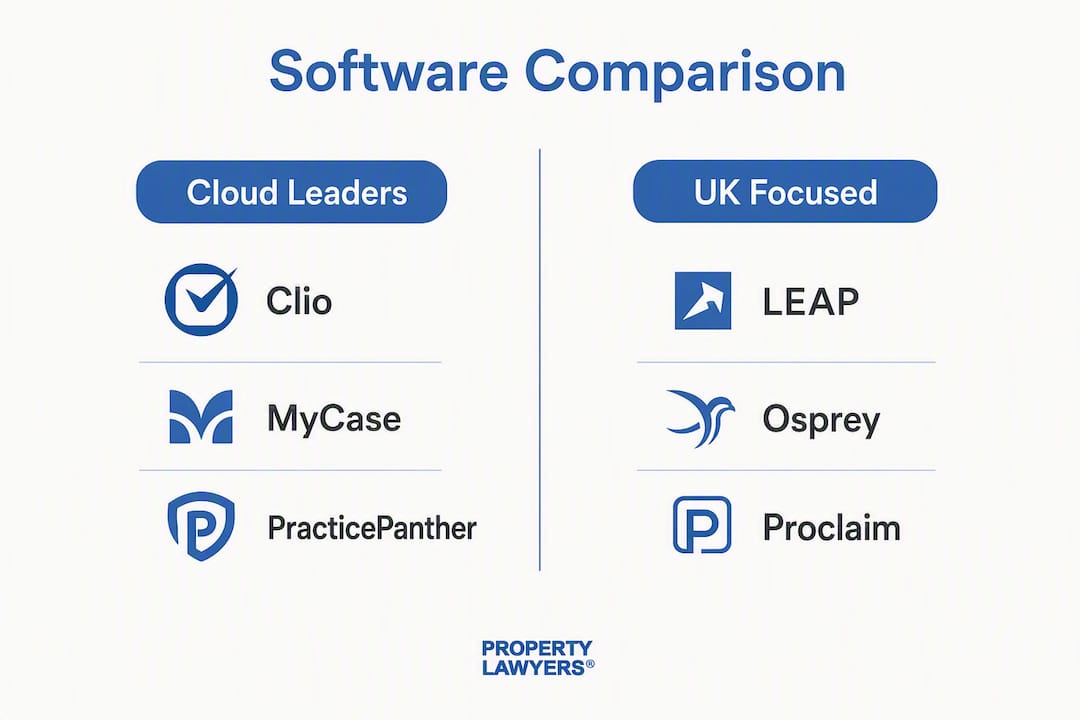
Trial and demo availability: Clio, MyCase, PracticePanther, Rocket Matter, and Hoowla offer free trials. Enterprise platforms (ProLaw, Aderant, Visualfiles) typically require a structured demo and scoping call rather than a self-serve trial.
What does each system actually deliver for UK firms?
Cloud-native leaders for small and mid-size firms
Clio is the most widely cited platform in independent roundups, and for good reason. Its integration marketplace is the deepest in the category, connecting with accounting, document management, e-signature, and payment tools. Trust accounting and three-way reconciliation are built in. The caution: total cost of ownership can be significantly higher than the advertised entry price once add-ons such as Clio Grow (intake) and Clio Draft (document automation) are included. Evaluate the tier that includes the features you need, not the advertised entry price.

MyCase keeps things genuinely simple. The client portal and two-way messaging are bundled at lower tiers, which removes the need for a separate client-communication tool. It suits solo practitioners and small firms that want one login for everything. UK-specific trust-accounting depth is thinner than Clio’s, so confirm reconciliation workflows before committing.
PracticePanther markets a low entry price, but key automation features are gated to higher tiers. For firms that need configurable workflow automation on repeatable matter types, the Essential or Business tier is the realistic starting point. Integrations with Xero and QuickBooks are available; native trust accounting requires verification for UK-specific reconciliation rules.
Rocket Matter offers a balanced feature set at SMB price points, with solid operational reporting. It suits budget-conscious solos and small firms that need reliable matter workflows without paying for enterprise depth they will not use.
Neos is a newer cloud-native entrant with a modern interface and faster onboarding than legacy platforms. Worth considering for firms that have struggled with clunky UX on older systems.
Document automation and time-capture specialists
Smokeball captures time automatically in the background as fee earners work, which is its single most distinctive capability. Document assembly is strong, making it a natural fit for litigation and family law teams. UK availability has expanded, but confirm local support SLAs before signing.
Hoowla focuses on client experience and case progression visibility. Clients can track their matter’s progress through a portal, which reduces inbound calls. It suits conveyancing and residential property teams where client communication volume is high.
Quill is straightforward matter tracking for small teams that do not need complex automation. If your firm has two to five fee earners and wants an uncomplicated system, Quill avoids the overhead of a full enterprise platform.
UK-focused and established platforms
Osprey has a long track record with UK mid-size firms and offers migration pathways from on-premises to cloud. Its local-market feature set includes familiar UK billing conventions and reporting formats.
LEAP is the strongest choice for conveyancing and property practices. Pre-built templates for residential and commercial property transactions reduce setup time considerably. Land Registry and HMRC integrations are built in rather than bolted on.
Proclaim serves niche UK practice areas with focused case workflows. Personal injury, clinical negligence, and debt recovery teams have historically used it for its specialist matter structures.
DPS Software and Redbrick both target UK practices with on-premises or hybrid deployment options, useful for firms with existing infrastructure investments or data-residency requirements that rule out US-hosted cloud platforms.
SOS covers varied UK firm sizes with practice management, billing, and document tools, and offers both cloud and on-premises deployment.
Peppermint suits growing firms that want to add capability incrementally. Its modular pricing means you pay for what you use and expand as the firm grows, rather than buying a full enterprise licence upfront.
InTouch focuses on client intake and CRM-style workflows, making it useful for firms with high new-enquiry volume that need structured intake before matters open formally.
Enterprise and complex-process platforms
ProLaw is built for large regional and AmLaw-size firms with deep general-ledger and ERP-style integration needs. Implementation typically requires dedicated teams, multi-week mapping workshops, and staged data migrations before the system reaches full productivity. Not a platform to buy and configure yourself over a weekend.
Aderant / Expert Sierra sits at the same enterprise tier, with sophisticated matter accounting and firm-finance controls. Large firms with complex partner-compensation models and multi-office reporting requirements are its natural home.
OneAdvanced serves larger UK firms that need custom integrations and on-premises options. It holds ISO 27001 certification and maintains UK data residency, which matters for firms handling sensitive client data under UK GDPR.
Visualfiles models complex case processes for larger practices or teams with highly non-standard workflows. Its strength is process automation depth rather than out-of-the-box simplicity.
Dye & Durham operates as a portfolio provider with multiple legal-tech products under one umbrella. Firms that want a single vendor relationship across several practice-support tools may find this convenient, though the breadth means individual products vary in depth.
PracticeEvolve integrates practice administration and accounts workflows for mid-size firms that want a single system for office management and billing without a full enterprise licence.
AbacusLaw and Amicus Attorney both have long market histories and support on-premises or hybrid deployment. They suit firms with existing legacy investments that are not yet ready for a full cloud migration.
8am MyCase, Visual Files, and the separately listed MyCase entry in some roundups refer to the same MyCase platform or closely related positioning. Treat them as one product when shortlisting.
Pro Tip: Before requesting demos, write down the three matter types your firm handles most often and the specific workflow steps each requires. Share that document with every vendor. A vendor that cannot map their system to your actual workflows in the demo is unlikely to do so after you sign.
How do you choose the right system for your UK firm?
Selection checklist
Match your requirements to these criteria before you open any vendor conversation:
- Trust accounting: Does the system handle three-way reconciliation natively, or does it require an external accounting package? For UK firms holding client funds, this is a category disqualifier if absent.
- Practice area fit: Conveyancing firms need Land Registry and HMRC integrations. PI and litigation teams need configurable pipelines. General practice needs broad matter management.
- Firm size: Solo and small firms benefit from cloud all-in-one platforms; high-volume litigation teams may require highly configurable systems.
- Deployment: Cloud-only, on-premises, or hybrid? UK data residency requirements narrow the field.
- Integration requirements: Which accounting package, document management system, and payment provider does your firm already use?
- Total cost of ownership: The entry-level price often excludes critical automation or reporting features. Budget for the tier that includes what you need, plus implementation, data migration, and training.
Ten questions to ask in every vendor demo
- Show me a complete trust-accounting workflow including three-way reconciliation. What does the audit trail look like?
- How does the system handle our specific matter type? (Describe your most common matter in detail.)
- Where is our data hosted? Is it within the UK or EEA?
- What is your ISO 27001 or SOC 2 status, and when was your last penetration test?
- What does data migration include, and what format do you need our existing data in?
- What is your SLA for incident response and breach notification under UK GDPR?
- Which accounting packages do you integrate with natively, and how does the reconciliation work?
- What does onboarding include, and how long does a firm our size typically take to go live?
- Can we export all our data in a portable format if we leave? Show us how.
- What features are gated to higher tiers that we would need for our workflows?
Red flags to watch for
- No clear answer on data residency or sub-processor locations.
- Trust-accounting demonstration that relies on a third-party add-on with no native reconciliation.
- Vague SLAs (“we respond as quickly as possible”) with no contractual commitment.
- No data-export or migration-out tooling.
- A demo that shows only the best-case scenario on a clean test database, not a realistic matter volume.
Analysts consistently recommend mapping your existing workflows before selecting a platform. The software should automate what already works, not force a reorganisation around the tool’s logic.
What do cloud vs on-premises mean for UK firms?
Deployment trade-offs
Cloud platforms offer lower upfront cost, automatic updates, and remote access from any device. For most small and mid-size UK firms, cloud is the practical default. The trade-off is dependence on the vendor’s infrastructure and, for some platforms, data hosted outside the UK.

On-premises deployment keeps data on your own servers, which some firms prefer for control and data-residency certainty. The cost is higher upfront, and your IT team carries responsibility for backups, updates, and security patching. Platforms such as ProLaw, Visualfiles, and AbacusLaw support on-premises or hybrid models.
Hybrid arrangements let firms keep sensitive data on local servers while using cloud services for less sensitive functions. OneAdvanced and Osprey both offer migration pathways that allow a phased move from on-premises to cloud.
UK GDPR and security checklist
Before signing any contract, confirm the following:
- Data processing agreement (DPA): The vendor must sign one. It should name all sub-processors and specify deletion rights on contract termination.
- Data residency: Confirm whether data is stored in the UK or EEA. If stored outside, ask for the transfer mechanism (standard contractual clauses or equivalent).
- Security certifications: ISO 27001 is the gold standard for UK firms. SOC 2 Type II is acceptable for US-headquartered vendors with UK operations. Ask for the certificate, not just a claim.
- Encryption: Confirm encryption at rest and in transit. Ask about key management.
- Breach notification: The vendor’s SLA for notifying you of a breach must be within 72 hours to allow you to meet your own UK GDPR obligations.
- Exit rights: You must be able to retrieve all your data in a usable format. Get this in writing before you sign.
- Penetration testing: Ask for the cadence and whether results are shared with clients.
Data migration is a major component of switching vendors. Many vendors offer complimentary migration support, but you must clean your existing data first. Migrating disorganised records replicates the problem in the new system rather than solving it.
Pro Tip: Request the vendor’s sub-processor list before signing. A vendor that cannot produce it promptly, or whose list includes processors in jurisdictions with no adequacy decision, is a compliance risk regardless of how good the software is.
How we selected and compared vendors
Vendors were included based on five criteria: feature coverage across the core dimensions (matter management, time and billing, document management, workflows, and reporting); native or integrated trust-accounting capability relevant to UK client-fund rules; confirmed UK availability and support presence; published security posture (ISO 27001, SOC 2, or equivalent); and verified user ratings from Capterra, G2, and Gartner Peer Insights.
Sources used include vendor documentation, independent review platforms (Capterra, G2, Gartner), and specialist legal-tech review sites. Pricing data is indicative and based on publicly available information at the time of writing; vendors update tiers frequently.
A note on limitations: Where a vendor does not publish pricing or security certifications publicly, the relevant table cell shows “—”. Missing data does not disqualify a vendor; it signals that you need to ask directly. Enterprise platforms in particular rarely publish list prices. Treat this comparison as a structured starting point, not a substitute for a vendor-specific evaluation.
Key takeaways
For UK law firms, the most important decision is not which platform has the most features — it is which platform fits your practice area, handles trust accounting natively, and keeps your client data within compliant boundaries.
| Point | Details |
|---|---|
| Start with practice-area fit | Conveyancing firms should prioritise LEAP or Osprey; PI and litigation teams should evaluate Filevine or Smokeball first. |
| Trust accounting is non-negotiable | Confirm three-way reconciliation is native, not dependent on a third-party add-on, before shortlisting any vendor. |
| Price the tier you will actually use | Entry-level pricing often excludes automation and reporting; the real cost can be significantly higher than the advertised figure. |
| Data residency matters for UK GDPR | Confirm UK or EEA data hosting and request a signed data processing agreement before signing any contract. |
| Property-lawyers as an alternative route | For firms handling international property clients, Property-lawyers offers a complementary directory model alongside your practice management choice. |
What most firms get wrong when choosing practice software
The most common mistake is buying the platform with the most features. A system that does everything rarely does your specific things well, and the configuration overhead to make it fit can cost more in staff time than the licence fee itself.
The second mistake is underestimating data migration. Firms often assume the vendor will handle it. Vendors do provide tools and support, but the quality of the migration depends entirely on the quality of the data going in. A pre-migration audit — removing duplicate client records, standardising matter naming, and locating orphaned documents — is not optional. It is the difference between a clean go-live and six months of correcting errors in the new system.
A small UK residential conveyancing firm recently switched from a legacy on-premises system to a cloud platform, attracted by the lower monthly cost. The migration took three times longer than planned because matter files had been named inconsistently for years. The lesson: the software decision is straightforward compared to the data-readiness work that precedes it.
In the first 30 days after purchase, run a single matter type end-to-end in the new system before migrating anything. In days 31 to 60, run trust-accounting flows with real figures in a test environment. By day 90, your team should be able to complete their most common matter type without referring to training notes. If they cannot, the implementation has not finished — regardless of what the vendor’s go-live checklist says.
Property-lawyers connects you with the right legal expertise
The platforms compared above handle the operational side of running a law firm. For UK property lawyers who also serve international clients buying or selling in Spain or Portugal, the client-acquisition side is a separate challenge entirely.

Property-lawyers is a specialist directory connecting international property buyers with vetted, English-speaking real estate lawyers across Spain and Portugal. For UK-based property law firms with cross-border clients, a listing on Property-lawyers puts your practice in front of buyers who are actively searching for legal representation in their target market. It is a direct route to international client enquiries, without the overhead of running your own multilingual marketing.
If your firm handles Spanish or Portuguese property transactions for UK or international clients, explore how a listing works or see the subscription options to find the right level of visibility for your practice.
FAQ
What is the best legal case management software for UK firms?
For most UK firms, Clio, LEAP, and Osprey are the strongest all-round options, with LEAP particularly well suited to conveyancing practices. The best choice depends on your practice area and whether you need native trust accounting.
Do most UK law firms use a single practice management system?
Many mid-size and larger firms use a core practice management platform supplemented by specialist tools for document management or accounting. Smaller firms increasingly use all-in-one cloud platforms to reduce the number of systems they manage.
What practice management software is best for a solo practitioner?
MyCase and Rocket Matter are consistently rated well for solo practitioners because they combine matter management, billing, and client communication in one platform at accessible price points, without requiring significant configuration.
Is Claude or ChatGPT better for lawyers than a dedicated practice management system?
AI writing tools such as Claude or ChatGPT assist with drafting and research but do not replace practice management software. They lack matter management, trust accounting, time capture, and GDPR-compliant client data handling. Use them alongside a dedicated system, not instead of one.
How much does legal practice management software typically cost for a UK firm?
Cloud platforms for small firms typically start at entry prices, but the tier that includes automation and reporting features you need often exceeds $200 per user/month for a full suite when add-ons are included. Enterprise platforms are priced on bespoke licences. Always evaluate the total cost of the tier you will actually use, including implementation and training.
Recommended
- Testimonials from Property Lawyers Members
- Law Firm Website Design for Property Lawyers | SEO & Leads

Sophie Gutenberg is a legal content specialist focused on Spanish property law, real estate transactions, conveyancing, due diligence and tax issues affecting international property buyers in Spain. She works alongside qualified Spanish property lawyers .
