

What is saneamiento por evicción and how does it protect buyers in Spain?
Saneamiento por evicción is the seller’s legal duty to compensate you if a Spanish court later rules that someone else, not you, was always the rightful owner of the property you bought. It sits in Articles 1475 to 1483 of the Spanish Civil Code and it exists specifically to stop buyers being left with nothing after paying full price for a home. Two things need to happen before you can claim: a court must issue a final judgment (sentencia firme) taking the property away from you, and you must have told the seller about the legal claim while it was ongoing, so they had the chance to defend it.
If you ever find yourself facing a third party’s claim on a property you have bought:
- Keep every document from the purchase safe (contract, deed, payment records).
- Tell your seller immediately, in writing, that a claim has been made.
- Speak to a Spanish property lawyer before responding to any court paperwork.
Spanish courts have confirmed this framework recently. In Sentencia 164/2021, the Supreme Court reiterated that the buyer’s right to claim depends on a final ruling, proper notice to the seller, and proof that the competing right existed before the sale.
Key Takeaways
Saneamiento por evicción only becomes enforceable once a Spanish court issues a final judgment removing your ownership, and it depends on you having notified the seller in time.
| Point | Details |
|---|---|
| Two conditions decide the claim | You need a sentencia firme and proof you notified the seller before the claim succeeds. |
| Recovery goes beyond the price | Costs, legal fees, and damages for seller bad faith can all form part of a valid claim. |
| Hidden charges carry a one-year limit | Undisclosed servitudes or charges must be claimed within one year of discovery under Article 1483. |
| Registry checks reduce but don’t eliminate risk | A nota simple confirms the registered position but can’t catch unregistered heirs or emerging claims. |
| Early legal advice changes outcomes | Property-lawyers.com connects buyers with English-speaking lawyers before and after a title problem appears. |
Table of Contents
- What counts as evicción in a Spanish property sale?
- What must you prove to make a saneamiento claim?
- What can you recover after eviction, and what are the limits?
- When can you actually make a claim, and how long do you have?
- What to do the moment a title problem appears
- How to reduce the risk of evicción before you sign anything
- When should you bring in a Spanish property lawyer?
- Why buyers underestimate this risk
- How Property-lawyers.com helps you avoid this situation
- Sources
- FAQ
What counts as evicción in a Spanish property sale?
Evicción happens when a court decides, after the sale has closed, that someone other than you had a stronger legal claim to the property all along, and that claim existed before you bought it. Article 1475 of the Civil Code frames it as deprivation “by virtue of a final judgment and by right prior to the sale.” That distinction matters: the problem has to predate your purchase, not arise afterwards.
It is easy to confuse evicción with other property problems, but the differences are significant:
- Evicción deals with ownership. Someone else legally owned all or part of the property, or held a right (like an easement) that predates your title.
- Vicios ocultos (hidden defects) deals with condition. The building has a structural or physical flaw the seller didn’t disclose. Our guide to building defects law in Spain covers that separately.
- Registry defects are administrative errors that a proper title check should catch before completion, not after.
Common scenarios that trigger evicción claims include a long-lost heir surfacing to contest an inheritance sale, an undisclosed mortgage or charge that survives the transfer, or a neighbour successfully asserting a boundary or right-of-way that pre-dates the deed.
What must you prove to make a saneamiento claim?
Winning a saneamiento por evicción claim depends on satisfying three linked conditions, and missing any one of them can sink an otherwise legitimate case.
- A sentencia firme. The court ruling that removes your ownership must be final and not subject to further appeal. Until that happens, you cannot bring your claim against the seller. This is the trigger point for everything that follows.
- A prior right. The competing claim must have existed before your purchase completed. If the right only arose afterwards (say, a debt the previous owner incurred after selling to you), evicción doesn’t apply.
- Notification of the seller. You must have told your seller about the legal proceedings while they were live, giving them a genuine opportunity to step in and defend the title. Courts treat this as a real precondition, not paperwork you can skip and fix later.
The Supreme Court’s 2021 ruling reinforced this last point specifically: notification isn’t a courtesy, it’s a condition that shapes whether the claim succeeds at all. The same judgment noted that eviction can sometimes stem from administrative decisions, not just court rulings, so the underlying cause of loss can be broader than many buyers assume.
What can you recover after eviction, and what are the limits?
If a court strips you of the property through a final judgment, the law gives you several routes back to a fair outcome, spelled out mainly in Article 1478 of the Civil Code.
You can typically claim:
- The full price you paid, regardless of whether the property has since risen or fallen in value.
- Costs of the sale, including notary and registry fees you covered at completion.
- Legal costs tied to defending the claim, where the seller was notified and failed to intervene.
- Fruits or income you had to hand over to the successful claimant.
- Damages, which increase if the seller acted in bad faith (mala fe), for example by knowingly hiding a competing claim.
Partial eviction, where you lose only part of the property or a right attached to it, works differently. Article 1479 allows you to seek rescission of the whole contract if the part you lost is significant enough that you wouldn’t have bought without it; otherwise, compensation is proportionate to what you lost.
Sellers cannot always escape liability by inserting a waiver clause. Articles 1476 and 1477 limit how far contractual exclusions go, and courts will strike down a waiver if the seller knew about the risk and hid it from you. That protection matters more than most buyers realise when reviewing draft contracts.
When can you actually make a claim, and how long do you have?
Your right to claim only becomes active once the sentencia firme is issued, not when the dispute first surfaces. Until the court rules, you have no enforceable claim against the seller under this doctrine, so tracking the litigation timeline matters as much as the outcome itself.

One deadline deserves special attention: hidden charges or servitudes not recorded on the property but later discovered carry a one-year window under Article 1483, running from the date they come to light. General prescription rules for other saneamiento claims can vary depending on the nature of the right affected, so getting a firm date from a lawyer early avoids losing your claim by missing a deadline you didn’t know existed.
Practical housekeeping helps here more than most buyers expect:
- Record the exact date you first learned of any competing claim.
- Note the date of the final judgment, since that is when your clock against the seller effectively starts.
- Keep dated copies of every letter you send the seller.
What to do the moment a title problem appears
Discovering a third party is contesting your ownership is unsettling, but the order in which you act genuinely affects your chances of a full recovery.
- Freeze every document. Gather the purchase contract, deed (escritura), payment proof, and all correspondence with the seller and agent. Nothing gets discarded from this point on.
- Order an updated nota simple and registral certificate. You need the property’s current legal status, not the one from when you bought it, to understand exactly what’s being claimed.
- Notify the seller formally, in writing. This isn’t optional. Send it by a method that proves delivery, and invite the seller to join the defence.
- Collect supporting evidence. Payment records, the original contract terms, and any written declarations the seller made about title all strengthen your position.
- Take legal advice on interim protective measures. In some cases, a lawyer may recommend urgent court applications before the underlying claim is even resolved.
Pro Tip: Send your notification to the seller by a channel that creates a paper trail, such as a notarised letter or registered post with proof of delivery. Courts have denied claims purely because buyers couldn’t prove the seller was properly informed in time.
How to reduce the risk of evicción before you sign anything
Prevention is far cheaper than litigation, and most evicción risk can be spotted before completion if someone checks the right things.
- Order a nota simple and, where the transaction is higher value or the history looks complicated, a full certificado registral from the Registro de la Propiedad. This confirms who is currently registered as owner and what charges are recorded.
- Ask your lawyer to check for unregistered rights, unpaid community fees, inheritance disputes, and any pending litigation connected to the property.
- Watch for red flags: a seller who is reluctant to provide ID documents, a chain of ownership with unexplained gaps, or a price that seems unusually low for the area.
- Build protections into the contract itself: completion conditional on a clean registry check, specific indemnity clauses if a defect surfaces later, and in some cases an escrow arrangement holding back part of the price until risk periods pass.
Title insurance exists in the Spanish market too, though it tends to suit specific situations, such as complex inheritance chains or rural land with unclear boundaries, rather than every purchase.
Pro Tip: A clean nota simple confirms the current registered position, but it cannot reveal an unregistered heir, a pending court case that hasn’t reached the registry yet, or fraud. That’s exactly why the checks below matter as much as the certificate itself.
When should you bring in a Spanish property lawyer?
Two moments matter most. First, before you exchange contracts, when a lawyer can run full due diligence and build protective clauses into the agreement. Second, the instant any third party raises a claim, when timing genuinely affects your legal position.
A property lawyer handling this for you will typically:
- Order updated registral searches and interpret what they actually mean for your purchase.
- Draft the formal notification to the seller if a claim arises.
- Manage litigation strategy, including whether to bring the seller into the proceedings.
- Advise on realistic recovery amounts based on the specific facts of your case.
Property-lawyers connects international buyers with vetted, English-speaking property lawyers across Spain, matched to the region where you’re buying.
Why buyers underestimate this risk
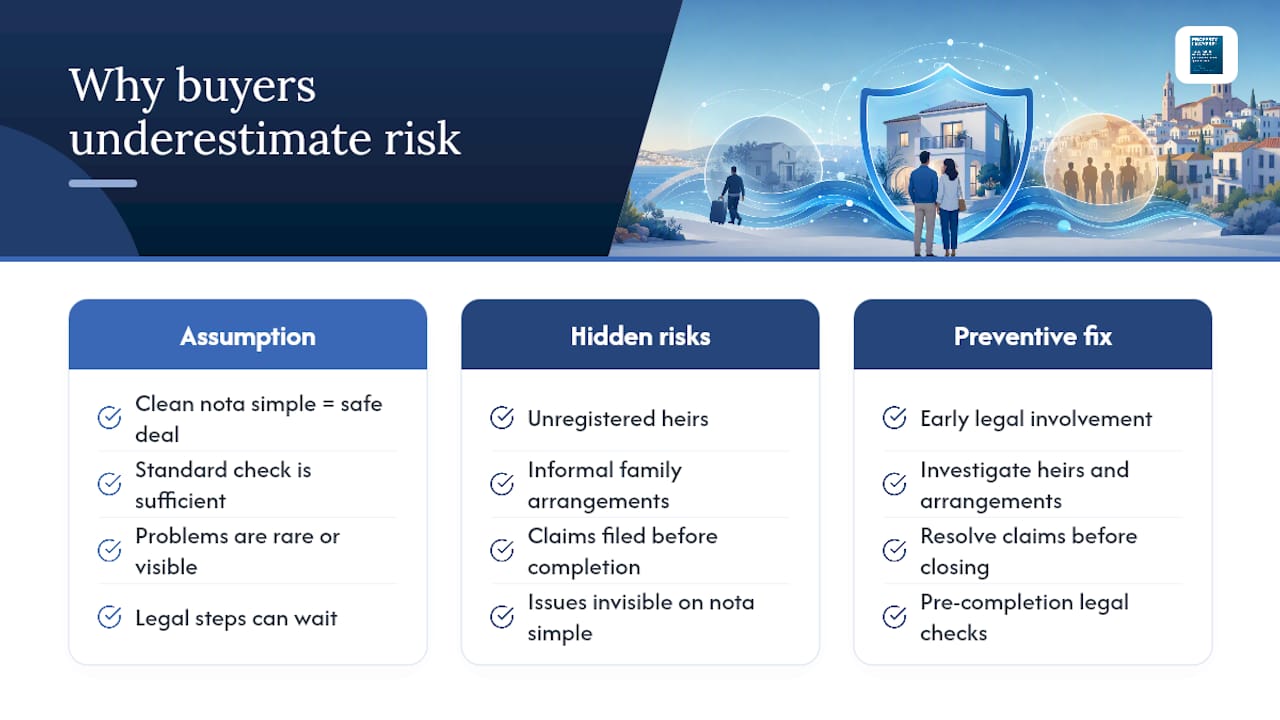
Most international buyers assume a clean-looking nota simple means the deal is safe. It usually is, but the cases that go wrong tend to involve exactly the things a standard check can’t catch: unregistered heirs, informal family arrangements, or claims filed the week before completion.
Early legal involvement changes outcomes far more than late litigation ever can.
— Sophie
How Property-lawyers.com helps you avoid this situation
Property-lawyers.com gives you something the average estate agent transaction doesn’t: direct access to independent, English-speaking lawyers who work specifically with international buyers across Spain, rather than a generalist solicitor juggling unrelated casework.
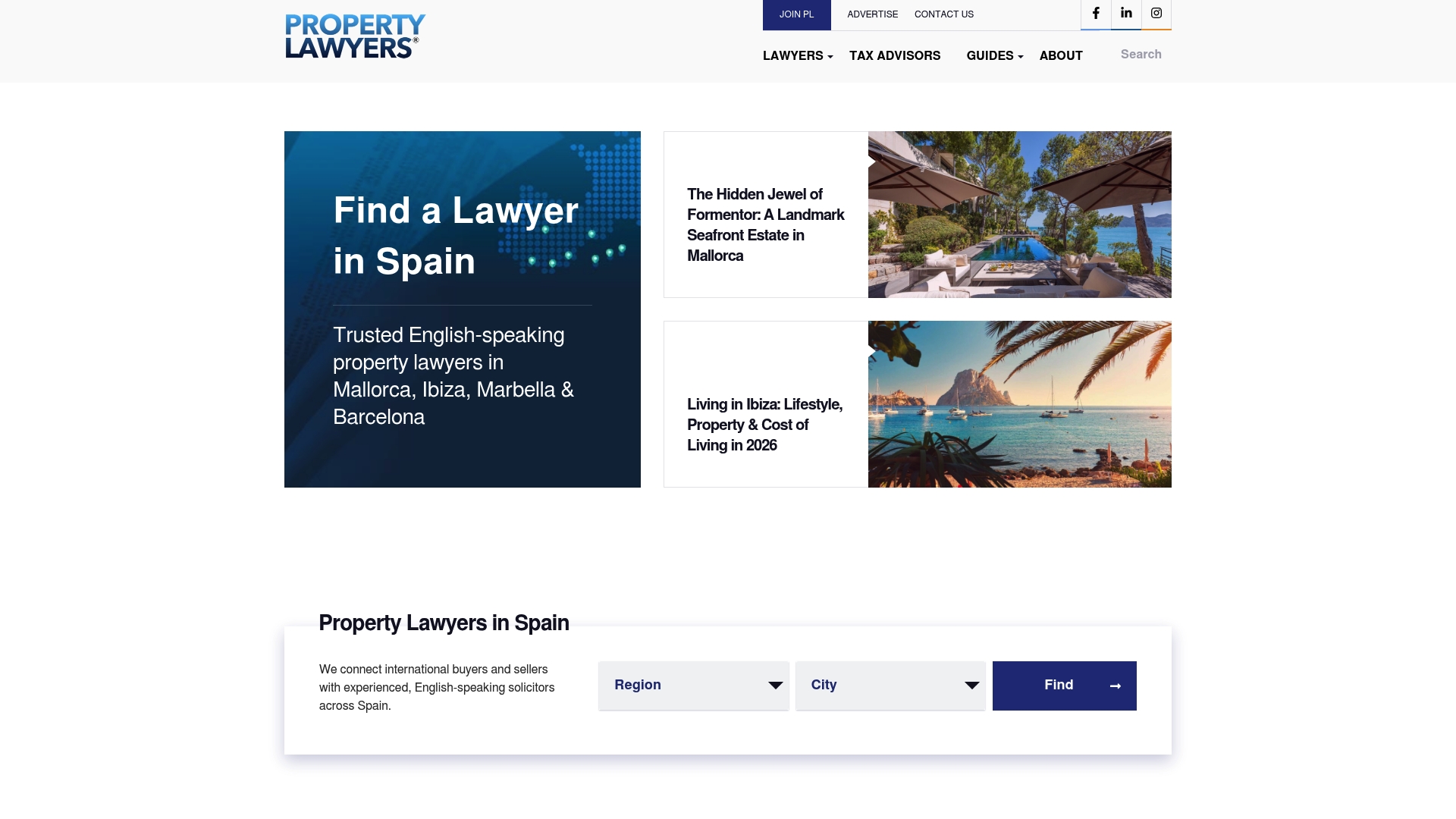
Search the directory by region, whether you’re buying in Marbella, Mallorca, Ibiza, Málaga, or Barcelona, and see lawyer profiles before you make contact. If you’re weighing up a purchase and want the registry side explained clearly first, our Land Registry Spain guide walks through exactly what a nota simple and certificado registral show. Buying from abroad and can’t attend in person? Our power of attorney guide explains how to authorise someone locally to act for you.
If you’d rather skip the research and get matched directly, request an introduction through Property-lawyers and a vetted lawyer covering your target region will be in touch.
Sources
- Sentencia CIVIL Nº 164/2021, TS, Sala de lo Civil, Sec. 1, Rec 2759/2018, 23-03-2021 – Iberley
- Concepto y régimen de la obligación de saneamiento por evicción – Derecho UNED
FAQ
What does Article 1485 of the Civil Code say?
Articles 1476 and 1477 limit how far contractual exclusions go, and courts will strike down a waiver if the seller knew about the risk and hid it from you.
What is the time limit for bringing a saneamiento por evicción claim?
The claim only becomes exercisable once a final judgment (sentencia firme) removes your ownership; general prescription periods then apply from that point, while hidden charges or servitudes carry a specific one-year window from discovery under Article 1483.
How long does it take for the action to prescribe?
There is no single fixed period for every scenario. It depends on the type of right affected and when the final judgment was issued, which is why recording exact dates and getting early legal advice matters.
Can the seller avoid liability with a contract clause?
Not always. Articles 1476 and 1477 limit how far a waiver can go, and courts routinely strike down exclusion clauses where the seller knew about the risk and failed to disclose it.
Does a clean nota simple guarantee there’s no eviction risk?
No. A nota simple confirms the current registered position but cannot reveal unregistered heirs, informal claims, or disputes that haven’t yet reached the registry, which is why a full lawyer-led check matters before you sign.
Recommended
- Spanish property forfeiture law explained for buyers
- Gazumping in Spain: what property buyers must know
- Property law in Spain: a 2026 guide for buyers

Sophie Gutenberg is a legal content specialist focused on Spanish property law, real estate transactions, conveyancing, due diligence and tax issues affecting international property buyers in Spain. She works alongside qualified Spanish property lawyers .
