

What is the buyer cooling-off period? A buyer’s guide
There is no general statutory cooling-off period for private property purchases. Once you sign a binding purchase contract, you cannot simply change your mind and walk away without cost. That surprises a lot of international buyers, who assume the same 14-day “returns” right that covers online shopping must apply to something as big as a house.
A few real protections do exist, though, and knowing them makes a genuine difference to how you plan a purchase:
- Mortgage reflection period: lenders must give you a minimum of seven days to study a mortgage offer before signing, under EU-based lending rules.
- 14-day distance-sale withdrawal: this consumer right rarely helps property buyers, because most real estate sales fall outside its scope.
- Reservation contracts and arras deposits: market practice, not statute, gives buyers their real short window to think things over before committing fully.
Understanding which of these applies to your situation, and at what stage of the purchase, matters far more than chasing a cooling-off right that doesn’t exist.
Key Takeaways
Spain has no statutory cooling-off period for property purchases; buyer protection comes instead from the mortgage reflection period, the reservation contract terms, and independent legal review.
| Point | Details |
|---|---|
| No general cooling-off right | Once you sign a private purchase contract, you cannot cancel it penalty-free in most cases. |
| Mortgage reflection period | Lenders must give a minimum reflection period to study a loan offer before signing. |
| 14-day withdrawal rarely applies | Distance-sale consumer withdrawal rights generally exclude standard property purchases. |
| Reservation stage is your real window | Arras or reservation deposits, typically 10% or less, define your practical cooling-off period. |
| Get legal review before signing | Property-lawyers connects buyers with independent lawyers to check contracts before commitment. |
Table of Contents
- What does “cooling-off period” actually mean for property buyers?
- When can you actually withdraw from a property purchase?
- How does the seven-day mortgage reflection period work?
- Does the 14-day consumer withdrawal right cover property purchases?
- What should you do the moment you want to cancel?
- What experienced buyers do differently
- Get help from an English-speaking property lawyer before you sign
- Sources
- FAQ
What does “cooling-off period” actually mean for property buyers?
The phrase gets used loosely, and that’s where confusion creeps in. A true cooling-off right, in consumer law terms, is a fixed window (usually 14 days) after signing where you can cancel a contract with no reason and no penalty. It was designed for online purchases and doorstep sales, not six-figure property deals.
Three separate concepts often get mixed up under this one label:
- Right of withdrawal: 14 calendar days for distance or off-premises consumer contracts, set out in Spain’s consumer protection framework.
- Mortgage reflection period: a minimum seven-day study window for a loan offer, not for the property purchase itself.
- Contractual cancellation terms: penalty clauses written into a reservation agreement or private contract, which govern what happens if you back out.
Mapped against a typical purchase, only the third one actually applies once you’ve reserved a property. Before that point, you have complete freedom. After you sign the private contract, you’re relying on whatever terms you agreed to, not a legal right.
When can you actually withdraw from a property purchase?
Timing decides almost everything. The further along you are, the more it costs to change your mind, and the difference between stages is often the difference between losing nothing and losing tens of thousands of euros.
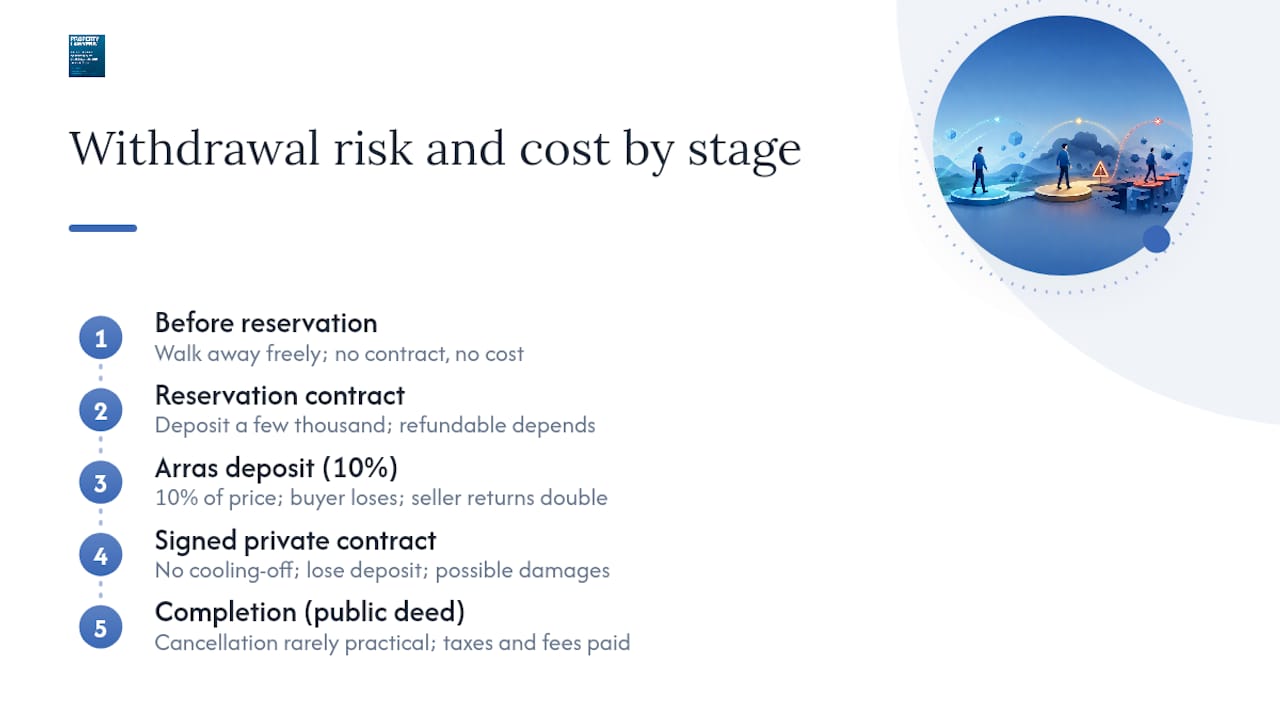
Before any reservation. You can walk away at any point during viewings, negotiations, or informal offers. No contract exists yet, so nothing binds you and nothing is owed.
At reservation or arras stage. This is where a short, practical cooling window actually exists, created by the contract itself rather than by law. A reservation contract typically takes the property off the market for a few weeks while you complete surveys, checks and financing arrangements. Deposits at this stage tend to be a few thousand euros, and whether that sum is refundable depends entirely on the wording. Some reservation agreements return the deposit if due diligence turns up a problem; others don’t. An arras deposit usually runs to 10% of the price and carries its own penalty structure: walk away and you typically lose the deposit, while a seller who backs out often has to return double.
After signing the private purchase contract. This is the point most buyers misunderstand. Spain has no general cooling-off right that lets you cancel a signed private contract and get your money back. Once both parties sign, the transfer of ownership is treated as agreed between the parties, even before completion. Backing out here usually means forfeiting the deposit in full, and in some cases facing a damages claim for the seller’s lost time and costs.
At completion (public deed). By the time you’re at the notary, cancellation is rarely practical. Taxes, notary fees and registry costs have often already been paid, and unwinding a completed sale usually means reselling rather than reversing the transaction.
A buyer who reserves a villa in Marbella in January, signs a private contract in February, and gets cold feet in March isn’t in the same legal position as a buyer who simply doesn’t turn up to the second viewing. The contract stage you’re at determines whether backing out costs nothing or costs a five-figure deposit.
How does the seven-day mortgage reflection period work?
If you’re financing your purchase, EU rules require lenders or credit brokers to give you a minimum of seven days to study a mortgage offer before you sign a binding credit contract. This sits within Spain’s consumer credit legislation and exists specifically to stop lenders pressuring borrowers into signing on the spot.
It’s worth being precise about what this period actually gives you. It covers time to read the loan offer document (known as the FEIN), check the APR, compare fees, and query anything unclear, often with a lawyer or independent mortgage adviser. It does not give you a right to cancel the property purchase itself. If you decide the mortgage terms are bad but you’ve already signed a binding purchase contract, the reflection period doesn’t rescue you from that separate commitment.
Buyers commonly use the seven days like this:
- Request the full written loan offer as early as possible, ideally before signing any private purchase contract.
- Use the window to get a second opinion on rate, fees and early-repayment terms.
- Loop in an independent property lawyer or mortgage broker rather than relying solely on the bank’s own explanation.
- Avoid signing the purchase contract until the mortgage terms are settled, wherever your timeline allows it.
Reservation deadlines and mortgage approval rarely line up neatly, which is a common coordination problem for buyers.
Pro Tip: Negotiate a reservation period that runs at least two weeks longer than your expected mortgage approval time. That buffer stops the seven-day reflection window from colliding with a hard contract deadline.
Does the 14-day consumer withdrawal right cover property purchases?
Rarely, and it’s worth being direct about that because this is the single biggest source of confusion for buyers researching cooling-off rights online.
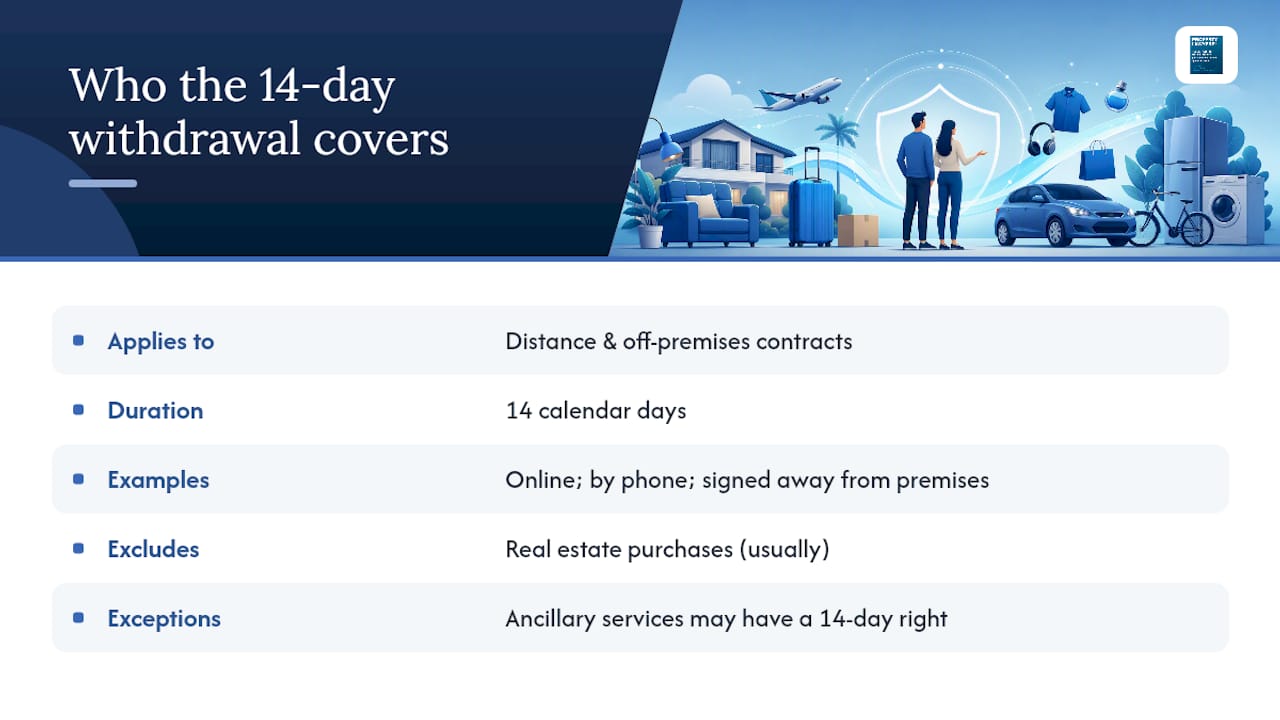
The right of withdrawal applies to distance sales and off-premises contracts, such as those bought online, by phone, or signed away from a business’s normal premises. Under Spain’s consumer rules, it runs 14 calendar days from delivery of goods, or from the contract date for services. Common exclusions already carve out flight tickets, made-to-order goods, and various personalised services.
Real estate purchases sit outside this right in the vast majority of cases. Buying a flat isn’t treated like buying a sofa online, and the property itself isn’t a “good” being delivered in the way the withdrawal right anticipates.
The narrow exceptions worth knowing about tend to involve ancillary services, not the property sale itself: a separate distance contract for a related service (certain remote advisory arrangements, for instance) might carry its own 14-day right, even though the underlying purchase doesn’t. These are genuinely uncommon, and you shouldn’t plan around one existing.
What should you do the moment you want to cancel?
Acting fast and acting correctly both matter. A rushed, informal message to the seller can weaken your position; so can waiting too long while costs mount.
In the first 48 to 72 hours:
- Stop any further payments immediately, including scheduled deposit instalments.
- Notify the seller or agent in writing, by email, so there’s a clear record of the date and your intent.
- Pull out your contract and check the exact cancellation and penalty clauses before saying anything definitive.
- Preserve every piece of communication: emails, WhatsApp messages, brochures, and anything the agent told you verbally that you noted down.
- Contact an independent property lawyer before agreeing to anything with the other side.
The likely costs depend heavily on stage. At reservation, you might lose a few thousand euros. After signing a private contract, forfeiting a 10% arras deposit is the standard outcome, and buyers who regret a purchase after signing typically face this loss plus any taxes or fees already paid. Trying to annul a signed contract outright is rarely realistic unless there’s evidence of fraud, coercion, or a genuine latent defect (vicio oculto) the seller concealed.
A property lawyer’s real value here isn’t drama, it’s leverage: reviewing the contract for grounds to negotiate, checking whether the property description was materially misleading, and often negotiating a partial refund rather than a full loss.
Pro Tip: A lawyer can sometimes buy you time by raising a legitimate due diligence query with the seller’s side, delaying the next contractual deadline while your options are assessed.
What experienced buyers do differently
The buyers who avoid regret aren’t the ones hoping a cooling-off right will save them. They’re the ones who treat the reservation stage as their real decision point, use it properly for surveys and legal checks, and don’t sign a private contract until a lawyer has read every clause. Staged decisions beat legal loopholes every time, because the loophole you’re hoping for often doesn’t exist.
Get help from an English-speaking property lawyer before you sign
Most of the costly mistakes in this article happen because buyers sign before getting proper legal advice, not because the law is unusually harsh. Property-lawyers connects you with independent, English-speaking lawyers across Spain who review reservation contracts, negotiate deposit terms, and coordinate mortgage timing so your seven-day reflection window doesn’t collide with a contract deadline.
Unlike relying solely on the estate agent (who is typically working for the seller), a lawyer you instruct directly works only for you. Before contacting one, have to hand: which stage you’re at (reservation, private contract, or completion), a copy of any contract you’ve signed, and your mortgage offer if you have one. Search the directory of vetted lawyers in Spain and get a contract reviewed before you sign the next document, not after.
Sources
For official guidance, consult the Centro Europeo del Consumidor’s mortgage rules, Spain’s consumer withdrawal rights page, and the general consumer protection law text. For practical next steps, see Property-lawyers’ guide to buyer’s guide for 2026.
This article is general information, not a substitute for advice from a qualified lawyer. Consult a qualified legal professional about your own circumstances before acting on anything here.
- Mortgages | Centro Europeo del Consumidor en España – Ministerio de Consumo
- Sale of products and services: Returns and refusals – Buying goods and services – Consumer rights – Citizens – Your rights and obligations in the EU – Tu espacio europeo – Punto de Acceso General
- Consolidated text of the general consumer and user Protection Act and other complementary laws (Ley.PDF)
- Real estate law Spain — Deloitte
FAQ
Is there a legal cooling-off period for buying property in Spain?
No. There is no general statutory cooling-off period once you sign a binding private purchase contract; any short window comes from your reservation contract’s terms, not the law.
How long is the mortgage reflection period?
A minimum of seven days, required under EU-based lending rules, giving you time to study the loan offer before signing.
Does the 14-day consumer withdrawal right apply to buying a house?
Almost never. This right covers distance and off-premises consumer sales and generally excludes standard real estate transactions.
What happens if I back out after signing the purchase contract?
You typically forfeit your arras deposit, often 10% of the price, and may face a damages claim depending on your contract’s penalty clauses.
Can a property lawyer help me cancel or renegotiate a purchase?
Yes. An independent lawyer can review your contract for grounds to negotiate, check for latent defects, and sometimes secure a partial refund; find one through Property-lawyers’ directory.
Recommended
- Buyer due diligence in Spain: your 2026 guide
- Spanish property purchase process: a guide for buyers
- Gazumping in Spain: what property buyers must know

Sophie Gutenberg is a legal content specialist focused on Spanish property law, real estate transactions, conveyancing, due diligence and tax issues affecting international property buyers in Spain. She works alongside qualified Spanish property lawyers .
