

Why check planning permissions for Spain property: 2026 guide
Skipping a planning permission check when buying or renovating property in Spain is one of the most expensive mistakes a UK buyer can make. Fines, demolition orders, blocked mortgages, and unsellable properties are all real outcomes for buyers who assumed the paperwork was someone else’s problem. The good news is that these risks are entirely avoidable with the right checks in place before you sign anything.
Here is what you need to know before committing to a Spanish property purchase or renovation:
- A property can be registered, taxed, and occupied yet still carry unauthorised works or missing licences.
- Utility connections do not prove compliance with urban planning laws. Water and electricity supply tells you the property exists, not that it was lawfully built.
- The Land Registry confirms ownership but does not verify that the physical building matches approved plans.
- Fines, forced demolition, and tax corrections can be inherited by the buyer if issues are not identified before purchase.
- Local town halls hold the enforcement power, and their records are the only reliable source of planning history.
- Independent legal advice is the single most effective safeguard for international buyers unfamiliar with Spanish property regulations.
What types of planning permission exist in Spain?
Spain divides building licences into two main categories, and understanding the difference matters before you buy or renovate.
Obra mayor covers major works: building extensions, swimming pools, structural changes, new constructions, and anything that alters the size or layout of a property. Major works require an architect’s project to accompany the application at the town hall. If the property sits within a community of owners, their agreement is also required, typically decided at the annual general meeting.
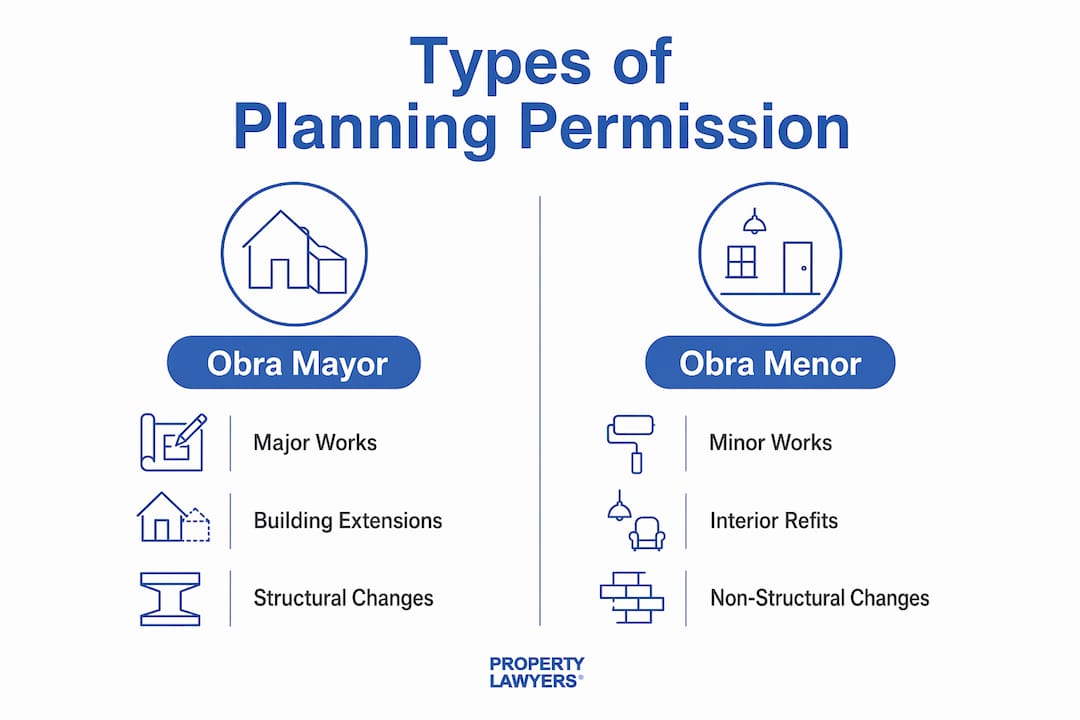
Obra menor covers smaller works such as retiling, kitchen refits, or cosmetic changes. These still require a licence from the town hall, even though the process is simpler and does not usually need an architect.
Beyond these two categories, buyers should also be aware of:
- Licencia de Primera Ocupación (LPO): The first occupation licence confirms that a building was constructed in line with approved plans and meets habitability standards. Without it, a property may face resale and financing challenges. Some regions call this the Cédula de Habitabilidad.
- Certificado de no infracción urbanística: An urban planning compliance certificate issued by the town hall, confirming no enforcement proceedings are open against the property. Particularly important for villas and rural homes.
- Community permissions: Since April 2025, converting a residential property into a tourist apartment requires express approval from the community of owners under the amended Horizontal Property Act.
If a major work changes the property’s built area, it must also be recorded in the Title Deed, Land Registry, and Cadastral Registry. Failing to do so creates a discrepancy that can cause serious problems at the point of resale.
What happens if planning permissions are ignored?
The consequences of non-compliance range from inconvenient to financially devastating. Spanish authorities treat unlicensed building works as an infringement of public order, and enforcement can follow years after the work was completed.
- Fines: Town halls can issue financial penalties for unauthorised works. In Torrevieja alone, 825 properties were identified as lacking correct planning permission, with council tax bills adjusted to include back-payments covering four previous years.
- Demolition orders: Where works are on land not designated for building, or exceed permitted limits, authorities can order the structure to be removed entirely.
- Tax corrections: Unregistered extensions or pools alter the valor catastral (rateable value). Authorities can pursue the tax difference retrospectively once the change is identified, often through aerial surveys or drone inspections.
- Mortgage and insurance problems: Lenders and insurers frequently decline to cover properties with unresolved planning issues. A buyer who discovers this after exchange faces a difficult position.
- Resale restrictions: A property with unlicensed works is harder to sell, particularly to buyers who need a mortgage. The issue does not disappear over time; it transfers to the next owner.
- Inherited liabilities: In Spain, debts and liabilities attach to the property, not the seller. A buyer who purchases without checking inherits those problems as their own.
The AFO (Asimilado a Fuera de Ordenación) pathway exists in Andalusia for rural properties built without permission more than six years ago. AFO status prevents demolition but does not legalise the building. An AFO property cannot be extended or significantly modified, and some lenders remain cautious about financing them.
How to check planning permissions before buying or renovating
A thorough check involves several documents and sources, and should be completed before you sign a reservation contract or private purchase agreement.
Step-by-step verification process:
- Request the building licence (Licencia de Obra): Ask the seller for a copy confirming the original construction was authorised. If they cannot provide one, find out why before proceeding.
- Check the first occupation licence: Confirm the LPO exists and is current. Its absence may indicate the property was built or extended without proper permission.
- Obtain a certificado urbanístico from the town hall: This document confirms the land classification (urban, developable, or rural) and whether any planning restrictions apply.
- Compare the Land Registry and Cadastre records: The Land Registry confirms title but not building legality. The Cadastre records the physical description and built area. Discrepancies between the two are a common red flag for undeclared works.
- Commission an independent architect’s inspection: For properties with visible modifications or rural locations, an architect can compare approved plans against what physically exists on site.
- Check community of owners records: If the property is in a development, verify that any works were approved by the community and that no outstanding disputes exist.
- Request an urban planning compliance certificate: This confirms the town hall is not pursuing any enforcement action against the property.
Key documents to request from the seller:
- Building licence (Licencia de Obra)
- First occupation licence (Licencia de Primera Ocupación or Cédula de Habitabilidad)
- Urban planning compliance certificate
- Title deed and Land Registry extract (nota simple)
- Cadastral reference and description
A comprehensive due diligence process covering all four areas, registry, planning, financial, and technical, is the most reliable way to identify problems before they become your responsibility.
Pro Tip: Never rely on verbal reassurances from a selling agent. Phrases such as “it has been there for years” or “the notary will check everything” do not protect you. The notary witnesses the signing; they do not investigate planning history on your behalf.
Why planning rules differ so much across Spain’s regions
Spanish planning regulation is fragmented across its autonomous communities, and what is acceptable in one region may be entirely non-compliant in another. This is one of the most misunderstood aspects of buying property in Spain.
- Andalusia has its own planning framework under the LOUA (Ley de Ordenación Urbanística de Andalucía), including the AFO regularisation process for rural properties. The statute of limitations for planning enforcement here is six years from completion of works.
- Catalonia operates under different regional legislation, with its own rules on land classification and permitted development near protected areas.
- Valencia has specific coastal zone restrictions under the Ley de Costas, which imposes building limits within 100 metres of the coast (and 20 metres for the transit zone). Properties within these zones can face demolition orders regardless of age.
- Other regions each apply their own interpretation of national planning law, meaning local knowledge is not optional. It is the foundation of any reliable check.
The practical consequence is that a lawyer who knows Marbella’s municipal planning rules may not be familiar with the specific requirements in a coastal town in Murcia or a rural area of Extremadura. Buyers who assume compliance transfers between regions take a real risk.
Pro Tip: Always hire an independent lawyer who is familiar with the specific municipality where you are buying. Regional expertise matters far more than general Spanish property knowledge when it comes to planning compliance.

For buyers considering residency alongside their purchase, understanding local legal frameworks is equally important. Permanent residency requirements for non-EU citizens add another layer of planning to any Spanish property decision.
What does obtaining planning permission cost and how long does it take?
Timelines and costs vary considerably depending on the region, the type of work, and the complexity of the application. Setting realistic expectations early prevents delays and budget surprises.
- Obra menor (minor works): Applications are generally processed within a few weeks. Fees are typically a percentage of the declared value of the works. One specialist firm quotes fees of €200 plus town hall charges of approximately 5% of the works’ value for minor works applications.
- Obra mayor (major works): These take considerably longer, often several months, because they require an architect’s project, health and safety documentation, and formal town hall review. Architect fees vary by project scope and are not standardised.
- Retrospective permissions: Where works were carried out without a licence, legalisation (if possible) takes longer still. The process depends on whether the works comply with current planning rules, the land classification, and the municipality’s workload.
- AFO regularisation in Andalusia: This process requires a local architect’s report and town hall assessment. Timelines are not fixed and can extend to a year or more in complex cases.
The cost of a comprehensive legal and planning check before purchase is considered modest compared to the potential cost of resolving inherited planning problems. That figure is modest compared to the potential cost of inheriting an unresolved planning problem after completion.
Buyers should factor both the time and cost of any required permissions into their purchase timeline and renovation budget before making an offer.
How to verify if existing permissions are correctly registered in the Land Registry
A property can have planning permission without that permission being properly recorded in the Land Registry. This gap creates risk for buyers who check only one source.

The Land Registry (Registro de la Propiedad) records legal title and any charges or encumbrances on a property. It does not automatically update when physical changes are made to a building. If a previous owner added an extension, enclosed a terrace, or built a pool without updating the registry, the discrepancy will not be visible from the title deed alone.
To verify that permissions are correctly registered:
- Compare the built area in the Land Registry with the Cadastral description. Discrepancies suggest undeclared construction or modifications.
- Check whether major works are recorded in the Title Deed. Any change that alters the property’s size or value should appear there.
- Request an Urban Planning Compliance Certificate from the town hall to confirm no enforcement action is outstanding.
- Ask your lawyer to cross-reference the nota simple, the Cadastral record, and the physical property against the approved building plans.
The Land Registry confirms ownership but not building legality. Only a full cross-check across multiple sources gives a reliable picture of whether the property’s physical reality matches its legal record.
Common pitfalls and red flags when checking planning permissions
Buyers who know what to look for can avoid the most common traps. These are the warning signs that should prompt further investigation before proceeding.
- Missing or unavailable licences: If the seller cannot produce the building licence or LPO, treat this as a red flag, not a minor administrative gap.
- Discrepancies between Cadastre and Land Registry: A difference in recorded built area between the two registers almost always indicates undeclared works.
- Enclosed terraces or converted spaces: These are among the most common unauthorised modifications in Spanish properties. A terrace incorporated into the living room or a garage converted to a bedroom may never have been approved.
- Rural land with residential structures: Buildings on non-urban land face stricter rules and may not be eligible for legalisation. The AFO route is only available in Andalusia and only under specific conditions.
- Coastal zone properties: Any property within 100 metres of the coast requires additional checks under the Ley de Costas. Demolition orders have been issued on properties of considerable age in these zones.
- Verbal assurances without documentation: Agents and sellers sometimes offer comfort without paperwork. Only documents from the town hall or Land Registry carry legal weight.
- Tourist rental permissions: Since April 2025, any property marketed as a tourist rental must have community of owners approval. Buyers purchasing with rental income in mind should verify this before exchange.
- Recent works without permits: If a property has been renovated recently, check whether the works were licensed. Recent unauthorised works are more likely to attract enforcement action than older ones.
A legal checks checklist reviewed by an independent lawyer before reservation is the most reliable way to catch these issues early.
How Property-lawyers can help UK buyers with Spanish planning checks
UK buyers navigating Spanish planning rules face a system that is local, document-heavy, and inconsistent across municipalities. Property-lawyers connects you with independent, English-speaking property lawyers across Spain who specialise in exactly this kind of due diligence.

Working with a lawyer through Property-lawyers means your legal adviser works exclusively for you, with no ties to the estate agent or seller. They will coordinate the full verification process: checking building licences, cross-referencing the Land Registry and Cadastre, requesting urban planning compliance certificates from the town hall, and flagging any discrepancies before you commit. Where issues are found, they can advise on whether regularisation is possible, what it would cost, and whether the asking price reflects the risk. For buyers purchasing remotely, a power of attorney arrangement allows your lawyer to act on your behalf throughout the process. Property-lawyers also covers Spanish real estate law guidance for buyers who want to understand the broader legal framework before they start their search.
FAQ
What can you build in Spain without planning permission?
Very little. Even minor works such as kitchen refits or tiling require a licence (obra menor) from the local town hall. Major works including extensions, pools, and structural changes always require a formal building licence and, in most cases, an architect’s project.
What are the new rules for UK buyers purchasing property in Spain?
Since April 2025, converting a residential property into a tourist apartment requires express approval from the community of owners under the amended Horizontal Property Act. UK buyers should also verify land classification, building licences, and the first occupation licence as standard parts of due diligence before purchase.
How hard is it to get planning permission in Spain?
For straightforward urban properties, minor works licences are usually processed within weeks. Major works take several months and require architect-prepared documentation. Retrospective permissions for unlicensed works are more complex and depend on land classification and local rules. Rural properties in particular can face lengthy or unsuccessful regularisation processes.
Who checks planning permission in Spain?
Local town halls (ayuntamientos) are responsible for issuing and enforcing planning permissions. An independent property lawyer coordinates the buyer-side verification, cross-referencing town hall records, the Land Registry, and the Cadastre to confirm a property’s planning status before purchase.
Key takeaways
Checking planning permissions before buying or renovating property in Spain is the most reliable way to avoid inherited liabilities, fines, and resale problems that can follow a property for decades.
| Point | Details |
|---|---|
| Land Registry is not enough | The registry confirms ownership but does not verify that the building was lawfully constructed or modified. |
| Two licence types matter | Obra mayor covers major works; obra menor covers smaller jobs. Both require town hall approval before work begins. |
| Regional rules vary significantly | Planning laws differ between Andalusia, Catalonia, Valencia, and other regions. Local legal expertise is not optional. |
| Costs of a check are modest | A comprehensive legal and planning review is considered modest compared to the potential cost of resolving inherited planning problems. |
| Property-lawyers connects you to experts | Independent English-speaking lawyers found through Property-lawyers carry out full due diligence with no ties to agents or sellers. |
Recommended
- Legal checks before buying property in Spain
- How to check property legal status in Spain
- Property law in Spain: a 2026 guide for buyers

Sophie Gutenberg is a legal content specialist focused on Spanish property law, real estate transactions, conveyancing, due diligence and tax issues affecting international property buyers in Spain. She works alongside qualified Spanish property lawyers .
