

Avoid Mortgage Delays When Registering a New Build in Spain
An escritura de obra nueva is a notarial public deed that records a new building, or regularises an old one, on the Registro de la Propiedad. In practice, you need it whenever you plan to sell, mortgage, or commercially rent a property in Spain. Without it, the building on the ground and the building on the register do not officially match, and that mismatch causes problems at exactly the moment you need a clean title: the sale, the mortgage application, or the lease.
TL;DR:
- Most delays occur when there is a mismatch between the actual property and the records, especially regarding unregistered extensions or boundary shifts.
- Proper georeferencing early in the process can prevent registration refusals caused by unclear property footprints or border inconsistencies.
- The costs involve multiple components such as technical certificates, notary fees, taxes, registry fees, and georeferencing, which vary depending on project complexity and location.
- Registering a building as obra nueva en construcción, terminada, or antigua requires different documentation, with older properties often needing proof of antiquity and technical surveys.
- Conducting a legal and technical audit before signing documents significantly reduces the risk of registration delays or conflicts during the process.
Table of Contents
- What is an escritura de obra nueva?
- When do you actually need it?
- Obra nueva en construcción, terminada, and antigua compared
- Documents to prepare before you see the notary
- The notary, the tax, and the registry: step by step
- What it costs and how long it takes
- Where this process commonly goes wrong
- After the escritura is signed and registered
- Sophie’s take: when to bring in a specialist
- Get expert help with your escritura de obra nueva
- Sources
- FAQ
What is an escritura de obra nueva?
Think of it as the legal bridge between bricks and mortar and what the Spanish property register actually says exists. A house can stand for decades without ever being formally declared, which sounds strange until you realise how common it is, especially with older rural properties or extensions built without much paperwork at the time.
The deed comes in three broad forms. Obra nueva en construcción covers a building still going up, declared before completion. Obra nueva terminada covers a finished building, backed by a completion certificate. Obra nueva antigua regularises something already built, often years or decades ago, without ever going through this process.
Banks will not lend against a property that is not properly declared. Buyers’ lawyers will flag it during due diligence. And the Registro de la Propiedad itself will not update its records to reflect reality until the deed exists. That is the practical weight this document carries, regardless of how routine it feels to sign.
When do you actually need it?
If you are selling, the buyer’s bank will almost certainly require the property to be correctly registered before releasing mortgage funds, which makes the escritura a practical necessity rather than a bureaucratic nicety. The same applies if you are mortgaging the property yourself, or letting it out on a commercial basis, where landlords increasingly find local authorities and letting agents asking for proof the building matches its registered description.

For private, ongoing use, with no sale, mortgage, or commercial letting on the horizon, some owners leave the paperwork unresolved for years. That is legally possible, but it is a risk you carry forward. Requirements and how strictly they are enforced can vary between autonomous communities and even between local land registries, so it is worth checking the specific position for your region rather than assuming a national rule applies uniformly. A property buying checklist for Spain is a sensible place to start if you are unsure where your situation sits.
Obra nueva en construcción, terminada, and antigua compared
Each type asks for a different documentary case, and knowing which one applies saves considerable time.
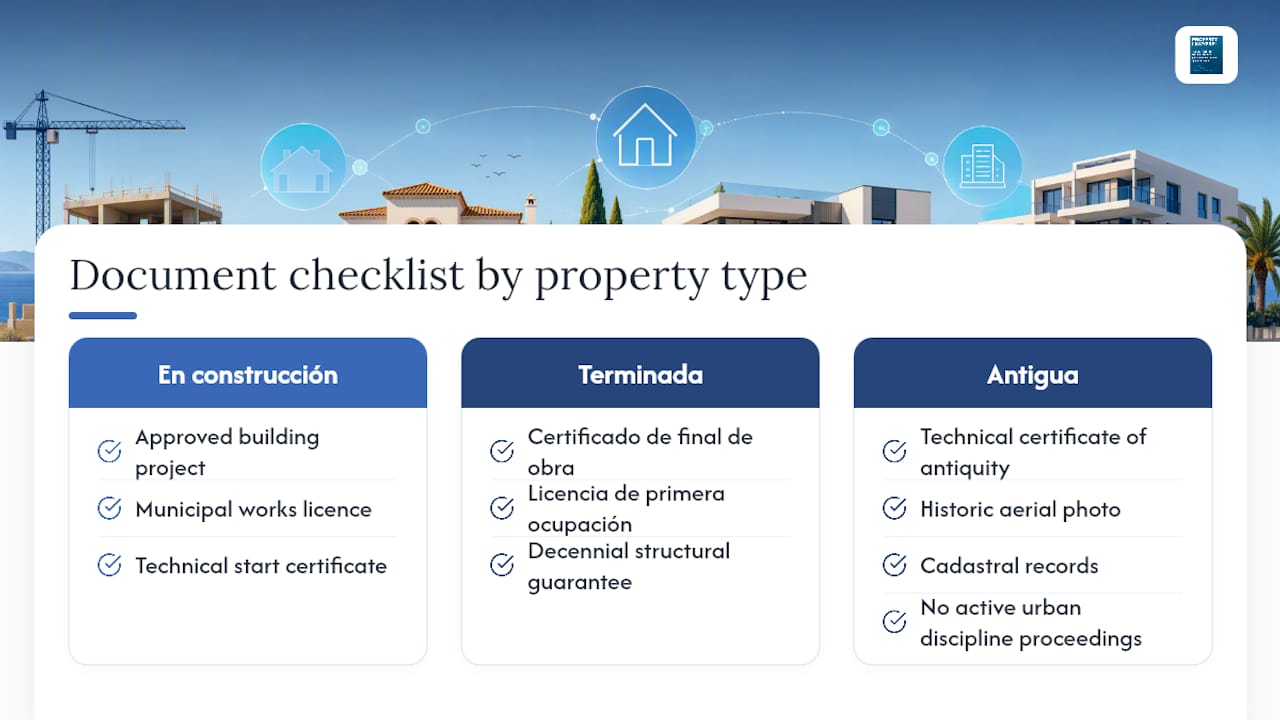
Obra nueva en construcción requires the approved building project, the municipal works licence, and a technical certificate confirming the works have genuinely started, since you cannot declare something purely speculative. Obra nueva terminada needs the certificado de final de obra signed by the director de obra, often the licencia de primera ocupación, and where the works are recent enough, evidence of the decennial structural guarantee. Obra nueva antigua takes a different route entirely: instead of licences, you prove the building’s age, typically through a technical certificate of antiquity, historic aerial photography, or cadastral records, alongside confirmation that no active urban discipline proceedings affect the plot.
Documents to prepare before you see the notary
Getting organised before the notary appointment saves weeks. The core paperwork rarely changes, whichever type of obra nueva you are declaring:
- Title deed to the land or existing property
- Municipal licence of works (or proof of antiquity for older builds)
- The approved project and the certificado final de obra, signed by a qualified technician
- Georeferenced coordinates (GML files) mapping the building’s exact footprint on the parcel
- Energy performance certificate
- Libro del edificio, where the building is new
- Decennial insurance documentation, when the works fall within that guarantee period
- Recent IBI receipts and a certificado catastral confirming how the property currently appears on record
Georeferencing has become far more central to this process than it used to be. Registrars increasingly ask for GML coordinates whenever a building’s footprint is not already clearly reflected in the cadastre, a shift confirmed by current notarial practice around online and remote deed preparation.
Pro Tip: Request your certificado catastral and IBI receipts before you approach a technician or notary. Discrepancies between what the cadastre shows and what actually exists on the ground are the single biggest cause of delay, and they are far cheaper to fix before the notary appointment than after.
The notary, the tax, and the registry: step by step
The notary is not simply a signature witness. Notaries verify that the technical documents genuinely match what has been built, checking the project against the certificado final de obra and confirming the correct administrative approvals exist, which acts as a meaningful safety filter before the deed ever reaches the register.
The process runs in three broad stages:
- Notarial signature. You and your technician present the documentation; the notary checks authenticity and drafts the public deed.
- Tax liquidation. The Impuesto de Actos Jurídicos Documentados (IAJD) is calculated on the declared value of the works, typically falling between 0.5% and 1.5% depending on the autonomous community, and it is normally paid by the property owner within the statutory window after signature.
- Presentation to the Registro de la Propiedad. The registrar reviews the deed against the property’s existing entries and, if everything aligns, records the new or updated description.
Registry timelines vary, but allow more time than you might expect. Registrars can suspend inscription when a new title’s description conflicts with what is already on file, a point Spanish registral resolutions address directly, stressing that new titles must be reconciled with prior entries rather than simply overwritten. Building in time for the registrador to raise queries, and for your technician or lawyer to respond, avoids nasty surprises close to a sale deadline.
What it costs and how long it takes
Costs break down into several distinct components rather than one flat fee: technician fees for the certificado final de obra, notary fees, the IAJD itself, registry fees, and, where required, the cost of preparing georeferenced coordinates.
- Technician and certification fees vary with the size and complexity of the build
- Notary fees follow official scales tied to the declared value
- IAJD generally runs as a regional percentage of the declared value
- Registry inscription fees are modest but scale with property value
- Georeferencing costs depend on whether a straightforward GML file or a fuller topographic survey is needed
Regional variation is real, and complex projects with unusual boundaries or older, undocumented extensions tend to cost more to certify. Tools such as the OCU mortgage cost calculator can help with related transaction budgeting, though it is worth building in a contingency for registry queries that push the timeline out further than planned.
Where this process commonly goes wrong
The most frequent blocker, by some distance, is a mismatch between what the Catastro or Registro de la Propiedad shows and what physically exists on the plot: an extension never declared, a pool added without permission, or boundaries that shifted slightly from the original survey.
Other recurring problems include pending urban discipline proceedings on the land, which can halt inscription entirely until resolved, and missing visado colegial where the professional college’s stamp on technical documents is required. Preventing these issues is largely a matter of sequencing:
- Commission a legal audit and technical survey before signing anything
- Check the plot’s status directly with the local town hall
- Prepare GML georeferencing early wherever there is any doubt about boundary alignment
Pro Tip: If your property sits near a protected area, a coastal zone, or rural land with ambiguous boundaries, get the georeferencing sorted months in advance, not days. It is the single step that most reliably prevents a registrar’s refusal.
After the escritura is signed and registered
Between the parties involved, the deed takes legal effect the moment it is signed. Full protection against third parties, though, only arrives once the Registro de la Propiedad has formally inscribed it, which is what makes registration, not just signature, the step that unlocks a mortgage or a clean sale.
Once inscribed, update your Catastro records to match, notify your community of owners where relevant, and confirm utility contracts reflect the property’s current legal status before moving to any sale or refinancing.
Sophie’s take: when to bring in a specialist
Most delays trace back to a single cause: skipping the legal audit before signing. If there is any doubt about boundaries, licences, or the plot’s planning history, commission a proper technical and legal check first, not after a registrar raises a query. Getting georeferencing sorted early is the cheapest insurance you will buy in this entire process. Property-lawyers connects readers with vetted Spanish property lawyers who handle exactly this kind of audit before problems reach the notary’s desk.
— Sophie
Get expert help with your escritura de obra nueva
Working through licences, certificates, and registry requirements alone is where most delays start, particularly for buyers managing the process from abroad. Property-lawyers is the direct route to a vetted, English-speaking property lawyer in Spain who already handles this paperwork routinely, rather than a general practice learning it as they go.

The process is straightforward: choose your region, whether that is Marbella, Mallorca, Ibiza, Málaga, or Barcelona, share the key documents you already have (title deed, licence, any technical certificates), and request an initial check or quote from a lawyer who specialises in exactly this type of registration. If you are further along and need to understand registration and taxes in more depth, the guide to registering a newly built property in Spain covers the deeds and tax side in detail. For a broader overview of the deed itself, see how the escritura works in Spain. When you are ready to speak to someone directly, find a property lawyer in Spain through the directory and get your specific situation reviewed.
Sources
- Declaración de obra nueva antigua: qué es y cómo regularizarla — Fotocasa
- Declaración de obra nueva — Notaría Ballester
- Resolución DGRN — declaración de obra nueva por antigüedad
- Notario
FAQ
What documents do you need for an escritura de obra nueva?
You typically need the municipal works licence, the certificado final de obra signed by the director de obra, the approved project, and increasingly, georeferenced GML coordinates for the building’s footprint.
Is the declaración de obra nueva obligatory?
It becomes a practical necessity when you sell, mortgage, or commercially let the property, though for purely private ongoing use some owners delay it, which carries its own risks.
What is an escritura de declaración de obra nueva en construcción?
It is the deed declaring a building still under construction, based on the approved project, the works licence, and a technical certificate confirming works have genuinely begun.
Recommended

Sophie Gutenberg is a legal content specialist focused on Spanish property law, real estate transactions, conveyancing, due diligence and tax issues affecting international property buyers in Spain. She works alongside qualified Spanish property lawyers .
