
Buyers, Heirs, Investors: Avoid Extra Tax from 2026 valor de referencia
The 2026 valor de referencia is the Catastro’s official reference value for every registered property in Spain, and it normally sets the minimum taxable base for transfer tax and inheritance tax. The 2026 figures are already published and consultable on the Sede Electrónica del Catastro. If your property’s value pushes your tax bill higher than the price you actually paid or declared, you have the right to request a rectification or lodge an appeal, provided you act within the legal deadlines and gather the right evidence.
TL;DR:
- The 2026 valor de referencia is calculated from real transaction data and adjusts for property type, age, and condition, but may be outdated or inaccurately descriptive.
- When the valor de referencia exceeds the declared price, buyers and heirs must pay transfer taxes based on the higher value, often resulting in a larger tax bill.
- Challenging a high valor de referencia requires obtaining a professional valuation, gathering evidence, and following formal appeal procedures, often with legal assistance.
- The valor de referencia is used for ITP and inheritance tax, but does not affect IBI or municipal capital gains tax, which rely on the older valor catastral.
- Verifying and understanding the valor de referencia before signing a deal can help renegotiate or plan for potential tax expenses more effectively.
Table of Contents
- What is the valor de referencia and where does it come from?
- How to check the 2026 valor de referencia for your property
- Which taxes use the valor de referencia (and which don’t)
- How the Catastro actually calculates these figures
- What to do if the valor de referencia works against you
- When it makes sense to bring in a lawyer
- Get the right legal support for your valor de referencia case
- Sources
- FAQ
What is the valor de referencia and where does it come from?
The valor de referencia is not a market valuation and it is not the same as the old valor catastral used for council tax. It is a figure the Catastro calculates every year for almost every property in Spain, designed to reflect a realistic transaction price without exceeding it.
Its legal basis comes from Ley 11/2021, the anti-fraud law that amended the Texto Refundido de la Ley del Catastro Inmobiliario. Since 2022, this reform has made the valor de referencia the default taxable base for Impuesto de Transmisiones Patrimoniales (ITP) and Impuesto sobre Sucesiones y Donaciones (ISD), replacing the old system where tax offices simply checked declared prices against their own estimates.
Three figures matter, and confusing them causes most disputes:
- Valor catastral: the older, generally lower figure used for IBI (council tax) and plusvalía municipal.
- Valor de referencia: the Catastro’s annual estimate, used as the minimum base for ITP and ISD.
- Declared price: what buyer and seller actually agree and write into the deed.
The Dirección General del Catastro published the 2026 valores de referencia for urban properties through an official BOE announcement, with the new figures consultable from 1 January 2026 onwards.
How to check the 2026 valor de referencia for your property
Checking your property’s value takes ten minutes if you have the right documents ready. Here is the process step by step.
- Gather your details first. You need either the referencia catastral (found on your IBI bill or title deed) or the full address. You will also need one of three ways to log in: Cl@ve, an electronic certificate, or your DNIe.
- Go to the Sede Electrónica del Catastro. The official portal hosts the consulta de valor de referencia tool and interactive maps showing which “module” applies to your area and property type.
- Request the certificate. Once identified, you can download a certified valor de referencia document. This is the figure tax authorities will compare against your declared price.
- Read the fields carefully. The certificate shows the reference date, the module applied, and any correction coefficients used. These matter if you later need to challenge the figure.
- Visit a Gerencia in person if you prefer. If your identification fails online, or you want confirmation face to face, Catastro’s Gerencias and the Línea Directa del Catastro handle enquiries directly.
Pro Tip: Check the valor de referencia before signing anything, not after. If the figure is higher than the price you are about to agree, you can renegotiate or budget for the extra tax before it becomes a problem, rather than fighting it afterwards.
Which taxes use the valor de referencia (and which don’t)
For ITP and ISD, the rule is simple: the taxable base is whichever is higher, the declared price or the valor de referencia. Buyers, heirs, and beneficiaries of gifts cannot simply declare a lower figure to reduce their tax if the Catastro’s reference value sits above it. AJD (stamp duty on mortgages and certain deeds) can also be affected in some regions, though rates and thresholds vary by autonomous community, so it is worth checking transfer tax rates for your region before completing.
Worked example: Imagine a flat in Málaga sells for €220,000, but the Catastro’s 2026 valor de referencia for that property is €245,000. Buyers must pay ITP on €245,000, not €220,000. At a typical regional ITP rate, that is a noticeable difference in extra transfer tax, purely because of the reference value.
Two taxes are not affected by any of this:
- IBI (annual council tax) still uses the older valor catastral.
- Plusvalía municipal (the municipal capital gains tax on land value increase) also relies on valor catastral, not the valor de referencia.
Anyone budgeting for a purchase should read the full breakdown of purchase tax obligations before assuming the price on the deed is the whole story.
How the Catastro actually calculates these figures
The Catastro does not value each property individually by inspection. It builds its figures from real transaction data, primarily prices reported by notaries (fedatarios) on completed sales, combined with annual market reports covering each area.
Spain is divided into ámbitos territoriales homogéneos, essentially zones where property types behave similarly in price terms. Within each zone, the Catastro assigns “modules” to representative product types (flats, terraced houses, villas) and adjusts them using coefficients for age, category, and state of conservation.
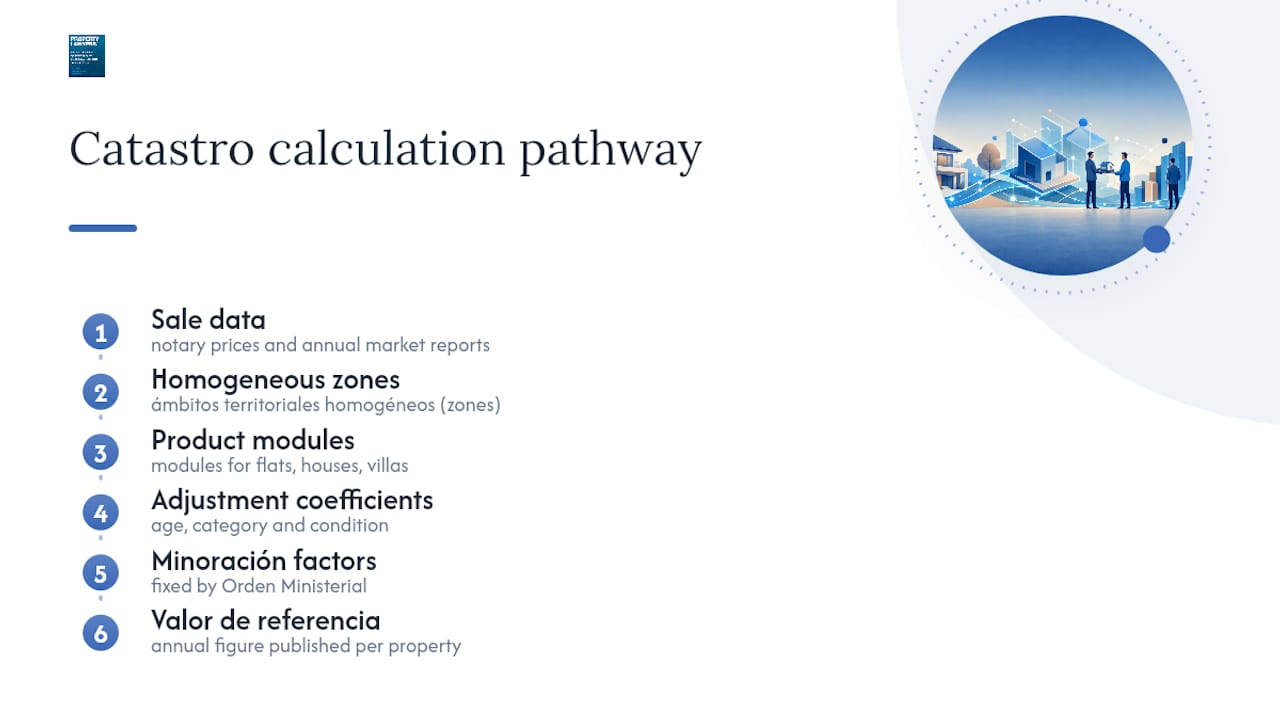
Crucially, an Orden Ministerial fixes the factors of minoración, correction factors applied specifically to keep the valor de referencia below likely market value. These factors, along with the maps and module lists, are published annually and can be checked property by property.
When a valor de referencia looks too high, the usual culprits are outdated cadastral descriptors (wrong square metres, wrong build year) or a property with genuinely unusual features the standard module simply cannot capture.
What to do if the valor de referencia works against you
Tax consequences and appeal strategy can differ by region and transaction type. For location-specific advice, compare specialists in Mallorca, Marbella, Madrid, Barcelona and Ibiza.
If your valor de referencia is higher than the price you paid, or higher than what you believe reflects your property’s real condition, you have two main routes, and choosing the right one matters.
- Rectify the autoliquidación. If you have already paid ITP or ISD self-assessed against the valor de referencia, you can request a refund by rectifying your own tax return. This is usually the simpler first step.
- Appeal a liquidación. If the tax office has issued its own assessment rather than accepting your self-assessment, you challenge that assessment directly through a recurso or a reclamación económico-administrativa.
- Gather your evidence before filing. A tasación pericial singularizada, an individual professional valuation, carries real weight, particularly one that includes an in-person inspection, carefully selected comparables, and a transparent explanation of why your property differs from the module used, as outlined by legal analysis on impugnation methods.
- Expect Catastro’s binding report. In most administrative procedures, the tax authority must request a binding report from the Catastro itself before resolving your case, since only the Catastro can technically revise its own figure.
The Tribunal Supremo has admitted a case for review that could affect how automatically the valor de referencia is applied, which is worth watching if your case is borderline.
Pro Tip: Keep every document, photographs, the tasación, correspondence with the Catastro, from day one. Appeals that succeed almost always have a clear paper trail; ones that fail usually rely on assertion alone.
When it makes sense to bring in a lawyer
Most straightforward purchases at fair market prices never trigger a valor de referencia problem worth fighting. But certain situations change that calculation. Large sums, inherited properties with disputed condition or unusual layouts, and cases where the cadastral description simply does not match the physical property are exactly where a specialised lawyer earns their fee, especially when dealing with complexities outlined in Paraguay Taxes for Expats: What Is Taxed and What Is Not.
A property lawyer experienced in this area will typically commission or review the tasación pericial, correspond directly with the Catastro on technical points you would struggle to navigate alone, and prepare the formal appeal documents with the right legal grounding. For heirs facing an inheritance tax bill based on an inflated valor de referencia, or buyers in high-value markets like Marbella or Ibiza where property descriptors are often outdated, this is rarely a task worth handling solo.
Before contacting anyone, collect your referencia catastral, the VR certificate, your purchase or inheritance documents, and any evidence the property differs from its cadastral description.
Get the right legal support for your valor de referencia case
Property-lawyers connects international and local buyers, heirs, and investors with vetted, independent, English-speaking property lawyers across Spain, so you are not left interpreting Catastro certificates or drafting appeals on your own.

Whether you are dealing with a valor de referencia dispute in Marbella, an inheritance case in Mallorca, or simply want a second opinion before signing in Barcelona, our directory of Spanish property lawyers lets you find someone who handles exactly this kind of case in your region. Many buyers also start by reviewing what they will owe under Spain’s property purchase tax rules before requesting a consultation. Have your referencia catastral, VR certificate, and any valuation documents ready when you reach out. A lawyer can then tell you within days whether a rectification or appeal is worth pursuing, and what it would likely cost against what it could save.
This article is general information, not a substitute for advice from a qualified lawyer. Consult a qualified legal professional about your own circumstances before acting on anything here.
Sources
- BOE-B-2025-46480 Anuncio de la Dirección General del Catastro para general conocimiento de los valores de referencia de los bienes inmuebles urbanos para el ejercicio 2026.
- Sede Electrónica del Catastro – Valor de Referencia
FAQ
Where can I check the official value of a property?
You can check both the valor de referencia and valor catastral on the Sede Electrónica del Catastro using the property’s referencia catastral or address.
Since when does the valor de referencia apply?
The valor de referencia has applied as the taxable base for ITP and ISD since 2022, following the reform introduced by Ley 11/2021; the Catastro updates the figures annually, including the 2026 values.
How do I know a property’s value for IBI purposes?
IBI is calculated using the valor catastral, not the valor de referencia; you can find your property’s valor catastral on your annual IBI bill or by consulting the Sede Electrónica del Catastro directly.
What is the difference between valor catastral and market value?
Valor catastral is an administrative figure used mainly for IBI and plusvalía municipal and is typically lower than market value, while market value is what a buyer would actually pay; the valor de referencia sits between the two, designed to approach market value without exceeding it.
Recommended
- Transfer Tax Spain (ITP) 2026 — Rates, Calculation and How to Pay
- Wealth Tax Spain (2026) — What Foreign Property Owners Must Know
- Spanish Inheritance Tax and Wills for Foreign Property Owners
- ITP Tax Spain (2026) — Impuesto de Transmisiones Patrimoniales Explained

Sophie Gutenberg is a legal content specialist focused on Spanish property law, real estate transactions, conveyancing, due diligence and tax issues affecting international property buyers in Spain. She works alongside qualified Spanish property lawyers .
