

Avoid a €1,500–€4,000 Eviction Bill When Buying a Rented Flat in Spain
Yes, you can buy a flat with a tenant in Spain, and it happens every day in Marbella, Barcelona and Málaga. But you step directly into the landlord’s shoes: the lease survives the sale, and you must honour its remaining term. Before you sign anything or hand over a euro, check the tenant’s pre-emption rights, confirm the contract dates, and verify the seller actually notified them of the sale.
TL;DR:
- Buyers inherit existing leases unchanged, including rent terms, deposit conditions, and the tenant’s remaining contract duration, regardless of ownership change.
- Spanish law grants tenants high protections through tanteo and retracto rights, requiring sellers to notify them before sale or risk tenant purchase rights within a limited period.
- Negotiations are more favorable if a significant rent shortfall or known arrears exist, and legal safeguards like escrow or cash-for-keys clauses can mitigate eviction risks.
- Judicial evictions in Spain can take six to eighteen months and cost between €1,500 and €4,000, so price negotiations should account for potential delay and expense.
- Engaging a specialised Spanish property lawyer before signing offers ensures proper lease verification, enforceable exit clauses, and reduces legal risks during the purchase process.
Table of Contents
- What Spanish law says about buying a rented flat
- Is buying an occupied flat right for you?
- The exact documents to request before paying arras
- How much of a discount should you negotiate?
- Getting the tenant out: your three realistic options
- What eviction actually costs and how long it takes
- Why a specialised Spanish property lawyer matters here
- Three actions I would take before making an offer
- Find a vetted lawyer to handle your occupied purchase
- Sources
- FAQ
What Spanish law says about buying a rented flat
Under the Ley de Arrendamientos Urbanos (LAU), a sale never cancels a lease. The buyer is subrogated into the landlord’s legal position, meaning you take over exactly the same rights and duties the seller had, including rent terms, duration and any deposit arrangements. Legal guidance on this subrogation principle is consistent: you cannot simply ask a sitting tenant to leave because ownership changed hands.
Spanish tenants also usually hold tanteo and retracto rights, a form of first refusal. Tanteo means the seller must offer the tenant the chance to buy on the same terms before completing a sale to anyone else. Retracto is the fallback: if the seller sells without proper notice, the tenant can step in and buy the property from the new owner within a limited window, typically 30 days from being made aware of the sale. The seller must notify the tenant by a reliable method such as a burofax, stating the price and conditions, to close off any later retracto claim.
How long you must respect the existing contract depends heavily on when it was signed. Contracts under the current LAU framework typically run for an initial term the tenant can extend, often referencing five years for individual landlords and seven years where the landlord is a company. Older contracts, particularly those from before 1995, may fall under renta antigua rules, which carry far stronger tenant protections and can bind an owner for decades. A contract’s registration status at the Registro de la Propiedad also matters: a registered lease is enforceable against a new owner even if that owner claims they didn’t know about it, while an unregistered lease still binds you if you knew or should have known it existed.
If the tenant has waived tanteo, get that renunciation in writing, ideally referenced in the notarial deed itself, not just promised verbally by the seller. A plain-language explainer on pre-emption rights is useful background if the legal terminology still feels unfamiliar.
Is buying an occupied flat right for you?
It depends entirely on what you want from the property. If you’re after immediate rental income with none of the hassle of finding a tenant, an occupied flat can be genuinely attractive: rent starts flowing from day one of ownership. If you want to move in yourself within months, an occupied flat is usually the wrong purchase.
Certain scenarios should make you pause, or walk away entirely:
- Renta antigua contracts, which can restrict your rights for years and are notoriously difficult to price correctly.
- Known arrears the seller hasn’t disclosed, or vague answers when you ask directly about payment history.
- Active litigation, including any ongoing eviction process the seller mentions only in passing.
- Social-housing or protected-tenancy status, which layers extra bureaucratic protections on top of the standard LAU rules.
- Missing paperwork, especially a seller who “can’t find” the signed lease or claims it was “just verbal”.
Tenant vulnerability protections in Spain, extended repeatedly by successive governments during periods of housing pressure, can significantly slow any eviction process, even one with strong legal grounds. If a seller is evasive about the tenant’s circumstances, pushes you to skip due diligence, or seems oddly keen to close quickly without documentation, treat that urgency as a warning sign rather than a bargain.
The exact documents to request before paying arras
Treat this as a lease audit that runs alongside your usual property checks, not an afterthought. Ask the seller, or their lawyer, for this in writing before you commit to arras.
- The full signed lease contract, including every annexe, addendum and renewal, with dates clearly visible.
- Written proof of where the deposit (fianza) is held, ideally lodged with the relevant regional deposit scheme.
- Six to twelve months of rent receipts and matching bank statements showing the payments actually cleared.
- A current nota simple from the Registro de la Propiedad, checked for any registered lease annotations or charges.
- Proof the tenant was formally notified of the sale, such as a burofax, plus confirmation of whether tanteo or retracto was exercised.
- A check for pending legal proceedings, social-housing designation, outstanding community fees, and up-to-date IBI receipts.
Rent receipts and deposit records are the two items sellers most often try to skip. Our own due diligence checklist for Spanish property buyers covers the standard checks alongside these lease-specific ones.
Pro Tip: Ask for bank statements, not just receipts. A seller who prints tidy “recibo de alquiler” documents but can’t produce matching bank transfers is often hiding a tenant who pays late, partially, or not at all.
How much of a discount should you negotiate?
Occupied flats almost always sell below vacant market value, but the right discount depends on how long the lease still runs and how healthy the tenancy is. As a general rule of thumb, the discount tends to fall into three broad bands.
A simple way to sanity-check any asking price: multiply the monthly rent shortfall (market rent minus actual rent) by the number of months remaining on the lease, then treat that total as a floor for your discount request. For example, a flat renting at €700 a month against a €1,000 market rate, with four years (48 months) remaining, shows a €300 monthly shortfall. That’s €14,400 in lost income alone, before factoring in the hassle of an eventual eviction if things turn difficult.
Protect yourself with these negotiation tools:
- Conditional arras, where completion depends on the seller meeting agreed lease-related conditions.
- Price retention or escrow, holding back part of the purchase price until vacant possession is actually delivered.
- Documented cash-for-keys terms, with a fixed delivery date and a daily penalty if the tenant doesn’t leave on schedule.
- A written renunciation of tanteo referenced in the deed itself, if the tenant has genuinely waived that right.
Getting the tenant out: your three realistic options
Once you own the flat, there are three routes to vacant possession, and each suits a different situation.
- Voluntary exit (cash-for-keys): you agree a payment in exchange for the tenant leaving by a set date. Structuring this as a formal agreement with a penalty clause tied to the arras contract gives you real recourse if the tenant delays.
- Waiting for lawful expiry: the simplest and cheapest route, but it can mean years of waiting depending on the contract’s remaining term, and owner-occupier exceptions only apply in narrow, specific circumstances set out in the lease or the LAU.
- Judicial eviction: appropriate when the tenant is in serious arrears or refuses to leave after lawful expiry, but it’s the slowest and most expensive option by far.
Social-housing designations, vulnerable tenants and renta antigua contracts can each independently extend any of these routes well beyond what a standard case would take, so factor that risk into your offer regardless of which path you expect to use.
What eviction actually costs and how long it takes
Judicial eviction in Spain commonly takes between six and eighteen months from filing to the bailiff actually recovering the property, with legal fees and court costs typically running from roughly €1,500 to €4,000. That range excludes the rent you won’t collect while the case runs, which can easily exceed the legal fees themselves over a year-long process.
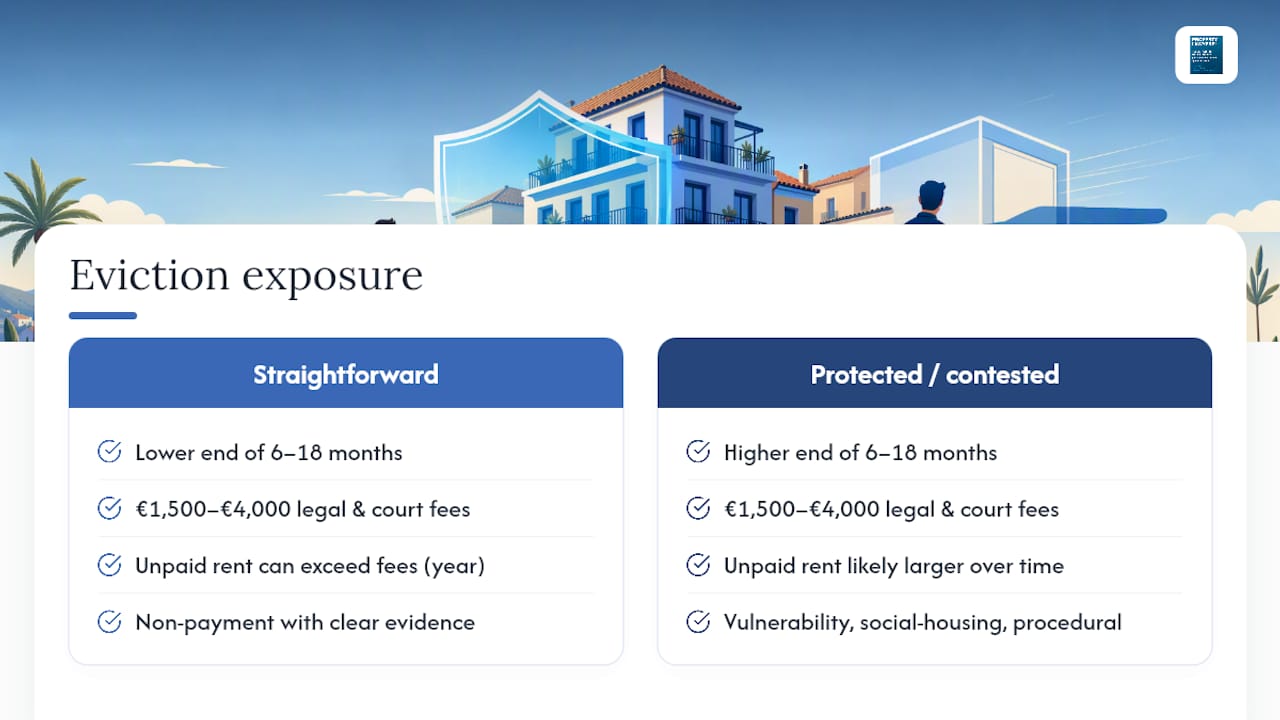
Cases move fastest when the ground is straightforward, non-payment of rent with clear documentary evidence, and courts tend to prioritise these. They slow down sharply when a tenant qualifies for vulnerability protections, when social-housing status applies, or when the tenant contests the claim on procedural grounds.
Build this uncertainty into your offer rather than your contingency plan. If a flat is occupied by a tenant with arrears and no clear exit date, price in the higher end of both the timeline and the cost range, and use that combined figure to justify a larger discount at the negotiating table.
Why a specialised Spanish property lawyer matters here
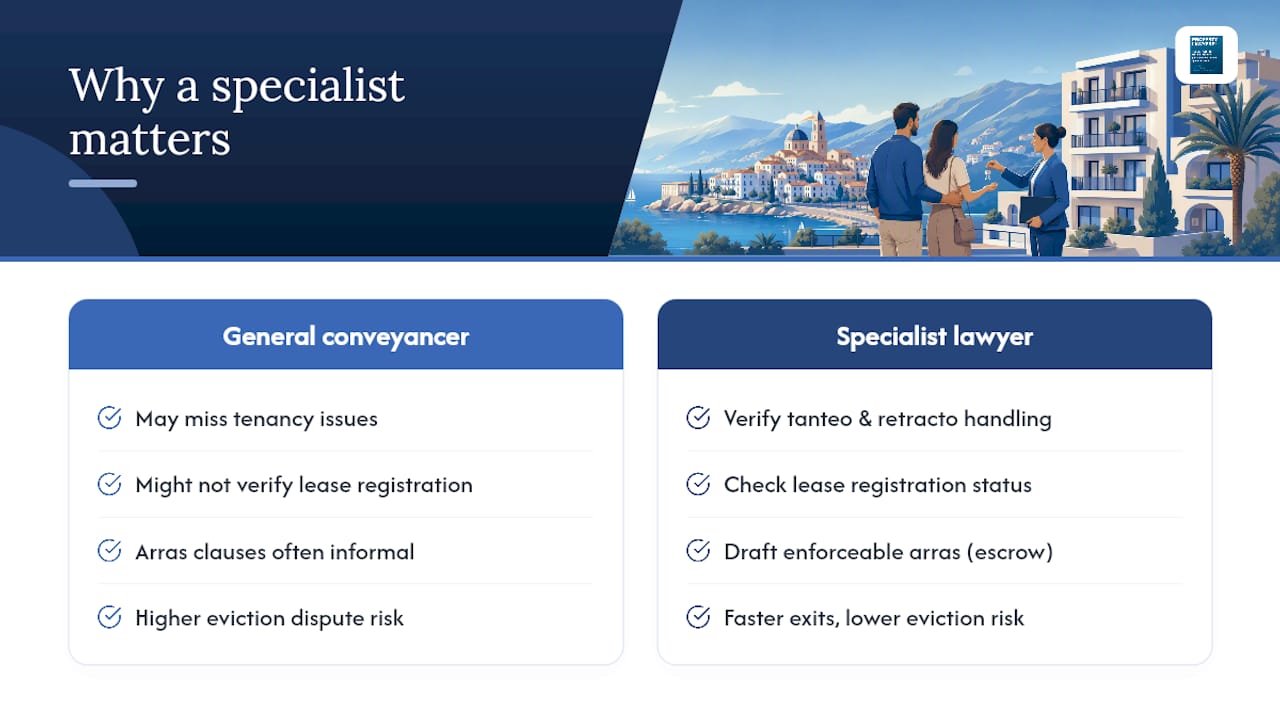
Occupied purchases carry legal detail that a general conveyancer can miss. A lawyer who specialises in tenancy-linked sales will verify that tanteo and retracto were correctly handled, check the lease’s registration status, and draft arras clauses that make cash-for-keys or escrow arrangements genuinely enforceable rather than a handshake promise.
Property-lawyers is a directory of vetted, independent Spanish property lawyers, built specifically to help international buyers find someone who handles exactly this kind of transaction. Sophie, a contributing author here, has seen how a properly drafted exit agreement, one with a delivery date and daily penalty, turns a vague tenant promise into something a court will actually enforce. The practical payoff: faster negotiated exits, correctly arranged escrow of funds, and far lower risk of ending up in a contested eviction you didn’t budget for.
Three actions I would take before making an offer
If I were buying an occupied flat tomorrow, I’d get the full lease and twelve months of payment evidence before signing arras, demand proof the seller followed the tanteo and retracto procedure (or a written renunciation if not), and insist on a conditional closing with escrow or a penalty-backed cash-for-keys agreement. Skip any of these three and you’re negotiating blind.
— Sophie
Find a vetted lawyer to handle your occupied purchase
Property-lawyers is the practical alternative to guessing your way through lease audits and eviction risk alone. Rather than relying on a seller’s assurances or a generic conveyancer who’s never handled a tanteo notification, you get matched with an independent, English-speaking Spanish property lawyer who specialises in exactly this kind of transaction, verifying subrogation compliance, drafting enforceable exit clauses, and negotiating the discount that actually reflects your risk.

If your target property is in the capital, our Madrid property lawyer directory is a good starting point. For anywhere else in Spain, the national directory of vetted property lawyers lets you filter by region and specialism. Get in touch with a lawyer before you pay arras, not after, so lease verification and protective clauses are in place from the first offer.
Sources
This guide draws on legal advisory columns and market analyses covering subrogation and tenant rights, discount negotiation, and eviction timelines. Property-lawyers’ own guide to Spanish property law covers the legal background in more depth.
This article is general information, not a substitute for advice from a qualified lawyer. Consult a qualified legal professional about your own circumstances before acting on anything here.
FAQ
What happens if I buy a flat with tenants already inside?
You inherit the existing lease exactly as it stands, meaning the tenant can stay for the remainder of the agreed term regardless of the change in ownership.
What does buying a rented flat actually involve, legally?
You take on subrogation into the landlord’s position under the LAU, which means respecting the contract’s duration, rent and deposit terms, and confirming the tenant’s tanteo or retracto rights were properly handled before the sale.
What if I buy a flat and later discover it’s rented?
If the tenancy wasn’t disclosed, you may have grounds to challenge the sale, but you’re still legally bound to honour the lease once discovered, so involve a lawyer immediately to check whether the seller breached their disclosure duty.
What happens if the property I rent gets sold?
Your lease survives the sale unchanged; the new owner becomes your landlord and must respect your contract’s remaining term, and you may hold tanteo or retracto rights if the seller didn’t notify you properly beforehand.
Recommended
- Buying new build in Spain: the legal process explained
- What is saneamiento por evicción and how does it protect buyers in Spain?
- 10 important steps before buying property in Spain
- Why hire a lawyer when buying property in Spain

Sophie Gutenberg is a legal content specialist focused on Spanish property law, real estate transactions, conveyancing, due diligence and tax issues affecting international property buyers in Spain. She works alongside qualified Spanish property lawyers .
