

Compra con usufructo: what buyers get and what they don’t
A compra con usufructo means you buy the nuda propiedad, the bare ownership title, while someone else, the usufructuario, keeps the legal right to live in the property or rent it out for the rest of their life or an agreed term. You get a real, registered property right at a substantial discount below full market value, but no key to the front door until that right ends. It suits patient investors and families planning succession, not anyone who needs a home or rental income now.
The deal only protects you once it’s signed before a notary and registered at the Registro de la Propiedad. Before you commit, weigh up:
- The price looks attractive, but you may wait years, sometimes decades, before you can use or sell the whole property
- You could inherit maintenance duties, service charges or tax bills sooner than the actual right to occupy
- Getting this wrong without a lawyer checking the paperwork is where most disputes start
Key Takeaways
Buying nuda propiedad works only when registration, regional tax planning, and clear maintenance clauses are all in place before you sign.
| Point | Details |
|---|---|
| Confirm the split of rights | The usufructuary keeps use and rental income; you hold title only, so check the deed’s exact terms first. |
| Treat the 89-age rule as a guide | Use it for valuation and tax purposes, but negotiate on health, condition and demand, not the formula alone. |
| Get a region-specific tax estimate | ITP and consolidation tax both vary by autonomous community, so ask a lawyer before making an offer. |
| Insist on protective clauses | Maintenance obligations, indemnities and a mediation clause prevent most common disputes. |
| Use a vetted local lawyer | Property-lawyers connects buyers with English-speaking lawyers who handle registry checks, tax estimates and contract drafting for these transactions. |
This article is general information, not a substitute for advice from a qualified lawyer. Consult a qualified legal professional about your own circumstances before acting on anything here.
Table of Contents
- What does compra con usufructo mean for your rights?
- How is the price of nuda propiedad calculated?
- What taxes apply when you buy or consolidate usufruct?
- What risks and disputes come up with usufruct property?
- What documents should you check before buying?
- How do you consolidate full ownership or exit early?
- How long does a usufruct last under Spanish law?
- Can you rent the property while someone else holds usufruct?
- Who pays for what: usufructuary versus bare owner?
- What is the step-by-step timeline for buying nuda propiedad?
- Can you get a mortgage to buy nuda propiedad?
- Why local legal advice matters more than the headline discount
- How Property-lawyers helps you buy nuda propiedad safely
- Sources
- FAQ
What does compra con usufructo mean for your rights?
Usufruct structures should be checked against the deed, tax treatment and local property context. Buyers can find relevant legal specialists in Mallorca, Marbella, Madrid, Barcelona and Ibiza.
Spain’s Código Civil splits property into two separate rights. The usufructuario holds uso y disfrute, the right to use the property and collect any income it generates, such as rent. The nudo propietario, that’s you as buyer, holds the underlying title but cannot move in, rent it out, or touch the income stream while the usufruct runs.
In practice, this changes who does what:
- The usufructuario decides whether the property is lived in or let out, and keeps any rental income
- The usufructuario generally covers day to day repairs and running costs; you, the bare owner, are usually responsible for extraordinary repairs and the property’s structure
- Usufructs are typically vitalicio (lasting for the usufructuary’s lifetime) or fixed term, and Spanish law limits how transferable each right is. A usufructuary can often sell or lease their right within its term, but cannot extend it beyond their own life
- Neither side is fully protected until the split is set out in a public deed and entered in the Land Registry, which is what makes the arrangement enforceable against future buyers, heirs or creditors
Skip the registration step and you own a right that’s difficult to prove and even harder to sell later. This single formality, backed by Spain’s tax authority guidance on real rights of use and enjoyment, is what separates a genuine investment from an informal family arrangement that courts struggle to enforce.
How is the price of nuda propiedad calculated?
Spanish valuers and tax offices lean on a well known formula: 89 minus the usufructuary’s age gives the percentage value of the bare ownership.
The 89 rule in numbers: the formula sets legal floors and ceilings, so the usufruct value can never dip below 10% or rise above 70% of the full property value, whatever the usufructuary’s age.
That formula is a tax and valuation anchor, not a market price guarantee. Real negotiated prices move around it depending on the usufructuary’s health and likely life expectancy, the physical condition of the property, and how much competing buyer demand exists in that particular pocket of Marbella, Mallorca or wherever you’re looking. A younger, healthy usufructuary generally pushes the effective discount lower than the formula suggests, because you’re likely to wait longer for full use.
Pro Tip: Get an independent valuation before you rely on the 89-age formula alone, and try to structure payment in tranches, releasing part of the price only once the registry check and technical inspection come back clean.
What taxes apply when you buy or consolidate usufruct?
Tax is where most surprises happen, and it’s the single biggest reason to get local advice before you sign anything.
- As the buyer, you typically pay Impuesto de Transmisiones Patrimoniales (ITP) on the value of the nuda propiedad itself, not on the full property price, but the rate is set by each autonomous community and varies noticeably between, say, Andalusia and Catalonia
- When the usufruct eventually ends and you gain full ownership (called consolidación del dominio), that step can trigger further tax, and Catalonia is one region where consolidation can attract additional taxation tied to the previously untaxed percentage
- Beyond ITP, budget for notary fees, registry fees, gestoría costs, and, if the seller is the usufructuary rather than a third party, possible capital gains implications on their side
Regional variation is the detail buyers miss most often. A practical breakdown of purchase taxes using Balearic examples shows how much the final bill can shift purely by location, even for the same type of transaction.
Ask your lawyer for a written tax estimate specific to the property’s autonomous community before you make an offer, not after.
What risks and disputes come up with usufruct property?
Buying nuda propiedad rarely goes wrong because of the concept itself. It goes wrong because the contract never spelled out what happens when things get messy.
The recurring problems are predictable:
- The usufructuary stops paying IBI (local property tax) or community fees, leaving the bare owner exposed
- The property is neglected, or the usufructuary actively blocks inspections or valuations
- The usufructuary abandons the property or lets it fall into disrepair, reducing its eventual value to you
Solid contracts head these off with a few specific clauses: a detailed inventory and photographic record at the outset, explicit maintenance obligations naming who pays for what, financial penalties or indemnities for non-payment, a clear timeline for any agreed buyout or joint sale, and a mediation clause so disputes don’t default straight to court. Notarially recorded schedules and evidence gathered early make claims far easier to prove later, and documented buyout and mediation clauses are the standard fix recommended by conveyancers who deal with these disputes regularly.
Pro Tip: Insist on a mediation clause before signing. Court disputes over usufruct terms often take a long time, whereas a pre-agreed mediator can resolve maintenance or payment disputes more quickly.
What documents should you check before buying?
Hand this list to your lawyer before you sign a reservation contract or pay a deposit:
- Nota Simple from the Land Registry, confirming exactly how the usufruct is inscribed, its term, and whether any charges or embargoes sit against the property
- The existing escritura (public deed) that created the usufruct, so you know its origin and exact wording
- Recent IBI receipts and community fee statements, proving there’s no debt attached to the property
- Any existing rental contracts the usufructuary has signed, since these can bind you once you’re the registered bare owner
- An independent valuation and, ideally, a technical condition report (ITE), plus a written inventory of fixtures
- Proof of the seller’s identity and legal capacity, and confirmation there’s no contested inheritance sitting behind the usufruct
Reading a Nota Simple correctly takes practice; a guide to interpreting Spanish land registry searches is worth reviewing before your first meeting with a lawyer, and the wider due diligence checklist for Spanish property buyers covers the conveyancing steps that follow.
How do you consolidate full ownership or exit early?
You don’t have to wait passively for the usufruct to end naturally. Three routes let you take control sooner or turn the asset into cash:
- Buy out the usufruct while the usufructuary is alive. This can be paid as a lump sum or structured as a renta vitalicia (a life annuity), which suits usufructuaries who want ongoing income rather than one payment
- Sell the full, consolidated property jointly with the usufructuary’s agreement, splitting proceeds according to the value each right represents
- Use a mediator-led settlement to agree a scheduled renunciation or buyout formula, useful when family relationships or valuation disagreements make a straightforward sale difficult
Pre-agreed buyout formulas often work out cheaper than waiting for automatic consolidation at death, particularly where the property has appreciated significantly and succession tax would otherwise bite hard. Once terms are agreed, registering the consolidated title typically takes a matter of weeks through the Land Registry, though tax settlement can add further time depending on the autonomous community.
How long does a usufruct last under Spanish law?
Usufruct is a temporary right, never a permanent one, and Spanish law is specific about how it can end. The most common form in these purchases is usufructo vitalicio, lasting for the usufructuary’s natural life. When they die, the right disappears automatically and you, the bare owner, become full owner without any further purchase or payment.
Usufructs can also be set for a fixed term (usufructo temporal), commonly used when parents want to guarantee a set number of years of use before handing the property fully to the next generation. A temporal usufruct granted to a company or organisation, rather than an individual, is capped at 30 years under Spanish law.
Beyond death or expiry of a fixed term, a usufruct can end through renunciation (the usufructuary gives it up voluntarily, sometimes for payment), merger (if the usufructuary later buys the bare ownership too, or vice versa), total loss of the property, or non-use over a set period. Each of these routes has different paperwork and tax implications, which is why a lawyer needs to confirm exactly which type of usufruct you’re buying into before you sign.
This is also where the growth in nuda propiedad transactions as a liquidity tool for older Spanish homeowners becomes relevant. Many usufructuaries are elderly sellers who want cash now while staying in their home, which is exactly why the term and type of usufruct need checking carefully rather than assumed.
Can you rent the property while someone else holds usufruct?
As bare owner, you cannot rent out, occupy, or otherwise use the property while a usufruct is active, full stop. That right sits entirely with the usufructuary until the usufruct ends. If they choose to let the property out, they, not you, collect the rent and manage the tenancy.
This catches new buyers off guard more than almost anything else in the transaction. You may hold registered title to a flat in central Málaga, yet have no legal standing to enter it, list it on a rental platform, or negotiate with an existing tenant. Any rental income generated during the usufruct period belongs to the usufructuary, and you have no automatic claim to a share of it, unless the original deed specifically says otherwise.
Your rights as bare owner are narrower but not worthless. You can sell your nuda propiedad to someone else at any time, since bare ownership is a transferable asset independently of the usufruct. You can also take legal action if the usufructuary damages the property, fails to insure it, or lets it fall into serious disrepair, since Spanish law requires a usufructuary to maintain the property in the condition they received it. You’re also entitled to inspect the property periodically to confirm it’s being looked after, provided this is written into the deed.
The practical takeaway: if your investment plan depends on rental income starting immediately, a nuda propiedad purchase is the wrong vehicle. It only makes sense if you’re comfortable holding a non-income asset until the usufruct ends, banking on the discount and eventual full ownership rather than any interim yield.
Who pays for what: usufructuary versus bare owner?
Spanish law draws a reasonably clear line between routine running costs, which fall to the usufructuary, and structural or extraordinary costs, which usually fall to the bare owner. In practice, that split needs spelling out in the deed, because “extraordinary” repair is a term that generates real arguments.
The usufructuary typically covers day to day IBI (the local property tax), ordinary community fees, utility bills, minor repairs, and insurance premiums for normal use. They keep the property in a habitable, maintained state as if they owned it outright, because functionally, day to day, they do.
The bare owner is usually on the hook for major structural repairs, such as roof replacement, foundation work, or anything classed as an extraordinary community charge (a lift installation, a major façade renovation voted through by the community of owners). These costs can be substantial and unpredictable, and they land on you well before you get any use of the property.
Where this gets murky is anything that sits between the two categories, and where the original deed is vague. A dispute over who pays for a new boiler, a leaking roof, or a community-voted improvement is exactly the kind of disagreement that drags on for months without a clear contractual clause assigning responsibility. This is precisely why the risks section earlier in this guide stresses a detailed maintenance clause at the outset, not a general reference to “usual obligations.” Ambiguity here costs money and time, and it’s entirely avoidable with proper drafting.
What is the step-by-step timeline for buying nuda propiedad?
The process runs on a broadly familiar Spanish conveyancing timeline, with a few extra checks layered in because of the usufruct.
Weeks 1 to 2: Your lawyer requests the Nota Simple, reviews the existing usufruct deed, and confirms there are no embargoes, contested inheritance issues, or undisclosed charges against the property.
Weeks 2 to 4: Independent valuation and, ideally, a technical condition report are commissioned. This is also when the 89-age formula gets applied as a baseline, and your lawyer drafts protective clauses covering maintenance, indemnities, and any buyout or mediation terms.
Weeks 4 to 6: Negotiation on final price, informed by the valuation and the usufructuary’s likely life expectancy where relevant, followed by drafting of the private purchase contract or reservation agreement, often with a deposit held conditionally pending final checks.

Weeks 6 to 10: Signing before a notary (escritura pública), payment of ITP, and submission to the Registro de la Propiedad for inscription. Registration itself typically takes several weeks to process once submitted, though this varies by region and registry workload.
Years later, at consolidation: When the usufruct ends, whether by death, expiry, or agreed buyout, a further registration step formalises your full ownership, and any consolidation tax due gets settled with the relevant regional tax office.
Buyers often assume the process ends at the notary. It doesn’t. The consolidation stage, sometimes decades later, needs its own paperwork and its own tax handling, which is worth planning for now rather than leaving to whoever inherits the file.
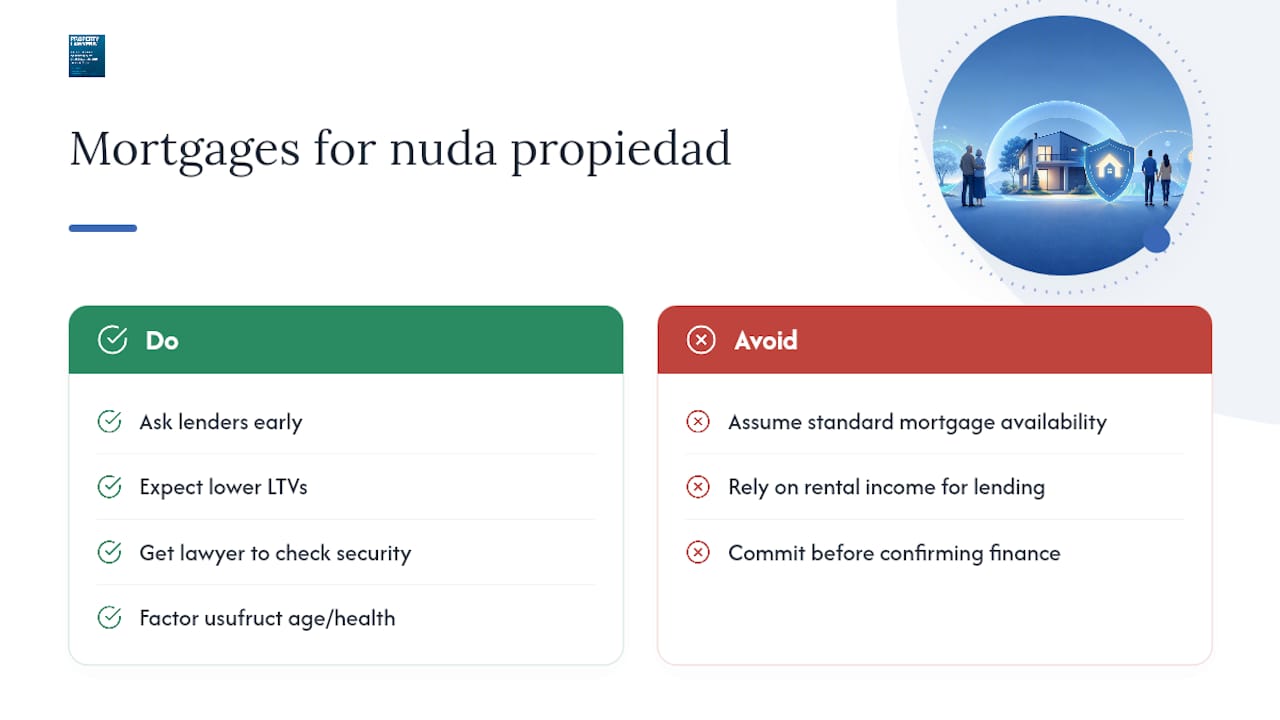
Can you get a mortgage to buy nuda propiedad?
Financing a nuda propiedad purchase is noticeably harder than financing a standard property purchase, and it’s worth knowing this before you start planning your budget around a mortgage.
Spanish lenders are generally cautious about nuda propiedad because the collateral, the bare ownership, doesn’t include the right to occupy or rent the property. If a buyer defaults, the bank would be left holding a non-income-producing asset it can’t easily sell or use until the usufruct ends, which could be years or decades away. That uncertainty makes many mainstream mortgage products unavailable or offered only on stricter terms.
Where financing is available, expect lower loan-to-value ratios than a standard residential mortgage, since lenders typically lend against a percentage of the discounted nuda propiedad value rather than the full property price. Some lenders also want the usufructuary’s age and health factored into the loan term, given that consolidation and any potential future refinancing may hinge on the usufruct ending within a foreseeable period.
Cash purchases remain the most common route for this reason, particularly among the international investors and succession planners who make up the bulk of this market. If financing matters to your plans, raise it with a lender early, before you commit to a purchase price, and ask a lawyer to confirm what security the bank would actually be taking, since a poorly drafted charge over a bare ownership right can complicate things for everyone if the loan ever needs enforcing.
Why local legal advice matters more than the headline discount
The conventional pitch around nuda propiedad focuses almost entirely on the discount: buy at 20% or 30% below market value, wait, and eventually own outright. That framing is true but incomplete, and it’s the incomplete version that gets buyers into trouble.
What the research behind this guide actually supports is a different priority order. The discount matters less than three things: the exact wording of the usufruct’s term, the tax treatment in the specific autonomous community where the property sits, and whether the contract has real teeth on maintenance and dispute resolution. Buyers who focus only on the 89-age formula and skip the contractual detail are the ones who end up in mediation, or worse, in court, years after signing.
Reporting on the growing use of nuda propiedad alongside instruments like reverse mortgages makes a point worth repeating: this market often involves elderly sellers whose circumstances change, and buyers whose patience is tested by exactly that unpredictability. Treat the usufructuary’s wellbeing and the clarity of your paperwork as part of the investment case, not a side issue. Get the region-specific tax estimate and the contractual clauses right before you fall for the discount on the price sheet.
— Sophie
How Property-lawyers helps you buy nuda propiedad safely
Finding a lawyer who genuinely understands usufruct transactions, rather than a general conveyancer working through their first one, makes the difference between a smooth purchase and a drawn-out dispute. Property-lawyers connects you directly with vetted, English-speaking property lawyers across Spain who handle nuda propiedad deals regularly, from the Costa del Sol to the Balearics.

A lawyer found through the directory can run the full Land Registry check on the property you’re considering, give you a written tax estimate specific to that region’s ITP and consolidation rules, and draft the protective clauses covering maintenance, indemnities and buyout terms before you sign anything. That’s meaningfully different from relying on a seller’s own paperwork or a generic template contract, particularly given how much tax and consolidation rules shift between autonomous communities.
Before you make an offer, request three things through a listed lawyer: a Nota Simple review, a regional tax estimate, and a draft clause set covering the risks this guide has walked through. If you’re specifically looking in the capital, the Madrid property lawyers directory is a direct starting point, and the Spain-wide buying guide and lawyer directory covers every other region, including Marbella, Mallorca and Barcelona.
Sources
- Agencia Tributaria — Derechos reales: uso y disfrute
- RTVE — Comprar sin entrar, cobrar sin vender: nuda propiedad e hipoteca inversa
FAQ
What does compra con usufructo actually give you?
You get registered bare ownership (nuda propiedad) of the property, but not the right to live in it or rent it out until the usufruct ends, typically on the usufructuary’s death or at the end of an agreed term.
How is the price of nuda propiedad worked out?
Spain commonly uses the ‘89 minus age’ formula to set a valuation percentage for tax purposes, with a legal floor of 10% and ceiling of 70%, though the real negotiated price also depends on the usufructuary’s health and the property’s condition.
Who pays the taxes on a nuda propiedad purchase?
The buyer typically pays ITP on the value of the bare ownership at purchase, and further tax can apply at consolidation when the usufruct ends, with both the rate and the consolidation rules varying by autonomous community.
Can you get a mortgage to buy nuda propiedad?
It’s possible but harder than a standard mortgage, since lenders see the lack of occupancy rights as added risk and typically offer lower loan-to-value ratios; cash purchases remain more common.
How do I find a lawyer who handles usufruct purchases?
Property-lawyers lists vetted, English-speaking property lawyers across Spain who specialise in conveyancing, including usufruct and nuda propiedad transactions, searchable by region through its directory.
Recommended
- Plusvalía Municipal Tax in Spain — What Sellers Need to Know | Property Lawyers
- Spanish property forfeiture law explained for buyers
- Gazumping in Spain: what property buyers must know

Sophie Gutenberg is a legal content specialist focused on Spanish property law, real estate transactions, conveyancing, due diligence and tax issues affecting international property buyers in Spain. She works alongside qualified Spanish property lawyers .
