

Conveyancing in Spain: a 2026 guide for buyers
TL;DR:
- Conveyancing in Spain is a legal process that transfers property ownership through documentation, checks, and notarisation. Independent legal advice is essential to protect buyers from risks like hidden debts, fraud, and ownership disputes. The process involves obtaining an NIE, requesting current property documents, signing binding contracts, completing at the notary, and registering ownership with the Land Registry.
Conveyancing in Spain is defined as the formal legal process that transfers property ownership from seller to buyer through a regulated sequence of documentation, official checks, and notarised completion. Known in Spanish legal practice as transmisión de propiedad, the process involves key documents including the nota simple, the escritura pública (public deed), and registration at the Land Registry (Registro de la Propiedad). For international buyers, understanding each stage is not optional. Spain’s property system differs significantly from those in the UK, Ireland, or the United States, and errors made at any point can result in inherited debts, ownership disputes, or outright fraud.
What are the main steps in conveyancing Spain?
The core conveyancing process is similar nationwide, but planning checks, taxes and local documentation can vary by region. Compare property lawyers for Mallorca, Marbella, Madrid, Barcelona and Ibiza.
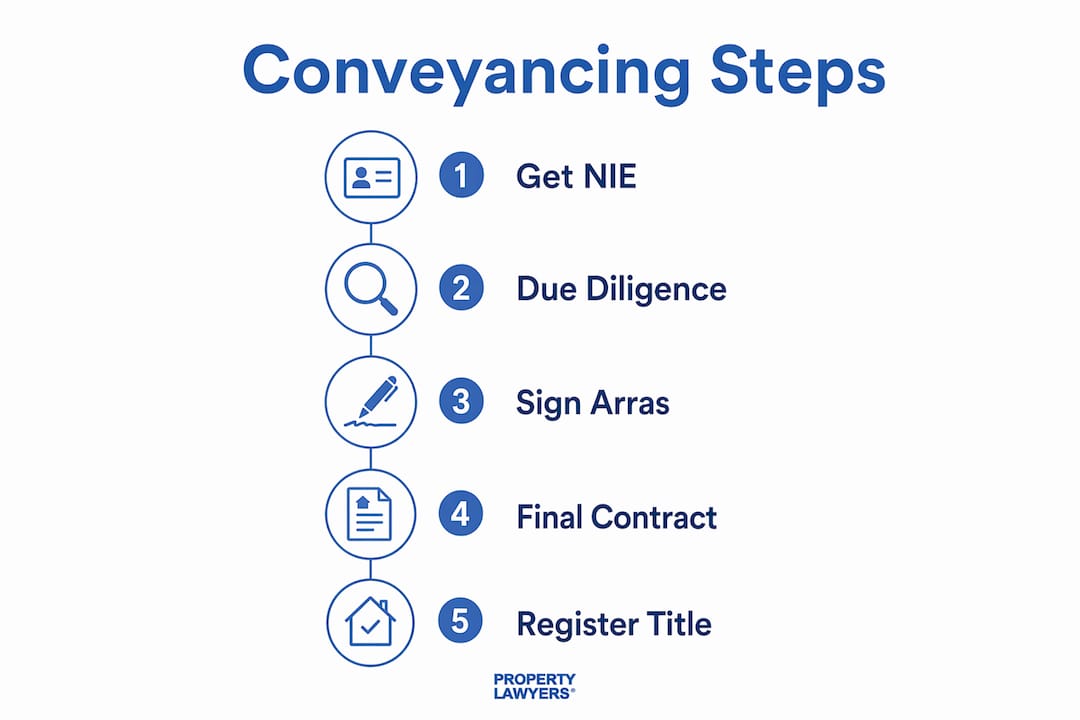
Spanish property conveyancing follows a defined sequence. The typical timeline runs between 6 and 12 weeks from initial document checks to final Land Registry entry, though complex transactions can take longer. Each stage carries specific legal obligations that buyers must fulfil in order.
-
Obtain your NIE number. The Número de Identificación de Extranjero (NIE) is a tax identification number required for every property transaction in Spain. Without it, you cannot sign contracts or pay taxes. The NIE application process can take several weeks, so apply early.
-
Request a nota simple. This official extract from the Land Registry confirms the property’s ownership, surface area, and any charges or encumbrances registered against it. Request a fresh copy at the outset of due diligence.
-
Sign the reservation contract. A short-form agreement removes the property from the market, typically secured with a small deposit of €3,000 to €6,000. This is not the binding purchase contract.
-
Exchange arras penitenciales. The private purchase contract (contrato privado de compraventa) is signed alongside a deposit, usually 10% of the purchase price. This stage creates binding legal commitments for both parties.
-
Complete at the notary. Both parties sign the escritura pública before a Spanish notary. The balance of the purchase price is paid, and legal ownership formally transfers.
-
Register at the Land Registry. Post-completion, the deed must be submitted to the Land Registry to make ownership legally enforceable against third parties. This step is often handled by the notary’s office or your lawyer.
Pro Tip: Request your NIE number at least six to eight weeks before your intended completion date. Delays at Spanish consulates abroad are common, and a missing NIE will halt the entire transaction.
What legal protections should buyers seek in Spain?

Independent legal representation is the single most important protection a foreign buyer can secure. Spanish notaries act as neutral officials who verify identity and formalise documents. They do not conduct exhaustive legal checks, and they do not represent the buyer’s interests. This distinction surprises many international buyers who assume the notary performs a role similar to a solicitor.
An independent property lawyer working exclusively for you will carry out the checks the notary does not. These include:
- Verifying the seller’s legal title and confirming no undisclosed co-owners exist
- Checking for outstanding mortgages, embargoes, or charges registered at the Land Registry
- Reviewing planning permissions and confirming the property has a valid licencia de primera ocupación (first occupation licence)
- Cross-checking the Land Registry, Cadastre, and town hall records to identify any discrepancies between registries that could affect ownership or future resale
- Confirming the property is free of unpaid community fees, local taxes (IBI), and utility debts
Common risks that independent legal advice directly mitigates include hidden debts attached to the property, illegal building works not reflected in official records, and zoning irregularities that could prevent future development or even demolition orders. These are not rare edge cases. They are documented problems that affect a meaningful proportion of resale properties in Spain, particularly in coastal regions.
Pro Tip: Always instruct a lawyer who is independent of the estate agent and the seller. Shared legal representation, or a lawyer recommended solely by the selling agent, creates a conflict of interest that may not serve your interests.
Which conveyancing mistakes and fraud warning signs should buyers watch for?
Foreign buyers are disproportionately targeted in Spanish property fraud, and rushed payments, pressure tactics, and requests for illegal payment methods are the clearest warning signs. Recognising these red flags before signing anything is the most reliable form of protection.
The most common conveyancing mistakes and fraud indicators include:
- Using an outdated nota simple. The nota simple is a snapshot of the property’s legal status on the day it is issued. Using an outdated extract risks inheriting liens or ownership changes registered after that date. Always request a fresh copy within days of completion.
- Accepting cash payment requests. Any request to pay part of the purchase price in cash “under the table” to reduce declared value is illegal under Spanish tax law. It also exposes the buyer to future capital gains tax liabilities based on the full market value.
- Pressure to skip due diligence. Sellers or agents who urge you to proceed quickly without completing legal checks are a serious warning sign. Legitimate transactions accommodate proper legal review.
- Problematic powers of attorney. If the seller is acting through a power of attorney, that document must be property-specific, valid, and current. Generic or expired powers of attorney have caused transactions to fail entirely, leaving buyers without recourse.
- Contracts in Spanish only. Foreign buyers should never sign a contract they cannot read and understand. Insist on a bilingual contract or a certified translation reviewed by your lawyer before signing.
The full due diligence checklist for Spanish property purchases covers each of these risk areas in detail and is worth reviewing before you reach the contracting stage.
How do deposits and contracts work in Spanish conveyancing?
The arras penitenciales deposit is the mechanism that converts a property negotiation into a binding legal commitment. Under Article 1454 of the Civil Code, the standard deposit is 10% of the agreed purchase price. The financial consequences of withdrawal are deliberately asymmetric to incentivise both parties to proceed.
| Party | Action | Consequence |
|---|---|---|
| Buyer | Withdraws after signing arras | Forfeits the full deposit paid |
| Seller | Withdraws after signing arras | Must repay double the deposit received |
This structure differs from deposit arrangements in many other jurisdictions, where deposits are more easily recovered. In Spain, the deposit is genuinely at risk the moment the contract is signed. Buyers should therefore complete all due diligence and legal checks before reaching the arras stage, not after.
The private purchase contract also sets the completion deadline, the agreed price, and any conditions precedent such as mortgage approval. Your lawyer should negotiate these clauses carefully. A poorly drafted deadline, for example, can leave a buyer in breach if a mortgage offer is delayed.
Pro Tip: Never sign the arras contract without your lawyer having reviewed the title, the nota simple, and the community fee certificate. Once signed, your deposit is at risk.
What post-completion steps should buyers take to secure ownership?
Signing the escritura pública at the notary is not the final step. Several post-completion obligations must be fulfilled to secure full legal ownership and avoid future liabilities.
-
Pay transfer taxes. Resale properties attract Impuesto de Transmisiones Patrimoniales (ITP), which varies by region between 6% and 10% of the purchase price. New-build properties attract VAT (IVA) at 10%, plus stamp duty (AJD). These must be paid within 30 days of completion.
-
Register the deed at the Land Registry. The notary typically submits the deed electronically, but confirm this with your lawyer. Registration makes your ownership legally enforceable against any third party and is the definitive record of title.
-
Obtain zero-debt certificates. Property-related debts including unpaid community fees and local taxes remain attached to the property and transfer to the new owner automatically. Obtain certificates confirming zero balances for community fees, IBI (council tax), and utility accounts before completion, and verify these are current.
-
Transfer utilities and set up direct debits. Contact the relevant utility providers to transfer accounts into your name. Register with the community of owners (comunidad de propietarios) if the property is part of a development.
-
Update the Cadastre. The Cadastre (Catastro) is the official property valuation register used for tax purposes. Notify the local council of the ownership change to update Cadastre records and avoid future billing errors.
The legal status of your property in Spain is only fully secured once all five of these steps are complete. Buyers who stop at notary completion leave themselves exposed to registration gaps and inherited financial liabilities.
Key takeaways
Conveyancing in Spain requires independent legal representation, precise documentation, and post-completion registration to transfer ownership securely and free of inherited liabilities.
| Point | Details |
|---|---|
| Independent legal advice is non-negotiable | Spanish notaries do not protect buyer interests; only an independent lawyer does. |
| Due diligence precedes the deposit | Complete all legal checks before signing the arras contract, as the deposit is genuinely at risk once signed. |
| The nota simple must be current | Request a fresh copy within days of completion to avoid inheriting undisclosed charges. |
| Post-completion steps are legally binding obligations | Tax payment, Land Registry registration, and zero-debt certificates must all be completed after signing. |
| Fraud warning signs are specific and recognisable | Pressure tactics, cash requests, and invalid powers of attorney are documented red flags in Spanish transactions. |
Why I believe most buyers underestimate the legal complexity here
After years of observing international buyers navigate Spanish property transactions, the pattern I see most often is this: buyers invest significant time researching the property itself and almost no time understanding the legal process that transfers it to them. That imbalance is where problems originate.
The assumption that the notary acts as a legal guardian for the buyer is the single most costly misunderstanding in Spanish conveyancing. Notaries are public officials. Their role is to verify identity, confirm the parties understand the deed, and formalise the transaction. They are not conducting a title search on your behalf. They are not checking whether the seller owes three years of community fees. That work belongs to your independent lawyer.
I have also observed buyers resist paying for proper legal representation because conveyancing costs in Spain feel like an additional expense on top of an already large purchase. The reality is that a fixed-fee property lawyer typically charges between €1,500 and €3,000 for a full conveyancing service. That fee covers due diligence, contract review, tax compliance, and Land Registry registration. Compared to the risk of inheriting a €20,000 community debt or purchasing a property with an unresolved demolition order, the cost is not significant.
Spain’s property system rewards buyers who engage with it properly. The legal protections are genuinely strong when used correctly. The risks are concentrated almost entirely among buyers who bypass independent legal advice.
— Sophie
How Property-lawyers can help with your conveyancing in Spain

Property-lawyers is Spain’s leading directory connecting international buyers with trusted, independent property lawyers across every region of the country. Whether you are purchasing a resale apartment on the Costa del Sol, a new-build villa in Valencia, or a rural finca in Andalucía, Property-lawyers matches you with an English-speaking specialist who handles every stage of the transaction.
From verifying property legal status and conducting full due diligence to managing post-completion registration and tax filings, the lawyers listed on Property-lawyers operate on transparent, fixed-fee structures. There are no percentage-based charges. For buyers purchasing remotely, power of attorney services are available so your lawyer can represent you at every stage without requiring your physical presence in Spain. Explore the full 2026 buyer’s guide to understand your legal rights before you commit.
FAQ
What is conveyancing in Spain?
Conveyancing in Spain is the legal process of transferring property ownership from seller to buyer, involving due diligence, private contract signing, notary completion, and Land Registry registration. The process typically takes between 6 and 12 weeks from start to finish.
Do I need a lawyer for conveyancing in Spain?
A lawyer is not legally required but is strongly recommended. Spanish notaries act as neutral officials and do not protect buyer interests, meaning independent legal representation is the only reliable safeguard against hidden debts, planning irregularities, and fraud.
What are the main conveyancing costs in Spain?
Transfer tax (ITP) on resale properties ranges from 6% to 10% depending on the region, while new builds attract 10% VAT plus stamp duty. Legal fees, notary fees, and Land Registry registration costs typically add a further 1% to 2% of the purchase price.
What is the arras penitenciales deposit?
The arras penitenciales is a binding deposit, typically 10% of the purchase price, governed by Article 1454 of the Spanish Civil Code. If the buyer withdraws, the deposit is forfeited. If the seller withdraws, they must repay double the amount received.
What are the main fraud warning signs in Spanish property transactions?
The clearest warning signs include requests for cash payments, pressure to skip legal checks, sellers acting under generic or expired powers of attorney, and contracts provided only in Spanish without translation. Any of these should prompt immediate consultation with an independent lawyer before proceeding.
Recommended
- Spanish real estate law: a buyer’s guide for 2026
- Property law in Spain: a 2026 guide for buyers
- Land Registry Spain — Registro de la Propiedad Guide for Buyers | Property Lawyers
- The Changing Profile of Foreign Buyers in Spain in 2026

Sophie Gutenberg is a legal content specialist focused on Spanish property law, real estate transactions, conveyancing, due diligence and tax issues affecting international property buyers in Spain. She works alongside qualified Spanish property lawyers .
