

How to invoice international clients in Spain legally
Whether you charge Spanish VAT, apply reverse charge, or zero-rate the invoice as an export depends on two things: your client’s status (B2B or B2C) and where the supply takes place. Get those two checks right before you issue anything.
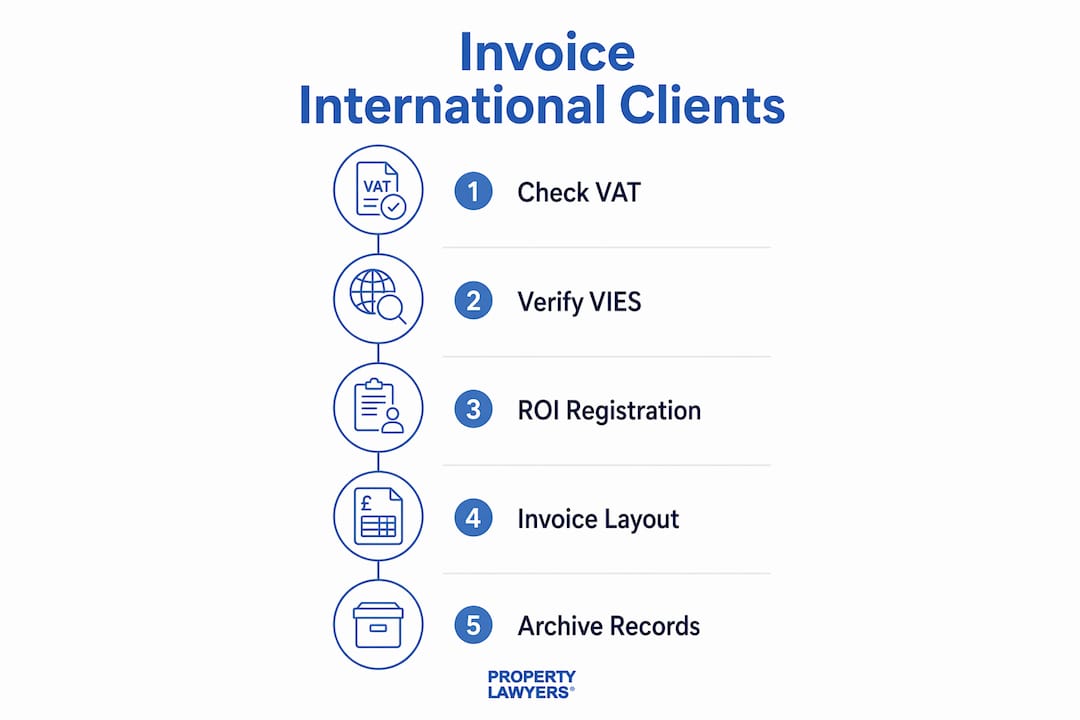
Immediate checklist before you invoice:
- Confirm whether your client is a business (B2B) or a private individual (B2C).
- Obtain their Spanish NIF, NIE, or EU VAT number.
- For EU B2B clients, verify via VIES before finalising the invoice. An invalid number means Spanish VAT may apply.
- Identify the type of transaction: property sale, long-term rental, tourist rental, or professional service. Each carries different VAT and withholding rules for non-EU residents.
- Confirm whether you need to register in Spain or appoint a fiscal representative (tourist rentals and certain property services can trigger this).
Every cross-border invoice must include:
- Your full legal name, address, and Spanish tax identifier (CIF/NIF) if registered
- Client’s full legal name and tax identifier (NIF, NIE, or VAT number)
- A unique, sequential invoice number
- Invoice date and date of supply
- Clear description referencing the property transaction or service
- Currency and, if applicable, the exchange rate
- Payment terms stated as a specific calendar date rather than vague “Net 30” wording
- Bank details including IBAN, SWIFT/BIC, and any client PO number
VAT in one sentence: EU B2B with a valid VIES number = reverse charge, no VAT charged. EU B2C = Spanish VAT. Non-EU clients (including UK buyers post-Brexit) = export, VAT-exempt, but you must add a legal justification on the invoice such as “Exportación de servicios” or a reference to Article 21 of Law 37/1992. Never leave the VAT field blank.
Registration triggers: ROI registration is only required for intra-EU B2B supplies using reverse charge. UK clients do not require it. However, operating tourist rentals or providing certain property-related services in Spain may create a local VAT obligation, and a fiscal representative may be needed. Check non-resident property tax obligations early.
Property-specific rules to know: On property sales, the buyer is typically required to withhold 3% of the purchase price and pay it directly to the Agencia Tributaria via Modelo 211. Tourist rentals attract VAT and require quarterly Modelo 303 filings. Long-term residential rentals are generally VAT-exempt. The Modelo 210 covers non-resident income tax on rental proceeds.
Record-keeping: Archive every invoice alongside the signed contract, proof of delivery or service completion, your VIES verification printout, and bank receipts. Discrepancies between Modelo 349 filings and client records are a common trigger for Agencia Tributaria inquiries. Keep records for at least four years.
Practical tips to avoid payment delays: Use a standardised invoice layout so corporate AP systems process it without manual review. Include the client’s PO number if they have one. Offer payment by SWIFT bank transfer and, where possible, an online payment option. State late-interest terms in neutral, non-punitive language.

Pro Tip: Store your VIES verification printout and export statement alongside each invoice in a single folder per transaction. If the Agencia Tributaria audits the file, you can demonstrate correct VAT treatment immediately without searching through separate systems.
This article is general information, not legal or tax advice. Confirm the current rules with the Agencia Tributaria, HMRC, or a qualified Spanish tax adviser for your specific situation.
Table of Contents
Need an English-speaking Spanish property lawyer?
Complex VAT cases, withholding on sales, tourist rental licences, and non-resident filings all benefit from specialist advice. A Spanish property lawyer or tax adviser can act as your fiscal representative, handle Modelo filings, and flag withholding obligations before they become costly surprises.

When you contact a lawyer, ask specifically about their experience with non-resident sellers, VAT and rental rules, and whether they can act as fiscal representative. Ask for a written fee estimate upfront. Property-lawyer costs in Spain vary by region and complexity, so comparing two or three quotes is sensible. For buyers and sellers in Catalonia, the Barcelona solicitor directory lists English-speaking specialists with regional expertise. Property-lawyers.com connects international buyers and sellers with independent, English-speaking property lawyers across Spain. Use the main directory to find a lawyer local to your property.
FAQ
Do I charge VAT when invoicing a UK client from Spain?
No. UK clients are non-EU, so the transaction is treated as an export and is exempt from Spanish VAT under Law 37/1992. Add a legal justification on the invoice, such as “Exportación de servicios”, and do not leave the VAT field blank.
Do I need ROI registration to invoice UK clients?
No. ROI registration is only required for intra-EU B2B supplies using the reverse charge mechanism. It is not needed for clients outside the EU, including the UK.
What is the 3% withholding on Spanish property sales?
When a non-resident sells Spanish property, the buyer must withhold 3% of the purchase price and pay it to the Agencia Tributaria via Modelo 211. This is a payment on account of the seller’s capital gains tax liability, not an invoicing charge.
What happens if a client’s VIES number is invalid?
The transaction may be reclassified as B2C, and Spanish VAT could apply. Always verify the VIES number before issuing the invoice to avoid costly corrections later.
How long must I keep international invoices in Spain?
Keep all invoices, contracts, VIES checks, and bank receipts for a minimum of four years. This matches the Agencia Tributaria’s standard audit window for VAT and income tax filings.
Recommended
- Modelo 210 Spain — Non-Resident Income Tax Return Guide | Property Lawyers
- ITP Tax Spain (2026) — Impuesto de Transmisiones Patrimoniales Explained
- How to register as autonomous lawyer in Spain

Sophie Gutenberg is a legal content specialist focused on Spanish property law, real estate transactions, conveyancing, due diligence and tax issues affecting international property buyers in Spain. She works alongside qualified Spanish property lawyers .
