

Nuda propiedad in Spain: how bare ownership sales work
Nuda propiedad in Spain lets an owner sell the title of their home while keeping the right to live there for life, or for a fixed number of years. The buyer pays a discounted price for that title and becomes full owner once the usufruct ends.
For the seller, usually someone over 65 who is asset-rich but cash-poor, this means a lump sum or income stream without leaving home. For the buyer, it means acquiring property below market value in exchange for waiting, sometimes many years, before they can move in or sell with full rights.
- Seller gets: cash now, guaranteed housing, no need to move.
- Buyer gets: a discounted purchase price, delayed use of the property.
- Both need: independent legal advice, because valuation rules and tax treatment shift by region.
Every case is different, and a qualified Spanish property lawyer should check the numbers before anyone signs.
Key Takeaways
Nuda propiedad transactions need careful local due diligence because valuation, taxes and marketability depend heavily on the property and region. Compare legal support in Mallorca, Marbella, Madrid, Barcelona and Ibiza.
Nuda propiedad works because it separates the right to live in a home from the right to own its title, letting sellers access cash without moving and buyers acquire property below market value in exchange for waiting.
| Point | Details |
|---|---|
| Two separate rights | Usufructo covers use and income; nuda propiedad covers title; together they form pleno dominio. |
| Discount depends on term | Lifetime usufruct uses age-based tables; fixed-term often applies roughly 2% per year, capped. |
| Market is growing | Around 1,798 nuda propiedad sales recorded in Spain in 2025, concentrated in Valencia, Andalucía and Madrid. |
| Taxes differ by region | Buyers pay ITP on the discounted value; sellers may claim IRPF exemptions if aged 65 and selling their main home. |
| Contracts prevent disputes | Written clauses on repairs, access, rental rights and heir notification avoid the most common conflicts. |
Table of Contents
- What is nuda propiedad and how does it differ from usufruct and full ownership?
- How is the nuda propiedad discount calculated?
- Taxes and fiscal implications in Spain
- What documents and steps does the transaction require?
- What are the biggest risks in a nuda propiedad deal?
- How big is the nuda propiedad market in Spain right now?
- Who should hire a lawyer, and what should due diligence cover?
- Nuda propiedad or hipoteca inversa: which suits your situation?
- What does the transaction timeline actually look like?
- What will buying or selling nuda propiedad actually cost?
- How do you negotiate usufruct duration and price fairly?
- How does nuda propiedad compare with other property rights?
- What do typical nuda propiedad scenarios look like?
- Why the discount is only half the story
- Sources
- FAQ
What is nuda propiedad and how does it differ from usufruct and full ownership?
Spanish property law splits ownership into two separate rights. Usufructo (usufruct) is the right to use a property and collect any income from it, such as rent. Nuda propiedad (bare ownership) is the underlying title, without the right to occupy or benefit from the asset while the usufruct exists. Put them back together and you get pleno dominio, or full ownership. This split is a long-standing feature of the Spanish Civil Code, not a modern invention dreamed up for elderly homeowners.
There are two common structures:
- Usufructo vitalicio (lifetime usufruct): the seller keeps the right to live in the home until they die, whatever their age. This is the version most retirees choose, because it guarantees housing security for life.
- Usufructo temporal (fixed-term usufruct): the right to occupy expires after an agreed number of years, regardless of whether the usufructuary is still alive. Buyers sometimes prefer this because the timeline for gaining full use is known in advance.
During the usufruct, the usufructuary can live in the property or rent it out and keep the income, but they must maintain it in reasonable condition and pay ordinary running costs. The nudo propietario (bare owner) holds the title, can sell or mortgage that title, and can register it at the Land Registry, but has no right to move in, rent it out, or interfere with the usufructuary’s occupation until the usufruct ends.
How is the nuda propiedad discount calculated?
Pricing a bare ownership sale comes down to one question: how long is the usufruct likely to last? The longer the wait, the bigger the discount the buyer expects.
- Lifetime usufruct: valuers commonly apply an age-based percentage, where the usufruct value falls as the usufructuary’s age rises, based on tables the Agencia Tributaria uses for official usufruct valuation.
- Fixed-term usufruct: practitioner guides often use a rough heuristic of around 2% deducted per year of the agreed term, capped at certain limits. This is market practice, not a legal formula, and should be treated as a starting point for negotiation rather than a fixed rule.
Statistic callout: discounts on the nuda propiedad price typically land somewhere between 30% and 60% of full market value, depending on the seller’s age, the type of usufruct, the property’s condition, and local demand. A younger usufructuary or a lifetime term generally pushes the discount toward the higher end, because the buyer waits longer to gain full use.
Location and the state of the building also move the number. A well-maintained flat in a sought-after coastal area holds value better than a property needing structural work, since the buyer eventually inherits both the title and whatever condition it’s in.
Taxes and fiscal implications in Spain
Both sides of a nuda propiedad transaction carry separate tax obligations, and the rules differ depending on where the property sits and who is buying.
- Buyer’s tax: Transfer Tax (ITP) applies to the value of the nuda propiedad itself, not the full market value of the home, which is one of the reasons the upfront cost looks attractive. If the seller is a developer selling a new-build, VAT (IVA) may apply instead of ITP.
- Seller’s tax: capital gains from the sale are declared under IRPF (personal income tax). Sellers aged 65 and over may qualify for an exemption on gains from the sale of their habitual residence, though the conditions attached to that exemption should always be checked with a tax adviser before assuming it applies.
- Consolidation tax on extinction: when the usufruct ends and the nudo propietario becomes full owner, some regions apply a further tax on that consolidation of dominio. The Agencia Tributaria’s guidance on extinción del usufructo flags this as a regional matter, and Catalonia has historically been cited as an example of a region with specific rules here.
- Notary and registration costs: both parties should budget for notary fees, Land Registry fees, and any legal or valuation fees, which follow broadly the same scale as a standard property purchase in Spain.
Fiscalidad nuda propiedad is genuinely one of the trickiest parts of the whole process, because a rule that applies in Valencia may not apply in the same way in Madrid or the Balearics. Nobody should treat a generic online guide as the final word here. A local tax office or a specialised lawyer needs to confirm the actual figures for the specific region and property before either party commits.
What documents and steps does the transaction require?
A nuda propiedad sale follows the same broad legal skeleton as any Spanish property purchase, with a few extra checks layered on top because two separate rights are being priced and recorded.
- Pre-checks: request the nota simple from the Land Registry to confirm ownership and any charges (cargas), get a certificado de comunidad confirming no unpaid community fees, gather the last three years of IBI (property tax) receipts, and check the energy certificate and, where relevant, the ITE (building inspection) for older properties.
- Negotiation: agree in writing who pays which running costs, whether the usufructuary can rent the property out, who covers major structural repairs, and what happens if either party defaults.
- Private agreement: many transactions start with a reservation or arras contract setting out price, timeline, and conditions before the formal deed.
- Signing before a notary: the escritura pública formalises the split between usufructo and nuda propiedad and states the agreed valuation of each.
- Tax liquidation and registration: ITP and any other applicable tax must be settled before the new bare ownership is registered at the Land Registry.
- Post-signing notifications: update the property’s registration with the community of owners and utility providers to reflect the new nudo propietario.
Payment structure affects risk. A single lump-sum payment is simplest and cleanest, while a renta vitalicia (staged payments for life) shifts more risk onto the buyer, since payments continue for as long as the usufructuary lives.
Pro Tip: Ask for a written maintenance clause specifying exactly who pays for a new roof, boiler, or lift repair. Vague wording here is the single biggest source of disputes later, according to practitioner guidance from Spanish law firms handling these sales.
Anyone unfamiliar with these steps should read a broader guide to the Spanish property purchase process before going further, since nuda propiedad sits on top of the same conveyancing framework.
What are the biggest risks in a nuda propiedad deal?
Most disputes in bare ownership sales trace back to four recurring problems, and all of them are avoidable with the right paperwork.
- Poor valuation: a discount based on unrealistic age or health assumptions can leave one side feeling shortchanged years later. Stress-test the price against a shorter and a longer usufruct scenario before agreeing a figure.
- Unclear repair responsibilities: without a written clause, arguments over who pays for a new roof or a burst pipe are common. Insist on a clear split between ordinary maintenance (usufructuary) and extraordinary repairs (often negotiated case by case).
- Hidden charges: an outstanding mortgage, embargo, or unpaid community debt attached to the property can surface after signing. Always request up-to-date certificates confirming the property is free of undisclosed charges.
- Heir disputes: children or other heirs sometimes challenge a sale made without their knowledge, particularly where the usufructuary’s mental capacity is later questioned. Recording communications and, where appropriate, informing heirs in writing before signing reduces this risk considerably.
Buyers who skip due diligence in these areas take on liabilities they didn’t price into their discount.
How big is the nuda propiedad market in Spain right now?
The market has grown from a niche estate-planning tool into a genuine mainstream option. Compraventas of nuda propiedad reached close to 1,798 transactions in 2025, with Comunidad Valenciana, Andalucía, and Madrid recording the highest activity.
- Comunidad Valenciana: around 433 operations, the busiest region in the country.
- Andalucía: around 340 operations.
- Madrid: around 251 operations.
- Cataluña and Canarias: further significant clusters, at 179 and 123 operations respectively.
Two forces sit behind this growth: an ageing population with property wealth but limited cash income, and rising housing costs that make bare ownership an attractive discounted entry point for buyers. Coverage from RTVE notes growing interest tied directly to these demographic and housing pressures.
For investors, the practical takeaway is that supply tends to cluster in regions with larger retired populations and strong second-home markets, so the coast and major cities are worth watching first. How quickly a bought nuda propiedad converts to full use depends entirely on the usufructuary’s age and health at the time of sale, which is exactly why realistic scenario planning matters more than the headline discount.
Who should hire a lawyer, and what should due diligence cover?
Before signing anything, both buyer and seller should independently verify a specific set of documents:
- Nota simple confirming current ownership and any registered charges.
- Certificación de comunidad proving no outstanding service charges.
- IBI receipts for the last few years, confirming the property tax position.
- Energy certificate and, for older buildings, the latest ITE inspection report.
- Mortgage certificate confirming whether any loan remains attached to the property.
On the contract side, insist on clauses covering maintenance duties, rights of access for inspections, whether rental is permitted, how disputes get resolved, and what happens if a payment is missed under a staged arrangement.
A specialised lawyer becomes essential where charges are unclear, where heirs might object, or where either party has cross-border tax exposure. These cases carry legal complexity that a standard estate agent simply isn’t equipped to navigate, which is exactly the gap Property-lawyers fills by connecting buyers and sellers with vetted, independent, English-speaking Spanish property lawyers who handle nuda propiedad transactions regularly.
Nuda propiedad or hipoteca inversa: which suits your situation?
Both options let an older homeowner unlock cash while staying put, but the mechanics are opposite.
- Nuda propiedad is a straightforward sale: the seller gets a lump sum (or staged payments) now, gives up the title, and the debt never grows. The estate loses the asset immediately.
- Hipoteca inversa (reverse mortgage) is a loan secured against the home: the owner keeps full title, but the debt accumulates interest over time and reduces what heirs eventually inherit.
Nuda propiedad tends to suit owners who want a clean break and certainty over the amount received today, with no future creditor claim. A hipoteca inversa often fits better for those who want to preserve the property fully within the family estate, accepting that the eventual payout to heirs will be reduced. Some owners explore a Spanish mortgage as a third route entirely, particularly if their goal is financing rather than liquidating an asset.
What does the transaction timeline actually look like?
From first listing to final registration, a nuda propiedad sale typically runs 8 to 14 weeks, similar to a standard Spanish property sale but with extra time built in for valuation negotiation.
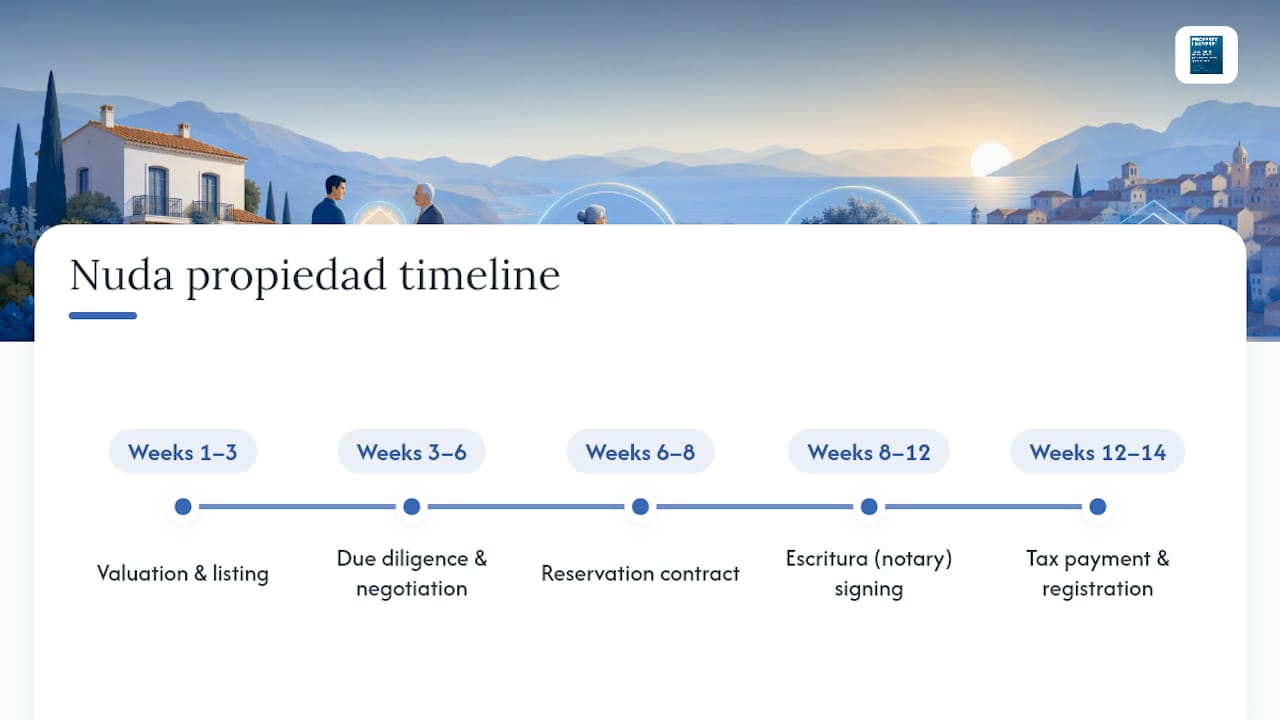
Weeks 1 to 3: the seller (or their lawyer) commissions a valuation of both the usufruct and the nuda propiedad, gathers the nota simple, IBI receipts, and energy certificate, and lists the property on the open market, where bare ownership listings appear regularly across southern Spain.
Weeks 3 to 6: interested buyers review documentation, commission their own legal due diligence, and negotiate price, payment structure, and maintenance clauses. This stage often takes longer than a standard sale because both sides need to agree not just on price but on the usufruct’s terms.
Weeks 6 to 8: a private arras or reservation contract is signed, usually with a deposit, locking in the agreed terms while final checks complete.
Weeks 8 to 12: the escritura pública is signed before a notary, formally splitting usufructo and nuda propiedad and recording each element’s valuation.
Weeks 12 to 14: ITP is paid, the new ownership structure is registered at the Land Registry, and the community of owners and utility providers are notified of the change.
Delays usually come from slow valuation agreement or missing paperwork, not from the notary stage itself, so starting document collection early is the single best way to keep the timeline on track.
What will buying or selling nuda propiedad actually cost?
Beyond the headline purchase price, both sides face a similar set of costs to a conventional Spanish property sale, plus a few items specific to bare ownership.
For the buyer, budget for ITP on the value of the nuda propiedad itself (calculated as a percentage of the discounted price, not the full market value), notary fees, Land Registry fees, and a lawyer’s fee for due diligence and contract review. A separate valuation of the usufruct and nuda propiedad split is often worth commissioning independently, even if the seller provides one, since it protects the buyer from an inflated discount claim.
For the seller, the main cost is IRPF on any capital gain, though the over-65 habitual residence exemption can reduce or eliminate this in qualifying cases. Sellers should also factor in their own legal fees and, if a renta vitalicia structure is used, the cost of formalising staged payments with appropriate guarantees.
Both parties share notary and registration costs in most transactions, though this is negotiable and should be agreed explicitly in the private contract rather than assumed. Incidental costs, such as an updated energy certificate or an ITE inspection for older buildings, typically fall to the seller before listing, since these are required to market the property lawfully in the first place.
None of these figures are fixed by national law across every category. Regional variation in ITP rates and consolidation tax means the real cost only becomes clear once a lawyer has checked the specific autonomous community’s rules.
How do you negotiate usufruct duration and price fairly?
The usufruct term is the single biggest lever in a nuda propiedad negotiation, and it’s where most of the back-and-forth happens.

For a lifetime usufruct, the age and general health of the usufructuary anchor the discount, but buyers sometimes push for a health disclosure or medical assessment before finalising price, since a shorter expected term justifies a smaller discount. Sellers are not obliged to share medical records, so this point often gets resolved through a compromise on price rather than disclosure.
For a fixed-term usufruct, the negotiation is more mechanical: a longer term means a bigger discount, and both sides can model several scenarios before settling on a number. It’s worth asking whether the term can include an early buyout option, letting the bare owner pay an additional sum to end the usufruct early if the usufructuary chooses to move out or into care.
Price adjustments tied to unexpected events are worth discussing upfront too. What happens if the usufructuary needs to move into long-term residential care before the term ends? Some contracts include a clause converting the arrangement to a rental income for the bare owner in that scenario, rather than leaving the property empty. Building this into the contract at signing avoids a much harder renegotiation later.
How does nuda propiedad compare with other property rights?
Compared with a standard full-ownership sale, nuda propiedad gives the buyer weaker protections in the short term. They hold registered title, which protects against third-party claims, but they cannot occupy, rent, or benefit from the property until the usufruct ends, unlike a conventional purchase where possession follows completion.
Compared with a simple rental agreement, the roles reverse. A tenant has no ownership stake and can be asked to leave under agreed conditions, whereas a usufructuary’s right to occupy is a real property right recorded at the Land Registry, and it cannot be revoked by the nudo propietario.
Compared with a life lease or “buy to let with sitting tenant” arrangement sometimes seen in other markets, nuda propiedad is more formally protected under Spanish law because usufructo and nuda propiedad are both codified property rights, not contractual arrangements that depend on ongoing landlord goodwill.
The obligations split fairly cleanly in principle: the usufructuary handles ordinary running costs and upkeep, while extraordinary repairs are frequently negotiated case by case, according to the Banc Sabadell explainer on nuda propiedad. In practice, this only works smoothly when the contract spells it out precisely, because “extraordinary” is not a term with a single fixed legal definition covering every scenario.
What do typical nuda propiedad scenarios look like?
Scenario one: the retired couple staying put. A couple in their late 70s, owning their flat outright in Málaga province, sell the nuda propiedad to supplement a modest pension. They keep a lifetime usufruct, receive a lump sum reflecting a discount toward the higher end of the typical range given their age, and continue living exactly as before. The buyer, an investor with a long time horizon, accepts that full use may be a decade or more away.

Scenario two: the fixed-term seller planning to relocate. A homeowner in Alicante, aged 68, knows they plan to move into a smaller property or assisted living within roughly ten years. They agree a temporal usufruct of ten years rather than a lifetime term, accepting a smaller discount than a lifetime deal would offer, in exchange for a firm date when the buyer gains full use.
Scenario three: the cautious investor. A buyer purchases nuda propiedad on a property with an 82-year-old usufructuary, expecting a relatively short wait before consolidation. They commission an independent valuation, insist on a written maintenance clause, and structure payment as a single lump sum to avoid the ongoing risk of a renta vitalicia arrangement.
Each of these outcomes hinges on the same variables: age, term type, contract clarity, and how carefully both sides priced the discount before signing.
Anyone weighing similar options should look at legal checks required before buying property in Spain to see how the standard due diligence framework applies here too.
Why the discount is only half the story
The conventional advice on nuda propiedad focuses almost entirely on the headline discount, and that’s a mistake.
What the market data actually supports is a more cautious read: transaction volumes are rising because the arrangement genuinely solves a real problem for asset-rich, cash-poor owners, not because it’s a risk-free investment for buyers. The regions leading the growth, Valencia, Andalucía, Madrid, are also places with strong retiree populations and active second-home markets, which tells you this is a structural trend rather than a passing fashion.
If there’s one thing readers should prioritise above the discount percentage, it’s the contract clauses covering repairs, access, and heir notification. Those three items, more than age tables or market averages, determine whether the transaction feels fair five or fifteen years down the line. Get independent legal advice before agreeing a price, not after.
— Sophie
Sources
- Qué es la nuda propiedad, una opción cada vez más atractiva que roza las 2.000 operaciones al año
- Agencia Tributaria — Usufructo y desmembramiento de la propiedad (IRPF guidance)
- Comprar sin entrar, cobrar sin vender: nuda propiedad e hipoteca inversa — RTVE
FAQ
How does nuda propiedad work in Spain?
The owner sells the title (nuda propiedad) to a buyer while keeping the right to live in the home (usufructo), either for life or for an agreed term. The buyer gains full ownership only once the usufruct ends.
How much do you get for selling nuda propiedad?
Sellers typically receive between 40% and 70% of the property’s full market value, depending on their age, health, the type of usufruct agreed, and the property’s condition and location.
What happens if I buy a home in nuda propiedad?
You acquire legal title immediately, but you cannot live in, rent out, or otherwise use the property until the usufruct ends, which could be a fixed term or the remaining lifetime of the seller.
What can the bare owner (nudo propietario) not do?
The nudo propietario cannot occupy the property, collect rental income from it, or interfere with the usufructuary’s use while the usufruct remains in force, even though they hold registered title to the home.
Recommended
- NIE Number in Spain — Complete Application Guide for Foreign Buyers | Property Lawyers
- Legal checks before buying property in Spain
- Jointly owned property in Spain: guide for international buyers
- Régimen matrimonial in Spain: property rights explained

Sophie Gutenberg is a legal content specialist focused on Spanish property law, real estate transactions, conveyancing, due diligence and tax issues affecting international property buyers in Spain. She works alongside qualified Spanish property lawyers .
