
Rural finca purchase checklist Spain: guide for international buyers
Yes, you can safely buy a rural finca in Spain — but only after completing a specific set of legal and technical checks that most estate agents will not walk you through. Specialist rural due diligence is essential: the biggest risk is a gap between what the listing says and what the property’s legal status actually is, particularly around water rights, building permissions, and access. Before you pay any deposit, run these five checks without exception:
- Land classification: Obtain the certificado urbanístico from the local Ayuntamiento (town hall) to confirm whether the land is suelo rústico or suelo urbano. This single document determines what you can build, renovate, or extend.
- Nota simple and catastro extract: Pull the nota simple from the Registro de la Propiedad and the catastro extract from Sede to confirm ownership, registered charges, and whether the physical boundaries match the records.
- Water rights: Verify whether the water supply is mains, a legally registered well, or tanker-dependent. Unregistered wells can be ordered sealed by the regional water authority.
- Legal access: Confirm that the access track is either a public road or that a registered servidumbre de paso (right of way) exists. Unregistered access is a serious legal risk.
- Habitation certificate: If you plan to live there permanently, check whether a cédula de habitabilidad or licencia de ocupación exists or can be obtained.
Hire an independent, English-speaking Spanish property lawyer and a qualified surveyor before you pay any holding deposit. The word “finca” is used loosely in marketing copy and covers everything from a legal residential property to an unregistered agricultural shed on protected land. Never rely on the agent’s description alone.
Key takeaways
Buying a rural finca in Spain is achievable for international buyers, but only with the right legal checks, the right professionals, and a realistic budget that accounts for rural-specific risks.
| Point | Details |
|---|---|
| Land classification first | Always obtain the certificado urbanístico before any deposit — suelo rústico severely limits building rights. |
| Nota simple and catastro | Pull both documents and resolve any discrepancies in registered size or unregistered buildings before exchange. |
| Water and access are non-negotiable | Confirm a registered well or mains supply and a legal servidumbre de paso before signing the arras. |
| Budget 10–15% for transaction costs | Add a 15–30% contingency on top if renovation or regularisation is likely. |
| Property-lawyers directory | Search by region to find vetted, English-speaking Spanish property lawyers with rural finca experience. |
Table of Contents
- What does a rural finca purchase checklist in Spain look like step by step?
- Which documents must you obtain before exchange?
- How do you confirm land classification and planning status?
- How do you read the nota simple and resolve catastro mismatches?
- What water, electricity, and access checks does a rural finca need?
- What technical surveys should you commission for a rural finca?
- How are irregular buildings treated under DAFO, AFO, and the cédula de habitabilidad?
- What are the typical taxes and costs when buying a rural finca?
- Mortgages, NIE, and moving money from the UK
- Who should you hire, and what should you ask them?
- What are the red flags that should stop a rural finca purchase?
- What is a realistic timeline and budget for a rural finca purchase?
- What should you do immediately after signing the escritura?
- Why does an independent Spanish property lawyer matter for a rural finca?
- Find a vetted English-speaking Spanish property lawyer
- Sources
- FAQ
What does a rural finca purchase checklist in Spain look like step by step?
A finca purchase moves through four clear stages. Knowing what to do at each one keeps you in control and protects your deposit.
Stage 1: Pre-offer preparation
Start by obtaining your NIE (Número de Identificación de Extranjero). Every international buyer needs one to sign contracts, pay taxes, and register ownership. You can apply through a Spanish consulate in the UK or in person at a Spanish police station. See the full NIE application guide for step-by-step instructions.
Open a Spanish bank account at the same time. You will need it to pay taxes and utility deposits. Run preliminary checks on the nota simple and catastro extract before you visit. If possible, visit in low season (November to February) when access tracks are wet and mobile coverage is easier to test honestly.
Stage 2: Reservation and offer
A contrato de reserva (reservation contract) takes the property off the market for a short period, typically in exchange for a holding deposit. This deposit is usually non-refundable if you withdraw without cause, so do not sign one until your lawyer has reviewed the nota simple and confirmed there are no obvious blockers.
Stage 3: Arras contract
The contrato de arras is the main pre-purchase agreement. Under the most common form (arras penitenciales), you lose your deposit if you withdraw; the seller pays you double if they pull out. Your lawyer should include conditions covering: a satisfactory certificado urbanístico, confirmed water rights, registered access, a clean structural survey, and a mortgage clause if you are financing. Set realistic timeframes — rural checks take longer than urban ones.
Pro Tip: Ask your lawyer to include a specific clause allowing you to exit the arras if the certificado urbanístico reveals land classification or building restrictions that were not disclosed before signing.
Stage 4: Completion and post-signing
Completion takes place before a Spanish notary, who reads the escritura pública (title deed) aloud and confirms all parties understand it. You pay the balance, taxes, and fees on the same day. Immediately after signing, your lawyer should register the escritura at the Registro de la Propiedad. Set up utility contracts and arrange insurance within the first week.
For payment safety, use a solicitor-managed client account or a regulated escrow arrangement rather than a direct bank transfer to the seller. Always obtain written confirmation of the recipient’s account details and cross-check them independently.
Which documents must you obtain before exchange?
These are the documents to request before you commit to the arras. Each one serves a specific purpose, and missing any of them is a risk you should not accept.
- Nota simple (Registro de la Propiedad): Confirms the legal owner, any mortgages, charges, liens, easements, and whether any buildings are formally registered. The Registro de la Propiedad is the authoritative source; discrepancies with the catastro are common on rural plots and must be investigated before exchange.
- Certificado urbanístico (Ayuntamiento): The definitive document on land classification and permitted uses. Request this directly from the local town hall. It is the only reliable way to confirm what you can legally do with the land.
- IBI receipts (last 3–5 years): Impuesto sobre Bienes Inmuebles is the annual property tax. Unpaid IBI creates a charge on the property that transfers to the new owner. Confirm all payments are up to date.
- Certificado de no expediente: Confirms that the town hall has no open enforcement or demolition proceedings against the property. A clean certificate is non-negotiable.
- Cédula de habitabilidad / licencia de ocupación: Certifies the property meets minimum habitability standards. Required for connecting utilities and, in most regions, for resale. Not all rural properties have one.
- Energy performance certificate (CEE): Legally required for all property sales. Older rural buildings often score poorly, which can affect insurance and mortgage terms.
- Water rights documentation: Concesión de aguas (water concession) or comunidad de regantes (irrigation community) membership documents if the property has a registered well or irrigation rights.
- Electricity boletín and supply contract: Confirms the electrical installation has been certified and that a legal grid connection exists (or documents the off-grid setup).
How do you confirm land classification and planning status?
Land classification under the PGOU (Plan General de Ordenación Urbana) is the single most important factor in a rural finca purchase. It determines what you can build, what you can renovate, and whether the property can ever be used as a permanent home.
Suelo rústico vs suelo urbano
Suelo urbano has full planning permissions and services. Suelo rústico — the classification covering most rural fincas — restricts new residential construction, sets minimum plot sizes (typically 5,000–25,000 m² depending on the region), and limits the buildable footprint to a very small percentage of the total plot, often 1–3%. Any new construction on rustic land usually requires a special authorisation such as a declaración de interés comunitario (DIC) in the Valencian Community, which can be expensive to obtain and may cost €10,000–20,000 or more.
Regional differences matter
Spain’s planning rules are set at the regional (comunidad autónoma) level, not nationally. Andalucía operates under its own legislation (currently LISTA), the Valencian Community under LOTUP, and other regions have their own frameworks. What is permissible in one region may be refused in another. Always check the specific PGOU for the municipality where the finca sits, not just the regional law.
The certificado urbanístico is your proof. Request it directly from the Ayuntamiento. It takes the property’s specific parcel reference and returns the official classification, permitted uses, and any restrictions. See rural property legal issues in Spain for a breakdown of the most common classification pitfalls.
Estate agents frequently use “finca” to describe any rural property regardless of its legal status. The only classification that counts is the one on the certificado urbanístico and the catastro record.
How do you read the nota simple and resolve catastro mismatches?
The nota simple is a short official extract from the Registro de la Propiedad. It is not a full title report, but it contains the key fields your lawyer needs to assess before you proceed.
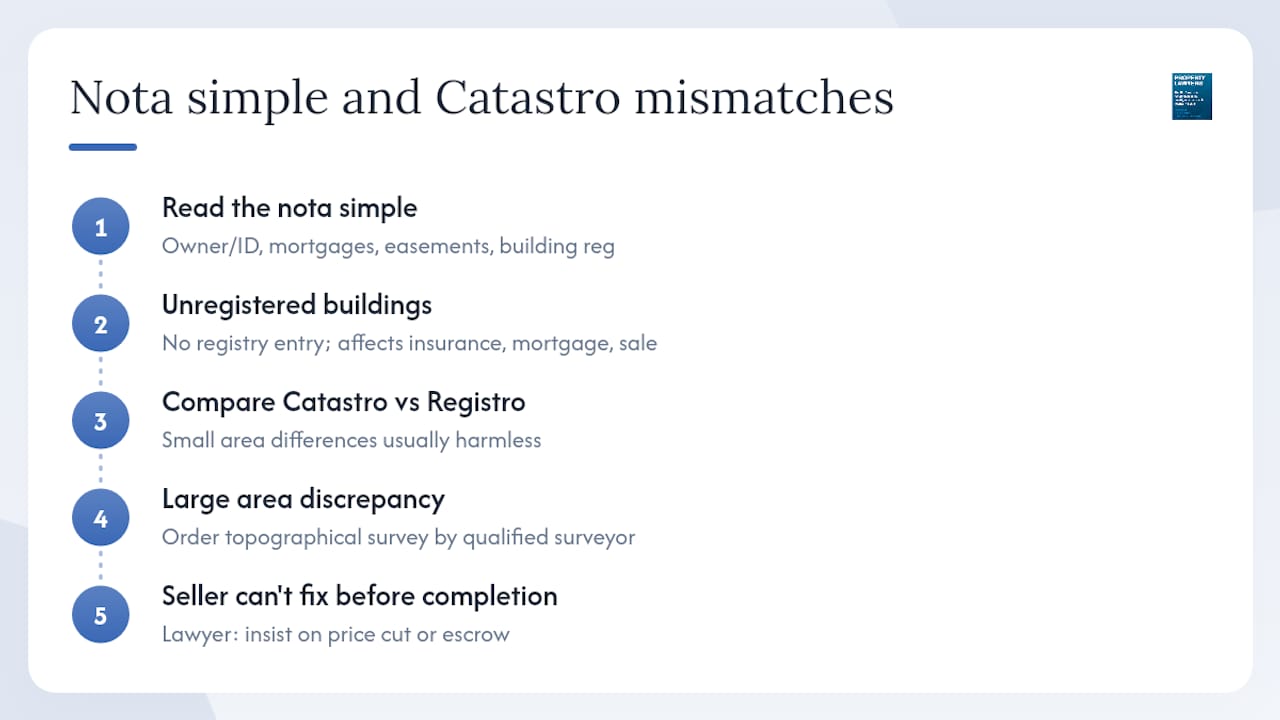
Read it for: the legal owner’s name and ID number; any mortgages or charges; registered easements or rights of way; and whether any buildings on the land are formally registered. An unregistered building on a nota simple is a significant problem — it means the structure has no legal existence in the registry, which affects insurance, mortgageability, and future sale.
The catastro and the Registro de la Propiedad are separate systems that do not always agree. The catastro records the physical reality of the plot for tax purposes; the registro records the legal title. On rural land, the registered surface area in the nota simple often differs from the catastro figure. A discrepancy of a few square metres is common and usually harmless. A large discrepancy — particularly where the catastro shows significantly more land than the registry — requires a topographical survey by a qualified surveyor to establish the physical boundaries.
If the seller cannot resolve registry errors before completion, your lawyer should either insist on a price reduction that reflects the risk or place the relevant sum in escrow until the correction is made. Accepting an unresolved discrepancy at completion leaves you owning a legal uncertainty, not just a property. For a full breakdown of legal checks before buying property in Spain, the process is well documented.
What water, electricity, and access checks does a rural finca need?
Infrastructure is where rural purchases most often surprise buyers after completion. Check each of the following before you sign the arras.
Water supply
Confirm whether the supply is mains (the simplest option), a registered well, membership of a comunidad de regantes (irrigation community), or tanker delivery. Wells must be registered with the regional Confederación Hidrográfica; unregistered wells can be ordered sealed, and new well permits typically take 6–12 months to obtain. Ask the seller for the concesión de aguas (water concession permit) and verify it with the relevant Confederación Hidrográfica directly. Tanker-dependent properties are legal but expensive to run, and supply can be unreliable in summer.
Electricity
Check the contracted potencia (power rating) and whether the connection is a legal grid supply. Extending a grid supply line to a remote rural property can cost €15,000–20,000 or more depending on distance. Off-grid solar with battery storage is a realistic alternative for many fincas, but factor the installation cost into your budget from the start.
Sewage and septic systems
Most rural fincas use a fosa séptica (septic tank). Ask when it was last emptied and inspected, and whether it meets current regional standards. Upgrading a non-compliant system typically costs €3,000–8,000.
Access
Confirm whether the track leading to the property is a public road (camino público) or a private track. If it is private, a registered servidumbre de paso must exist in the nota simple. An unregistered access route means you could legally be denied entry by a neighbouring landowner. Check this with your lawyer before you commit.
What technical surveys should you commission for a rural finca?
A technical survey is non-negotiable for older rural buildings. Budget for a structural survey depending on the size of the property, and commission it before the arras deadline.
- Structural and architectural survey: Commissioned from a chartered architect (arquitecto) or technical architect (aparejador). Covers foundations, walls, roof structure, damp, and any signs of subsidence. This is the core survey for any rural building.
- Electrical inspection and boletín: A certified electrician checks the installation and issues a boletín eléctrico confirming it meets current standards. Without this, you cannot legally connect or reconnect a supply.
- Well yield and potability test: A hydrologist or licensed drilling company tests the well’s output (litres per hour) and takes a water sample for laboratory analysis. A well that runs dry in August is a serious problem.
- Septic system inspection: A licensed contractor inspects the tank, drainage field, and compliance with regional standards.
- Roof and damp survey: Often included in the structural survey but worth specifying explicitly, particularly for older cortijos or stone buildings where roof timbers are vulnerable.
- Asbestos and lead check: Required for properties built before 1980. Asbestos removal costs vary widely but can be substantial.
For each inspector, give a written remit that specifies the property address, the parcel reference, and the exact scope. Ask for a written report (not just a verbal opinion) that identifies defects, estimated remediation costs, and whether any issue is a legal compliance matter. Your lawyer can then use the report to trigger a contract exit or negotiate a price reduction if the findings are material.
Pro Tip: Include a clause in the contrato de arras that gives you 21–28 days to complete all technical surveys and allows you to withdraw or renegotiate if any survey reveals a defect costing more than a specified threshold to remediate.
How are irregular buildings treated under DAFO, AFO, and the cédula de habitabilidad?
Many rural fincas in Spain contain buildings that were constructed without a licence or that predate current planning rules. The treatment of these structures varies by region, but two mechanisms are widely used in Andalucía: the DAFO (Declaración de Asimilado Fuera de Ordenación) and the AFO (Asimilado Fuera de Ordenación).
A DAFO or AFO provides municipal recognition that an older irregular building exists and is tolerated, but it does not fully legalise it. Extensions, new structures, and major renovations remain prohibited. Regularisation costs typically run to €10,000–15,000 or more, and the process does not guarantee mortgageability. Some lenders will not lend on DAFO/AFO properties at all, and certain insurers exclude irregular structures from standard cover.
The cédula de habitabilidad (or licencia de ocupación in some regions) certifies that a property meets minimum habitability standards — adequate room sizes, sanitation, and ventilation. It does not confirm that the building was constructed legally. A property can hold a cédula and still have planning irregularities.
If a property you are considering has irregular structures, your options are: negotiate a price reduction that reflects the cost and risk of regularisation; require the seller to complete regularisation before completion; or walk away. Your lawyer should advise which path is realistic given the specific property and municipality.
What are the typical taxes and costs when buying a rural finca?
Budget 10–15% of the purchase price for transaction costs alone, plus a further 15–30% contingency if the property needs renovation or regularisation.
ITP applies to resale properties and is the most common scenario for rural fincas. The rate varies: Andalucía charges 7%, the Valencian Community 10%, and other regions set their own rates. IVA at 10% applies only to new-build properties sold by a developer. For full guidance on the Spanish property purchase process, including tax forms and timelines, the official rates are confirmed by the Agencia Tributaria.
Mortgages, NIE, and moving money from the UK
NIE: your first step
Every international buyer needs an NIE before signing any contract or paying any tax in Spain. Apply through the Spanish consulate in the UK or in person at a Spanish National Police station. The process typically takes 2–6 weeks via consulate. The Agencia Tributaria’s non-resident pages at sede.agenciatributaria.gob.es are the primary official source for fiscal obligations once you own property.
Mortgage availability for rural fincas
Many Spanish lenders are cautious about rural fincas. Properties with DAFO/AFO status, unregistered buildings, or unclear water rights are frequently declined for mortgage finance. Even where a lender agrees in principle, the mortgage valuation (tasación) may come in significantly below the agreed purchase price, leaving a funding gap. Secure a mortgage offer that is explicitly conditional on a satisfactory certificado urbanístico and a clean legal survey before you commit to the arras.
Moving funds from the UK
Open a Spanish bank account before completion. Use a regulated currency exchange service or your solicitor’s client account to transfer funds, and keep full anti-money laundering (AML) documentation for every transfer. Spanish notaries and lawyers are required to verify the source of funds, so have bank statements and proof of funds ready well in advance. For non-resident buyers with assets in multiple countries, international property purchase guidance covers the broader documentation picture for cross-border buyers.
Who should you hire, and what should you ask them?
Buying a rural finca requires a small team of specialists. Each professional has a specific role, and hiring generalists who lack rural experience is one of the most common mistakes buyers make.
- Independent Spanish property lawyer (English-speaking): Your most important hire. They must be independent of the agent and the seller. Ask: Have you handled rural finca purchases in this municipality? Do you have experience with DAFO/AFO regularisation cases? Do you have contacts at the local Ayuntamiento for certificado urbanístico requests? See why hire a lawyer when buying property in Spain for a full breakdown of what they should cover.
- Chartered architect or aparejador: Commissions the structural survey and can advise on renovation feasibility. Ask: Have you surveyed rural cortijos or fincas of this age and construction type? Can you provide a written report with itemised remediation costs?
- Gestor: Handles ITP submission, catastro updates, and ongoing non-resident tax filings. Ask: Do you handle non-resident IRNR filings? Can you manage the post-completion catastro update?
- Certified electrician: Issues the boletín eléctrico. Confirm they are registered with the relevant regional body and can certify the installation for reconnection.
- Licensed well tester or hydrologist: Tests yield and water quality. Ask for a written report with litres-per-hour output and a laboratory potability certificate.
Pro Tip: When searching for a lawyer, use a region-filtered directory that shows verified credentials and client reviews. Ask specifically whether the lawyer has handled rural land cases in the same comarca (district) as your finca — local knowledge of the Ayuntamiento and the PGOU is genuinely valuable.
A vetted directory such as Property-lawyers lets you filter by region and language, which speeds up the selection process considerably. Confirm professional indemnity insurance and ask for at least one reference from a rural finca case before instructing anyone.
What are the red flags that should stop a rural finca purchase?
Some issues are negotiable; others are deal-killers. Know the difference before you spend money on surveys.
- Unregistered main building with no regularisation path: If the principal dwelling does not appear in the nota simple and the town hall confirms there is no route to DAFO/AFO or equivalent recognition, the property has no legal existence as a home. Walk away.
- No registered access: An unregistered track with no servidumbre de paso in the nota simple means access can be blocked. Do not proceed until a registered right of way is confirmed or the seller registers one before completion.
- Unregistered well with pending enforcement: If the Confederación Hidrográfica has an open file on the well, the risk of a sealing order is real. Either require the seller to regularise it or negotiate a substantial price reduction.
- Large registry/catastro discrepancy the seller will not resolve: A significant difference in recorded land area that the seller refuses to correct before completion is a title defect. Insist on resolution or walk away.
- Open enforcement or demolition proceedings: A certificado de no expediente that is not clean means the town hall has active proceedings against the property. This is a serious red flag and in most cases a reason to exit.
What is a realistic timeline and budget for a rural finca purchase?
Set your expectations before you start. Rural finca purchases take longer and cost more than urban ones.
- Cash buyer, clean title, no regularisation needed: 2–4 months from offer to completion.
- Financed buyer with mortgage: 3–6 months, depending on the lender’s valuation process and any conditions attached to the mortgage offer.
- Property requiring DAFO/AFO regularisation: Add 6–18 months to the timeline. Regularisation processes are not fast, and some town halls have significant backlogs.
- New well permit required: Add 6–12 months for the Confederación Hidrográfica permit process.
For budgeting, use this phased approach:
- Reservation deposit: €3,000–6,000 (typically non-refundable if you withdraw without cause).
- Arras deposit: 10% of the purchase price, held until completion.
- Transaction costs at completion: 10–15% of the purchase price (ITP, notary, registry, lawyer, gestor).
- Immediate infrastructure: Budget €5,000–20,000+ for electrical, water, and septic work depending on the property’s condition.
- Renovation and regularisation contingency: Add 15–30% of the purchase price if the property needs significant work or has irregular structures.
Double your estimated timeline and add 30% to your renovation budget. Rural fincas consistently take longer and cost more than initial estimates suggest.
What should you do immediately after signing the escritura?
Completion is not the end of the process. Several tasks need to happen within days or weeks of signing.
- Register the escritura: Your lawyer must lodge the signed escritura at the Registro de la Propiedad promptly. Until it is registered, your ownership is not fully protected against third-party claims.
- Update the catastro: If the catastro record does not match the property you have purchased (different boundaries, unregistered buildings), instruct your gestor to submit a correction. This affects your IBI calculation going forward.
- Transfer utility contracts: Contact the electricity supplier, water authority, and any other providers to transfer contracts into your name. Bring the escritura and your NIE.
- Arrange insurance: Home and contents insurance for rural fincas can be more complex than for urban properties. Some insurers exclude irregular structures, certain rural fire risks, or properties without a legal access road. Read the exclusions carefully before accepting a policy.
- File tax payments: ITP (or IVA for new builds) must be filed and paid within 30 days of completion. Your gestor handles this, but confirm the deadline is in their diary.
- Non-resident tax obligations: If you are not a Spanish tax resident, you will have annual IRNR (Impuesto sobre la Renta de No Residentes) obligations. Instruct your gestor to set up the filings from year one.
Why does an independent Spanish property lawyer matter for a rural finca?
A rural finca purchase involves legal checks that a general conveyancing lawyer may not be equipped to handle. The specific risks — suelo rústico classification, DAFO/AFO status, unregistered wells, unregistered access — require someone with direct experience of rural land law and local Ayuntamiento processes.
A specialist lawyer’s duties on a rural finca purchase include:
- Reviewing the nota simple for charges, unregistered buildings, and easements.
- Requesting and interpreting the certificado urbanístico from the Ayuntamiento.
- Verifying water rights with the Confederación Hidrográfica.
- Drafting or approving the contrato de arras with appropriate exit conditions.
- Representing you at the notary on completion day.
- Registering the escritura at the Registro de la Propiedad.
A vetted, region-filtered directory speeds up finding the right person. Property-lawyers connects international buyers with independent, English-speaking Spanish property lawyers across Spain, with profiles searchable by region and verified credentials. The directory is a referral tool — you should still confirm the lawyer’s specific experience in rural finca work and ask for a reference from a comparable case before instructing them. For a broader overview of due diligence in Spain, the process is well documented.
A practical note on viewings
Visit in winter if you can. A finca that looks idyllic in July can be a different proposition in January when the access track is flooded and the mobile signal drops to nothing. Drive the track yourself in wet conditions before you commit. Ask a local — a neighbour, a nearby farmer, anyone who knows the land — whether the track floods, whether the well has ever run dry, and whether there are any boundary disputes. That conversation costs nothing and can save you from a very expensive mistake.
Find a vetted English-speaking Spanish property lawyer

Buying a rural finca in Spain is one of the most rewarding property purchases you can make — and one of the most legally complex. Property-lawyers is a directory for international buyers seeking independent, English-speaking property lawyers. Search by region, review verified profiles, and connect directly with a lawyer who has genuine rural finca experience in the area where you are buying.
Whether you are at the early research stage or ready to instruct someone for the arras, the Spanish property purchase process guide gives you a clear picture of what to expect at each step. For buyers who want to go deeper on legal checks, the buying property in Spain guide covers taxes, timelines, and notary process in full.
Start your search by region today and find a lawyer who knows your area.
Sources
Print or save the certificado urbanístico and nota simple as soon as you obtain them. They are the two documents you will refer back to most during due diligence.
This article is general information, not a substitute for advice from a qualified lawyer. Consult a qualified legal professional about your own circumstances before acting on anything here.
FAQ
What is a rural finca in Spain?
A rural finca is a property on land classified as suelo rústico under the local PGOU. The term is used loosely in marketing but legally refers to any rural plot, from a small agricultural holding to a large country estate.
Do I need an NIE to buy a finca in Spain?
Yes. Every international buyer must obtain an NIE before signing any contract, paying taxes, or registering ownership in Spain. Without it, you cannot complete the purchase or register ownership.
What does suelo rústico mean for building rights?
Suelo rústico typically restricts new residential construction and limits the buildable footprint to a small percentage of the plot, often 1–3%. Special authorisations are usually required for any new build, and minimum plot sizes vary by region.
Can I get a mortgage on a rural finca in Spain?
Many lenders are cautious about rural fincas, particularly those with DAFO/AFO status or unregistered buildings. Mortgage valuations often come in below the agreed price, so cash buyers have a significant advantage in this market.
How long does a rural finca purchase take in Spain?
A cash purchase with a clean title typically takes 2–4 months. A financed purchase takes 3–6 months. If regularisation or a new well permit is required, add 6–18 months to the timeline.
Recommended
- Property Buying Guide Spain: Legal Advice for Foreign Buyers
- Rural property legal issues in Spain: types explained
- Buying new build in Spain: the legal process explained

Sophie Gutenberg is a legal content specialist focused on Spanish property law, real estate transactions, conveyancing, due diligence and tax issues affecting international property buyers in Spain. She works alongside qualified Spanish property lawyers .
