

30 and 9 day deadlines: Tanteo y Retracto in Spain (Barcelona/Valencia)
Tanteo and retracto give certain people the legal right to buy a property on the same terms already agreed with a third party. Tanteo works before a sale completes; retracto works after. These rights most often surface in rented flats and subsidised housing, so if you have received a notice, or you are selling a property with a sitting tenant, check the deadline immediately and speak to a lawyer before it expires.
TL;DR:
- The right of tanteo allows tenants and certain co-owners to purchase a property before a sale completes, while retracto lets them undo the sale after it occurs, both within strict timeframes.
- Proper proof of notice, such as notarial acts or registered mail, is essential, and missing or defective notices can shift the remedy from tanteo to retracto, with later discovery restarting deadlines.
- Regional procedures, especially in Barcelona and Valencia, impose specific steps and deadlines that sellers must follow to avoid delays or invalidation of the right.
- Mortgage processing times often exceed exercise periods, requiring buyers to consider bridging finance or pre-approvals to match the short deadline to act.
- Always check the Land Registry for registered rights and ensure notices contain full sale details to prevent disputes or claims from later buyers.
Table of Contents
- What is tanteo y retracto in Spanish property law?
- Who can exercise tanteo and retracto in Spain?
- What legal rules govern tanteo and retracto?
- How do the notice periods and procedure actually work?
- Barcelona and Valencia: what’s different locally?
- Step-by-step checklist for tenants, buyers and sellers
- Financing hurdles when exercising the right
- Why trust this guide
- What happens if notice is defective or never given?
- Real-world scenarios where these rights come up
- Real estate versus movable property: does the right differ?
- How to draft and serve a valid notification
- Going to court over a disputed right
- What about third parties and later buyers?
- Common pitfalls and quick rules of thumb
- How Property-lawyers can help you act in time
- Sources
- FAQ
What is tanteo y retracto in Spanish property law?
Tanteo lets a qualifying person step in and buy a property before the sale to a third party goes through, matching the agreed price and conditions. Retracto is the same right exercised after completion, effectively undoing the sale and putting the rightholder in the buyer’s place. Spanish courts have described both as ways of granting an “acquisition preference” rather than a veto over the sale itself, according to academic analysis in Indret.
The law creates these rights for specific reasons: to protect tenants from losing their home to an unknown buyer, to stop co‑owners being forced into partnership with a stranger, or to prevent public housing leaking into the private market at inflated prices. There is also a private version, known as conventional tanteo or retracto, agreed by contract rather than imposed by statute. A conventional right binds the parties who signed it, but only a statutory right, or a conventional one properly registered at the Land Registry, reliably protects the holder against a later buyer who claims no knowledge of it.
Who can exercise tanteo and retracto in Spain?
Not everyone gets this protection. The right belongs to specific categories of people, defined by law or contract.
- Tenants under a residential lease governed by the LAU have a right of tanteo when their landlord sells the property, provided the letting was arranged directly and no exclusion clause applies.
- Co‑owners (comuneros) and coheirs (coherederos) can exercise retracto if one co‑owner sells their share to an outsider instead of offering it first to the others.
- Colindantes, or neighbouring landowners, hold a retracto right over the sale of small rural plots under certain conditions in the Código Civil.
- Public administrations hold tanteo and retracto over subsidised housing (VPO) to stop it being resold above the protected price.
If you rent your home, co‑own a flat with siblings, or bought a VPO property in Barcelona or Valencia, one of these categories probably applies to you.
What legal rules govern tanteo and retracto?
The Código Civil sets out the general framework for retracto, including the nine‑day exercise period for co‑owners under article 1524, while the Ley de Arrendamientos Urbanos (LAU), article 25, governs the tenant’s right of tanteo and retracto in residential lettings. Beyond these national rules, autonomous communities and city councils layer on their own procedures for protected or subsidised housing, which is where most confusion happens.
The distinction between legal and conventional rights matters in practice. A legal right exists automatically because a statute grants it; a conventional one only exists because a contract created it, and it binds third parties only when registered at the Land Registry. The registrador de la propiedad checks these entries before completing a transfer, which is why registration is never a formality to skip.
Municipal and regional pages, such as Barcelona’s Habitatge service, publish the specific procedure for their own housing stock, and these often add steps the Código Civil never mentions.
How do the notice periods and procedure actually work?
Deadlines are short, and missing one usually closes the door for good. The starting point is always the day after the seller gives proper notice, known in Spanish practice as notificación fehaciente, meaning notice that can be proven in court.
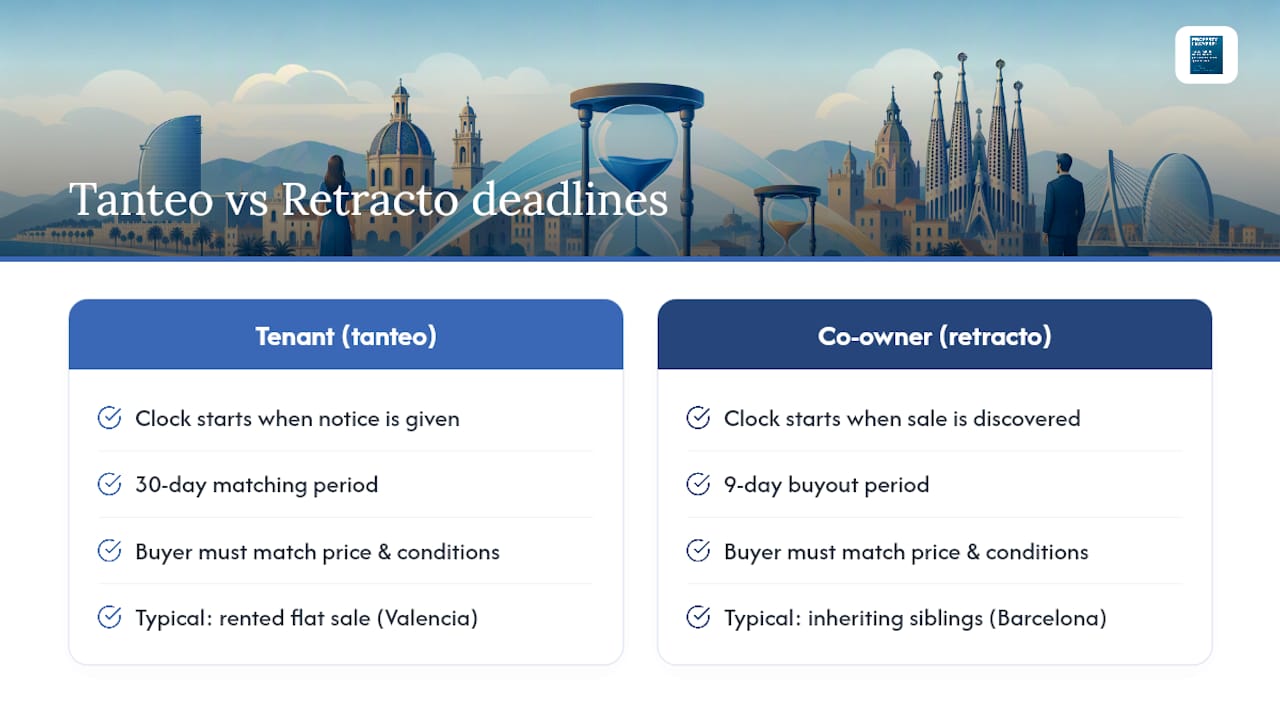
- Tenancy sales (LAU, art. 25): the tenant has 30 days from the day after fehaciente notification to exercise tanteo.
- Co‑ownership and inheritance sales (Código Civil): the classic rule gives co‑owners nine days from notice to exercise retracto.
- Administrative cases (VPO and municipal tanteo): some regional and municipal procedures allow up to 60 days, though the exact figure depends on the local rule in force, so always check the specific ordinance.
Notice must be provable, which is why sellers typically use a notarial deed, a burofax with acknowledgement of receipt, or registered post with proof of delivery. A phone call or an informal email will not stand up if the case reaches a judge.
Pro Tip: If you receive a notice you were not expecting, do not assume the deadline is flexible. Request the full sale contract in writing on day one, and get a lawyer to check the notice was validly served before you decide whether to act.
Barcelona and Valencia: what’s different locally?
Barcelona operates a municipal tanteo and retracto scheme covering certain categories of housing, and the Ayuntamiento’s Habitatge service publishes exactly how and where to notify the council of an intended sale, plus the timeframe the council has to respond. Sellers of qualifying properties in the city need to factor this step into their completion timetable, since skipping it can delay or unravel a sale.
The Valencian Community regulated the Generalitat’s own acquisition preference over certain protected housing in 2020, and subsequent amendments have adjusted how authorisations and exercise periods work, according to the Generalitat Valenciana’s housing pages. In practice, this means notaries in Valencia may ask for proof that the administrative authorisation was obtained before they will complete certain sales. Always check the relevant regional housing authority page before assuming a national rule covers your case.
Step-by-step checklist for tenants, buyers and sellers
Each side of the transaction has a different job to do, and getting it wrong tends to cost more than getting advice early.
- Tenants: confirm the notice was validly served, request the full sale terms in writing, check whether the property has VPO status, decide within the 30‑day window, and either arrange financing or formally renounce the right in writing.
- Sellers: serve fehaciente notice with proof of delivery, include the true price and full conditions of the sale in that notice, and keep evidence of when and how it was sent.
- Buyers: budget for the possibility the sale gets displaced by a rightholder, and use a conditional deposit arrangement rather than an unconditional one until the exercise period has passed.
Sellers who cut corners on notice content are the most common source of disputes. A notice that understates the price, for example, gives the rightholder grounds to challenge the sale later.
Financing hurdles when exercising the right
Exercising tanteo or retracto means matching the agreed price within a fixed, short deadline, and mortgage lenders rarely move that fast. Banks typically need weeks to process a full mortgage application, valuation included, which creates a real mismatch against a 9 or 30‑day exercise window, a point worth flagging for anyone considering the right.
Practical workarounds exist. Bridging finance, a payment plan agreed directly with the seller, or a fast‑track pre‑approval from a lender who already knows your finances can all close the gap. Budgeting for property purchase tax at the same time avoids a nasty surprise once the deal completes. A lawyer who coordinates the notary, the lender, and the seller’s deadline in parallel is usually what makes an exercise of the right actually deliverable within the time allowed.
Why trust this guide
This guide draws on statutory sources, municipal procedure pages, and academic legal analysis rather than generic advice. For related reading on protected housing status, see the rental licences archive. [Sophie’s professional credentials and experience in property law will be detailed here.]
What happens if notice is defective or never given?
A seller who sells without giving proper notice, or who gives notice with incorrect terms, does not make the sale bulletproof. The rightholder’s remedy simply shifts from tanteo, exercised before completion, to retracto, exercised after it. This is the entire point of having two related rights rather than one: the law does not let a seller dodge the obligation just by moving quickly.
If a tenant discovers after completion that the landlord sold the flat without ever sending a valid notice, the tenant can still exercise retracto within the statutory period, counted from the moment they actually learn of the sale and its terms, typically through the Land Registry entry or a formal communication. The same principle applies to co‑owners who find out a fellow owner sold their share to an outsider without offering it to them first.
Defective notice, meaning notice that was sent but understated the price, omitted conditions, or went through an unprovable channel, produces the same outcome. Courts treat an incomplete or unverifiable notice as no notice at all for the purpose of starting the clock, so the deadline effectively never began running until proper notice is given, or discovery occurs.
For sellers, the practical risk is significant. A successful retracto claim unwinds the sale after the fact, forcing the original buyer to hand the property to the rightholder against reimbursement of the price paid. That is disruptive for everyone involved, including any lender who advanced a mortgage on the assumption the sale was final. It is one of the strongest reasons a seller should never treat notification as a box‑ticking exercise, and should always keep hard proof, such as a burofax receipt or notarial certificate, of exactly what was communicated and when.
Real-world scenarios where these rights come up
Most disputes fall into a handful of recurring patterns, and recognising which one applies to you speeds up the whole process considerably.
A landlord decides to sell a rented flat in Valencia to a property investor. Because a tenant occupies the flat under a standard residential lease, the landlord must notify the tenant of the sale terms before completing with the investor. If the tenant wants the flat, they have 30 days to match the offer.
Three siblings inherit a flat in Barcelona from their parents. One sibling wants to sell their third to an outside buyer instead of offering it to the other two first. The other siblings can exercise retracto within nine days of learning about the completed sale, buying out the share on the same terms the outside buyer agreed.
A family bought a VPO flat in Valencia at a subsidised price years ago and now wants to sell at market value. Before that sale can proceed, the Generalitat’s housing department may need to be notified, since the administration holds tanteo and retracto specifically to prevent subsidised stock being resold above the protected ceiling.
A smallholding farmer in a rural part of Spain sells a narrow strip of land bordering a neighbour’s plot. The neighbouring landowner, as colindante, may have a retracto right over that specific sale under the rural retracto rules in the Código Civil, though this scenario is far less common in urban property markets like Barcelona or Málaga.
Each scenario shares the same underlying logic: someone with a recognised legal connection to the property gets first refusal, and the deadline clock starts the moment proper notice is given or the sale is discovered.
Real estate versus movable property: does the right differ?
Tanteo and retracto were designed with real estate in mind, and the vast majority of practical cases in Spain involve flats, houses, or land. The statutory versions found in the LAU and in the Código Civil’s rural retracto provisions apply specifically to immovable property, reflecting the underlying policy goal, which is protecting people’s housing and land relationships, not general commerce.
Movable property can still carry a conventional tanteo or retracto right, but only if the parties wrote it into their contract. There is no general statutory right of first refusal over the sale of a car, a boat, or business equipment in the way there is for a rented flat or a co‑owned parcel of land. If you want that protection over movable assets, it has to be negotiated and documented, and it will only bind a later buyer if that buyer had notice of the clause, since there is no land registry equivalent for most personal property.
This distinction matters practically for property buyers because it explains why registration is central to real estate transactions but largely irrelevant to sales of goods. A registered conventional retracto over a flat protects the rightholder against any future buyer, informed or not, because the Land Registry entry gives constructive notice to the world. A similar clause in a contract for the sale of furniture protects the rightholder only against the specific buyer who agreed to it, and offers little defence if that buyer resells to someone unaware of the arrangement.
For anyone buying real estate in Spain, the practical lesson is to always check the Land Registry entry for any recorded tanteo or retracto before signing, since a registered right can follow the property regardless of who currently holds title.
How to draft and serve a valid notification
Getting the notice right protects the seller from a later retracto claim, and getting it wrong invites exactly that outcome. The notice needs several elements to count as legally sound under Spanish practice.
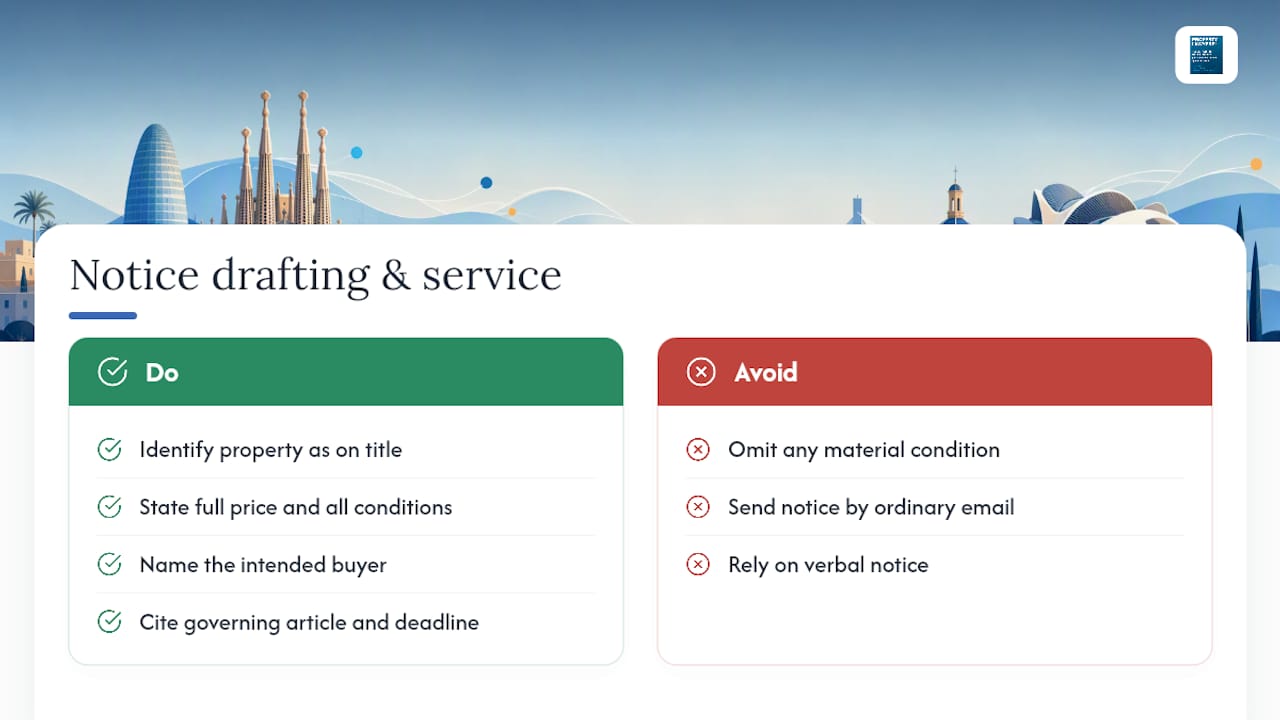
First, identify the property precisely, using the same description that appears on the title deed and Land Registry entry. Second, state the full agreed price and every material condition of the sale, including payment terms, any furniture included, and the proposed completion date. Omitting a condition, even one that seems minor, gives the rightholder grounds to argue the notice was incomplete.
Third, identify the intended buyer, since some rightholders need this information to assess the transaction properly. Fourth, state clearly that this is a formal notification under the relevant article, whether that is article 25 of the LAU for a tenancy or the applicable Código Civil provision for a co‑ownership sale, and specify the exact deadline the rightholder has to respond.
The delivery method is just as important as the content. Three channels are widely accepted as fehaciente, meaning legally provable: a notarial act, where a notary formally delivers the notice and certifies the fact; a burofax with certified content and acknowledgement of receipt, sent through Correos; or registered post with a signed delivery receipt. An ordinary email or a verbal conversation, however well‑intentioned, will not satisfy a court if the rightholder later disputes ever receiving proper notice.
Sellers should keep every piece of proof indefinitely, not just until completion. A retracto claim can surface months or years after a sale, once the rightholder discovers what happened, so the burden of proving notice was correctly given can resurface long after the transaction feels finished.
Going to court over a disputed right
When a rightholder believes they were denied a valid tanteo or retracto, or a seller believes a claim is unfounded, the dispute typically ends up before the civil courts, since Spanish law treats this as a private property matter rather than an administrative one, except where a public administration itself holds the right.
The rightholder bringing a retracto claim generally needs to act within the statutory period, counted from valid notice or from actual discovery of the sale if notice was defective or absent. Filing later than that risks the court dismissing the claim as time‑barred, regardless of how strong the underlying grounds are. This is why lawyers usually advise documenting the date of discovery carefully, since it becomes central to the case if the timing is challenged.
If the court upholds the claim, the remedy is specific: the rightholder steps into the buyer’s position, paying the same price and accepting the same conditions originally agreed, and the original buyer is reimbursed. The court does not award damages instead of the property in most cases, because the entire purpose of the right is substitution, not compensation.
Where a public administration’s tanteo or retracto over subsidised housing is contested, the case can involve both civil courts and administrative review, since the Constitutional Court has recognised the public interest basis for these rights over VPO stock, which strengthens the administration’s position when a dispute arises. Given the procedural complexity, and the strict deadlines involved on both sides, anyone facing a contested claim benefits from involving a lawyer at the earliest possible stage rather than after a court date is already set.
What about third parties and later buyers?
A successful exercise of retracto affects more than the seller and the original buyer. It unwinds the transaction and can pull in anyone who acquired rights over the property in the meantime, which is why third‑party protection matters as much as the rightholder’s own claim.
If the original buyer had already taken out a mortgage to fund the purchase, that lender’s security is directly affected when a rightholder successfully substitutes into the transaction. In practice, the rightholder typically needs to either take on the existing mortgage arrangement or the original buyer’s lender needs to release its charge as part of unwinding the sale, which is one reason lenders scrutinise any property with a recorded tanteo or retracto before advancing funds.
Subrogation, where a new party takes over an existing legal position, comes up specifically because the rightholder is stepping into a deal someone else negotiated, on the terms that other person agreed. If the original buyer had already registered the purchase at the Land Registry, unwinding that entry to substitute the rightholder involves its own formal process, and any registered charges or subsequent transactions layered on top complicate matters further.
This is precisely why buyers should always check for a recorded conventional tanteo or retracto, or confirm whether statutory rights apply, before completing a purchase, rather than discovering the risk after money has changed hands. A property lawyer checking the registry entry before signing is a far cheaper safeguard than untangling a retracto claim after the fact.
Common pitfalls and quick rules of thumb
Three mistakes come up again and again. Always get provable proof of notice, never rely on a phone call or a casual email. Act inside the deadline; asking for “a bit more time” carries no legal weight once the clock has started. And always confirm VPO status before assuming a straightforward sale, since subsidised housing rarely behaves like the open market. When the deadline is short and the money is significant, a specialist local lawyer earns their fee many times over.
— Sophie
How Property-lawyers can help you act in time
Tanteo and retracto cases move fast, and the biggest risk for most buyers, tenants, and sellers is not knowing which rule applies until the deadline has already started ticking. Property-lawyers is the directory that puts you in touch with vetted, independent, English‑speaking real estate lawyers across Spain, including specialists familiar with Barcelona’s municipal procedures and the Valencian Community’s regional rules.

Rather than searching for a lawyer from scratch under time pressure, you can browse profiles by region and get matched with someone who already understands the local notice requirements and court procedure that apply to your case. If you have received a notice, want to check whether a property carries a registered right, or simply need someone to review a sale before you sign, find a vetted property lawyer through the directory today.
Sources
- Repensando los derechos de tanteo y retracto (Indret, 2026)
- Tanteo y retracto | Habitatge
- Derecho de tanteo y retracto en favor de la Generalitat (Generalitat Valenciana)
This article is general information, not a substitute for advice from a qualified lawyer. Consult a qualified legal professional about your own circumstances before acting on anything here.
FAQ
What is the main difference between tanteo and retracto?
Tanteo is exercised before a sale completes, letting the rightholder buy first; retracto is exercised after completion, letting the rightholder undo the sale and take the buyer’s place.
How long does a tenant have to exercise tanteo in Spain?
Under LAU article 25, a tenant generally has 30 days from the day after receiving fehaciente notification to exercise the right.
Can I lose the right if the seller never notifies me?
No. If notice was never given or was defective, your remedy shifts from tanteo to retracto, and the deadline typically starts from when you actually discover the sale.
Does tanteo and retracto apply to every property sale in Spain?
No, it applies only when a specific statutory or contractual condition exists, such as a tenancy, co‑ownership, VPO status, or a registered conventional right.
Where can I find a lawyer to check my situation?
Property-lawyers connects buyers, sellers, and tenants with vetted, English‑speaking property lawyers across Spain through its regional directory.
Recommended
- Spain Utilities Transfer in 3–7 Days: Checklist and English Lawyer
- Gazumping in Spain: what property buyers must know
- Plusvalía Municipal Tax in Spain — What Sellers Need to Know
- Modelo 210 Spain — Non-Resident Income Tax Return Guide

Sophie Gutenberg is a legal content specialist focused on Spanish property law, real estate transactions, conveyancing, due diligence and tax issues affecting international property buyers in Spain. She works alongside qualified Spanish property lawyers .
