
Lawyer fees for Spanish property deals explained
Buying property in Spain is an exciting prospect, but the costs involved can catch buyers off guard, particularly when it comes to legal fees. Understanding how to set lawyer fees for Spanish property deals is not straightforward: unlike notary and registry charges, which follow official regulated tariffs, Spanish property lawyer costs are unregulated and vary considerably between firms, regions, and transaction types. Without clarity on what you are paying for and why, you risk either overpaying or, worse, engaging a lawyer whose scope of work leaves critical risks unchecked.
Table of Contents
- Key takeaways
- How set lawyer fees work in Spanish property deals
- What your lawyer’s fee should cover
- Getting clear, transparent fee quotes
- Budgeting for total purchase costs
- Common mistakes buyers make on legal fees
- My perspective on fee transparency and value
- Find a trusted property lawyer in Spain
- FAQ
Key takeaways
| Point | Details |
|---|---|
| Fees are unregulated | Spanish lawyer fees are not fixed by law, so always request a written, itemised quote before committing. |
| Typical rate is around 1% | Most lawyers charge approximately 1% of the purchase price plus 21% VAT, though this varies by transaction type. |
| Total buying costs reach 8–13% | Legal fees sit within a broader cost picture that includes taxes, notary, and registry charges. |
| Written agreements protect you | A formal fee agreement (hoja de encargo) sets out scope, pricing, and disbursements to prevent disputes. |
| Price alone is a poor guide | Comparing quotes requires understanding what each fee includes, not just the percentage or headline figure. |
How set lawyer fees work in Spanish property deals
The most widely cited benchmark for legal fees in Spanish real estate is approximately 1% of the purchase price plus 21% IVA (the Spanish equivalent of VAT). This is not a regulated figure. It is simply a market convention that has become the informal standard across much of Spain. In practice, what you actually pay depends on the lawyer, the complexity of the transaction, and the type of property involved.
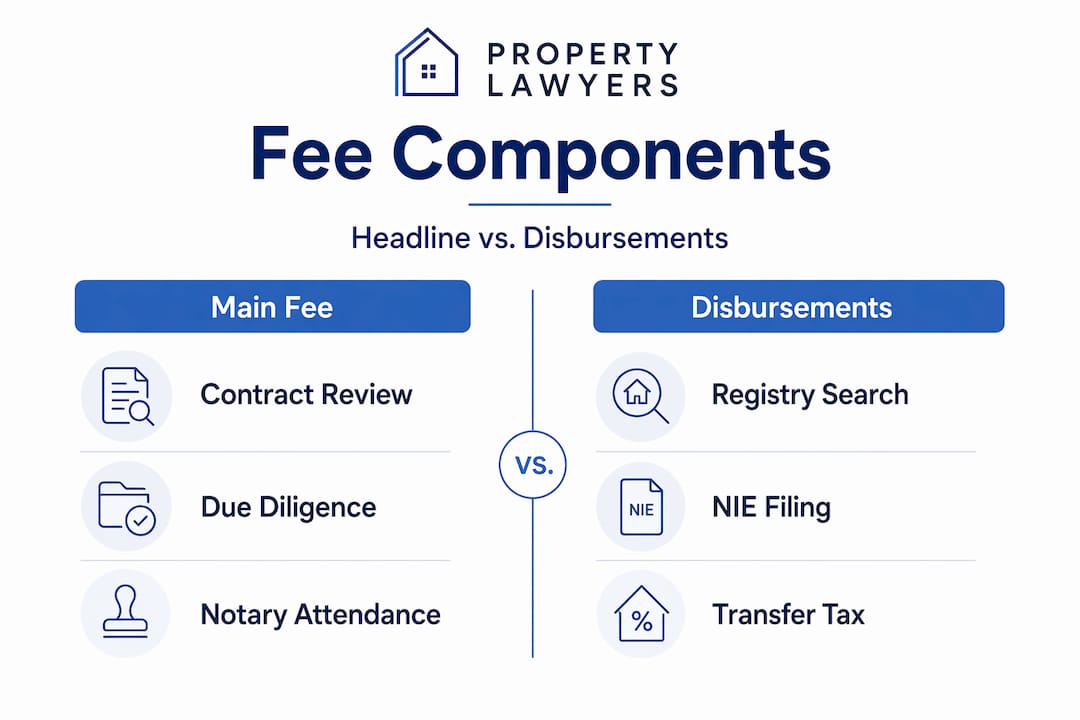
Each stage involves specific legal requirements and costs that contribute to the overall legal fees for buying property in Spain.
Fee structures generally fall into two categories: percentage-based fees and fixed fees. Percentage-based fees scale with the property price, which can be advantageous on lower-value purchases but expensive on high-value ones without a cap in place. Fixed fees offer predictability, though they may not reflect the actual complexity of the work involved.
Typical fee ranges by transaction type, based on 2026 market guides, are as follows:
| Transaction type | Typical fee range (excl. VAT) |
|---|---|
| Resale property | €1,500 – €3,000 |
| Off-plan (new build) | €2,000 – €4,000 |
| Rural or complex property | €2,500 – €5,000 |
Beyond the headline fee, watch for disbursements charged separately. These can include Land Registry search fees, NIE application costs, courier charges, and bank transfer fees. Some firms bundle these into an all-in quote; others bill them on top. Always ask upfront which model applies.
Minimum fees are also common. A lawyer may quote 1% but apply a floor of €1,500, meaning a €100,000 purchase attracts a minimum charge rather than the calculated €1,000. Caps work in the opposite direction, limiting fees on high-value properties so that a €1,000,000 purchase does not automatically generate a €10,000 bill.
The legal fees involved in buying property in Spain are an important investment that can help buyers avoid costly problems and unnecessary stress. Professional legal assistance ensures that potential issues are identified before completion, helping to protect your investment and making the property purchase process in Spain smoother and more secure.
What your lawyer’s fee should cover
A well-scoped legal fee for a Spanish property transaction covers considerably more than simply attending the notary. Understanding the full range of services helps you assess whether a quote represents genuine value. A comprehensive legal quote should typically include:
- Due diligence on the property: Checking title deeds, confirming ownership, identifying any charges, embargoes, or unpaid community fees registered against the property.
- Planning and licence checks: Verifying that any extensions or structures have the correct building licences and that the property complies with local planning rules.
- Contract review and negotiation: Reviewing the reservation contract (contrato de arras) and the private purchase contract before you commit funds.
- NIE number application: Obtaining your Spanish tax identification number, which is required for all property purchases.
- Notary attendance: Accompanying you or representing you at the signing of the public deed (escritura pública).
- Land Registry filing: Registering the transfer of ownership after completion.
- Tax calculations and filings: Calculating and submitting transfer tax (ITP) on resale properties, or VAT and stamp duty (AJD) on new builds.
- Utility and ownership transfers: Updating contracts for electricity, water, and community fees in your name.
One area of frequent confusion is the distinction between a lawyer and a gestor. A gestor is an administrative professional who handles bureaucratic paperwork such as tax filings and utility transfers. Lawyer fees often cover the legal advisory work, while gestor services may be billed separately at around €600 or more. Clarify with your lawyer whether gestor work is included or priced additionally.
Pro Tip: Ask your lawyer to provide a written list of every task included in the fee before you sign anything. If a service is not on the list, assume it will be charged as an extra.
Getting clear, transparent fee quotes
Securing a quote is only the first step. Understanding exactly what that quote covers is where most buyers fall short. Follow this process to protect yourself:
- Request a written fee agreement (hoja de encargo). This formal document sets out the scope of work, the fee calculation method, and how disbursements are handled. Fee disputes most commonly arise when no written agreement exists before work begins.
- Confirm whether VAT is included. Quotes are frequently stated exclusive of IVA. A fee of €2,000 plus 21% IVA becomes €2,420. Always ask for the VAT-inclusive total.
- Ask about caps and minimums. If the fee is percentage-based, ask whether a cap applies on higher-value properties and whether a minimum applies on lower-value ones.
- Clarify disbursements. Ask specifically whether Land Registry fees, NIE costs, and translation charges are included or billed separately.
- Check gestor fees. Confirm whether administrative tasks such as tax filings and utility transfers are handled by the lawyer or referred to an external gestor, and what that costs.
- Evaluate scope, not just price. Comparing fee structures requires understanding what each quote includes. A lower percentage fee that excludes due diligence is not cheaper; it is incomplete.
- Verify independence. Confirm that your lawyer has no financial relationship with the estate agent or developer selling the property. An independent lawyer works solely in your interest.
Pro Tip: When comparing multiple quotes, create a simple table listing each firm’s fee, VAT status, disbursements, gestor inclusion, and any caps or minimums. This turns an apples-vs-oranges comparison into a clear, like-for-like assessment.
Budgeting for total purchase costs
Legal fees do not exist in isolation. They are one component of a broader set of costs that every buyer must budget for. Total purchase costs in Spain typically range from 8% to 13% of the property price, depending on whether the purchase is a resale or new build, and which region the property is in.
A typical cost breakdown looks like this:
- Transfer tax (ITP): 6% to 10% of purchase price on resale properties, varying by region.
- VAT (IVA) and stamp duty (AJD): Applicable on new builds, typically 10% IVA plus 0.5% to 1.5% AJD.
- Notary fees: Regulated and relatively modest, usually €600 to €1,200.
- Land Registry fees: Also regulated, typically €400 to €700.
- Lawyer fees: Approximately 1% plus IVA, as discussed above.
- Gestor fees: Approximately €400 to €800 if not included in the legal fee.
To illustrate with a concrete example: on a €500,000 Costa del Sol apartment, legal fees would be approximately €5,000 plus IVA (€6,050 total), with gestor fees adding a further €600 or so. Against a total purchase cost of roughly €540,000 to €565,000 once taxes and all fees are included, the legal fee represents a small but critical proportion.
Regional variation matters. Andalucía, Valencia, and the Balearic Islands each apply different ITP rates. Notary and registry costs are set by national tariffs and are therefore consistent, but lawyer fees will still differ. Buyers in Madrid, for example, may find slightly different market rates compared to the Costa Blanca. Property-lawyers provides a useful property buying guide covering regional cost differences in more detail.

Underestimating total costs is one of the most common reasons transactions stall or collapse. If you have budgeted only the purchase price plus a rough 10%, and the actual costs come in at 12%, you may face a shortfall at the point of signing.
Common mistakes buyers make on legal fees
Even well-prepared buyers make avoidable errors when it comes to legal fees for Spanish real estate. The following are the most consequential:
- Choosing solely on price. Selecting the cheapest lawyer risks missing crucial checks on title, debts, or planning issues that could cost far more to resolve later.
- Accepting verbal quotes. Without a written hoja de encargo, there is no agreed scope. Disputes become difficult to resolve and additional charges appear with little recourse.
- Ignoring VAT. Many buyers compare quotes without realising some are stated exclusive of IVA, leading to a higher-than-expected final bill.
- Overlooking disbursements. Assuming all costs are covered by the headline fee, then receiving a separate invoice for registry searches, translations, and NIE applications.
- Conflating lawyer and gestor fees. Assuming the lawyer handles all administrative tasks, only to discover that tax filings and utility transfers are billed separately.
- Not confirming independence. Using a lawyer recommended by the estate agent without checking whether that lawyer has a commercial relationship with the seller.
Legal fees provide critical protection against expensive risks, including illegal extensions and unpaid community debts, that may not be visible without a thorough due diligence review by a skilled, independent lawyer.
The benefits of hiring a real estate lawyer in Spain go well beyond contract signing. A properly scoped engagement protects your investment at every stage of the transaction.
My perspective on fee transparency and value
I have worked with enough international buyers navigating Spanish property transactions to know that the fee conversation is almost always the wrong one. Buyers focus on the percentage. They should focus on the scope.
I have seen buyers save €500 on legal fees by choosing a lower-cost firm, only to discover after completion that the lawyer had not checked for an illegal extension on the property. The cost to regularise it exceeded €15,000. The saving was not a saving at all.
In my experience, the most reliable indicator of a good lawyer is not their fee. It is the quality of their written fee agreement. A lawyer who provides a clear, detailed hoja de encargo before asking for a single euro is a lawyer who understands their obligations and respects yours. A lawyer who quotes verbally and starts work on a handshake is a risk, regardless of how competitive their rate appears.
What I tell every buyer is this: negotiate the scope before you negotiate the price. Confirm that due diligence, contract review, notary attendance, tax filings, and registry work are all included. Then, if the fee is percentage-based on a higher-value property, negotiate a cap. Most reputable lawyers will agree to one.
Affordable lawyer fees for property transactions are achievable. But affordability means getting full value for what you pay, not simply paying the lowest number on the page.
— Sophie
Find a trusted property lawyer in Spain
Choosing the right legal representation for buying property in Spain is one of the most consequential decisions you will make in the entire transaction. Property-lawyers connects international buyers with vetted, independent, English-speaking real estate lawyers across Spain, all of whom provide transparent, written fee agreements as standard.

Whether you are buying a resale apartment in Madrid, an off-plan villa on the Costa del Sol, or a rural finca in Andalucía, the directory makes it straightforward to find qualified legal support with clear, upfront pricing. Specialist tax advisors in Spain are also available for buyers who need guidance on fiscal obligations alongside their conveyancing. Request a personalised quote through members of Property-lawyers.com and go into your purchase with full clarity on costs and scope.
FAQ
What is the standard lawyer fee for buying property in Spain?
The market standard is approximately 1% of the purchase price plus 21% VAT, though this is not regulated by law and varies by firm and transaction type.
What does a Spanish property lawyer’s fee typically include?
A well-scoped fee covers due diligence, contract review, NIE application, notary attendance, Land Registry filing, and tax submissions, though gestor administration may be priced separately.
How do I avoid unexpected legal costs in a Spanish property purchase?
Request a written fee agreement (hoja de encargo) before work begins, confirm whether VAT and disbursements are included, and ask specifically about any caps or minimum charges.
Are lawyer fees the same across all regions of Spain?
No. While the 1% benchmark is widely used, actual fees vary by region, property type, and firm. Taxes such as ITP also differ by autonomous community, affecting total purchase costs.
Is it safe to use a lawyer recommended by the estate agent?
Only if you can confirm the lawyer is fully independent from the agent and seller. An independent lawyer works exclusively in your interest, which is not always guaranteed with agent referrals.
Recommended

Sophie Gutenberg is a legal content specialist focused on Spanish property law, real estate transactions, conveyancing, due diligence and tax issues affecting international property buyers in Spain. She works alongside qualified Spanish property lawyers .
