

Tourist licence in Spain: what property investors must know
TL;DR:
- A tourist license in Spain is a regional permit that authorizes property rentals to tourists for short stays.
- Buying a property with an existing license requires verifying its validity, transferability, and compliance with local regulations.
A tourist licence in Spain is a mandatory regional permit that authorises a property owner to legally rent their home for short-term tourist stays. Without it, you cannot legally advertise on platforms such as Airbnb or Booking.com, and fines can reach tens of thousands of euros. Spain has no single national system. Each of the country’s 17 autonomous communities issues its own licence under its own rules, which makes understanding what is tourist license spain property far more complex than most buyers expect. This guide explains the regional differences, the application process, the compliance obligations, and the due diligence checks every investor must carry out before committing to a purchase.
What is a tourist licence for a Spain property?
A tourist licence is an official authorisation issued by a regional government that permits a property to be rented to tourists for short periods, typically fewer than 30 days. The formal industry term is licencia turística, though each region uses its own acronym. In Andalucía the licence is called a VFT (Vivienda con Fines Turísticos). In Catalonia it is a HUT (Habitatge d’Ús Turístic). In the Balearic Islands it is an ETV (Estança Turística en Habitatge). These are not interchangeable. A VFT registered in Málaga carries no legal weight in Mallorca.

Spain has no national tourist licence; the regional licence is the only controlling legal requirement. Operating without the correct regional licence exposes owners to administrative fines, forced closure, and removal of listings from major booking platforms. The stakes are high, and the rules differ significantly depending on where the property sits.
The holiday rental licence in Spain framework exists because tourism policy is a devolved competence under the Spanish Constitution. That means regional governments, not Madrid, set the standards for habitability, safety, permitted rental durations, and registration procedures. Investors buying in Marbella face different rules from those buying in Ibiza or Barcelona, even though all three are popular short-term rental markets.
How do regional tourist licence systems differ across Spain?
Because licensing rules are regional and often municipal, investors should check the local position before buying. See the legal market pages for Mallorca, tourist rental licences in Ibiza, Marbella and Barcelona.
The decentralised nature of Spanish tourist accommodation regulations creates a patchwork of rules that investors must map carefully before buying. The table below summarises the key regional differences across Spain’s most popular investment markets.
| Region | Licence acronym | Key restriction |
|---|---|---|
| Andalucía | VFT | Must file declaración responsable before renting |
| Catalonia | HUT | Barcelona ceased issuing new licences in 2014 |
| Balearic Islands | ETV | Strict zoning; many areas have moratoriums |
| Valencia | VT | Licence tied to property; not freely transferable |
| Canary Islands | VV | Registration through regional tourism portal |
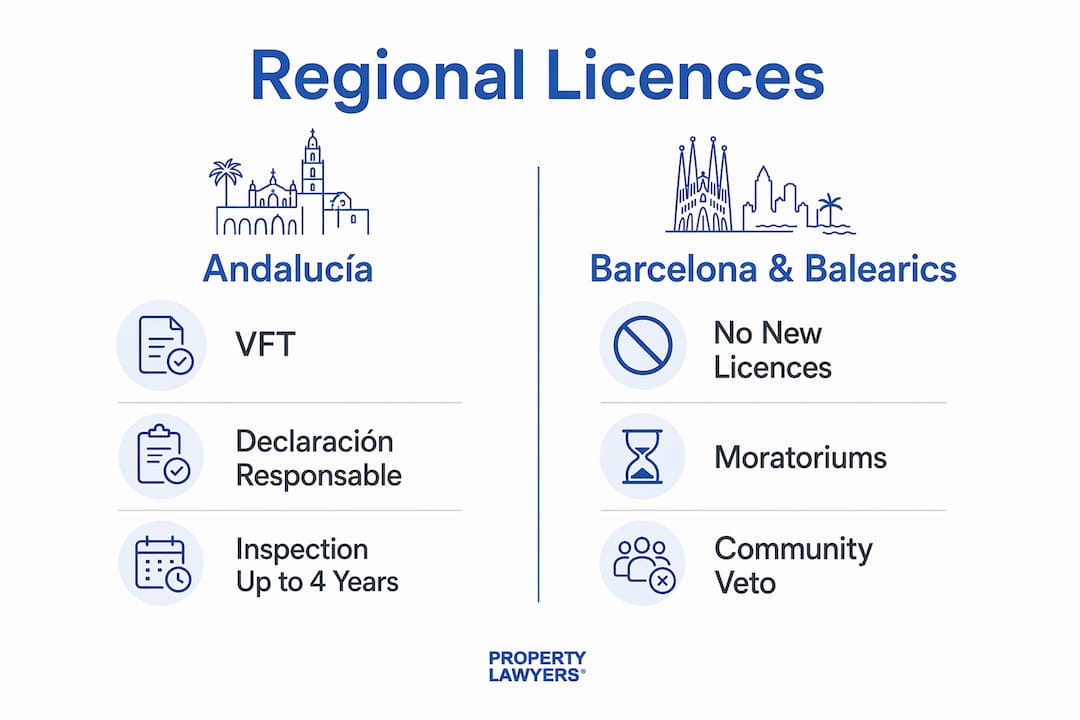
Barcelona is the most extreme example of regional restriction. The city ceased issuing new tourist licences in 2014, and all existing HUT licences will expire by november 2028 with no renewal option. That means approximately 10,100 licences will disappear from the market entirely. Buying a rental property in Barcelona today carries a significant and time-limited income risk that many buyers underestimate.
The Balearic Islands apply equally tight controls. Many municipalities in Mallorca and Ibiza operate moratoriums on new ETV licences, meaning no new licences are being granted in certain zones regardless of the property’s condition or the owner’s intentions. Investors must check the municipal zoning plan, known as the PGOU, to confirm whether a licence can be obtained or renewed at all.
Pro Tip: Before viewing any property marketed as a rental investment, ask the agent to confirm the licence acronym for that region and whether the specific municipality has an active moratorium. This one question eliminates many unsuitable properties immediately.
Permitted rental durations also vary. Some regions cap short-term tourist rentals at 30 days per booking, while others allow up to 60 days. A handful of communities distinguish between whole-property rentals and room-by-room rentals, applying different rules to each. The rental licence requirements in Mallorca illustrate how granular these distinctions become at the island level.
What is the process for getting a tourist licence in Spain?
Obtaining a tourist licence follows a broadly similar sequence across most regions, though the specific portal, documents, and timelines differ. The process is administrative rather than judicial, but errors or omissions cause delays and can trigger inspections.
- Confirm eligibility. Check the municipal PGOU and regional tourism regulations to confirm the property sits in a zone where tourist rentals are permitted. This step must happen before any application.
- Gather the required documents. Most regions require the title deed (escritura), the certificate of first occupation (cédula de habitabilidad or licencia de primera ocupación), an energy efficiency certificate (certificado de eficiencia energética), and civil liability insurance covering tourist rental activity.
- File the declaración responsable. Most regions require owners to file a responsible declaration through the regional tourism portal, confirming the property meets all habitability, safety, and equipment standards. This declaration activates the right to rent immediately in most regions, without waiting for formal approval.
- Receive the registration number. Once the declaration is accepted, the regional tourism authority assigns a registration number. This number must appear on all advertising, including listings on Airbnb and Booking.com.
- Display the licence. The registration number must be visible on the property and in all promotional materials. Failure to display it correctly is itself a sanctionable offence in several regions.
- Register guests after every booking. Royal Decree 933/2021 mandates that owners register every guest with the Interior Ministry within 24 hours of check-in. This is a recurring daily obligation, not a one-off registration.
Regional authorities may conduct inspections up to four years after the declaración responsable is filed. That means compliance must be maintained continuously, not just at the point of application.
Pro Tip: Do not attempt to register through the Spanish Land Registry (Registro de la Propiedad). Property Registries are not competent to assign tourist rental registration numbers. Applications must go through the regional tourism body, or they will be denied.
Guest registration under Royal Decree 933/2021 is the compliance obligation most frequently overlooked by licensed owners. Data must be submitted through the SES.HOSPEDAJES portal or the relevant regional police system. Delays or omissions expose owners to fines ranging from €100 to €30,000, even when the tourist licence itself is fully valid.
What should investors check before buying a property with a tourist licence?
Buying a property that already holds a tourist licence sounds straightforward. In practice, four critical checks determine whether that licence has any real value to you as the new owner.
- Licence validity and transferability. A tourist licence is tied to the property and the registered owner. Ownership transfer requires re-registration or a formal licence transfer to maintain legal rental rights. Buying “with a licence” does not automatically grant you the right to operate it. You must confirm with the regional tourism authority that the licence can be transferred to your name and that no conditions block that transfer.
- Community of owners’ statutes. The building’s community of owners can veto tourist rental activity through a qualified majority vote of three-fifths of owners. This veto applies retroactively, meaning an existing licence can be rendered inoperable by a community vote after you purchase. Always obtain and review the community statutes and minutes before exchanging contracts.
- Municipal zoning plan (PGOU). Many Spanish regions have moratoriums or restrictions on new tourist licences. Zoning plans determine whether a licence can be granted, renewed, or operated in a given location. A property in a saturated zone may hold a licence today that cannot be renewed when it expires.
- Regional public register verification. Confirm the licence number on the regional tourism register before purchase. Fraudulent or lapsed licence numbers are occasionally presented by sellers as active. The legal checks before buying in Spain must include this verification as a standard step.
Pro Tip: Commission a full due diligence report covering all four checks before signing any reservation contract. The cost of this report is negligible compared to the financial exposure of buying a property whose licence cannot be operated.
Foreign investors frequently assume that an existing licence transfers automatically with the property. It does not. The licence, the community statutes, the PGOU classification, and the regional register must all align before a purchase can be considered genuinely investment-ready.
How do 2026 legal changes affect tourist licences in Spain?
The regulatory environment for tourist rentals in Spain tightened considerably in 2026, and the changes carry direct financial consequences for property owners.
The most significant development is the Supreme Court’s annulment of the national NRUA (National Registry of Tourist Accommodation) system. The NRUA was intended to create a unified national register, but the court ruled it exceeded the central government’s competence. Confusion over the abolished NRUA registry now creates compliance risks for owners who believed they had satisfied their registration obligations nationally. The regional licence remains the only valid legal requirement.
Operating a tourist rental in Spain without the correct regional licence, or failing to register guests within 24 hours under Royal Decree 933/2021, exposes owners to fines of up to €30,000 per infraction. Municipal enforcement teams in cities such as Barcelona, Palma, and Málaga are actively cross-referencing listing platforms against regional licence registers, and unlicensed properties are being reported and closed at an increasing rate.
Municipal enforcement has intensified across Spain’s most popular tourist destinations. Platforms such as Airbnb and Booking.com now verify regional licence numbers before publishing listings in many Spanish regions. Properties without a valid, correctly displayed licence number are being delisted automatically. This enforcement mechanism means that non-compliance is no longer just a theoretical legal risk. It directly removes rental income.
The community of owners’ powers have also been clarified and reinforced. Buildings where a three-fifths majority votes to prohibit short-term rentals can now enforce that prohibition against existing licence holders. Investors who purchase without checking community statutes face the real possibility of holding a valid licence that the building’s residents can legally block from operating.
Key takeaways
A tourist licence in Spain is a regional permit, not a national one, and verifying its validity, transferability, and operational status across four key checks is the non-negotiable foundation of any short-term rental investment in Spain.
| Point | Details |
|---|---|
| No national licence exists | Each autonomous community issues its own licence under its own rules and acronyms. |
| Community veto is a real risk | A three-fifths majority vote can block tourist rentals even in licensed properties. |
| Guest registration is mandatory | Royal Decree 933/2021 requires guest data submission within 24 hours of every check-in. |
| Licence does not transfer automatically | Buyers must re-register or formally transfer the licence after purchase to operate legally. |
| Zoning plans override licences | A PGOU moratorium or saturation zone can prevent licence renewal regardless of current status. |
Why I think most investors underestimate the community veto risk
The question I hear most often from buyers is whether a property “has a licence.” That is the right question to start with, but it is rarely the right question to stop at.
In my experience working with international buyers across Andalucía, the Balearics, and the Costa del Sol, the community of owners’ veto is the risk that catches people most off guard. A buyer purchases a flat in a well-located building in Málaga, the licence is valid, the paperwork is clean, and then six months later the community votes to prohibit tourist rentals. The licence becomes worthless overnight. This is not a hypothetical. It happens, and it is entirely legal.
The PGOU check is the second most overlooked step. Investors focus on the property itself and forget that the municipality controls what can happen on the land. A saturation zone designation can freeze licence renewals for years, turning a short-term rental investment into a long-term let by default.
My honest view is that the four-check framework (licence validity, community statutes, PGOU classification, and regional register verification) should be treated as a minimum standard, not a thorough one. The regulatory environment in 2026 is more active than it has been in a decade. Enforcement is real, fines are substantial, and the rules change at the regional level without much national fanfare.
Seek specialist legal advice before you sign anything. Not after. The cost of getting this wrong far exceeds the cost of getting it right.
— Sophie
Legal support for tourist licence compliance in Spain
Navigating Spain’s regional licensing rules is not something most international buyers can do alone. The differences between regions, the community veto risk, the guest registration obligations, and the due diligence required before purchase all demand specialist legal knowledge.
Property-lawyers connects international buyers with independent, English-speaking real estate lawyers in Spain who specialise in tourist licence compliance, property due diligence, and regional registration processes. Whether you are buying a property that already holds a licence or applying for one from scratch, the right legal support protects your investment from the outset. Property-lawyers also covers the full range of rental licence categories across Spain’s autonomous communities, so you can find the specific guidance you need for your target region.
FAQ
What is a tourist licence for a property in Spain?
A tourist licence (licencia turística) is a mandatory regional permit that authorises a property owner to rent their home to tourists for short-term stays. Each of Spain’s 17 autonomous communities issues its own licence under a different acronym, such as VFT in Andalucía or HUT in Catalonia.
Can I rent my Spanish property without a tourist licence?
Renting without the correct regional licence is illegal and carries fines that can reach tens of thousands of euros, plus forced removal from booking platforms. Enforcement has increased significantly in 2026, with municipalities actively cross-referencing listings against regional registers.
Does a tourist licence transfer automatically when I buy a property?
No. A tourist licence is tied to the registered owner, and ownership transfer requires formal re-registration or a licence transfer with the regional tourism authority. Buying a property “with a licence” does not grant you automatic rental rights.
What documents do I need to apply for a tourist licence in Spain?
Most regions require the title deed, a certificate of first occupation, an energy efficiency certificate, and civil liability insurance. Owners then file a declaración responsable through the regional tourism portal to activate the right to rent.
What is the guest registration obligation for licensed properties?
Royal Decree 933/2021 requires owners to register every guest’s data with the Interior Ministry within 24 hours of check-in. Failure to comply carries fines of €100 to €30,000, even when the tourist licence itself is valid.
Recommended
- Holiday Rental Licence in Spain — Legal Requirements for Property Owners | Property Lawyers
- Non-Resident Tax in Spain — Property Owners Guide | Property Lawyers
- Property tax in spain: 2026 guide for non-residents
- Plusvalía Municipal Tax in Spain — What Sellers Need to Know | Property Lawyers

Sophie Gutenberg is a legal content specialist focused on Spanish property law, real estate transactions, conveyancing, due diligence and tax issues affecting international property buyers in Spain. She works alongside qualified Spanish property lawyers .
