

What does propiedad horizontal mean in Spain?
TL;DR:
- Propiedad horizontal is a Spanish legal system that divides buildings into private units and shared common areas. Buyers automatically join the community, which manages costs, voting, and property regulations through legal structures and recent reforms. Due diligence on community debts, fees, and rental restrictions is essential before purchasing property in Spain.
Propiedad horizontal is defined as the Spanish legal regime that allows multiple owners to hold exclusive rights over individual units in a building while sharing ownership of common areas such as stairways, roofs, lifts, and gardens. Governed by Ley 49/1960, known as the Ley de Propiedad Horizontal (LPH), this framework applies to the vast majority of apartments, townhouses, and residential complexes across Spain. If you are buying a flat in Barcelona, a townhouse in Marbella, or an apartment in Mallorca, you are almost certainly buying into a propiedad horizontal arrangement. Understanding what that means legally and financially is not optional. It shapes your rights, your costs, and your obligations from the day you sign.
What does propiedad horizontal mean in Spain, and how does it work?
Propiedad horizontal is the legal system that splits a building into two distinct types of ownership: your private unit and the shared common elements. Your private unit is yours alone. The common elements, including the entrance hall, swimming pool, roof, and garden, belong to all owners collectively.

Every owner’s stake in the common areas is measured by a fixed percentage called the coeficiente de participación (participation quota). This quota is registered in the title deed and can only be changed by unanimous agreement of all owners. It determines two things: how much you pay towards shared costs, and how much voting weight you carry in community decisions. A larger apartment typically carries a higher quota, meaning a greater share of both costs and influence.
The legal entity that manages all of this is the Comunidad de Propietarios (owners’ community). This community forms automatically the moment a building is divided under propiedad horizontal. You do not choose to join. Ownership of a unit makes you a member by law, with all the rights and obligations that come with it.
Recent amendments, including Organic Law 1/2025 and Ley 10/2022, have updated governance procedures and usage rules. These reforms are not minor tweaks. They affect how communities vote, how tourist rentals are regulated, and how meetings can be held digitally. Buyers in 2026 need to understand the current version of the law, not the version from a decade ago.
How are rights and responsibilities divided among owners?
Every owner under propiedad horizontal holds two categories of rights simultaneously. The first is exclusive use and enjoyment of their private unit. The second is a proportional share in the common elements, which cannot be sold separately from the unit itself.
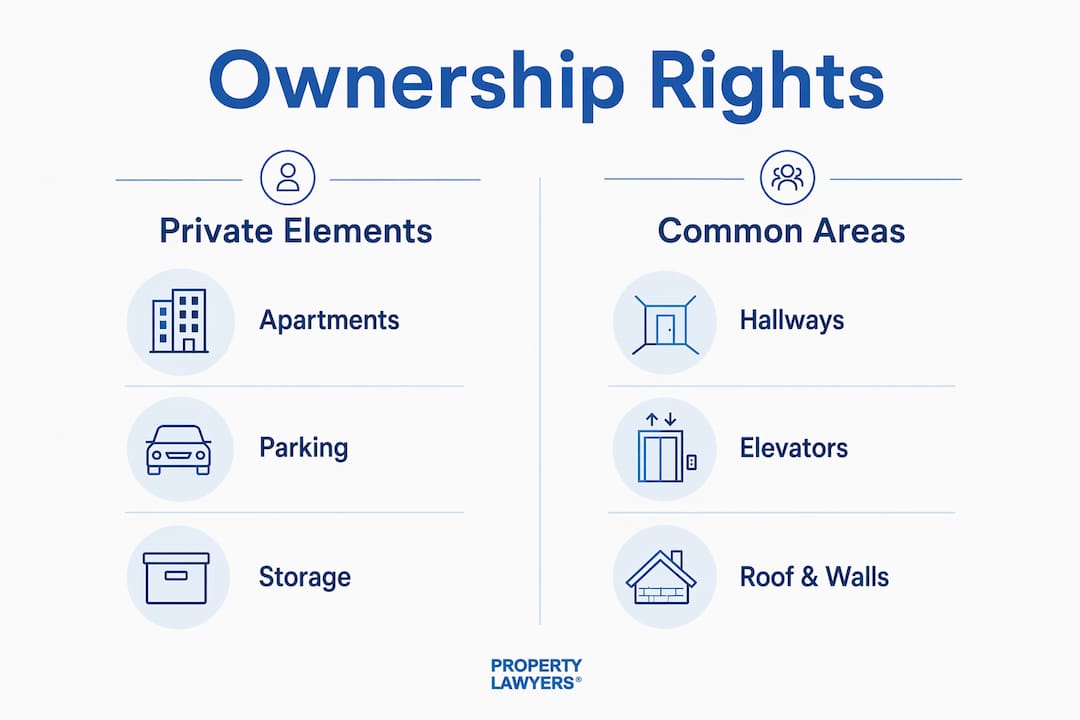
Private elements vs common elements
Private elements include the interior of your apartment, your parking space (if individually registered), and your storage room. Common elements cover everything shared: the building’s structure, the roof, the lift, communal gardens, the swimming pool, and the building’s external façade. You cannot alter or obstruct common elements without community approval, even if the area is directly adjacent to your unit.
Community fees and what they cover
Community fees typically start around €100 per month, though this varies significantly by location, building size, and the facilities on offer. Fees cover cleaning of communal areas, shared electricity, lift maintenance, building insurance, and the wages of any concierge or gardening staff. In premium developments in Marbella or Ibiza, fees can run considerably higher due to extensive shared amenities.
Paying community fees is not optional. The law treats them as a mandatory obligation tied to ownership. Owners who fall behind face legal debt recovery proceedings, interest charges, and loss of their voting rights in community meetings. These are not idle threats. Spanish courts enforce them regularly.
Your participation quota also determines your share of any extraordinary levies, which are one-off charges raised for major repairs such as roof replacement or lift modernisation. A higher quota means a larger share of these costs.
Pro Tip: Before signing any purchase contract, ask for a full breakdown of current community fees and any approved extraordinary levies. A building with a large pending repair bill can cost you thousands in your first year of ownership.
Legal obligations for all owners
- Pay community fees on time, in full, according to your participation quota.
- Attend or submit a proxy vote for the annual general meeting.
- Comply with community rules regarding noise, use of common areas, and property modifications.
- Maintain your private unit in a condition that does not damage neighbouring units or common elements.
- Notify the community if you rent your property, particularly for short-term tourist lets.
What governance structures exist under propiedad horizontal?
The Comunidad de Propietarios is governed through a formal structure with three key roles: the Junta de Propietarios, the Presidente, and the Administrador. Each plays a distinct part in keeping the community functioning legally and financially.
-
Junta de Propietarios (Owners’ Assembly). This is the supreme decision-making body. It meets at least once a year for the annual general meeting, where the budget is approved, accounts are reviewed, and major decisions are voted on. Extraordinary meetings can be called when urgent matters arise. Every owner has the right to attend, speak, and vote.
-
Presidente (Community President). The president is elected by the owners and serves as the legal representative of the community. The role is mandatory and rotates among owners unless the community agrees otherwise. The president signs contracts, represents the community in legal proceedings, and chairs meetings. Refusing the role is possible only with a valid legal justification accepted by a court.
-
Administrador (Property Manager). Many communities appoint a professional property manager to handle day-to-day administration: collecting fees, managing suppliers, preparing accounts, and advising on legal compliance. This role can be filled by the president or by a qualified external professional. In larger communities, a professional administrador is strongly advisable.
-
Voting thresholds. Not all decisions require the same level of agreement. Routine matters such as budget approval require a simple majority. Significant changes, such as installing new facilities or altering the building’s structure, require a qualified majority. Recent reforms have adjusted some of these thresholds, particularly around tourist rental restrictions.
-
Legal effect of community decisions. Once the Junta passes a valid resolution, it binds all owners, including those who voted against it and those who were absent. Challenging a community decision requires a formal legal action within specific time limits. Ignoring a binding resolution is not a legal option.
How have recent legal reforms changed propiedad horizontal?
The 2025 legal reforms represent the most significant update to Spanish horizontal property law in years. Buyers and investors need to understand these changes before committing to a purchase.
The most discussed change concerns tourist rentals. Under the 2025 Organic Law reforms, communities can now restrict or ban short-term tourist lets with a 3/5 majority vote, rather than the previous unanimous agreement. This is a major shift. It means a community can effectively block your ability to list your apartment on short-term rental platforms, even after you have bought it, provided enough owners vote in favour.
Pro Tip: Always check the minutes of the last three community meetings before exchanging contracts. If a vote on tourist rental restrictions is pending or has already passed, it will directly affect your investment plans.
Other key changes from the 2025 reforms include:
- Digital meetings. Communities can now hold general meetings online or in hybrid format, making it easier for non-resident owners to participate.
- Accessibility works. The threshold for approving accessibility improvements, such as ramps or adapted lifts, has been lowered, making it easier to pass these works even without full consensus.
- Stricter compliance obligations. Communities face tighter rules on maintaining documentation, financial records, and insurance coverage.
For investors planning to use their Spanish property as a holiday rental, these reforms create real risk. A community that currently permits tourist lets could vote to restrict them at any future meeting. Due diligence on community decisions is no longer a formality. It is a financial necessity.
Recent legal analysis confirms that the 2025 reforms introduce volatility for investors, making it critical to review community voting records before purchase. Buyers who skip this step risk buying a property with restrictions they did not anticipate.
What practical steps should buyers take before purchasing?
Buying into a propiedad horizontal arrangement means inheriting the community’s financial history, not just its current state. Spanish law is clear on this point: buyers inherit liability for unpaid community debts for the current year and the preceding three calendar years. This is a legal obligation that many international buyers overlook entirely.
Checks every buyer must carry out
- Request a certificate of no outstanding debts. The seller must provide a certificate signed by the Community President confirming that all fees are paid up to date. Without this, you risk inheriting the previous owner’s arrears.
- Review the community’s annual accounts. Ask for the last two years of approved accounts to understand the community’s financial health and spending patterns.
- Check the reserve fund. Communities are legally required to maintain a reserve fund of at least 10% of the annual ordinary budget. A fund below this level signals financial instability and the likelihood of extraordinary levies.
- Read the community statutes and internal rules. These documents set out what you can and cannot do with your property, including rules on pets, noise, short-term rentals, and modifications.
- Examine recent meeting minutes. The minutes reveal pending decisions, disputes, and any approved works that will generate future costs.
Property lawyers recommend obtaining the debt clearance certificate directly from the Community President as a non-negotiable step before signing. If the seller cannot or will not provide it, treat that as a serious warning sign.
Failing to pay community fees after purchase carries real consequences. Legal enforcement can include court proceedings, interest charges, and the suspension of your voting rights. In extreme cases, unpaid debts can lead to a charge being placed against the property itself. The community’s financial health is your financial health the moment you become an owner.
Pro Tip: Ask your property lawyer to request the full community documentation pack as part of standard due diligence. This should include the statutes, the last three years of accounts, the reserve fund balance, and the minutes of the last three general meetings.
Key takeaways
Propiedad horizontal is a mandatory legal framework that every buyer of a Spanish apartment or shared-ownership property enters automatically, with binding financial and governance obligations from the date of purchase.
| Point | Details |
|---|---|
| Legal framework | Propiedad horizontal is governed by Ley 49/1960, updated by Organic Law 1/2025 and Ley 10/2022. |
| Participation quota | Your coeficiente de participación determines your voting weight and share of all community costs. |
| Inherited debts | Buyers inherit unpaid community fees for the current year and the three preceding calendar years. |
| Reserve fund rule | Communities must hold a reserve fund of at least 10% of the annual budget; a low fund signals financial risk. |
| Tourist rental risk | Since 2025, a 3/5 majority vote is sufficient for a community to restrict or ban short-term tourist lets. |
What I have learned from watching buyers navigate comunidad life
By Sophie
After years of working with international buyers across Spain, the single most common mistake I see is treating the Comunidad de Propietarios as a background administrative detail. Buyers focus on the apartment, the view, the price. They sign, they celebrate, and then they discover they owe €3,000 in inherited community arrears, or that the community voted last month to ban tourist rentals.
The comunidad is not a homeowners’ association in the loose, voluntary sense that many British or American buyers are familiar with. It is a legally binding entity with real enforcement powers. Its decisions bind you whether you attended the meeting or not. Its debts follow the property, not the previous owner.
What I find most telling is how quickly buyers’ attitudes shift once they attend their first Junta de Propietarios. The dynamics are real: personality clashes, long-standing disputes over parking spaces, disagreements about whether to repaint the façade. Understanding that you are entering a legal and social structure, not just buying four walls, changes how you approach the purchase.
My honest advice is this: spend as much time reviewing the community documents as you spend viewing the property itself. A well-run community with healthy finances and cooperative owners is worth more than a slightly cheaper apartment in a dysfunctional one. And always, always use a qualified English-speaking property lawyer who knows how to read community accounts and spot the warning signs before you commit.
— Sophie
Legal support for buying property under propiedad horizontal
Buying a property governed by propiedad horizontal involves more legal checks than a standard freehold purchase. Community debts, reserve fund health, pending works, and tourist rental restrictions all require careful review before you sign anything.

Property-lawyers connects international buyers with independent, English-speaking property lawyers across Spain who specialise in exactly these checks. Whether you are buying in Marbella, Mallorca, Ibiza, or Barcelona, the right lawyer will review community accounts, obtain debt certificates, and flag any risks before you commit. Start your Spanish property purchase with the legal protection you need. You can also explore the full property buying guide for a step-by-step overview of the process.
FAQ
What is propiedad horizontal in Spain?
Propiedad horizontal is the Spanish legal regime, established by Ley 49/1960, that governs buildings divided into individually owned units with shared common areas. Every owner automatically becomes a member of the Comunidad de Propietarios with binding rights and obligations.
Do I have to join the Comunidad de Propietarios?
Membership is automatic and mandatory. The moment you purchase a property under propiedad horizontal, you become a member of the community and are bound by its rules, fees, and decisions.
Can a community ban tourist rentals in Spain?
Yes. Since the 2025 Organic Law reforms, a community can restrict or ban short-term tourist rentals with a 3/5 majority vote. Buyers planning to let their property short-term must check community minutes and statutes before purchasing.
What debts can I inherit when buying a Spanish apartment?
Buyers inherit liability for unpaid community fees for the current calendar year and the three preceding years. Requesting a signed debt clearance certificate from the Community President before signing is the standard way to protect against this risk.
What is the reserve fund and why does it matter?
The reserve fund (fondo de reserva) must equal at least 10% of the community’s annual ordinary budget. A healthy reserve fund means the community can cover unexpected repairs without raising emergency levies from owners.
Recommended
- Escritura Spain — The Spanish Property Title Deed Explained | Property Lawyers
- Régimen matrimonial in Spain: property rights explained
- Freehold property in Spain explained for international buyers
- Succession and inheritance in Spain | Property Lawyers

Sophie Gutenberg is a legal content specialist focused on Spanish property law, real estate transactions, conveyancing, due diligence and tax issues affecting international property buyers in Spain. She works alongside qualified Spanish property lawyers .
