

Freehold property in Spain explained for international buyers
TL;DR:
- Freehold property in Spain, called pleno dominio, provides permanent ownership of both the land and the building without time restrictions. Spain offers this full ownership to international buyers in 2026, supported by strong legal protections through land registry registration.
Freehold property in Spain is defined as outright, indefinite ownership of both the property and the land it stands on, with no time limit and no landlord above you. Spanish law calls this pleno dominio, meaning full ownership. Unlike the leasehold system common in the United Kingdom, where you may own a flat for a fixed term of 99 or 125 years, Spanish freehold gives you permanent title. Spain offers full freehold ownership to all international buyers in 2026, with no nationality or residency restrictions. You do need a mandatory NIE (Número de Identificación de Extranjero) and should budget an additional 10–13% of the purchase price for taxes and fees.
What is freehold property in Spain? The core concept explained
Pleno dominio is the standard legal term used in Spanish property law. It means you hold full rights over the property and the land beneath it, permanently and without conditions. No ground rent. No lease expiry. No permission required from a freeholder to make changes.

This distinction matters enormously for buyers from the UK or Ireland, where leasehold ownership is common and often misunderstood. In Spain, the concept of a long leasehold on a residential property simply does not exist in the same way. When you buy a flat in Marbella or a villa in Mallorca, you are buying pleno dominio as the default ownership structure.
Foreign buyers are protected under Spanish law on equal terms with Spanish nationals. The Registro de la Propiedad, Spain’s Land Registry, records your ownership and provides legal certainty. Registering your title is not optional. It is the act that makes your ownership enforceable against the world.
How does freehold differ from leasehold and other Spanish ownership types?
Spain does not operate a mainstream leasehold system for residential property. This surprises many British buyers who assume the same framework applies abroad. The practical result is that the freehold versus leasehold debate, so familiar in the UK, is largely irrelevant when buying in Spain.
That said, Spain does recognise alternative ownership structures that buyers should understand before signing anything.
Nuda propiedad and usufruct
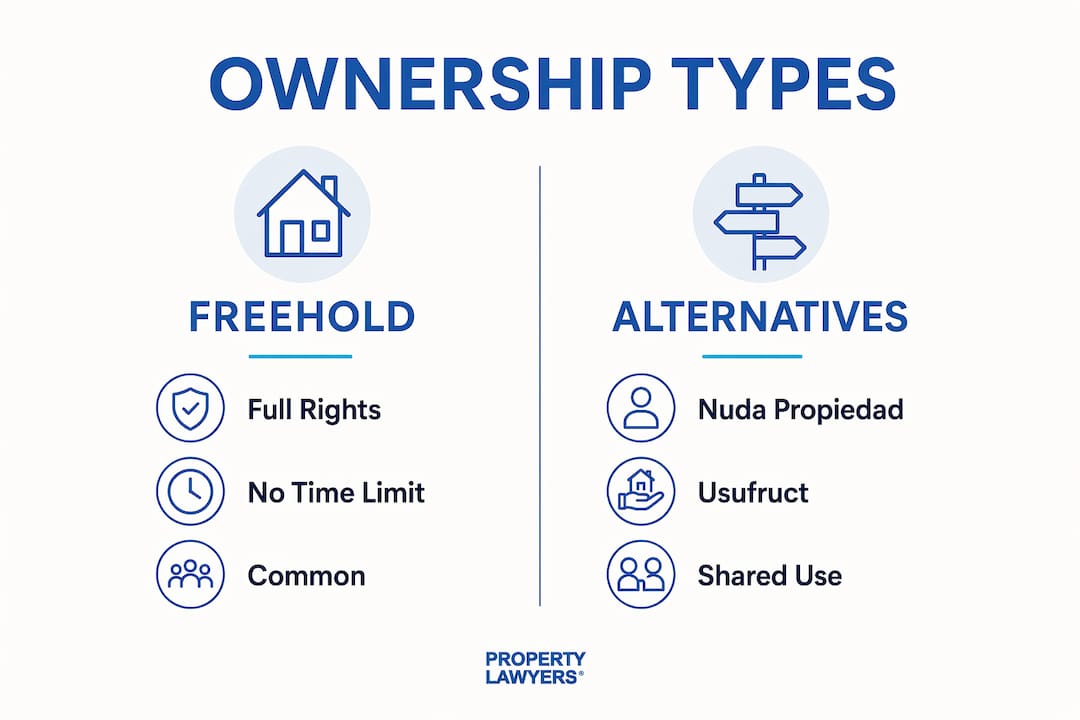
Nuda propiedad transfers title without the right to use the property. The seller retains usufruct, meaning the right to live in or use the property, often for the rest of their life. This arrangement is common among older Spanish owners who need liquidity but wish to remain in their home. For investors, it offers a lower purchase price in exchange for a delayed right of occupation. The tax and legal implications are complex, and specialist advice is essential before pursuing this route.
Horizontal property regime
Apartment ownership in Spain operates under the Régimen de Propiedad Horizontal, or horizontal property regime. You own your individual unit outright as freehold, but you share ownership of common areas such as lifts, pools, and gardens with other residents. This is governed by the Ley de Propiedad Horizontal and comes with community fee obligations.
The table below summarises the key differences between the main ownership types you will encounter in Spain.
| Ownership type | Right to use | Time limit | Common in Spain |
|---|---|---|---|
| Pleno dominio (freehold) | Full and permanent | None | Yes, standard |
| Nuda propiedad | Deferred until usufruct ends | None | Yes, specialist use |
| Usufruct only | Right to use, no title | Lifetime or fixed term | Yes, linked to nuda propiedad |
| Leasehold (residential) | Limited by lease | Fixed term | Rare, not standard |
Pro Tip: If a seller proposes a nuda propiedad arrangement, always instruct a qualified Spanish property lawyer before agreeing to terms. The tax treatment differs significantly from a standard freehold purchase.
Buyers must understand the distinction between full freehold and complex alternative structures like nuda propiedad to properly evaluate investment and legal risks before committing.
How does Spanish law protect freehold property owners?
The Spanish Land Registry provides strong protections through the principle of fe pública registral. Article 34 of the Ley Hipotecaria means that a buyer who purchases in good faith and registers their title is protected even if a prior unrecorded claim later emerges. This is one of the most buyer-friendly aspects of Spanish property law.
Registration also activates the Principle of Priority. The first registered ownership right supersedes any later claim. This means that registering your title promptly after completion is not a formality. It is the act that locks in your legal position.
The process involves two independent bodies. The notary validates and witnesses the public deed (escritura pública), confirming the transaction is legally sound. The Land Registry then records the transfer. The Land Registry and notary are independent entities, which ensures impartial oversight at every stage.
Key steps in the registration and protection process include:
- Obtaining your NIE before any formal legal steps can proceed
- Signing the escritura pública before a Spanish notary
- Submitting the deed to the Registro de la Propiedad for registration
- Paying the applicable transfer tax before registration is accepted
- Confirming the registered title matches the Cadastre description
Pro Tip: Always cross-check the Land Registry entry with the Cadastre (Spain’s property mapping authority) before exchange. Discrepancies between the two can indicate undeclared extensions or planning infringements that affect your mortgage and future tax position.
You can read more about the role of the Land Registry in protecting buyers under Spanish law on the Property-lawyers website.
What are the financial costs and community responsibilities of freehold ownership?
Buying freehold property in Spain costs more than the headline price. Additional taxes and fees typically add 10–13% to the purchase price. That figure includes Transfer Tax (ITP) on resale properties, VAT on new builds, notary fees, Land Registry fees, and legal costs. Budgeting accurately from the start avoids unpleasant surprises at completion.
For properties within a community development, such as an apartment block or gated urbanisation, there is an additional financial obligation that catches many buyers off guard.
Article 9.1.e) of the Ley de Propiedad Horizontal makes buyers liable for unpaid community fees from the year of purchase and the preceding three years. This liability transfers automatically with the property. Sellers must provide a community debt certificate at the time of signing the deed. If they cannot, or will not, treat this as a serious warning sign.
The main financial considerations for freehold buyers in Spain are:
- Transfer Tax (ITP): Applies to resale properties; the rate varies by region, typically 6–10%
- VAT (IVA): Applies to new build properties at 10%, plus stamp duty
- Notary fees: Fixed by scale, typically €600–€1,500 depending on property value
- Land Registry fees: Regulated, typically €400–€1,000
- Legal fees: Typically 1% of the purchase price for a qualified property lawyer
- Annual property tax (IBI): Paid by the owner each year to the local municipality
- Community fees: Monthly or quarterly charges for shared maintenance in developments
For a full breakdown of what you will owe, the property taxes guide on Property-lawyers covers every cost category for foreign owners in 2026.
What due diligence steps must international buyers complete?
Due diligence is the process of verifying that the property you are buying is legally sound before you commit. Skipping or rushing this stage is the single most common mistake international buyers make in Spain.
The following steps apply to all freehold purchases, whether resale or new build.
-
Obtain a nota simple from the Land Registry. This document confirms the registered owner, the property description, and any charges or encumbrances. Request it directly from the Registro de la Propiedad or through your lawyer.
-
Cross-check with the Cadastre. Discrepancies between the Land Registry and Cadastre can indicate undeclared modifications, risking mortgage approvals and tax liabilities. Your lawyer should reconcile both records before exchange.
-
Verify the absence of debts and encumbrances. Check for mortgages, charges, embargoes, or unpaid community fees attached to the property. The nota simple reveals registered charges; the community debt certificate covers community obligations.
-
Check urban planning compliance. Confirm the property has all required licences and that no illegal extensions exist. Local planning records held by the town hall (ayuntamiento) are the definitive source.
-
For new build properties, verify developer guarantees. New build purchases require confirming the developer’s bank guarantees and the licencia de primera ocupación (first occupation licence). Without this licence, you cannot legally occupy or later resell the property.
-
Confirm there are no restrictions on foreign ownership. Spain places no general bans on foreign ownership, but some restrictions apply near military or border zones. A qualified lawyer will verify this as part of standard due diligence.
Pro Tip: Always instruct your lawyer before paying any reservation deposit. The due diligence process should begin before you are contractually committed, not after.
The 10 steps before buying guide on Property-lawyers walks through each stage of the process in plain language, including how to obtain your NIE and what to expect at notary.
Key takeaways
Freehold property in Spain, known as pleno dominio, gives international buyers permanent, unrestricted ownership of both the property and the land, backed by strong legal protections through the Spanish Land Registry.
| Point | Details |
|---|---|
| Freehold means permanent ownership | Pleno dominio gives you full title with no time limit, ground rent, or lease conditions. |
| Registration is legally critical | Registering with the Land Registry activates the Principle of Priority and protects your title against later claims. |
| Budget 10–13% above the purchase price | Transfer tax, notary, registry, and legal fees add significantly to the headline cost. |
| Community debts transfer with the property | Under the Ley de Propiedad Horizontal, buyers inherit up to three years of unpaid community fees. |
| Due diligence must precede any deposit | Cross-checking the nota simple, Cadastre, and planning records before committing is non-negotiable. |
My honest assessment of buying freehold in Spain
Spanish property law is, in many respects, clearer and more buyer-friendly than the UK system. The absence of a mainstream leasehold structure removes an entire layer of risk that British buyers often carry without realising it. When you buy freehold in Spain, you own it. There is no ground rent review, no lease extension negotiation, and no freeholder to answer to.
That said, the system rewards buyers who take registration seriously. I have seen cases where buyers delayed registering their title and found themselves in a complicated legal position when a prior creditor’s claim emerged. The Principle of Priority is not just a legal technicality. It is your primary protection, and it only activates once you register.
The growing popularity of nuda propiedad arrangements also deserves more attention than it typically receives. These deals are presented as attractive investment opportunities, and sometimes they are. But the deferred right of occupation and the complex tax treatment make them unsuitable for buyers who do not have specialist legal guidance from the outset.
My consistent advice is this: instruct a qualified, independent Spanish property lawyer before you pay any deposit, not after. The Spanish real estate law guide on Property-lawyers is a good starting point for understanding your rights and obligations before you speak to anyone.
— Sophie
How Property-lawyers can help you buy freehold property in Spain
Buying freehold property in Spain as an international buyer involves multiple legal checks, tax obligations, and registration steps. Getting any one of them wrong can be costly and time-consuming to resolve.
Property-lawyers connects international buyers with trusted, independent real estate lawyers across Spain, covering popular areas including Marbella, Mallorca, Ibiza, Málaga, and Barcelona. Every lawyer in the directory specialises in working with foreign buyers and communicates in English. Whether you need help with due diligence, the escritura pública, or understanding your property purchase tax obligations, Property-lawyers can match you with the right legal professional for your situation. Start with the 2026 buyer’s legal guide to understand exactly what lies ahead.
FAQ
What does freehold mean in Spain?
Freehold in Spain, known as pleno dominio, means you own both the property and the land outright with no time limit. There is no landlord, no lease expiry, and no ground rent.
Can foreigners buy freehold property in Spain?
Yes. Spain imposes no nationality or residency restrictions on freehold ownership. Foreign buyers must obtain a NIE and comply with standard tax and registration requirements.
What is the difference between freehold and leasehold in Spain?
Leasehold residential property is not a standard ownership form in Spain. The default is freehold (pleno dominio). Alternative structures like nuda propiedad exist but are specialist arrangements, not mainstream leasehold equivalents.
How much does it cost to buy freehold property in Spain?
Additional taxes and fees typically add 10–13% to the purchase price. This includes Transfer Tax or VAT, notary fees, Land Registry fees, and legal costs.
Do I need a lawyer to buy freehold property in Spain?
Instructing a qualified Spanish property lawyer is not legally mandatory, but it is strongly advisable. A lawyer conducts due diligence, verifies the nota simple, checks for community debts, and protects your interests throughout the transaction.
Recommended
- Property law in Spain: a 2026 guide for buyers
- Spanish real estate law: a buyer’s guide for 2026
- Spanish off-plan property law explained for buyers
- How foreign buyers are protected under Spanish law

Sophie Gutenberg is a legal content specialist focused on Spanish property law, real estate transactions, conveyancing, due diligence and tax issues affecting international property buyers in Spain. She works alongside qualified Spanish property lawyers .
