
Why avoid an unlicensed Spain property agent
Buying property in Spain is one of the most significant financial decisions you will ever make, and understanding why avoid an unlicensed Spain property agent is the first step to protecting that investment. Spain’s property market attracts tens of thousands of international buyers each year, yet the country has no single national licensing requirement for estate agents. That gap creates real danger. Without the right checks, buyers can find themselves tied to agents who have no professional accountability, no obligation to disclose property defects, and no incentive to flag problems that might delay a sale.
Table of Contents
- Key takeaways
- Why avoid an unlicensed Spain property agent
- Risks of using an unlicensed agent in Spain
- How unlicensed agents undermine due diligence
- How to identify a licensed agent and choose wisely
- Licensed vs. unlicensed agents: a comparison
- My perspective: what buyers consistently get wrong
- Protect your purchase with independent legal support
- FAQ
Key takeaways
| Point | Details |
|---|---|
| No national licence required | Spain has no uniform national requirement for estate agents, making verification your responsibility as a buyer. |
| Financial exposure is significant | Skipping independent legal checks can leave buyers facing remediation costs well above €35,000. |
| Conflicts of interest are common | Agent-referred lawyers may receive referral fees, creating incentives to close deals rather than protect buyers. |
| Independent legal advice is non-negotiable | Only an independent property lawyer can verify title, debts, planning status, and contract terms on your behalf. |
| Verification steps exist | You can check a lawyer’s registration through official Bar Association records before committing to any professional. |
Why avoid an unlicensed Spain property agent
Spain’s regulatory framework for estate agents is, to put it plainly, fragmented. There is no single national body that licences all property agents across the country. Some autonomous communities, such as Catalonia, have introduced regional registration requirements, but many regions have not. This means that, in practice, almost anyone can set up as a property agent in Spain without formal qualifications or professional insurance.
This is not a technicality. It has direct consequences for buyers.
A licensed or professionally registered agent is accountable to a professional body, carries indemnity insurance, and operates under a code of conduct. An unlicensed agent carries none of those obligations. The distinction matters because Spanish property agents have limited legal duties in any case. When you remove even the baseline of professional registration, you are left with an intermediary whose primary interest is completing the transaction and collecting their commission.
Key differences between licensed and unlicensed agents include:
- Professional accountability. Licensed agents are answerable to a regulatory body and can face formal complaints or sanctions.
- Professional indemnity insurance. Licensed agents carry cover that protects buyers if negligent advice causes financial loss.
- Duty of disclosure. Professionally registered agents are more likely to be bound by obligations to disclose known defects or encumbrances.
- Verification of credentials. A licensed agent can provide registration numbers that you can cross-reference with official records.
An unlicensed agent offers none of these protections. For an international buyer unfamiliar with Spanish law, that absence of accountability is a serious vulnerability.
Risks of using an unlicensed agent in Spain
The consequences of using an unlicensed property agent in Spain are not abstract. They translate into specific, measurable financial and legal problems that buyers discover only after contracts are signed.
Undisclosed planning violations are among the most common issues. Illegal extensions, unregistered outbuildings, and pools built without permission are widespread across Spain, particularly in rural areas and coastal regions. Visual inspections by agents are insufficient to identify these problems. An unlicensed agent has no professional obligation to investigate urban planning status and may not even know how to do so correctly.
Hidden debts and embargoes present another serious risk. Spanish properties can carry outstanding mortgages, unpaid community fees, or tax debts that transfer to the new owner upon purchase. An unlicensed agent is not required to verify the property’s debt status, and many simply do not.
Lost deposits are a direct financial consequence when a purchase falls through due to undisclosed problems. If you have paid a reservation deposit or signed a private purchase contract before these issues come to light, recovering that money can be extremely difficult.
The financial exposure is well documented. Remediation costs for problems such as unlicensed extensions, planning violations, and inherited debts can exceed €35,000. By contrast, independent legal advice typically costs between €3,000 and €4,000. The arithmetic is straightforward.
Additional risks include:
- Buying a property with an AFO certificate (Asimilado Fuera de Ordenación), which recognises irregular building status but does not fully legalise it. This can affect your ability to obtain a mortgage, connect utilities, or resell the property.
- Receiving misleading assurances from an agent who presents themselves as knowledgeable about legal matters without any formal qualification to back that up.
- Being directed towards a lawyer who has a commercial relationship with the agent, creating a conflict of interest that compromises the quality of advice you receive.
How unlicensed agents undermine due diligence
Due diligence in a Spanish property transaction covers title verification, debt searches, planning checks, and review of contract terms. It is the process that stands between you and a costly mistake. Unlicensed agents can undermine this process in several ways, some of which are not immediately obvious.
Spanish notaries verify the formal validity of a transaction. They confirm that the deed is correctly executed and that the parties have legal capacity to sign. What they do not do is check whether the property has outstanding debts, whether planning permissions are in order, or whether the contract terms are fair to the buyer. That work falls to your lawyer, and only your lawyer.
The problem arises when an unlicensed agent refers you to a lawyer they work with regularly. Referral fees between agents and lawyers typically range from €300 to €500 per transaction. A lawyer receiving those fees has a financial incentive to keep the deal moving rather than raise concerns that might cause a buyer to withdraw.
This is not a hypothetical scenario. It is a recognised pattern in the Spanish property market, and it is one of the primary reasons why independent legal advice matters so much.
Specific due diligence failures linked to unlicensed or conflicted advisers include:
- Failure to obtain a full nota simple (the official property registry extract) and interpret it correctly.
- Incomplete review of community of owners’ minutes, which can reveal planned special assessments or disputes.
- Missing urban planning certificates that confirm the legal status of all structures on the property.
- Inadequate review of the private purchase contract before the buyer commits funds.
Pro Tip: Before engaging any lawyer recommended by your agent, ask directly whether they pay or receive referral fees. Transparency about referrals is one of the clearest indicators of honest legal representation. A lawyer who is genuinely independent will have no hesitation in answering that question.
How to identify a licensed agent and choose wisely
Protecting yourself begins before you view a single property. There are practical steps you can take to verify who you are dealing with and to build a team of professionals who are genuinely working in your interest.
-
Ask for registration details. In regions with formal agent registration requirements, ask the agent for their registration number and verify it with the relevant regional body. In regions without mandatory registration, ask whether the agent is a member of a professional association such as the API (Agentes de la Propiedad Inmobiliaria) or GIPE.
-
Verify your lawyer’s Bar Association status. In Spain, the terms colegiado and ejerciente confirm that a lawyer is registered with the Bar Association and authorised to practise. Both statuses are critical to verify before instructing anyone. You can check these directly through the relevant regional Bar Association’s online register.
-
Instruct your lawyer independently. Do not accept a lawyer introduced solely by the selling agent. Find your own legal representation through a trusted directory, a personal recommendation, or a specialist service such as Property-lawyers, which connects international buyers with independent, verified property lawyers across Spain.
-
Ask about the lawyer’s client base. A lawyer who acts exclusively or predominantly for sellers and developers is not the right choice for a buyer. You need someone whose practice is genuinely buyer-focused.
-
Confirm the scope of due diligence in writing. Before signing any engagement letter, confirm that your lawyer will carry out title checks, debt searches, planning verification, and contract review as part of their service.
Pro Tip: Due diligence timeline planning is critical. Never sign a reservation contract or pay any advance without confirming that your lawyer has completed, or at minimum commenced, the key legal and urban planning checks.
Red flags to watch for in any agent or adviser include: pressure to sign quickly, reluctance to provide written information, vague answers about their professional qualifications, and any suggestion that a lawyer is “included” in the agent’s service at no extra cost.
Licensed vs. unlicensed agents: a comparison
The practical difference between working with a properly vetted professional and an unlicensed agent becomes clear when you compare typical outcomes side by side.
| Factor | Licensed/professional agent | Unlicensed agent |
|---|---|---|
| Professional accountability | Answerable to a regulatory body | No formal accountability |
| Indemnity insurance | Typically required | Rarely held |
| Due diligence support | Refers buyers to independent legal counsel | May refer to conflicted lawyers |
| Disclosure obligations | Bound by professional code | No binding obligations |
| Risk of hidden defects | Lower, with proper legal support | Significantly higher |
| Typical buyer cost if problems arise | €3,000–€4,000 for legal advice | €35,000+ in remediation costs |
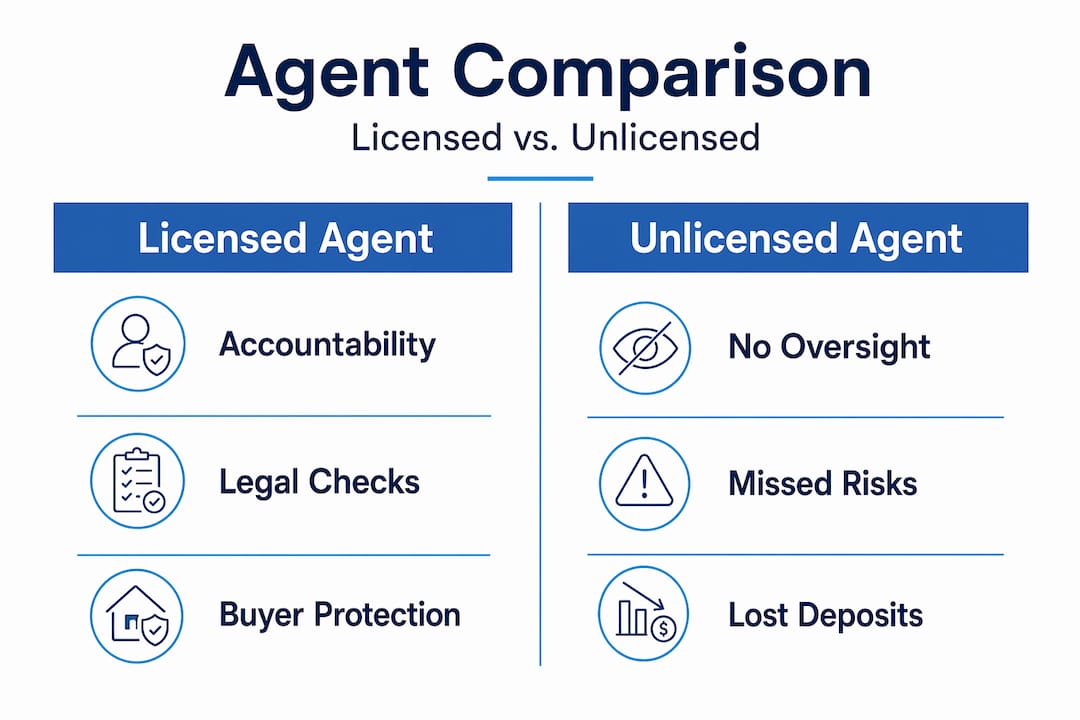
The cost difference alone makes the case. Buyers who invest in proper legal representation from the outset spend a fraction of what those who cut corners may ultimately pay. Beyond cost, the benefits of working with licensed professionals include transparency at every stage, clear contractual protections, and the confidence that someone is genuinely looking after your interests.
For buyers considering investment properties, including those exploring the Spanish Airbnb market, the stakes are even higher. Documentation failures caused by inadequate agent oversight can block licences, prevent registration, and make a property commercially unviable.
My perspective: what buyers consistently get wrong
I have spent years working alongside international buyers purchasing property in Spain, and the pattern I see most often is not carelessness. It is misplaced trust. Buyers arrive with good intentions, find an agent who speaks their language, shows them beautiful properties, and seems knowledgeable. They assume that because the agent is operating openly in the market, there must be some form of oversight keeping them honest.
There is not. Not always.
What I have learned is that the single most important decision a buyer makes is not which property to purchase. It is who they instruct to protect them during the purchase. An unlicensed agent, however charming, cannot fulfil that role. And a lawyer introduced by that agent may not either.
The buyers I have seen face the most serious problems are those who accepted the agent’s recommended lawyer without question. By the time they discovered the property had an unregistered extension or an outstanding community debt, they had already paid a deposit and signed a private contract. Recovering from that position is expensive, stressful, and sometimes impossible.
My advice is straightforward. Treat the selling agent as someone who knows the properties and the local market. Respect that knowledge. But instruct your own lawyer, independently, before you commit a single euro. The notary’s role is not to protect you. Only your lawyer is.
— Sophie
Protect your purchase with independent legal support
Knowing the risks is the first step. Acting on that knowledge is what protects your investment.
Property-lawyers connects international buyers with independent, verified property lawyers across Spain. Every lawyer in the directory is checked for Bar Association registration, buyer-focused practice, and genuine independence from agent referral networks. Whether you are purchasing a holiday home on the Costa del Sol, an apartment in Madrid, or a rural property in Andalucía, you deserve legal representation that is working exclusively for you.
Visit Property-lawyers to find a trusted property lawyer in Spain who can carry out full due diligence, review your contracts, and guide you through every stage of your purchase. If your transaction is based in the capital, our Madrid property lawyers page connects you with specialists in that region. Do not leave the most significant financial decision of your life to chance or to an unverified intermediary.
FAQ
What makes an estate agent “unlicensed” in Spain?
In Spain, there is no single national licensing requirement for estate agents, so an unlicensed agent is one who holds no regional registration, no professional association membership, and no formal qualifications. This means they operate with no professional accountability and no obligation to carry indemnity insurance.
Can an unlicensed agent cause me to lose my deposit?
Yes. If an unlicensed agent fails to disclose debts, planning violations, or legal irregularities before you sign a private purchase contract, you may lose your deposit if the transaction cannot proceed. Independent legal checks before signing any contract are the only reliable protection.
How do I verify a property lawyer’s credentials in Spain?
Check that your lawyer holds colegiado and ejerciente status, confirming Bar Association registration and authorisation to practise. You can verify both through the relevant regional Bar Association’s online register before instructing anyone.
Is the notary enough to protect me as a buyer?
No. Spanish notaries confirm formal validity of the deed but do not check for outstanding debts, planning violations, or unfair contract terms. Only an independent lawyer acting solely for you provides that protection.
What should I ask a lawyer before instructing them?
Ask whether they pay or receive referral fees from agents, confirm their Bar Association registration number, and request a written scope of services covering title checks, debt searches, planning verification, and contract review.

Sophie Gutenberg is a legal content specialist focused on Spanish property law, real estate transactions, conveyancing, due diligence and tax issues affecting international property buyers in Spain. She works alongside qualified Spanish property lawyers .
