
Why hire a lawyer when buying property in Spain
Buying property in Spain without independent legal counsel is one of the most common and costly mistakes international buyers make. Many assume the notary will protect them, or that the estate agent’s recommended solicitor is sufficient. Neither assumption is correct. Understanding why you need to hire a lawyer when buying Spain property, and specifically why that lawyer must be independent, can be the difference between a safe purchase and a financial disaster. This guide explains the key risks, the roles of each party involved, and how to choose the right legal representation before you sign anything.
Table of Contents
- Key takeaways
- Why hire a lawyer buying Spain property
- Roles of the notary, agent, and lawyer
- Legal risks before you sign
- Choosing an independent lawyer, not an agent’s choice
- Power of attorney for remote buyers
- Fees, qualifications, and avoiding traps
- My perspective on independent legal advice in Spain
- Find a trusted independent lawyer in Spain
- FAQ
Key takeaways
| Point | Details |
|---|---|
| Notaries do not protect buyers | The notary witnesses signatures but does not investigate title defects, debts, or planning violations. |
| Estate agents represent sellers | Agents are typically paid by the seller and do not act in the buyer’s legal interest. |
| Independent lawyers conduct due diligence | Only your own lawyer will check ownership, charges, community debts, and planning compliance before you commit. |
| Agent-recommended lawyers carry risks | Referral fee arrangements can bias legal advice away from raising problems that might slow a sale. |
| Power of attorney enables remote buying | A notarial power of attorney allows your lawyer to complete the purchase on your behalf if you cannot be present in Spain. |
Why hire a lawyer buying Spain property
Spain’s property buying process looks straightforward on the surface. You find a property, agree a price, sign a contract, and complete at the notary. The reality is considerably more complex, and the consequences of skipping proper legal advice can be severe.
The term “independent property lawyer” refers to a qualified Spanish solicitor, known in Spanish as an abogado, who acts exclusively for the buyer with no financial ties to the seller, developer, or estate agent. This is the recognised standard for buyer protection in Spanish property transactions, and it is the role that Property-lawyers describes throughout its directory.
Legal advice buying property Spain is not optional in the way some buyers believe. Spain does not have an automatic conveyancing system that protects buyers the way some other countries do. The buyer must actively appoint their own counsel. Without that step, nobody in the transaction is legally obligated to protect your interests.
Roles of the notary, agent, and lawyer
This is where most foreign buyers become confused, and the confusion is understandable. In the UK, for example, a conveyancing solicitor handles title checks, contract negotiation, and completion. In Spain, those roles are split across different parties, and the buyer is responsible for filling the gap.
What the notary actually does
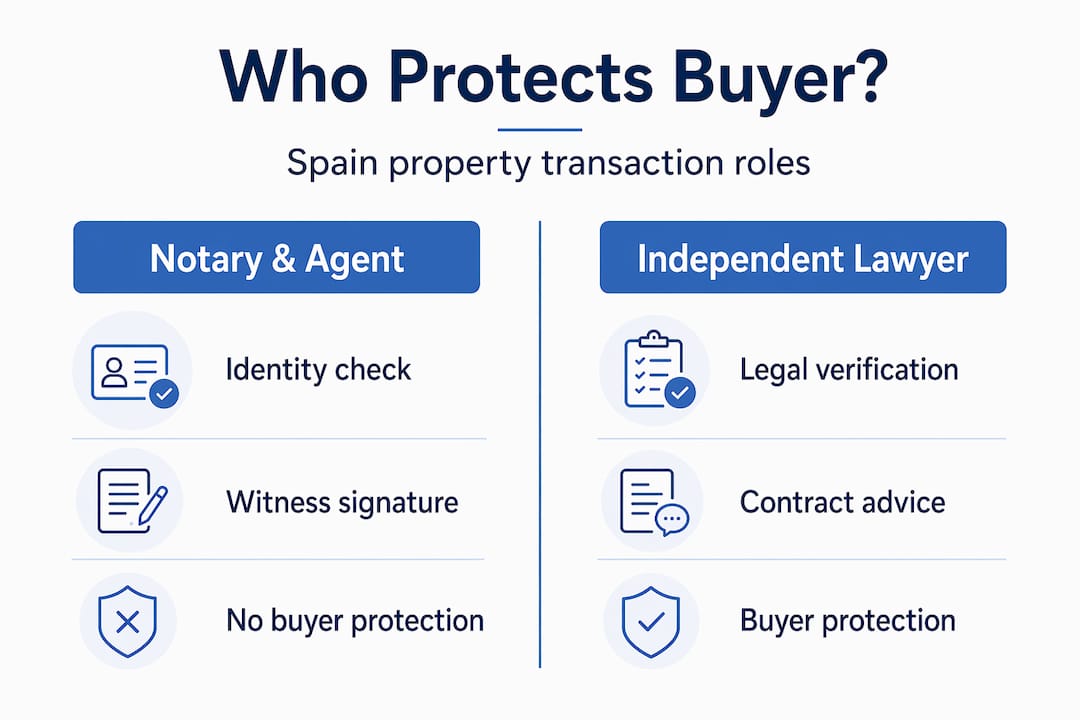
The notary in Spain is a public official. Their function is to verify the identities of both parties, confirm the formalities of the transaction, and certify that the deed has been executed correctly. As international buyers often discover, the notary does not investigate title problems, planning violations, or hidden charges. That work must be done before the notary appointment, by the buyer’s own legal counsel.
The estate agent’s position
Estate agents in Spain are typically paid by the seller. Their commercial interest lies in completing the transaction, not in uncovering problems that might cause a buyer to withdraw. As the seller’s lawyer and agent are structurally aligned with the seller’s side, the buyer must rely entirely on their own independent counsel for proper contract drafting and risk mitigation.
“An independent lawyer is not a luxury but an essential safeguard for buyers, since Spanish conveyancing does not protect buyer risks automatically.”
This structural reality is why the question of why buyers need a separate lawyer in Spain is so important. No other party in the transaction is positioned or incentivised to protect you.
Legal risks before you sign
The most critical legal work happens before the notary appointment. Once you have paid a deposit and signed a contract, your leverage and legal protections can be significantly reduced. This is where an independent property lawyer earns their fee many times over.
Here are the key checks your lawyer should conduct before you commit to any payment:
- Title and ownership verification. Your lawyer searches the Land Registry (Registro de la Propiedad) to confirm the seller legally owns the property and that no undisclosed co-owners exist.
- Charges, mortgages, and liens. Properties in Spain can carry existing mortgages, embargoes (court-ordered charges), or other encumbrances that transfer to the new owner if not cleared at completion.
- Community of owners debts. Unpaid service charges to the comunidad de propietarios become the new owner’s liability. Your lawyer requests a certificate confirming the property is debt-free.
- Local tax debts (IBI). Outstanding municipal property tax (Impuesto sobre Bienes Inmuebles) can also attach to the property. Your lawyer verifies this is clear.
- Planning and urban compliance. This is one of the most overlooked risks. Illegal extensions, unlicensed constructions, or properties built on protected land can result in demolition orders. Multiple risk layers must be verified, including planning compliance, before any contract is signed.
- Contract review. The arras (deposit) contract requires careful scrutiny. Deposit contract types vary significantly. An arras penitenciales contract means the buyer loses the deposit if they withdraw, while the seller must return double if they pull out. Other contract types carry different consequences entirely.
Pro Tip: Ask your lawyer to hold your deposit in their client account rather than transferring it directly to the seller. Holding deposits in escrow protects your funds and ensures they are only released on completion or a qualifying refund event.
Financing contingencies are equally critical. Contract language around financing clauses determines whether your deposit is refundable if your mortgage falls through. Without the right wording, buyers have lost tens of thousands of euros because their mortgage was declined after signing.
Choosing an independent lawyer, not an agent’s choice
The phrase “independent property lawyer” carries specific meaning in Spain’s property market. It means a lawyer who has no referral arrangement, commission agreement, or financial relationship with the estate agent, developer, or seller involved in your transaction.

Estate agents commonly recommend lawyers with referral fee arrangements in place. The lawyer receives a fee for each client the agent sends. The problem is structural: a lawyer dependent on agent referrals has a financial incentive to keep deals moving rather than raise legal red flags that might cause a buyer to withdraw.
When comparing why property lawyers versus estate agents in Spain serve different interests, the key distinction is this. The agent wants a completed sale. Your independent lawyer wants a safe purchase for you, even if that means advising you to walk away.
To identify genuine independence, ask these questions when interviewing prospective lawyers:
- Do you receive referral fees or commissions from any estate agent or developer involved in this transaction?
- Are you registered with the local Colegio de Abogados (Bar Association)?
- Do you hold professional indemnity insurance?
- How many Spanish property transactions have you completed for international buyers in the past year?
Pro Tip: Search the Colegio de Abogados directory for your region to verify a lawyer’s registration independently before appointing them.
Watch for red flags. Anyone describing themselves as a “legal advisor” or “property consultant” rather than an abogado may not hold the qualifications required to practise Spanish law. Similarly, unusually low fees can indicate limited experience or a conflict of interest you have not yet identified. True lawyers hold a Licenciado or Graduado en Derecho and are registered members of their regional Bar Association.
Power of attorney for remote buyers
Many international buyers cannot travel to Spain for every stage of the purchase. Completion at the notary requires physical presence or a formal legal substitute. That substitute is a poder notarial, a notarial power of attorney, which authorises your lawyer to sign documents and act on your behalf.
The process for granting a power of attorney involves the following steps:
- If you are in Spain: Visit a Spanish notary with your passport to sign the power of attorney document. The notary will certify it, and your lawyer can use it immediately.
- If you are outside Spain: Sign the power of attorney before a notary in your home country, then obtain an apostille stamp to validate it for use in Spain. Notarial power of attorney fees typically range from EUR 100 to EUR 250, plus the cost of the apostille.
- If you are a UK resident post-Brexit: The apostille process remains valid under the Hague Convention, so this route is still straightforward.
Without a valid power of attorney, you must be physically present at the notary’s office on the completion date. Missing that appointment can delay the transaction, trigger penalty clauses, or in some cases cause the deal to collapse entirely. A trusted lawyer holding your power of attorney removes that risk and gives you the flexibility to manage the purchase from abroad.
Fees, qualifications, and avoiding traps
Understanding what you should pay and what you should receive in return helps you avoid poor-value or inadequate legal representation.
Typical fee ranges
Most qualified Spanish property lawyers charge between 1% and 1.5% of the purchase price for a full conveyancing service, with a minimum fee typically around EUR 1,500 to EUR 2,000. That fee should cover title due diligence, contract review and negotiation, NIE number assistance, power of attorney drafting, and attendance at or representation at completion.
What to compare when selecting a lawyer
| Feature | Inexperienced or tied lawyer | Independent qualified lawyer |
|---|---|---|
| Bar registration | May be unverifiable | Confirmed with Colegio de Abogados |
| Referral arrangement | Often present | None |
| Deposit handling | Direct to seller | Held in client account |
| Contract negotiation | Minimal or none | Full review and amendment |
| Planning checks | Rarely conducted | Standard part of due diligence |
| Professional indemnity | May be absent | Confirmed and current |
Pro Tip: Request a written engagement letter before paying any fee. This letter should specify exactly which services are included, the total cost, and the lawyer’s Bar registration number.
The benefits of hiring an independent property lawyer in Spain extend beyond legal protection. A good lawyer also manages the administrative process, coordinates with the notary, liaises with the tax authorities, and guides you through post-completion obligations such as registering the title and paying transfer tax.
My perspective on independent legal advice in Spain
I have spoken with hundreds of international buyers over the years, and the pattern is consistent. The buyers who had the most difficult experiences were not the ones who faced complicated properties. They were the ones who relied on the agent’s recommended lawyer or assumed the notary would flag problems.
What I find particularly telling is how often buyers describe the agent-recommended lawyer as “perfectly friendly and helpful.” They are not wrong. The lawyer was helpful. The question is: helpful to whom? A lawyer who never raises an objection, never queries a contract clause, and never advises a buyer to reconsider is not doing their job. They are doing the agent’s job.
The benefits of independent legal advice in Spain are not abstract. I have seen buyers avoid purchasing properties with illegal extensions, properties with undisclosed mortgages exceeding the purchase price, and properties where the seller had no legal right to sell at all. Every one of those situations was identified by an independent lawyer before contracts were exchanged.
My honest view is that the 1% to 1.5% legal fee is the best money you will spend in the entire transaction. It is also the only fee where the person you are paying is unconditionally on your side. That matters more than most buyers realise until something goes wrong.
— Sophie
Find a trusted independent lawyer in Spain
Choosing the right legal representation before you buy is the single most protective step you can take as an international buyer in Spain.

Property-lawyers is Spain’s leading directory of trusted, independent real estate lawyers serving international buyers across all regions. Whether you are purchasing in Madrid, the Costa del Sol, the Balearic Islands, or anywhere else in Spain, you can find a verified, independent Spanish property lawyer through the directory. Each listed lawyer is independent, qualified, and experienced in representing foreign buyers. If you are also considering the broader context of buying property in Europe as a foreign national, Property-lawyers provides resources to guide you through the legal process from start to finish.
FAQ
Does the notary protect the buyer in a Spanish property transaction?
No. The notary verifies identities and certifies the deed but does not investigate title defects, planning violations, or unpaid debts. Those checks are the responsibility of the buyer’s own lawyer.
Can an estate agent’s recommended lawyer act independently for the buyer?
Not reliably. Agent-recommended lawyers often receive referral fees, which creates a conflict of interest. Buyers should appoint a lawyer with no financial ties to the agent or seller.
What happens if I lose my deposit in Spain?
If you sign an arras penitenciales contract and withdraw, you lose the full deposit. If the contract lacks a financing contingency clause and your mortgage is declined, the deposit may also be forfeited. A lawyer reviews and negotiates these terms before you pay anything.
Do I need to be in Spain to complete my property purchase?
No. You can grant a notarial power of attorney to your lawyer, authorising them to sign all documents on your behalf. This is a standard arrangement for international buyers and costs between EUR 100 and EUR 250 plus apostille fees if signed outside Spain.
How much does a property lawyer charge in Spain?
Most independent property lawyers charge between 1% and 1.5% of the purchase price, with a typical minimum of EUR 1,500 to EUR 2,000. This fee covers due diligence, contract review, NIE assistance, and representation at completion.

Sophie Gutenberg is a legal content specialist focused on Spanish property law, real estate transactions, conveyancing, due diligence and tax issues affecting international property buyers in Spain. She works alongside qualified Spanish property lawyers .
