
Building defects law in Spain: buyer’s guide 2026
Purchasing property in Spain is a significant financial commitment, and what building defects law Spain explained means in practice is something far too many buyers discover only after problems arise. The legal framework governing construction defects is more layered than most people expect, covering everything from cosmetic finishing faults to structural failures, each with distinct liability periods and claim procedures. Whether you are buying a new build in Valencia or investing in a Costa del Sol apartment, understanding Spanish construction defect laws before you complete is one of the most practical steps you can take to protect your investment.
Table of Contents
- Key takeaways
- What building defects law Spain explained: the three categories
- Legal frameworks governing defect claims
- How to pursue a building defect claim
- Complexities and nuances buyers must understand
- My perspective on defects law as a property investor
- How a specialist property lawyer can protect you
- FAQ
Key takeaways
| Point | Details |
|---|---|
| Three distinct warranty periods | Spanish law sets 1, 3, and 10-year guarantees depending on the type of defect identified. |
| Warranty versus limitation period | A defect appearing within the warranty window triggers a separate 2-year period to bring a legal claim. |
| Burofax is critical | Sending a formal Burofax notification documents your claim and interrupts the limitation period. |
| Two legal routes available | Buyers can pursue claims under both the LOE statute and the Civil Code for maximum protection. |
| 2026 regulatory changes matter | New rules expand defect definitions to include energy and product compliance, widening buyer protections. |
What building defects law Spain explained: the three categories
The primary statute governing construction liability in Spain is the Ley de Ordenación de la Edificación, commonly known as the LOE (Ley 38/1999). This law replaced a patchwork of older provisions and created a structured system of warranties that applies to all new buildings. Understanding building flaws Spain through the lens of the LOE starts with recognising that not all defects are treated equally. The law divides them into three categories, each carrying a different warranty period measured from the formal reception of works, known as the acta de entrega.
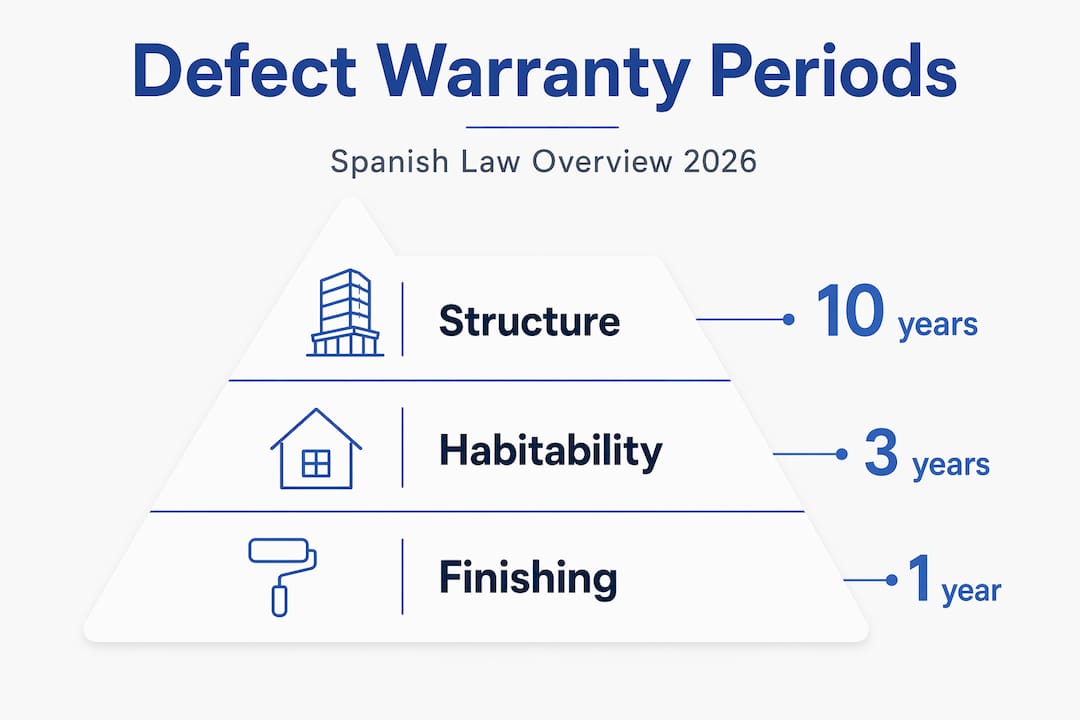
The three LOE warranty periods are:
- 1 year for finishing defects (vicios o defectos de terminación): cosmetic or aesthetic issues such as cracked tiles, poor paintwork, or defective flooring.
- 3 years for habitability defects (vicios o defectos que afecten a la habitabilidad): problems affecting insulation, waterproofing, acoustic performance, or general liveability.
- 10 years for structural defects (vicios o defectos que afecten a la cimentación, soportes, vigas, forjados, muros de carga u otros elementos estructurales): failures in foundations, load-bearing walls, beams, or any element that compromises the building’s structural integrity.
The table below summarises these categories clearly:
| Defect category | Examples | Warranty period |
|---|---|---|
| Finishing | Cracked tiles, paint defects, faulty fittings | 1 year |
| Habitability | Damp, poor insulation, waterproofing failure | 3 years |
| Structural | Foundation failure, subsidence, load-bearing wall cracks | 10 years |
For older resale properties not covered by the LOE, the Civil Code applies instead. Under Article 1490, hidden defect claims must be filed within just 6 months of property delivery. This is a much shorter window and is frequently missed by buyers who assume they have more time. If you are purchasing a resale property, this distinction is particularly relevant to your due diligence.
Legal frameworks governing defect claims
Building defects legislation Spain draws on two principal legal sources that can operate independently or together, depending on the circumstances of your claim.
The LOE establishes statutory liability for all parties involved in a construction project, including architects, engineers, site managers, contractors, and developers. Each carries defined responsibilities, and liability can be joint and several where multiple parties contributed to a defect. The law also makes 10-year decennial insurance mandatory for structural defects, meaning there is an insurer to pursue even if the developer has dissolved or become insolvent.
Alongside the LOE, the Civil Code provides additional remedies through general contract law. This is where the strategic advantage for buyers becomes clear. Contractual liability claims under the Civil Code carry a statute of limitations of up to 5 years, compared to the shorter periods under the LOE. Buyers can therefore pursue both routes simultaneously, using the LOE for its clear warranty structure and the Civil Code for its longer claim window and broader contractual remedies.
Recent changes in 2026 have added further complexity. A new Real Decreto expands defect definitions to include compliance with building product declarations and energy performance standards. In practical terms, a building that fails to meet its declared energy rating or uses non-compliant materials may now give rise to a defect claim. This is a significant development for investors purchasing properties marketed with specific sustainability or energy credentials.
Pro Tip: If you are buying a new build, request a copy of the building’s energy performance certificate and product compliance documentation at completion. Any divergence between declared and actual performance may now constitute a legally actionable defect under 2026 regulations.
How to pursue a building defect claim
Knowing your rights is one thing. Knowing how to exercise them effectively is another. Property defect claims in Spain follow a broadly consistent process, though the details vary depending on the defect type, the parties involved, and whether the matter proceeds to court.
The recommended procedure, based on current legal practice, runs as follows:
-
Commission an independent technical report. An architect or structural engineer must assess and document the defect, its cause, and the responsible party. Courts rely heavily on professional expert evidence to establish liability. A poorly prepared or absent report can result in a claim being dismissed entirely.
-
Send a formal Burofax notification. A Burofax is a certified postal communication with legal standing in Spain. It documents that you notified the responsible party of the defect on a specific date, which is critical for interrupting the 2-year limitation period that begins once a defect manifests within the warranty window.
-
Attempt a negotiated settlement. With a strong expert report and formal notification in hand, many claims are resolved without litigation. Developers and their insurers are often willing to settle when the evidence is clear and the legal exposure is documented.
-
Proceed to litigation if necessary. If settlement fails, court proceedings can be initiated. Be aware that Spanish litigation is slow and can take several years to resolve. This is why exhausting settlement options first is nearly always the wiser course.
Pro Tip: Do not wait until the warranty period is about to expire before acting. The warranty period is a guarantee window, not a claim deadline. Once a defect appears within that window, you have a separate 2-year period to bring legal action. Acting early gives you time to build a strong case.
Complexities and nuances buyers must understand
One of the most persistent misunderstandings in Spanish construction defect law concerns the difference between a warranty period and a limitation period. Many buyers believe that once the 3-year or 10-year warranty expires, their right to claim is gone. This is not accurate. As legal experts clarify, the warranty period defines the window during which a defect must manifest, not the deadline for bringing a claim. Once the defect appears within that window, a separate 2-year limitation period begins.
Latent and progressive defects create additional complexity. A structural crack that develops slowly over several years may not become visible until year 8 or 9 of the 10-year structural warranty. In such cases, the 2-year claim window starts from the point at which the defect became apparent, not from the date of completion.
Identifying the responsible party is another practical challenge. The LOE assigns liability across multiple agents, and in complex construction projects, determining whether a defect originates from design, materials, or workmanship requires expert analysis. The following table illustrates how liability is typically distributed:
| Responsible party | Typical liability area |
|---|---|
| Architect (proyectista) | Design errors, specification failures |
| Site architect (director de obra) | Supervision failures during construction |
| Contractor (constructor) | Workmanship defects, material substitution |
| Developer (promotor) | Overall project liability, LOE obligations |
“The 2026 regulatory changes materially increase the scope of actionable defects, including energy and compliance issues, which means buyers now have broader grounds to pursue claims than at any previous point under Spanish law.” — 2026 construction regulation update
Where a developer has made representations about a property’s specification, energy performance, or build quality that turn out to be inaccurate, contractual misrepresentation claims under the Civil Code may provide an additional remedy. This is particularly relevant for off-plan purchases where buyers rely heavily on marketing materials and sales contracts.
My perspective on defects law as a property investor
I have spent considerable time working with buyers who discovered construction defects months or even years after completing their purchase in Spain. The single most common mistake I see is treating the warranty period as if it were the claim deadline. Buyers watch the 3-year or 10-year clock, assume time is running out, and either panic into a poorly prepared claim or give up entirely. Both outcomes are avoidable.
What I have found is that early action, even when a defect seems minor, is almost always the right approach. Getting an independent expert report commissioned within the first year of ownership, before any obvious problems arise, gives you a baseline. If something develops later, you have documented evidence of the property’s original condition.
The 2026 regulatory changes genuinely shift the balance in favour of buyers. Energy compliance and building product declarations are now part of the defect framework, which means buyers who purchased properties marketed with specific green credentials have new legal grounds to explore if those credentials do not hold up. This is not a theoretical risk. It is a practical issue I expect to see tested in Spanish courts over the next several years.
My honest advice is this: do not treat legal protection as something you activate only when things go wrong. Integrate defect analysis into your purchase process, use a qualified Spanish property lawyer from the outset, and document everything formally. The cost of that preparation is negligible compared to the cost of a disputed structural claim.
— Sophie
How a specialist property lawyer can protect you
Handling new build defects legally in Spain requires more than a general awareness of the law. It requires precise knowledge of deadlines, the ability to commission and interpret expert reports, and experience in negotiating with developers and their insurers.

Property-lawyers connects international buyers and investors with independent, specialist real estate lawyers across Spain who handle construction defect claims as a core part of their practice. Whether you need a contract reviewed before completion, a formal defect notification drafted, or legal representation in a disputed claim, the right lawyer makes a material difference to the outcome.
From Madrid solicitors handling urban apartment defects to coastal property specialists managing habitability claims, Property-lawyers gives you direct access to vetted legal professionals who understand both the LOE and the Civil Code strategies available to you. If you are buying in Spain or already own a property with suspected defects, speaking with a qualified Spanish property lawyer is the most effective step you can take to protect your position.
FAQ
What are the warranty periods for building defects in Spain?
Under the LOE, Spanish law provides 1 year for finishing defects, 3 years for habitability defects, and 10 years for structural defects, all measured from the formal reception of works.
Does the warranty period expiry mean I can no longer claim?
No. The warranty period defines when a defect must appear, not the deadline for legal action. Once a defect manifests within the warranty window, you have a separate 2-year period to bring a claim.
What is a Burofax and why does it matter for defect claims?
A Burofax is a certified postal communication with legal standing in Spain. Sending one to the responsible party formally documents your claim and interrupts the 2-year limitation period, making it a critical step in any defect dispute.
Can I pursue claims under both the LOE and the Civil Code?
Yes. Dual claims are permitted and often strategically advisable. The Civil Code offers contractual liability claims with a limitation period of up to 5 years, providing an additional route alongside the statutory LOE framework.
How have 2026 regulations changed building defect law in Spain?
The 2026 Real Decreto expanded the definition of actionable defects to include non-compliance with building product declarations and energy performance standards, giving buyers broader grounds to claim than under previous legislation.

Sophie Gutenberg is a legal content specialist focused on Spanish property law, real estate transactions, conveyancing, due diligence and tax issues affecting international property buyers in Spain. She works alongside qualified Spanish property lawyers .
