
How to obtain a digital certificate in Spain
Dealing with Spanish bureaucracy without the right credentials is genuinely frustrating. Whether you are a foreign property buyer trying to manage tax obligations remotely, or a legal professional who needs to access government portals on behalf of clients, the ability to obtain a digital certificate as a Spanish lawyer or individual is no longer optional. Formally known as the certificado electrónico, this credential is issued primarily by the FNMT (Fábrica Nacional de Moneda y Timbre) and acts as your verified digital identity across Spain’s public administration systems. This guide covers exactly what you need, step by step, and where the process most commonly goes wrong.
Table of Contents
- Key takeaways
- How to obtain a digital certificate as a Spanish lawyer or individual
- Step-by-step: applying for and downloading your certificate
- Common mistakes that derail the process
- Using your certificate for legal and property dealings
- My experience helping people through this process
- How Property-lawyers can help you move forward
- FAQ
Key takeaways
| Point | Details |
|---|---|
| Three-stage FNMT process | You must complete an online application, an in-person identity check, and a certificate download on the same device. |
| Device consistency is critical | The browser and computer used to apply must be the same ones used to download the certificate. |
| Certificate type matters | Choosing the wrong certificate type (natural person vs representative) causes failures in legal and property transactions. |
| Non-residents need extra planning | Verification can be done at Spanish consulates abroad, but appointments must be arranged well in advance. |
| Delays carry real consequences | Missing a certificate deadline can result in penalties or missed legal deadlines with no automatic extension. |
How to obtain a digital certificate as a Spanish lawyer or individual
Before anything else, it helps to understand what you are actually applying for. The FNMT issues two main categories of digital certificate: the natural person certificate (certificado de persona física) and the representative or company certificate (certificado de representante). Most individuals, including foreign property buyers and resident lawyers acting in a personal capacity, will need the natural person certificate. Legal professionals acting on behalf of a company or as an authorised representative require the representative certificate. Selecting the wrong type is one of the most common and costly errors in the certification process for lawyers and individuals alike.
What you need before you start
Gathering the right documents before beginning saves considerable time. Here is what you will need:
- DNI or NIE number. Spanish nationals use their DNI (Documento Nacional de Identidad). Foreign nationals, including EU citizens and non-EU property buyers, use their NIE (Número de Identificación de Extranjero). If you do not yet have an NIE, you will need to obtain your NIE first before proceeding.
- Your first surname as it appears on your identity document.
- A valid email address to receive your application code.
- FNMT configuration software installed on your computer. This is available from the FNMT website and must be set up before submitting your application.
The system and browser requirements are specific. Internet Explorer has historically been the most compatible browser for FNMT applications, though Firefox with the correct configuration also works. Chrome and Safari frequently cause problems. The FNMT provides a configuration tool that checks compatibility before you proceed.
Pro Tip: Install the FNMT configuration software and run the compatibility checker before you begin the application. Discovering a browser incompatibility midway through the process wastes time and may require you to start over.
| Certificate type | Who needs it | Common use cases |
|---|---|---|
| Natural person (persona física) | Individuals, foreign buyers, resident lawyers acting personally | Tax filings, property registration, personal admin |
| Representative (representante) | Company directors, legal representatives, notaries | Acting on behalf of a legal entity, company transactions |
| Employee (empleado público) | Public sector employees | Government administration tasks |
For non-residents, the process requires additional planning. Verification outside Spain can be completed at a Spanish consulate abroad, but not all certifiers support overseas accreditation. The FNMT is the most reliable option for non-residents, and consular appointments can take several weeks to arrange. Factor this into your timeline, particularly if you are managing a property purchase with fixed legal deadlines.
Step-by-step: applying for and downloading your certificate
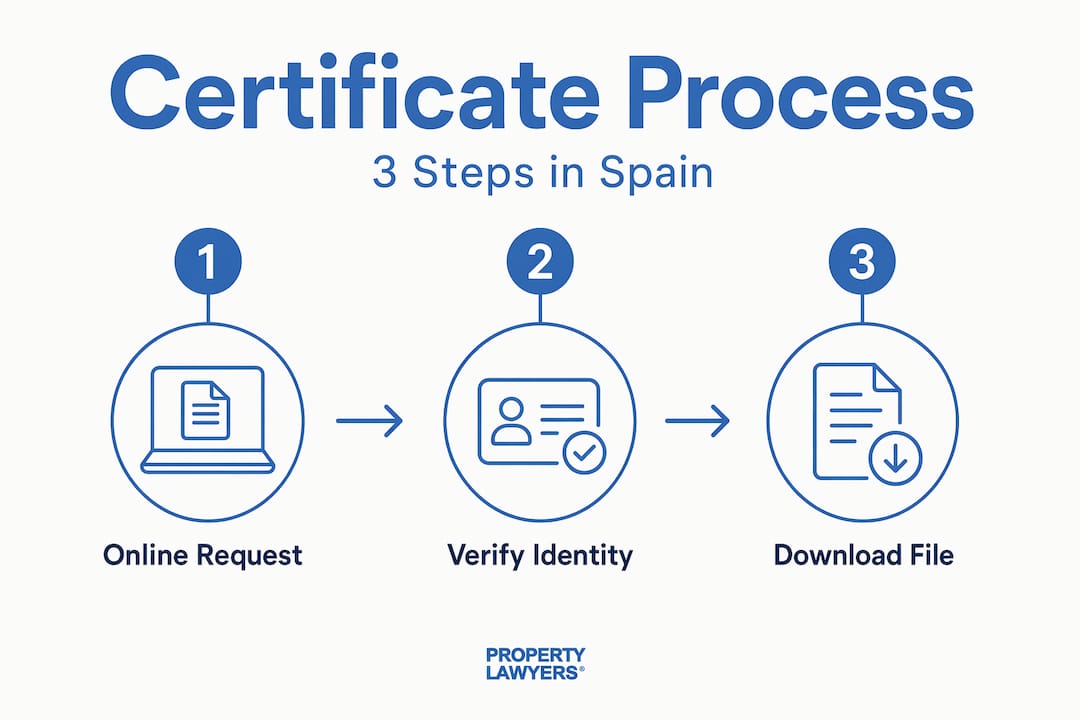
The FNMT application process follows three distinct stages. Each must be completed correctly and in sequence.
- Submit your online application. Visit the FNMT website and select the certificate type you need. Enter your DNI or NIE number, your first surname, and your email address. The system will generate a unique request code and send it to your email. This code is valid for a limited period, typically around 10 days.
- Attend your identity verification appointment. This is the step that requires physical presence. You must visit an authorised accreditation office, which includes Tax Agency offices (Agencia Tributaria), Social Security offices, and certain town halls. Bring your original identity document and your request code. For non-residents, this step takes place at a Spanish consulate. Identity accreditation is widely considered the most challenging part of the process, as it cannot be delegated or completed remotely.
- Download and install the certificate. After your identity has been verified, you will receive an email confirming that your certificate is ready to download. You must return to the FNMT website and download it using the exact same computer and browser you used for the initial application. The cryptographic key pair is generated locally and linked to that specific environment, so any mismatch will cause the installation to fail.
- Back up your certificate immediately. Export the certificate as a .p12 or .pfx file and store it securely, ideally in an encrypted folder and on a separate storage device. Set a strong, memorable password and record it somewhere safe.
Pro Tip: Do not download your certificate on a shared or work computer unless you are certain you will always have access to that machine. Losing access to the device means losing access to the certificate.
Non-residents managing property or tax matters in Spain should note that digital certification enables remote access to a wide range of administrative tasks, from correcting residency records to submitting tax declarations, without needing to travel to Spain each time.
Common mistakes that derail the process
Most failed applications come down to a handful of avoidable errors. Understanding them in advance makes a significant difference.
- Switching devices or browsers between application and download. This is the single most frequent technical failure. The cryptographic keypair is generated locally at the time of application, which means the download must happen in the same environment. Using a different browser or computer breaks the chain entirely and forces a restart.
- Losing the request code or forgetting the password. Even losing track of the password used to protect the certificate request requires restarting the entire application process. There is no recovery option. Write down your request code and password immediately and store them securely.
- Selecting the wrong certificate type. A lawyer acting personally does not need a representative certificate, and vice versa. Wrong certificate types cause direct failures when attempting to access specific government portals or complete authorised transactions.
- Assuming the certificate can be obtained by proxy. Legal delegation applies after the certificate is issued, not during the application. The personal identity check cannot be delegated to a lawyer or third party. You must attend in person.
- Underestimating the timeline. Delays or errors in obtaining the certificate can lead to missed legal deadlines, and authorities do not grant automatic extensions. For property buyers with completion dates approaching, this is a serious risk.
A note on fallback options: If you miss a deadline due to certificate issues, the Cl@ve system and DNIe (electronic national identity card with a card reader) can serve as temporary alternatives for some administrative tasks. However, these do not offer the same breadth of access as the FNMT certificate, and re-application timelines can carry cost implications.
Using your certificate for legal and property dealings
Once installed, the digital certificate opens access to a wide range of official processes. For property buyers and legal professionals, the most relevant applications include:
- Submitting tax declarations and accessing your tax record with the Agencia Tributaria
- Registering or querying property entries with the Registro de la Propiedad
- Managing NIE-related administrative tasks
- Applying for or renewing residency documentation
- Accessing social security records
- Handling rental licence applications and related property compliance matters
It is worth understanding the distinction between using your own certificate directly and granting power of attorney (apoderamiento). When you appoint a lawyer to act on your behalf, they use their own credentials combined with a formal authorisation registered in the Registro Electrónico de Apoderamientos. Your certificate and their certificate serve different functions. For property transactions, roles must often be backed by both appropriate certificates and power of attorney documents, reflecting a legal complexity that goes beyond simply holding a certificate.
Alternatives such as Cl@ve PIN and Cl@ve Permanente are useful complements to the FNMT certificate. Cl@ve Permanente includes signing capabilities and suits users who interact with the administration frequently but do not need the full scope of the FNMT certificate. The DNIe (electronic DNI with a card reader) is another option for Spanish nationals. These tools complement rather than replace the FNMT certificate, particularly for foreign buyers managing Spanish property from abroad.
My experience helping people through this process
I have seen many individuals arrive at the certificate application stage having done everything else correctly, only to have the process unravel over something entirely preventable. The most consistent pattern I have observed is underestimating preparation. People assume the online steps are straightforward and leave the in-person verification to the last moment, not realising that appointment slots at the Agencia Tributaria or a consulate abroad can be weeks away.
What I have learned from working with non-residents in particular is that the timeline for non-residents needs to be built around the verification appointment, not the other way around. Start with the appointment and work backwards.
The device consistency rule also catches people out more than almost anything else. I have seen clients complete the online application on a laptop, then attempt the download on a desktop at their lawyer’s office. The result is a failed installation and a restart from the beginning. It sounds simple, but the technical reason behind it is not obvious to most people. The cryptographic key pair generated at application time is tied to the local browser environment. Move the environment, lose the certificate.
My advice is this: treat the certificate as foundational legal infrastructure, not an administrative afterthought. For lawyers and property buyers alike, getting it right the first time saves significant time, money, and stress.
— Sophie
How Property-lawyers can help you move forward
Obtaining a digital certificate is often just one piece of a larger legal process, particularly for international property buyers dealing with Spanish administration for the first time. Property-lawyers connects you with trusted, independent real estate lawyers in Spain who understand both the technical and legal dimensions of digital certification, property transactions, and tax compliance.
Whether you need guidance on selecting the right certificate type, support managing a property purchase from abroad, or a qualified solicitor to handle the full transaction on your behalf, Property-lawyers has the right professional for your situation. Our directory includes English-speaking lawyers across Spain who regularly assist international clients with the full range of legal and administrative requirements. Find your property lawyer in Spain today and take the next step with confidence.
FAQ
What is a digital certificate in Spain?
A digital certificate (certificado electrónico) is a verified electronic credential issued by the FNMT that confirms your identity when accessing Spanish government portals and completing official transactions online.
Can a lawyer obtain the certificate on my behalf?
No. The personal identity verification step must be completed by you in person. A lawyer can assist with preparation and use the certificate on your behalf after it is issued, but cannot apply for it in your name.
What happens if I use a different computer to download my certificate?
The download will fail. The cryptographic keys are generated locally during the application and are tied to that specific browser and device. You will need to restart the process from the beginning.
How do non-residents obtain a digital certificate in Spain?
Non-residents can complete the identity verification step at a Spanish consulate in their country of residence. Appointments should be booked well in advance as availability is often limited.
Which certificate type do I need for property transactions in Spain?
Most individuals, including foreign property buyers, need the natural person certificate. Legal representatives acting on behalf of a company require a representative certificate. Selecting the wrong type will prevent access to certain official procedures.
Recommended
- How to Buy a Property in Spain With 100% Confidence |
- Property Buying Guide Spain: Legal Advice for Foreign Buyers

Sophie Gutenberg is a legal content specialist focused on Spanish property law, real estate transactions, conveyancing, due diligence and tax issues affecting international property buyers in Spain. She works alongside qualified Spanish property lawyers .
