
How to register as autonomous lawyer in Spain
Deciding to practise law independently in Spain means confronting a registration process that trips up even experienced legal professionals. To register as autonomous lawyer Spain requires completing two entirely separate administrative procedures: one with the tax authority Hacienda and one with the Social Security system. These systems do not communicate with each other automatically, and getting the timing or documentation wrong can result in financial penalties, lost benefits, and delays to your practice. This guide walks you through every step, in the correct sequence, so you can begin freelance legal practice in Spain with full compliance from day one.
Table of Contents
- Key takeaways
- Registering as an autonomous lawyer: who qualifies
- Step 1: Tax registration with Hacienda
- Step 2: Social Security registration in RETA
- Coordinating your Hacienda and RETA registrations
- Common mistakes and how to avoid them
- My perspective on getting this right from the start
- Support for lawyers setting up in Spain
- FAQ
Key takeaways
| Point | Details |
|---|---|
| Two-step registration | You must register separately with Hacienda and Social Security. Neither system notifies the other. |
| Timing is critical | RETA registration can be filed up to 60 days before your start date but no later than the activity start day. |
| Form selection matters | Choosing between Modelo 036 and Modelo 037 affects your tax regime and compliance obligations from the outset. |
| Non-EU lawyers face extra steps | Immigration authorisation must align precisely with your declared economic activity and Social Security registration. |
| Proration limits apply | You may only benefit from quota proration on up to three altas and bajas per calendar year. |
Registering as an autonomous lawyer: who qualifies
Before starting the autonomous lawyer registration process, you need to confirm that your situation meets the legal definition of an autónomo in Spain. The term refers to a professional who carries out an economic activity on a habitual, personal, and direct basis, outside of an employment relationship. For lawyers, this means you are billing clients directly, bearing your own professional risk, and not operating under a contract of employment.
There are several prerequisites to address before filing any forms.
- Bar Association membership. You must be registered with the relevant Colegio de Abogados in the province where you intend to practise. This is a non-negotiable professional requirement and precedes all administrative registrations.
- NIE (Número de Identificación de Extranjero). Foreign lawyers require a valid NIE for all tax and Social Security filings. You can find a full application walkthrough in this NIE number guide.
- Digital certificate. Most filings are completed online. A valid digital certificate issued by the FNMT or equivalent is required to access both the Agencia Tributaria and Importass portals. Property-lawyers has published a practical guide on obtaining a digital certificate that covers the process step by step.
- Immigration authorisation (non-EU lawyers). EU/EEA/Swiss nationals have simplified registration routes compared to non-EU citizens, who must hold an authorisation that explicitly permits self-employed activity. Using a general residence permit that does not cover self-employment will create serious compliance problems later.
Pro Tip: If you are a non-EU lawyer, consult an immigration specialist before filing anything. Specialists such as those at EPIC Residency can confirm whether your current authorisation covers self-employed legal practice or whether you need a separate permit first.
Step 1: Tax registration with Hacienda
The first formal step in the self-employed lawyer application Spain process is registering with the Agencia Tributaria using a declaración censal. This declares your professional activity, establishes your tax obligations, and authorises you to issue invoices legally.

Two forms are available: Modelo 036 and Modelo 037. Understanding the difference is not merely administrative preference. It determines which tax regimes apply to you.
Modelo 037 is a simplified version available to individual professionals who are resident in Spain, do not carry out intra-community transactions, and do not act as tax representatives for others. For many Spanish-resident lawyers starting out, this form is sufficient.
Modelo 036 is the comprehensive version. You will need it if you operate through a professional association structure, conduct intra-community transactions, or require more complex VAT or IRPF regime declarations.
Here is the standard process for completing your Hacienda registration:
- Access the Agencia Tributaria portal at sede.agenciatributaria.gob.es using your digital certificate or Cl@ve PIN.
- Select the correct form. Choose Modelo 037 if you meet the simplified criteria; otherwise use Modelo 036.
- Enter your personal and professional data. This includes your NIE or DNI, fiscal address, and professional details.
- Declare your economic activity code (IAE). For lawyers, the relevant epígrafe is typically 731 (Abogados). Entering an incorrect code can affect your VAT treatment and professional categorisation.
- Declare your VAT (IVA) and IRPF regimes. Legal services in Spain are generally subject to 21% IVA. You will also need to declare whether you are subject to IRPF withholding, which applies when billing other businesses.
- Set your activity start date. This date must match your RETA registration date precisely. Discrepancies between the two systems create administrative conflicts that neither system will correct automatically.
- Submit the form. Confirmation is typically immediate when filing online.
Pro Tip: Do not set your Hacienda start date as the day you plan to send your first invoice. Set it as the date you genuinely begin professional activity, even if that is preparation work. Backdating or forward-dating this entry relative to your RETA registration is one of the most common and costly errors lawyers make.
Step 2: Social Security registration in RETA
The Régimen Especial de Trabajadores Autónomos (RETA) is Spain’s Social Security regime for self-employed professionals. Registration with RETA is mandatory and entirely separate from your Hacienda registration. Completing one does not trigger the other.
You register using Modelo TA.0521, which has several variants. For most lawyers registering as standard autonomous professionals, the base variant applies. If you are a socio of a professional firm with a majority stake, a different variant applies. Selecting the wrong TA.0521 variant can place your registration in administrative limbo, requiring corrections that delay your compliance status.
Key details for RETA registration:
- Timing window. RETA registration can be filed up to 60 days before your declared start date, or on the start date itself. Filing after the start date results in penalties.
- Contribution base selection. You choose your monthly contribution base, which determines both your Social Security contributions and the benefits you can access. In 2026, the minimum base for most autónomos is linked to your estimated net income under the new quota system.
- Online filing via Importass. The Importass portal handles all RETA affiliation processes including registration, modifications, and contribution base changes. You will need your digital certificate to access it.
- Proration of monthly quotas. If you register mid-month, you pay only for the days you are active. However, this proration benefit applies only to the first three altas and bajas per calendar year. Beyond that, you pay the full monthly quota regardless of how many days you were active.
| Registration timing | Quota treatment | Risk |
|---|---|---|
| Up to 60 days before start | Full proration applies | None if dates align with Hacienda |
| On start date | Full proration applies | None if dates align with Hacienda |
| After start date | Full month charged, surcharge applied | Financial penalty, lost benefits |
| Fourth alta in same year | Full month charged regardless of days | Unexpected cost increase |
Coordinating your Hacienda and RETA registrations
The most overlooked aspect of becoming a freelance lawyer in Spain is the coordination between two independent administrative systems. Hacienda and Social Security do not share data in real time. A mismatch in your declared start dates, even by a single day, creates conflicts that neither system will flag or resolve automatically.
Mismatched registration dates can cost you access to the tarifa plana reduced quota benefit, trigger surcharges, and complicate future tax inspections. The recommended approach is to complete both registrations on the same day, using the same start date on both forms.
Follow this sequence:
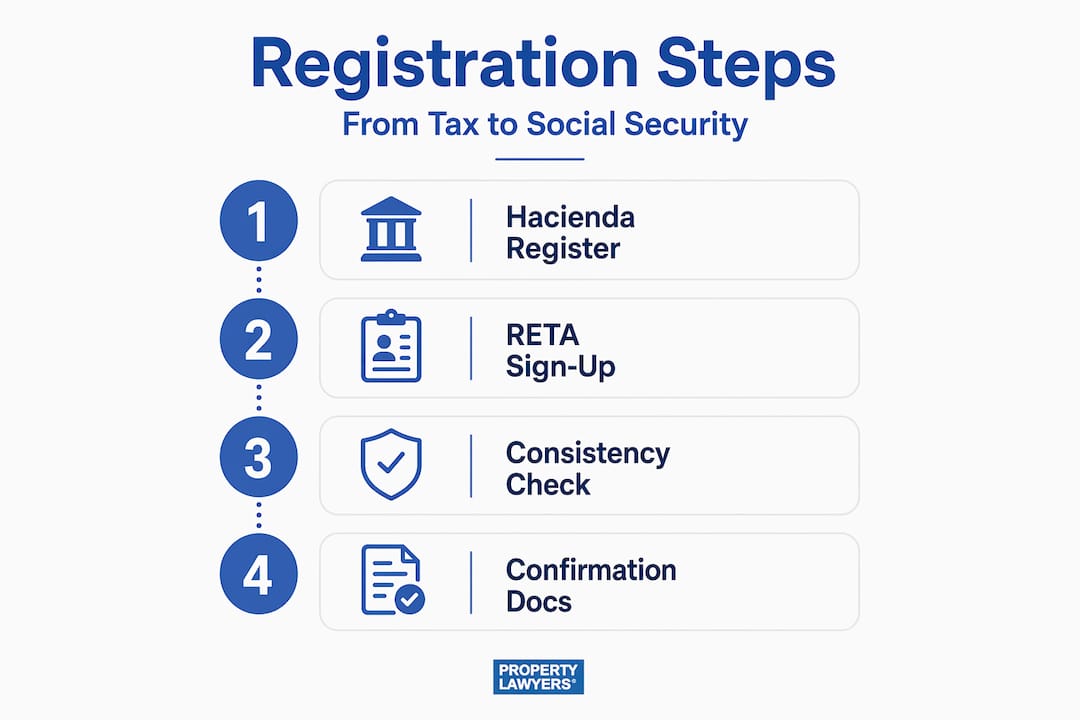
- Complete your Modelo 036 or 037 with Hacienda first and note the confirmed start date.
- File your TA.0521 with RETA via Importass on the same day, using the identical start date.
- Save confirmation receipts from both portals. These are your proof of compliance.
- Verify your registration status in both systems within 48 hours. Hacienda confirmations appear in your Sede Electrónica account; RETA confirmations appear in your Importass profile.
“Despite process claims of possible completion ‘in one day,’ experts recommend careful planning around dates and sequences due to penalties on mis-timings.” — Spain registration guidance
For non-EU lawyers, there is an additional layer of complexity. Three-way consistency is required between your immigration authorisation, the economic activity declared to Hacienda, and your RETA registration. If these three elements do not align, you risk compliance issues that can affect your right to remain and practise in Spain.
Common mistakes and how to avoid them
Even legally trained professionals make avoidable errors when completing legal registration for freelance attorneys in Spain. These are the most frequent problems and how to address them.
- Registering only with Hacienda. Many lawyers assume that filing a Modelo 036 or 037 is sufficient to begin trading. It is not. Hacienda registration alone does not satisfy Social Security obligations. You must complete both steps before issuing any invoices.
- Choosing the wrong tax form. Using Modelo 037 when your situation requires Modelo 036 (for example, if you handle intra-community transactions) creates tax regime errors that require formal correction later.
- Late RETA filing. Filing your TA.0521 even one day after your declared start date results in a surcharge and the loss of proration for that month’s quota.
- Using the wrong TA.0521 variant. The standard autónomo variant and the societario variant carry different obligations. Confirm your professional structure before selecting.
- Exceeding three altas and bajas in a year. If you deregister and re-register more than three times in a calendar year, the proration benefit disappears entirely for subsequent registrations.
- Inconsistent documentation for non-EU lawyers. If your immigration authorisation does not explicitly cover self-employed legal services, your entire registration may be invalid.
Pro Tip: If you discover an error after filing, do not ignore it. Both Hacienda and Importass allow modifications online. Correcting a mistake proactively is far less costly than waiting for an inspection to identify it.
My perspective on getting this right from the start
I have seen lawyers approach the autónomo registration process with the same confidence they bring to complex litigation, only to find themselves facing administrative penalties for what seemed like minor oversights. The registration itself is not technically difficult. What catches people out is the assumption that the two systems are linked.
In my experience, the single most effective thing you can do is treat the Hacienda and RETA registrations as one coordinated event rather than two separate tasks. Block out a morning, have your digital certificate ready, and complete both filings in sequence. Do not leave days between them.
For non-EU professionals, I would add that immigration compliance is not a separate concern. It is part of the same process. I have seen lawyers invest months building a client base only to discover their authorisation did not cover self-employed activity. Consulting an immigration specialist before you file anything is not overcaution. It is sound professional practice.
Working with a gestoría for your first registration is worth considering. A good gestoría knows the current contribution base tables, the correct IAE codes for legal professionals, and the precise timing requirements. The cost is modest relative to the penalties you avoid.
— Sophie
Support for lawyers setting up in Spain
Property-lawyers works with a network of trusted legal and tax professionals across Spain who understand the specific requirements facing autonomous practitioners. Whether you are setting up in Madrid or along the Costa del Sol, finding the right support makes the administrative side of independent practice far more manageable.

If you are based in or moving to the capital, the Madrid legal services directory connects you with experienced practitioners who can advise on autónomo registration, ongoing tax compliance, and professional structuring. For specialist tax guidance on your Hacienda filings and IRPF obligations, Property-lawyers also maintains a directory of vetted tax advisors in Spain who work regularly with self-employed legal professionals. Getting the right advice at the start costs far less than correcting errors later.
FAQ
What does it mean to register as an autonomous lawyer in Spain?
Registering as an autonomous lawyer in Spain means formally declaring yourself as a self-employed legal professional through two separate processes: tax registration with Hacienda using Modelo 036 or 037, and Social Security registration under RETA using Modelo TA.0521 via the Importass portal.
Do I need to register with both Hacienda and Social Security?
Yes. Both registrations are mandatory and independent. Completing only the Hacienda registration does not satisfy your Social Security obligations, and issuing invoices without RETA registration exposes you to surcharges and penalties.
How long does the autonomous lawyer registration process take?
Both registrations can technically be completed online in a single day if your documents are in order, including a valid NIE, digital certificate, and Bar Association membership. Careful preparation of dates and form selection is strongly recommended before you begin.
Can non-EU lawyers register as autonomous in Spain?
Yes, but non-EU lawyers must hold an immigration authorisation that explicitly covers self-employed activity. EU, EEA, and Swiss nationals face fewer administrative requirements. Non-EU professionals should verify their immigration status before filing any registration forms.
What happens if I file my RETA registration late?
Filing after your declared activity start date results in a financial surcharge and the loss of quota proration for that period. You will be charged the full monthly Social Security contribution regardless of how many days you were actually active.
Recommended
- How to obtain a digital certificate in Spain
- Power of Attorney in Spain — Buying Property Remotely | Property Lawyers
- Land Registry Spain — Registro de la Propiedad Guide for Buyers | Property Lawyers
- Join Property Lawyers Spain | Get Clients for Your Law Firm

Sophie Gutenberg is a legal content specialist focused on Spanish property law, real estate transactions, conveyancing, due diligence and tax issues affecting international property buyers in Spain. She works alongside qualified Spanish property lawyers .
