

Why property boundaries matter in Spain: 2026 guide
TL;DR:
- Property boundaries in Spain define land extent and legal ownership, with discrepancies risking disputes. Verifying cadastral records, physical markers, and title deeds before buying safeguards property rights and prevents costly litigation. Recent legal rulings emphasize georeferencing and neighbor consent, making expert surveys and early negotiations crucial.
Property boundaries in Spain are the legal lines that define precisely what land you own, what rights you hold, and what obligations you carry as a property owner. For international buyers and existing owners alike, understanding why property boundaries matter in Spain is not a formality. It is the foundation of secure ownership. Discrepancies between physical markers, the Cadastre (Catastro), and the Land Registry (Registro de la Propiedad) are among the most common triggers for costly disputes. Getting boundaries right before you buy, or before you build, protects your investment and your peace of mind.
Why property boundaries matter in Spain
Property boundaries in Spain serve a dual purpose: they define the physical extent of your land and establish your legal rights over it. When those two definitions do not match, disputes follow. The Spanish legal system treats the Cadastre as primarily a fiscal and administrative record, while the Land Registry holds the authoritative record of legal ownership. These two systems do not always agree, and that gap is where problems begin.

The Cadastre records surface area and location for tax purposes. The Land Registry records who owns what and under what conditions. Neither automatically updates the other. A property can appear larger in the Cadastre than in the title deed, or a fence may sit several metres beyond the legally registered boundary. For buyers relying solely on a visual inspection or a single document, these discrepancies are invisible until a dispute surfaces.
Understanding land demarcation, the formal process of defining and recording boundaries, is therefore not optional for anyone purchasing or modifying property in Spain. It is the difference between a clean title and years of litigation.
What are property boundaries and how are they defined under Spanish law?
Under Spanish law, a property boundary is defined by a combination of physical markers, cadastral records, and registered title information. No single source is automatically decisive. The legal boundary is what the Land Registry records, supported by the title deed (escritura). The physical boundary is what exists on the ground. When these two realities diverge, the law requires resolution, not assumption.
Several key elements define how boundaries are established:
- Physical markers: Fences, walls, and hedges mark the visible extent of a property. However, physical markers alone do not constitute legal boundaries unless both neighbouring owners have consented to their placement. A wall built unilaterally carries no legal weight in a boundary dispute.
- Cadastral records: The Catastro provides a graphic representation of each property, including its surface area and location. This is the administrative record used for taxation. It is not proof of ownership.
- Land Registry records: The Registro de la Propiedad records legal ownership and any charges or encumbrances. It is the authoritative source for property rights in Spain.
- Georeferencing: Since recent reforms, properties must include georeferenced coordinates when registrations or modifications are made. This links the legal description to a precise geographic location.
- Topographic surveys: Certified surveyors produce technical reports that courts and registries rely upon as primary evidence in boundary dispute resolution.
The importance of mutual consent between neighbours cannot be overstated. A boundary change, even a minor one, requires agreement from all adjoining owners to be legally valid. Without that agreement, the change cannot be registered.
Pro Tip: Before exchanging contracts, request both the nota simple from the Land Registry and the Cadastre certificate for the property. Compare the surface areas and boundary descriptions. Any discrepancy, however small, warrants investigation before you proceed.
What causes boundary disputes in Spain?
Boundary disputes in Spain arise from four principal causes, each capable of blocking a sale, triggering litigation, or reducing property value significantly. Rural properties, older urban plots, and coastal land are disproportionately affected, largely because historical records were less precise and physical encroachment went unchallenged for decades.
The four main causes are:
- Cadastral mismatch: The surface area or boundary lines in the title deed do not match the Cadastre record. This is the most common issue and affects properties of all ages. A mismatch does not automatically mean fraud, but it does mean the legal and administrative records are inconsistent, which creates risk during any registration or sale.
- Physical encroachment: A fence, wall, or structure has been built beyond the legal boundary, often without the neighbour’s knowledge or consent. Over time, these encroachments become embedded in the physical reality of the property, making resolution more complex.
- Usucapión (adverse possession): Spanish law allows a person who has occupied land openly and continuously for a prescribed period to claim legal ownership of it. This is known as usucapión. It is particularly relevant for rural plots where boundaries were never formally recorded and neighbours have farmed or used land beyond their registered limits for generations.
- Double registration: Two separate entries in the Land Registry claim ownership of the same parcel of land. This occurs due to historical errors in registration and creates competing ownership claims that require court resolution.
Older rural and coastal properties in Spain carry the highest risk of boundary disputes. Historical records were imprecise, physical markers shifted over decades, and many plots were never formally coordinated between the Cadastre and the Land Registry. Buyers of these property types should treat boundary verification as a non-negotiable part of due diligence.
Properties without coordinated registration between the registry and the Cadastre are more vulnerable to objections and delays during any future registration or modification. This lack of coordination is not a minor administrative gap. It is an active legal risk.
How do 2026 legal rulings affect boundary registrations?
The Dirección General de Seguridad Jurídica y Fe Pública (DGSJFP), the Spanish authority that oversees property registration doctrine, has issued several significant rulings in 2025 and 2026 that directly affect how boundaries are registered and disputed. These rulings clarify obligations and set new standards for what registrars will and will not accept.
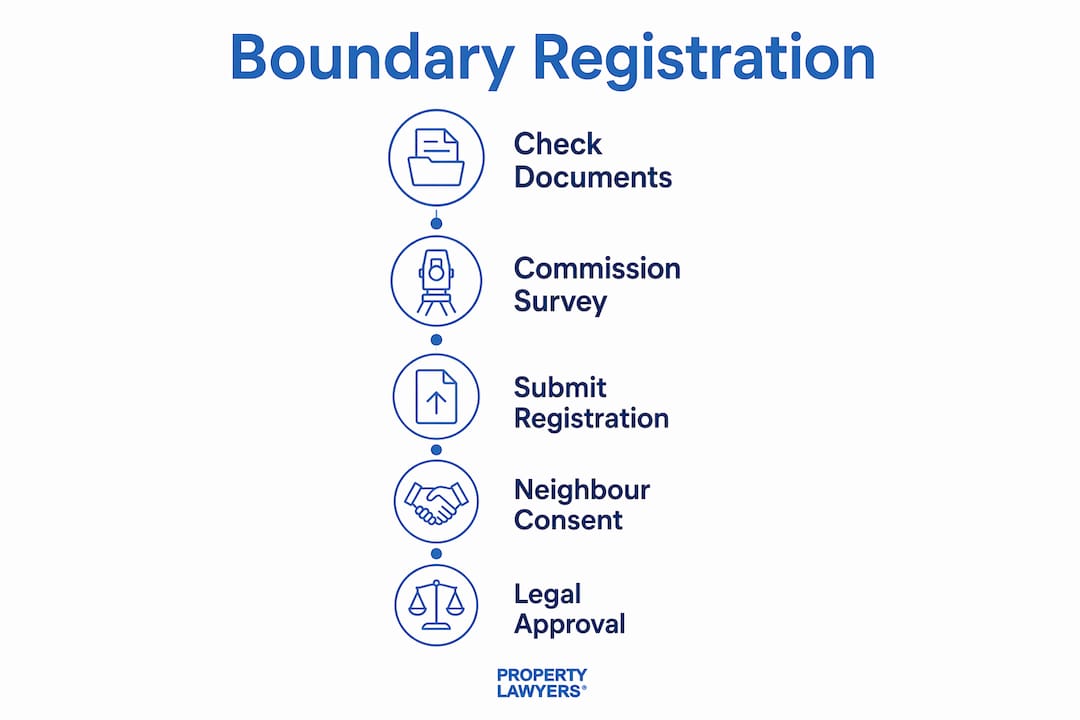
The table below summarises the key 2026 developments and their practical implications:
| Legal development | What it means for owners |
|---|---|
| Georeferencing mandatory for registrations | Any modification or registration of a property entity now requires georeferenced coordinates. Leases on part of a property are exempt, but sales and structural modifications are not. |
| Neighbour objections can block registration | Under Article 199 of the Mortgage Law, a neighbouring owner can oppose a registration if they have legal grounds. The DGSJFP has confirmed that meritorious objections suspend the procedure until the dispute is resolved. |
| Encroachment grounds for refusal | If the cadastral graphic representation of a property overlaps a neighbour’s registered construction, registration can be denied. A technically plausible drawing is not sufficient if it invades another registered property. |
| Physical reality vs legal reality | The DGSJFP has reinforced that physical markers do not override legal records. Courts and registries rely on mutual consent and expert evidence, not unilateral physical facts. |
The Article 199 procedure is voluntary and designed to coordinate the registry with the Cadastre. However, it only proceeds when there is no reasonable controversy. If a neighbour objects and that objection has legal merit, the registration is suspended. This means that unresolved boundary issues discovered during a sale can halt the entire transaction.
Pro Tip: Commission a certified topographic surveyor to check for cadastral overlaps before submitting any registration or modification. A pre-check costs a fraction of the legal fees involved in a denied registration or a neighbour dispute.
Practical steps to confirm and protect your property boundaries
Protecting your property boundaries in Spain requires a structured approach that combines document verification, technical surveys, and legal advice. The following steps apply whether you are buying a property or seeking to clarify boundaries you already own.
- Obtain a nota simple: Request this document from the Land Registry. It confirms ownership, surface area, and any charges or encumbrances. You can check the legal status of a property through this document before committing to a purchase.
- Request the Cadastre certificate: Compare the surface area and boundary description in the Cadastre with the nota simple and the title deed. Any discrepancy requires explanation before you proceed.
- Review the escritura: The Spanish title deed contains the legal description of the property, including its boundaries and surface area. Confirm that this matches both the Cadastre and the Land Registry records.
- Commission a topographic survey: A certified surveyor will physically measure the property and produce a technical report. This report is the primary evidence used in courts and registries and will identify any encroachments or discrepancies.
- Seek neighbour agreement: If boundaries need to be clarified or modified, approach neighbouring owners early. Mutual consent is a legal requirement for boundary changes, and early dialogue prevents objections during registration.
- Use the deslinde procedure: For rural or undivided land, the formal deslinde (boundary delimitation) procedure allows owners to establish boundaries with legal certainty, provided all parties agree.
- Engage a specialist property lawyer: When objections arise, or when discrepancies are significant, legal advice from a solicitor with expertise in Spanish property law is the most reliable path to resolution.
The importance of property lines extends beyond the transaction itself. A property with unresolved boundary issues is harder to sell, harder to mortgage, and harder to develop. Addressing these issues proactively, rather than reactively, saves time and money.
Key takeaways
Accurate property boundaries in Spain are a legal requirement, not an administrative detail, and unresolved discrepancies between the Cadastre, Land Registry, and physical markers directly threaten ownership rights and transaction security.
| Point | Details |
|---|---|
| Cadastre and registry differ | The Cadastre is fiscal; the Land Registry is legal. Mismatches between them create active ownership risk. |
| Physical markers are not legal proof | Fences and walls require mutual neighbour consent to carry legal weight in boundary disputes. |
| 2026 rulings tighten registration | Georeferencing is now mandatory for modifications; neighbour objections can suspend registration under Article 199. |
| Surveys are primary evidence | Topographic reports by certified surveyors are the key evidence in Spanish courts and registries. |
| Early verification prevents disputes | Comparing the nota simple, Cadastre certificate, and title deed before purchase is the most cost-effective protection available. |
Why I always advise buyers to verify boundaries before anything else
Having worked with international property buyers across Spain for many years, I can say with confidence that boundary issues are the most underestimated risk in Spanish property transactions. Buyers focus on price, location, and condition. Boundaries are treated as a detail. They are not.
The cases I see most frequently involve rural properties where a fence was moved decades ago and nobody questioned it, or coastal plots where the Cadastre shows a different surface area to the title deed by a margin that seems trivial until a neighbour objects during a sale. These are not edge cases. They are routine.
What surprises buyers most is that a property can look perfectly straightforward on paper and still carry a boundary problem that takes months to resolve. The Land Registry and the Cadastre are independent systems. Neither automatically reflects changes in the other. A property that has been bought and sold several times can accumulate discrepancies that no single previous owner noticed or addressed.
My advice is always the same: verify boundaries before you exchange contracts, not after. Commission a topographic survey. Compare all three documents. If there is a discrepancy, understand it fully before you proceed. The cost of a survey and a legal review is negligible compared to the cost of a boundary dispute that surfaces after completion.
Collaboration with neighbouring owners is also something buyers underestimate. A polite conversation before registration, rather than a formal objection after it, resolves most minor boundary issues without litigation. Spanish property law rewards mutual agreement. Use that to your advantage.
— Sophie
How Property-lawyers can help with boundary matters in Spain

Boundary issues in Spain require both technical expertise and legal knowledge. Property-lawyers connects international buyers and owners with independent, English-speaking solicitors who specialise in Spanish property law and understand the practical realities of boundary disputes, registration procedures, and cadastral coordination.
Whether you are purchasing a property and need due diligence support, dealing with a neighbour objection under Article 199, or seeking to resolve a long-standing discrepancy between your title deed and the Cadastre, the right legal support makes the difference between a resolved matter and a protracted dispute. Find a specialist property lawyer through Property-lawyers and approach your boundary questions with the confidence that comes from expert guidance.
FAQ
What are the main causes of property boundary disputes in Spain?
The four principal causes are cadastral mismatch, physical encroachment, usucapión (adverse possession), and double registration errors. Rural, older, and coastal properties carry the highest risk due to historically imprecise records.
Do physical fences define legal property boundaries in Spain?
No. Physical markers such as fences and walls do not constitute legal boundaries unless both neighbouring owners have consented to their placement. Courts and registries rely on mutual consent and expert topographic evidence.
Is georeferencing required for all property registrations in Spain in 2026?
Georeferencing is mandatory for registrations and modifications of registered property entities. Leases on part of a property are exempt, but sales and structural modifications require georeferenced coordinates under current DGSJFP doctrine.
Can a neighbour block my property registration in Spain?
Yes. Under Article 199 of the Mortgage Law, a neighbouring owner can oppose a registration if their objection has legal merit. The DGSJFP has confirmed that meritorious objections suspend the registration procedure until the dispute is resolved.
What documents should I check to verify property boundaries before buying in Spain?
Obtain the nota simple from the Land Registry, the Cadastre certificate, and the title deed (escritura). Compare the surface areas and boundary descriptions across all three. Any discrepancy warrants a topographic survey and legal advice before you proceed.
Recommended
- Property Taxes in Spain — Full Guide for Foreign Owners (2026) | Property Lawyers
- Why translate Spanish property documents: a clear guide
- Building defects law in Spain: buyer’s guide 2026
- Benefits of property law specialisation in Spain

Sophie Gutenberg is a legal content specialist focused on Spanish property law, real estate transactions, conveyancing, due diligence and tax issues affecting international property buyers in Spain. She works alongside qualified Spanish property lawyers .
