
Buying new build in Spain: the legal process explained
TL;DR:
- Buying a new build property in Spain requires verified bank guarantees, precise construction timelines, and independent legal advice.
- Legal safeguards like bank guarantees, licences, and snagging rights protect buyers during off-plan and completed purchases, reducing financial risks.
Buying a new build property in Spain requires following a specific legal process designed to protect your investment from the moment you reserve a plot to the day you receive your keys. The process covers off-plan purchases, where you buy before construction completes, and completed new build homes. Both routes carry distinct legal obligations for developers and clear protections for buyers. Understanding the buying new build Spain legal process means knowing which documents to demand, which guarantees to verify, and when to involve an independent lawyer. Get these steps right, and you significantly reduce your financial risk.
What legal documents and guarantees must be in place before you buy?
The most critical legal protection in any new build purchase is the bank guarantee, known in Spain as an aval bancario. All payments made before handover must be covered by a bank guarantee or insurance policy protecting 100% of amounts paid, plus legal interest. This guarantee activates if the developer becomes insolvent or fails to deliver the property.
Before signing any contract, you should verify the following documents are in place:
- Private purchase contract (contrato privado de compraventa): This sets out the agreed price, payment schedule, completion date, and penalties for delays. Every clause must be reviewed by your lawyer before you sign.
- Building licence (Licencia de Obra): This confirms the local authority has approved construction. No valid building licence means the development may not be legal.
- First occupation licence (Licencia de Primera Ocupación): This is issued once construction is complete and confirms the property meets all building regulations. Without it, you cannot legally connect utilities or register as a resident.
- Bank guarantee certificates: These must be individualised to each buyer and specific payment. Generic or blanket guarantees carry no legal weight.
The individualised nature of these certificates matters enormously. A certificate must name you, identify your specific unit, and state the exact amount covered. If a developer offers only a general policy covering the whole development, that offers you no enforceable protection.
Pro Tip: Ask your lawyer to confirm the bank guarantee certificate is in your name before transferring any stage payment. If the certificate is missing or incorrect, you have the legal right to withhold payment.
If a developer cannot produce a valid building licence or refuses to issue individualised guarantee certificates, treat this as a serious warning sign. Proceeding without these documents exposes you to significant financial loss.
Step-by-step: how does the purchase process work in Spain?
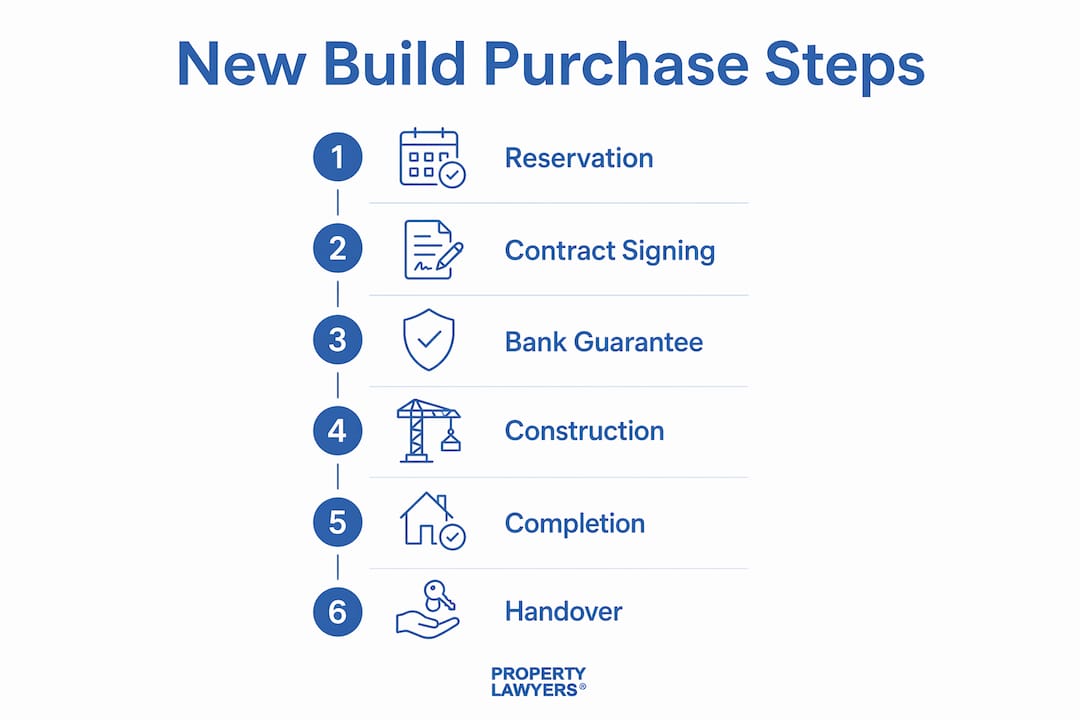
Purchasing a new build property in Spain follows a clear sequence of legal steps. Off-plan transactions typically take 18–36 months to complete, compared to 8–12 weeks for a resale property. That extended timeline means more opportunities for things to go wrong, which is why each stage carries its own legal requirements.
- Reservation agreement and deposit. You pay a small reservation fee, typically €3,000–€10,000, to take the property off the market. This is a preliminary agreement and does not bind the developer to full legal obligations yet.
- Private purchase contract. Within a few weeks of reservation, you sign the main private contract. This document locks in the price, payment milestones, completion date, and penalty clauses. Your lawyer must review this before you sign.
- Stage payments during construction. You pay in instalments as construction progresses. Each payment must be covered by an individualised bank guarantee certificate issued before the transfer clears.
- Snagging inspection. Before signing the final deed, you have the legal right to inspect the property and document any defects. Buyers can withhold final payment and refuse to sign the deed until the developer remedies all recorded defects.
- Signing the public deed of sale (escritura) at the notary. Once defects are resolved, you sign the escritura before a Spanish notary. This is the legally binding transfer of ownership.
- Property registration. Your lawyer registers the escritura at the Land Registry (Registro de la Propiedad). Registration confirms your legal title and protects you against future claims.
| Stage | Key legal requirement |
|---|---|
| Reservation | Written agreement; refundable deposit terms confirmed |
| Private contract | Bank guarantee in place; completion date specified by calendar month |
| Stage payments | Individualised guarantee certificate per payment |
| Snagging | Written defect report; payment withheld until resolved |
| Escritura | Signed before notary; first occupation licence confirmed |
| Registration | Title registered at Land Registry |
Pro Tip: Always instruct your lawyer to carry out full due diligence on the developer before signing the private contract. Check for existing embargoes, debts, or planning disputes on the land.

How do you protect yourself legally when buying off-plan?
Off-plan purchases carry the highest legal risk of any property transaction in Spain. The developer holds your money for months or years before you receive anything tangible. The legal steps for buying in Spain off-plan require you to be proactive, not passive.
The most effective protections are:
- Verify guarantees before every payment. Never transfer funds without first receiving the individualised bank guarantee certificate for that specific instalment.
- Insist on a precise completion date. Contracts must specify a calendar month for completion to legally trigger compensation or rescission rights. A vague date such as “Q3 2027” is not legally sufficient and gives you no remedy if the developer is late.
- Know your rights on delays. If the developer misses the agreed completion date, you can claim compensation or rescind the contract and recover all payments plus interest, provided the guarantee is in place.
- Choose your lawyer independently. Developers’ or agents’ lawyers represent sellers, not buyers. Using a lawyer recommended by the developer is one of the most common and costly mistakes international buyers make.
Treat every stage payment as a high-value financial transaction. Demand the individualised bank guarantee certificate before the money leaves your account. If the developer resists, your lawyer can formally request it in writing. Refusal is grounds to withhold payment under Spanish law.
Construction delays are common. Spanish law does provide remedies, but only if your contract contains the right clauses. A well-drafted contract will specify penalty payments for each month of delay and give you the right to exit with a full refund if delays exceed a defined threshold.
Pro Tip: If defects appear after completion, Spanish law under Ley 38/1999 provides a 10-year structural guarantee on new builds. This protection does not exist for resale properties and is one of the strongest arguments for buying new.
What are the tax and cost implications of buying a new build in Spain?
Regional tax rates and planning checks can materially change the numbers on a new-build purchase. For local guidance, compare specialists in Mallorca, Marbella, Madrid, Barcelona and Ibiza.
New build properties in Spain carry a different tax structure from resale homes. Acquisition costs for new builds average 12.5–14% of the purchase price, driven by 10% VAT (IVA) plus Stamp Duty (Actos Jurídicos Documentados, or AJD) of 0.5–1.5% depending on the region. For a full breakdown of foreign buyer taxes, the rates vary by autonomous community.
Resale properties, by contrast, attract Transfer Tax (Impuesto sobre Transmisiones Patrimoniales, or ITP) at 7–10% instead of VAT. The total acquisition cost for resale is typically lower, but new builds offer other financial advantages that offset the higher tax burden.
Key costs to budget for when purchasing a new build:
- 10% IVA (VAT): Paid on the purchase price at the point of signing the escritura.
- AJD (Stamp Duty): Rates range from 0.5% to 1.5% depending on the region. Andalucía, which covers Marbella and Málaga, currently applies 1.2%.
- Legal fees: An independent lawyer typically charges 1–1.5% of the purchase price.
- Notary and registry fees: Combined, these usually total 0.5–1% of the purchase price.
The price premium for new builds is substantial. New build properties command a 49.4% price premium over resale, with average 2026 prices at €2,712 per square metre versus €1,815 per square metre for resale. That premium reflects modern energy efficiency standards, contemporary design, and the structural guarantees that come with new construction.
Tax payments are timed to the transaction milestones. IVA is due at the point of signing the escritura, not during the construction phase. Stage payments during construction are subject to IVA at the applicable rate, so each instalment will include the tax element. Your lawyer should confirm the exact tax schedule before you commit to any payment plan.
Key takeaways
The buying new build Spain legal process requires verified bank guarantees, a precise completion date, and independent legal representation at every stage to protect your investment.
| Point | Details |
|---|---|
| Bank guarantees are non-negotiable | Every stage payment must have an individualised guarantee certificate naming you and the specific amount. |
| Completion dates must be specific | Contracts need a calendar month for completion; vague dates remove your legal remedies for delays. |
| Independent legal advice is critical | Never use a lawyer recommended by the developer or agent; they represent the seller, not you. |
| New build taxes are higher | Budget 12.5–14% in acquisition costs, including 10% IVA and regional Stamp Duty. |
| Snagging rights protect your final payment | You can legally withhold the final payment until all documented defects are resolved. |
Why I think most buyers underestimate the legal side of new builds in Spain
Having worked closely with international buyers purchasing new build properties across Spain, the pattern I see most often is this: buyers spend months researching locations, comparing floor plans, and calculating rental yields, but they leave the legal side until the last moment. That is the wrong order of priorities.
The legal framework for new builds in Spain is genuinely protective. The mandatory 10-year structural guarantee under Ley 38/1999, the bank guarantee requirements, and the snagging rights are all powerful tools. The problem is that these protections only work if the paperwork is correct. A bank guarantee certificate with the wrong name, a contract with a vague completion date, or a missing first occupation licence can render those protections worthless.
The buyers who come to me after things have gone wrong almost always made the same mistake: they used the lawyer the developer’s sales agent recommended. That lawyer reviewed the contract, said it looked fine, and the buyer signed. What they did not realise is that “fine” from the developer’s perspective and “protective” from the buyer’s perspective are very different things.
My honest advice is to appoint your lawyer before you even visit the show home. A good independent property lawyer will review the developer’s track record, check the land registry for embargoes, and negotiate contract clauses before you are emotionally committed to the purchase. That is when you have the most leverage.
The extended off-plan timeline, typically 18–36 months, also tests buyers’ patience. Delays happen. Defects appear. Developers sometimes push back on snagging lists. None of this is unusual, and none of it should panic you. What matters is that your contract gives you the legal tools to respond. If it does, you are in a strong position. If it does not, you are relying on goodwill, which is not a legal strategy.
— Sophie
How Property-lawyers can help you buy safely in Spain
Purchasing a new build property in Spain is one of the most significant financial decisions you will make. Getting the legal side right from the start protects your deposit, your stage payments, and your long-term investment.

Property-lawyers connects international buyers with trusted, independent real estate lawyers across Spain who specialise in new build and off-plan purchases. The lawyers in the directory offer contract review, due diligence, bank guarantee verification, tax guidance, and full support through to registration at the Land Registry. Whether you are buying in Marbella, Mallorca, Ibiza, or Barcelona, you can find a specialist through Property-lawyers’ 2026 legal guide who works exclusively for you, not the developer. For buyers who want a broader overview of Spanish real estate law, the buyer’s guide for 2026 covers the full legal framework in plain English.
FAQ
What is the bank guarantee requirement for new builds in Spain?
All stage payments made before handover must be covered by an individualised bank guarantee or insurance policy protecting 100% of the amount paid plus legal interest. The certificate must name the buyer, the specific unit, and the exact amount covered.
How long does buying a new build off-plan take in Spain?
Off-plan transactions typically take 18–36 months from reservation to completion. This is significantly longer than resale purchases, which usually complete within 8–12 weeks.
What taxes do you pay when buying a new build in Spain?
New build buyers pay 10% IVA (VAT) plus regional Stamp Duty (AJD) of 0.5–1.5%, bringing total acquisition costs to approximately 12.5–14% of the purchase price.
Can you withhold payment if a developer misses the completion date?
Yes. If the contract specifies a precise calendar month for completion and the developer misses it, you have the legal right to claim compensation or rescind the contract and recover all payments plus interest, provided valid bank guarantees are in place.
Do new build properties in Spain come with a structural warranty?
Yes. Under Ley 38/1999, all new build properties in Spain carry a mandatory 10-year structural guarantee. This protection does not apply to resale properties and is one of the key benefits of purchasing new.

Sophie Gutenberg is a legal content specialist focused on Spanish property law, real estate transactions, conveyancing, due diligence and tax issues affecting international property buyers in Spain. She works alongside qualified Spanish property lawyers .
