

How the Spanish property market works in 2026
TL;DR:
- The Spanish property market in 2026 faces a housing shortage exceeding 700,000 units, driving price increases. Buyers, especially foreigners, pay a premium, with regional variations influencing prices and demand. Due diligence and professional legal support are essential for safe and successful purchases.
The Spanish property market in 2026 is defined by a severe structural housing shortage and strong buyer demand, pushing prices upward and making transactions increasingly competitive. A housing deficit exceeding 700,000 units is driving price growth forecasted between 5.7% and 10.2% this year. Foreign buyers are paying a significant premium over local purchasers, and properties in the most desirable areas are selling within days. Understanding how the Spanish property market works in 2026 means grasping these supply and demand forces, the regional price variations, the full cost of purchase, and the legal safeguards that protect you as a buyer.
What are the current supply and demand dynamics in the Spanish property market?
Spain’s housing market is structurally undersupplied. The 700,000-unit deficit did not appear overnight. It reflects years of constrained construction output, planning delays, and land availability problems that have compounded since the post-2008 building slowdown. New housing completions have simply not kept pace with population growth, internal migration to urban centres, and sustained foreign demand.
Demand drivers are broad and persistent. Spain attracts buyers from the United Kingdom, Germany, the Netherlands, Scandinavia, and the United States, drawn by the climate, lifestyle, and comparatively strong rental yields in coastal and urban markets. Population growth in cities such as Madrid, Barcelona, Valencia, and Málaga adds further pressure on an already limited supply of homes.
Regional supply differences are pronounced. Coastal areas like the Costa del Sol, Mallorca, and Ibiza face the sharpest shortfalls, where land is scarce and planning restrictions are strict. Inland cities and less connected rural areas have more available stock, but buyer demand there is correspondingly lower. This imbalance creates a two-speed market where buyers in hotspots must act quickly and decisively.
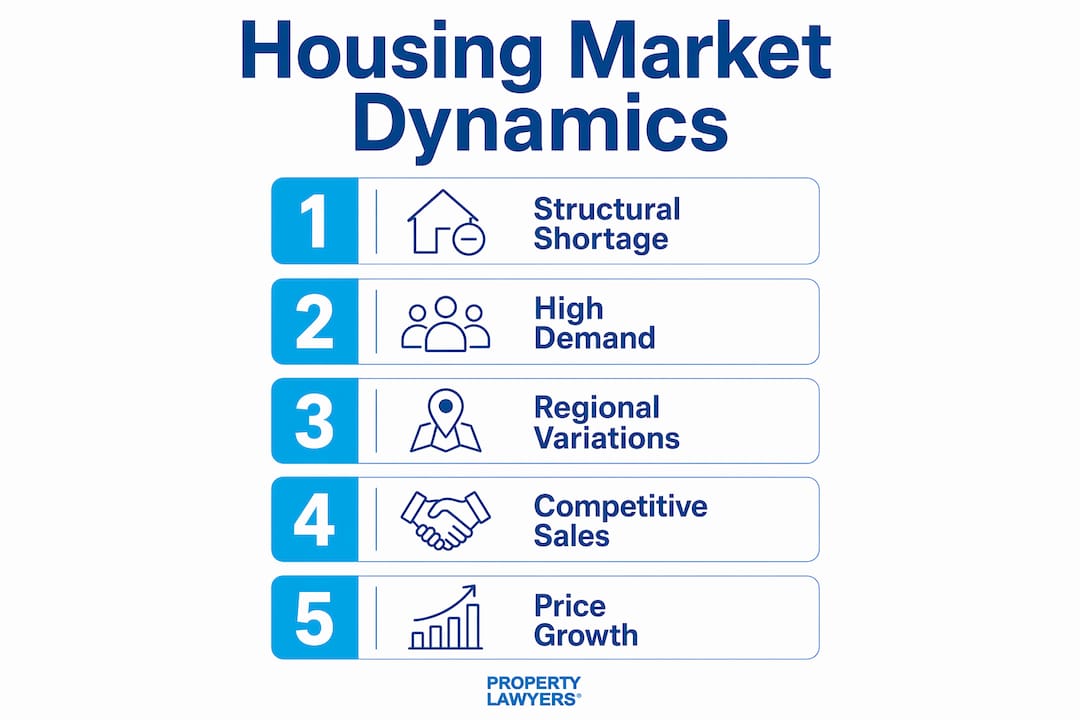
Sales velocity data confirms the competitive conditions. In Q1 2026, 13% of homes sold nationally within seven days, with regions such as Burgos reaching 28%. That figure tells you something concrete: in the most active markets, you do not have the luxury of extended deliberation. Buyers who arrive without financing pre-arranged or legal representation in place regularly lose properties to faster-moving competitors.
Affordability remains the central challenge in 2026. Strong employment figures and population growth sustain demand, but wages have not risen at the same pace as property prices. This is pushing a growing segment of the market towards renting rather than buying, which in turn supports rental yields for investors who do purchase.
Key demand pressures shaping the market right now:
- Foreign buyer demand concentrated in coastal and luxury segments
- Urban population growth in Madrid, Barcelona, Valencia, and Málaga
- Limited new construction due to planning and land constraints
- Rising rents making ownership aspirational but less accessible for locals
- Short-term rental demand sustaining investor appetite in tourist areas
How do property prices and regional variations shape buyer decisions?
Price growth in Spain is not uniform. National forecasts of 5.7% to 10.2% growth in 2026 mask significant regional differences. Buyers in Marbella or Palma de Mallorca face a very different market to those looking at Murcia or inland Castile.

The gap between what foreign and local buyers pay is striking. Non-resident foreign buyers pay an average of €3,242 per square metre, compared to €1,839 per square metre for Spanish nationals. That is a 75% premium. This reflects the concentration of foreign demand in premium coastal and urban locations, where supply is tightest and lifestyle appeal is highest.
Regional price overview for key buyer markets
| Region | Typical price per m² | Key appeal |
|---|---|---|
| Marbella / Costa del Sol | €4,000–€6,500+ | Luxury lifestyle, strong rental demand |
| Mallorca | €3,500–€7,000+ | Island exclusivity, international buyer base |
| Barcelona | €4,000–€5,500 | Urban investment, tourism, culture |
| Madrid | €3,500–€5,000 | Capital city, employment hub, rental yields |
| Valencia | €2,000–€3,200 | Affordability, growing expat community |
| Alicante / Costa Blanca | €1,800–€3,000 | Value, large British and German buyer base |
| Ibiza | €5,000–€10,000+ | Ultra-premium, limited supply |
Coastal areas consistently outperform inland markets on price growth, but they also carry higher entry costs and more complex regulatory environments for short-term rentals. Buyers focused purely on capital appreciation tend to favour established hotspots. Those seeking rental income need to weigh licence availability and local regulations carefully.
Emerging markets deserve attention. Valencia has seen strong price growth driven by an expanding expat community and improving infrastructure. The Costa Blanca, particularly around Alicante and Torrevieja, offers comparatively accessible entry prices with solid rental demand from Northern European visitors. These areas represent genuine value relative to the established luxury markets.
Factors that influence regional desirability for buyers and investors:
- Proximity to international airports and transport links
- Short-term rental licence availability and local restrictions
- Quality of local amenities, international schools, and healthcare
- Existing expat community and English-language services
- Historical price growth and liquidity of the resale market
What additional costs and taxes must buyers plan for?
The asking price is not the total cost of buying property in Spain. Buyers must budget an additional 12–14% on top of the purchase price to cover taxes, notary fees, land registry fees, and legal costs. Failing to account for these costs is one of the most common mistakes international buyers make.
The tax structure depends on whether you are buying a resale property or a new build.
Resale properties are subject to the Property Transfer Tax, known as ITP (Impuesto de Transmisiones Patrimoniales). This tax is set at the regional level and varies considerably:
- Madrid: 6%
- Andalusia (covering Marbella, Málaga, and the Costa del Sol): 7%
- Valencia: 10%
- Catalonia (Barcelona): up to 13%
New build properties follow a different structure. Instead of ITP, buyers pay 10% VAT (IVA) plus the Stamp Duty tax, known as AJD (Actos Jurídicos Documentados), which ranges from 0.5% to 1.5% depending on the region. For a new build in Andalusia priced at €400,000, that means approximately €40,000 in IVA plus up to €6,000 in AJD before any professional fees.
Additional costs to factor into your budget:
- Notary fees: Typically €600–€1,500 depending on property value
- Land Registry fees: Usually €400–€1,000
- Legal fees: Independent property lawyer fees, typically 1% of the purchase price
- Mortgage arrangement fees: If financing, lenders charge arrangement and valuation fees
- NIE (Número de Identificación de Extranjero): Required for all foreign buyers; modest administrative cost
For a full breakdown of what you will owe at completion, the property purchase tax guide from Property-lawyers covers each regional variation in detail.
Pro Tip: Non-euro buyers face an additional cost that rarely appears in purchase guides. Currency conversion fees of 0.5% to 3% apply when transferring funds into euros. On a €500,000 purchase, that could add up to €15,000 to your total outlay. Using a specialist currency broker rather than a high-street bank typically reduces this cost significantly.
How do legal safeguards and due diligence protect buyers in Spain?
Spain has a well-established legal framework for property ownership. The Registro de la Propiedad, or Land Registry, is the cornerstone of buyer protection. Under Article 34 of the Ley Hipotecaria, the principle of fe pública registral (registral public faith) legally protects buyers who purchase in good faith from the registered owner. This means that if you buy a property that is correctly registered and you act in good faith, your ownership is legally secure even if prior ownership disputes exist.
However, the Land Registry only protects what has been registered. Properties with unregistered encumbrances, illegal extensions, or outstanding urban planning violations may not appear problematic in a basic registry search. This is where independent legal due diligence becomes critical.
The notary’s role is frequently misunderstood by foreign buyers. The notary verifies the deed signature but does not perform buyer-side legal due diligence. The notary is a public official who authenticates the transaction. Checking for hidden debts, unpaid community fees, planning compliance issues, and encumbrances is not part of the notary’s remit. That work falls to your independent property lawyer.
The essential legal checks before any purchase include:
- Registry search: Confirm the seller’s ownership and identify any mortgages, charges, or embargoes registered against the property.
- Urban planning check: Verify the property complies with local planning regulations and that no illegal constructions exist.
- Community of owners check: Confirm there are no outstanding community fees owed by the current owner.
- Local authority search: Check for any pending fines, local taxes, or compulsory purchase orders affecting the property.
- Energy performance certificate: Required by law for all property sales in Spain.
Foreign buyers who skip independent legal advice and rely solely on the notary regularly encounter problems after completion. Undisclosed debts transfer with the property under Spanish law. An illegal extension can result in demolition orders. These are not theoretical risks; they are documented outcomes that experienced property lawyers prevent through proper due diligence checks before contracts are signed.
Pro Tip: Regional property taxes and procedures vary significantly across Spain’s autonomous communities. A lawyer with specific local expertise in your target area, whether that is Andalusia, the Balearic Islands, or Catalonia, will know the regional quirks that a generalist may miss. Property-lawyers connects international buyers with vetted, English-speaking solicitors who specialise in their chosen region.
What practical strategies help buyers and investors succeed in 2026?
Succeeding in the 2026 Spanish market requires preparation, not speed alone. The buyers who secure the best properties at fair prices are those who arrive with financing confirmed, legal representation appointed, and a clear understanding of their target area.
New build versus resale is the first strategic decision. New builds offer modern specifications, energy efficiency, and the protection of developer guarantees. They also require patience, as completion timelines can extend by 12–24 months. Resale properties offer immediate occupation and established neighbourhoods, but require more thorough legal checks given their history. For investors focused on short-term rental income, new builds in tourist areas often command higher nightly rates and lower maintenance costs in the early years.
Financing considerations matter more than many buyers anticipate. Spanish banks offer mortgages to non-residents, typically at 60–70% loan-to-value. Fixed-rate mortgages have become more popular following Euribor volatility in recent years, offering payment certainty over the loan term. Variable-rate products remain available and may suit buyers who plan to sell or refinance within a shorter horizon. Getting a mortgage agreement in principle before you search actively puts you in the same position as a cash buyer when speed matters.
Timing and location selection should reflect your goals. In hotspot markets like Marbella, Mallorca, and central Barcelona, acting quickly is necessary. In slower markets such as inland Andalusia or the northern coast, you have more time to negotiate. Investors targeting short-term rental income must check rental licence availability before committing, as many municipalities have introduced caps or moratoriums on new tourist licences.
Building the right professional team is not optional. You need:
- An independent property lawyer with regional expertise
- A local estate agent who understands the specific micro-market
- A tax adviser familiar with Spanish non-resident tax obligations
- A currency specialist if you are transferring funds from outside the eurozone
Key takeaways
The Spanish property market in 2026 rewards buyers who combine market knowledge, legal preparation, and a clear investment strategy before they begin their search.
| Point | Details |
|---|---|
| Structural supply shortage | A deficit exceeding 700,000 units is driving price growth of 5.7%–10.2% nationally in 2026. |
| Foreign buyer premium | Non-resident buyers pay on average 75% more per square metre than Spanish nationals. |
| Budget beyond the asking price | Add 12–14% to the purchase price for taxes, fees, and legal costs. |
| Notary does not replace a lawyer | The notary authenticates the deed; only an independent lawyer performs full due diligence. |
| Regional variation is significant | Tax rates, rental regulations, and price growth differ substantially between Spain’s autonomous communities. |
What I have learnt from watching buyers navigate this market
The data tells one story. The experience of buyers on the ground tells another, and the gap between them is where costly mistakes happen.
The supply shortage is real, but it affects markets very differently. Buyers who fixate on Marbella or Palma because those names appear in every headline often overlook areas like Valencia or the Costa Blanca, where the fundamentals are strong, prices are more accessible, and the competition is less frantic. The best investment decisions I have seen come from buyers who defined their goals first, whether that was lifestyle, rental income, or capital growth, and then matched their location to those goals rather than following the crowd.
The legal due diligence point cannot be overstated. I have seen buyers lose significant sums because they assumed the notary had checked everything. The notary’s role is narrow and specific. An independent lawyer working exclusively for you is the only person whose job is to find problems before you sign. The cost of that legal advice is modest relative to the purchase price. The cost of not having it can be catastrophic.
Affordability pressures are reshaping the market in ways that create genuine opportunity for well-prepared investors. As more Spanish residents are priced out of ownership and pushed into renting, rental demand in urban and coastal areas strengthens. Investors who understand the local rental licence framework and buy in areas with genuine rental demand are well positioned. Those who buy without checking licence availability first often find their investment thesis does not survive contact with local regulations.
My honest advice: build your professional team before you start viewing properties. A good lawyer, a knowledgeable local agent, and a tax adviser will save you more than their combined fees many times over.
— Sophie
How Property-lawyers supports international buyers in Spain
Buying property in Spain as an international buyer is entirely achievable. The process becomes significantly safer and more straightforward when you have the right legal support from the outset.

Property-lawyers connects international buyers with trusted, independent, English-speaking property solicitors across Spain, from Madrid and Barcelona to Marbella, Mallorca, and the Costa Blanca. Every lawyer in the directory specialises in Spanish real estate transactions for foreign buyers, covering due diligence, contract review, tax advice, and the full completion process. Whether you are purchasing a resale villa or a new build apartment, the right legal team in Spain makes the difference between a secure purchase and an expensive lesson. Find your specialist solicitor through Property-lawyers and approach the market with confidence.
FAQ
What is the housing shortage in Spain in 2026?
Spain faces a structural housing deficit exceeding 700,000 units in 2026. This shortage is the primary driver of rising property prices and competitive market conditions across the country.
How much extra should I budget when buying property in Spain?
Budget an additional 12–14% on top of the purchase price to cover taxes, notary fees, land registry fees, and legal costs. The exact amount depends on whether you are buying a resale or new build property, and in which region.
Do foreign buyers pay more for property in Spain?
Non-resident foreign buyers pay an average of €3,242 per square metre, compared to €1,839 per square metre for Spanish nationals. That represents a 75% premium, concentrated in coastal and luxury markets.
What does a notary do in a Spanish property purchase?
The notary authenticates the deed and verifies the signatures of both parties. The notary does not check for hidden debts, planning violations, or encumbrances. An independent property lawyer must carry out those checks on your behalf.
Is it safe to buy property in Spain as a foreigner?
Spain’s Land Registry provides strong legal protection for buyers who purchase in good faith from the registered owner. The key safeguard is engaging an independent property lawyer to conduct full due diligence before you sign any contract or transfer any funds.
Recommended
- Spanish real estate law: a buyer’s guide for 2026
- The Changing Profile of Foreign Buyers in Spain in 2026
- End of Spain’s Golden Visa: What It Means for Property Buyers ?
- Property law in Spain: a 2026 guide for buyers

Sophie Gutenberg is a legal content specialist focused on Spanish property law, real estate transactions, conveyancing, due diligence and tax issues affecting international property buyers in Spain. She works alongside qualified Spanish property lawyers .
