

Spanish property forfeiture law explained for buyers
TL;DR:
- Spanish property forfeiture law includes criminal confiscation and civil embargoes, both affecting property transactions. Buyers must conduct thorough due diligence, including updated registry checks and legal advice, to identify hidden risks and avoid potential confiscation or seizure. Proper legal safeguards help ensure a safe purchase by addressing risks from embargoes, criminal proceedings, and unpaid debts.
Spanish property forfeiture law is the legal framework that allows the Spanish state or creditors to seize, confiscate, or place restrictions on privately owned property. For international buyers considering a purchase in Marbella, Mallorca, Ibiza, Málaga, or Barcelona, understanding this framework is not optional. A property that looks clean on the surface can carry hidden embargoes, criminal confiscation proceedings, or unpaid tax debts that transfer risk directly to you. This guide covers the two main mechanisms under Spanish law on asset forfeiture, explains how they appear on the property registry, and sets out the practical steps every buyer should take before signing anything.
What is Spanish property forfeiture law and why does it matter?
Spanish property forfeiture law covers two distinct legal processes: criminal confiscation (known as decomiso) and civil seizure (known as embargo). Confusing the two is one of the most common mistakes international buyers make. Each process has different triggers, different legal consequences, and different implications for your ability to buy, finance, or resell a property.

Criminal confiscation operates under Article 127 of the Spanish Criminal Code, which sets out automatic confiscation for intentional crimes and allows the state to seize the instruments used in a crime, the gains derived from it, and equivalent assets if direct seizure is not possible. Civil embargo, by contrast, is an administrative or judicial tool used by creditors, including the Spanish tax authority, the Agencia Tributaria, to recover unpaid debts. Both can affect a property you are considering buying, and both leave traces on the Spanish Land Registry.
The legal implications of property forfeiture in Spain are real and consequential. A property subject to criminal confiscation proceedings may be frozen mid-transaction. A property with a registered embargo may be auctioned to satisfy a debt. Knowing which mechanism applies, and at what stage, is the foundation of safe property buying in Spain.
What is the difference between criminal confiscation and civil embargo in Spain?
The two primary forfeiture mechanisms under Spanish law operate through entirely separate legal channels.
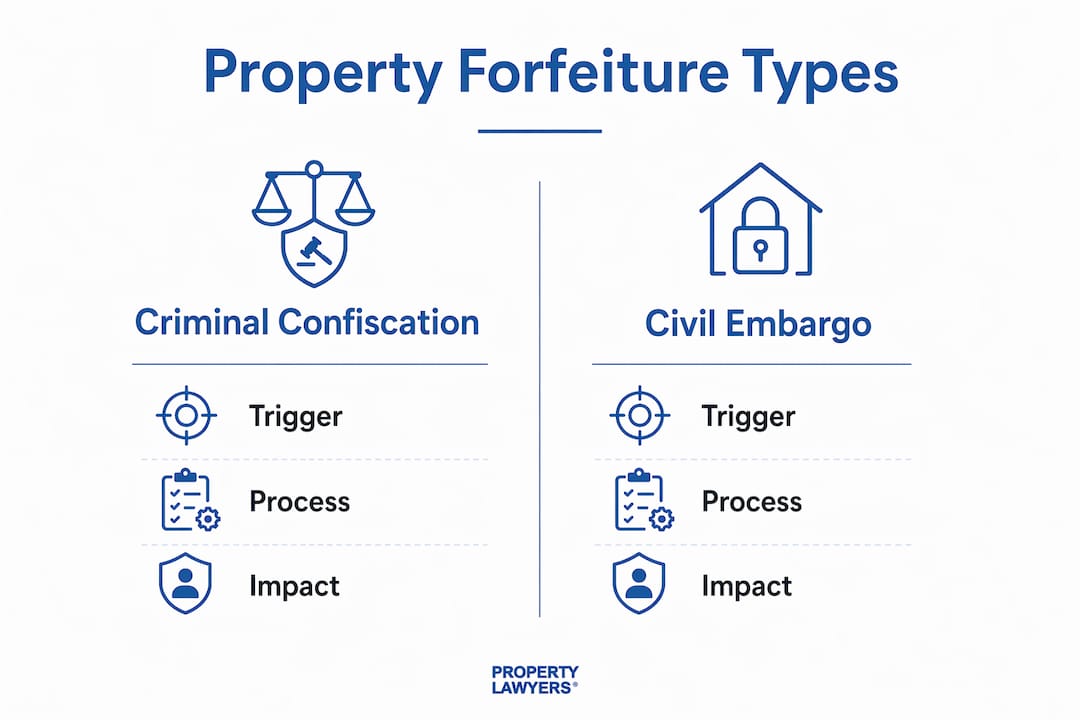
Criminal confiscation (decomiso)
Criminal confiscation is triggered by a criminal conviction. Article 127 of the Spanish Criminal Code applies to intentional crimes and covers three categories of assets: instruments used to commit the crime, gains derived from it, and equivalent assets where the original cannot be seized. The state does not need to prove ownership of a specific asset if it can demonstrate that the asset represents criminal proceeds.
Article 127 quinquies goes further. It allows confiscation of assets linked to prior criminal activity when a convicted person’s wealth appears disproportionate to their lawful income. The criteria include value disproportion, concealment through intermediaries, and unjustified transfers exceeding €6,000 in benefit. This extended confiscation power means a seller’s past criminal history can put a property at risk even if the property itself was not directly connected to the crime.
Criminal forfeiture proceedings can affect a transaction even before a final conviction. In-progress procedural actions can still restrict a property’s transferability, which means a buyer could complete a purchase only to find the asset later subject to state confiscation.
Pro Tip: Ask your lawyer to check whether the seller is subject to any ongoing criminal investigations or precautionary asset freezes before you pay any deposit.
Civil embargo for debts and tax enforcement
Civil embargo is the more common risk for everyday property buyers. The Agencia Tributaria can initiate seizure proceedings against a property owner for unpaid taxes. The process includes enforcement notices, a formal seizure phase, and eventual registration of the embargo on the property registry. Once registered, the embargo is visible to any buyer who checks the Land Registry.
The key procedural difference between criminal confiscation and civil embargo is notice and timing. Civil embargo follows an administrative process with defined steps and deadlines. Criminal confiscation can move faster and with less predictability, particularly where precautionary measures are applied during an investigation. Both affect property rights and transferability, but civil embargo is more likely to appear in a standard residential transaction.
How do embargo annotations work in the Spanish Land Registry?
An embargo annotation on the Registro de la Propiedad is a formal entry that alerts any buyer or lender to a registered debt claim against the property. It does not mean the property has been sold or confiscated. It means a creditor has secured their position in the queue for any future sale proceeds.
The 4-year validity rule and the 2026 DGSJFP ruling
Embargo annotations carry a 4-year validity limit. A creditor must apply for an extension before the annotation expires, or they lose their registered security. The Dirección General de Seguridad Jurídica y Fe Pública (DGSJFP) issued a resolution in january 2026 clarifying the formal requirements for extension and the consequences of failure to extend.
The practical implication is significant. An embargo annotation that expired without extension may appear on the registry but no longer carries legal weight. That sounds like good news for buyers, but it creates a different problem. If the annotation expires, the creditor loses their registered priority. They may then seek to re-register the claim or pursue the debt through other channels, creating uncertainty during your transaction.
| Registry status | What it means for buyers |
|---|---|
| Active embargo annotation | Creditor has a registered claim; property may be auctioned to settle the debt |
| Expired annotation (not extended) | Creditor loses registered priority; debt may still exist but is unregistered |
| No annotation present | No registered claim at time of search; does not guarantee no debt exists |
| Criminal confiscation notation | State has a claim; transaction may be frozen or reversed |
Pro Tip: Always request a nota simple from the Land Registry dated within the last 48 hours before signing any contract. Registry status can change quickly.
The interaction between the Land Registry and the Cadastre adds another layer. The Cadastre records the physical and fiscal description of a property, while the Land Registry records legal ownership and encumbrances. Discrepancies between the two can indicate undeclared constructions or legal encumbrances that threaten your ability to use or finance the property.
What due diligence steps should buyers take to avoid forfeiture risks?
Due diligence is the single most effective protection against property seizure risks in Spain. The steps below apply to every purchase, whether you are buying a villa in Marbella or an apartment in Barcelona.
-
Obtain an up-to-date nota simple. Request this directly from the Registro de la Propiedad. It shows current ownership, registered encumbrances, embargoes, and any notations related to confiscation proceedings. Timing matters: obtain the nota simple immediately before signing the deposit contract to maximise your protection.
-
Cross-check with the Cadastre. The Cadastre confirms the physical description and fiscal value of the property. Differences between the Cadastre and the Land Registry can signal illegal extensions, undeclared outbuildings, or planning breaches that affect value and legality.
-
Check for community debts and IBI arrears. Article 9.1.e of the Horizontal Property Law holds buyers responsible for community debts from the year of purchase and the preceding three years. Unpaid local property tax (IBI) can also become your liability after completion.
-
Verify the seller’s tax standing. Tax debt enforcement seizures are administrative and can appear late in a transaction. Ask your lawyer to confirm the seller has no outstanding Agencia Tributaria enforcement actions before you reach completion.
-
Instruct an independent lawyer. A lawyer who acts only for you, with no connection to the agent or developer, will conduct legal checks that an estate agent cannot and will not perform. This is not an optional extra. It is the most reliable way to identify forfeiture risks before they become your problem.
-
Include suspensive clauses in your arras contract. A suspensive clause allows you to withdraw from the purchase and recover your deposit if a specific legal defect is discovered. If a new embargo appears between the arras signing and completion, a well-drafted clause protects your funds.
A typical property purchase in Spain runs 2–4 months from offer to completion. That is enough time for a new embargo to be registered. Updating your registry checks at each key stage of the transaction is not excessive caution. It is standard practice.
What practical risks can property forfeiture laws create for buyers?
The impact of property forfeiture in Spain on buyers falls into several distinct scenarios. Each one is avoidable with the right preparation.
-
Hidden embargo annotations. A seller may be unaware of an embargo registered against the property, particularly if it relates to a business debt or a tax dispute from several years ago. You discover it only when your lawyer pulls the nota simple. Without that check, you could pay a deposit on a property that cannot legally be transferred until the debt is resolved.
-
Criminal confiscation proceedings mid-transaction. If a seller is under criminal investigation, the state can apply precautionary asset freezes. These do not always appear on the registry immediately. A transaction can proceed to an advanced stage before a freeze is applied, leaving a buyer exposed if they have already paid a deposit.
-
Tax authority seizures blocking mortgage approval. A bank conducting its own valuation and registry check before issuing a mortgage will refuse to lend against a property with an active embargo. If you discover this only at the mortgage stage, you may have already paid reservation fees and legal costs.
-
Expired embargo annotations creating false confidence. An annotation that expired without extension looks harmless on the registry. The underlying debt, however, may still exist. A creditor who lost their registered priority may pursue the debt through other means, creating complications after you complete the purchase.
-
Negotiation leverage when risks arise. If your lawyer identifies a registered embargo during due diligence, you have three realistic options: require the seller to clear the debt before completion, negotiate a price reduction that accounts for the risk, or walk away using a suspensive clause in the arras contract. None of these options are available to buyers who skip legal checks.
Understanding Spanish real estate property rights means accepting that the registry is a snapshot, not a guarantee. The registry reflects what has been formally registered at a given moment. It does not capture debts that have not yet been registered or criminal proceedings that are still at an early stage.
Key takeaways
Spanish property forfeiture law requires buyers to check both criminal confiscation risks and civil embargo annotations before signing any contract, using an independent lawyer and an up-to-date nota simple.
| Point | Details |
|---|---|
| Two distinct mechanisms | Criminal confiscation and civil embargo operate separately and require different checks. |
| 4-year embargo validity | Embargo annotations expire after four years; always verify whether an annotation is still active. |
| Nota simple timing | Obtain a fresh nota simple immediately before signing the deposit contract to catch late registrations. |
| Community debt liability | Buyers inherit community debts from the year of purchase and the three preceding years under Spanish law. |
| Independent legal advice | An independent lawyer is the most reliable protection against hidden forfeiture risks in any Spanish transaction. |
My honest view on forfeiture risks in Spain
Having worked with international buyers across Spain for many years, I can say with confidence that forfeiture risks are not rare edge cases. They appear regularly, particularly in transactions involving resale properties where the seller has had financial difficulties or business disputes.
The mistake I see most often is buyers who treat the nota simple as a one-time check done at the start of the search process. By the time they reach the arras stage, weeks or months have passed. A new embargo can be registered in that window. I always recommend a fresh registry check within 48 hours of signing any contract that involves a deposit payment.
The second mistake is assuming that an expired embargo annotation means the problem has gone away. It has not. The debt may still exist. The creditor may re-register or pursue recovery through other channels. An expired annotation is a flag, not a clean bill of health.
Criminal confiscation risks are less common but more serious. If a property has changed hands multiple times in a short period, or if the seller’s pricing is significantly below market value, those are signals worth investigating. A lawyer with experience in Spanish criminal property law can run checks that go beyond the standard registry search.
The buyers who navigate Spain’s property market successfully are the ones who invest in proper legal representation early. Not after they have fallen in love with a property. Before they make any financial commitment. That timing makes all the difference.
— Sophie
How Property-lawyers can help you buy safely in Spain
Buying property in Spain is one of the most rewarding decisions you can make. The country offers exceptional lifestyle, strong rental demand in areas like Marbella, Mallorca, and Barcelona, and a well-established legal framework for foreign buyers. The risks are real, but they are manageable with the right support.
Property-lawyers connects international buyers with trusted, independent Spanish property lawyers who specialise in due diligence, registry checks, and contract drafting. Every lawyer in the directory works exclusively for the buyer, with no conflict of interest from agents or developers. Whether you need a full Land Registry search or a complete transaction managed from offer to completion, Property-lawyers can connect you with the right specialist for your area and budget. Start your legal checks before you pay a single euro in deposits.
FAQ
What is decomiso in Spanish property law?
Decomiso is criminal confiscation under Article 127 of the Spanish Criminal Code. It allows the state to seize assets connected to a crime, including gains and instruments used, and can apply even where direct seizure of the original asset is not possible.
How long does an embargo annotation last on the Spanish Land Registry?
An embargo annotation is valid for four years from the date of registration. The creditor must apply for an extension before it expires, or they lose their registered security over the property.
Can a buyer inherit debts from a previous owner in Spain?
Yes. Under Article 9.1.e of the Horizontal Property Law, buyers are responsible for community fees from the year of purchase and the preceding three years. Unpaid IBI (local property tax) can also transfer to the new owner after completion.
When should I check the Land Registry when buying in Spain?
Obtain a fresh nota simple immediately before signing the deposit contract (arras). A typical Spanish purchase takes 2–4 months, and a new embargo can be registered at any point during that period.
Does a criminal investigation always show on the Land Registry?
Not immediately. Precautionary asset freezes linked to criminal investigations may not appear on the registry at an early stage. An independent lawyer can conduct additional checks beyond the standard nota simple to identify these risks.
Recommended
- Plusvalía Municipal Tax in Spain — What Sellers Need to Know | Property Lawyers
- Spanish real estate law: a buyer’s guide for 2026
- Spanish property purchase process: a guide for buyers
- Freehold property in Spain explained for international buyers

Sophie Gutenberg is a legal content specialist focused on Spanish property law, real estate transactions, conveyancing, due diligence and tax issues affecting international property buyers in Spain. She works alongside qualified Spanish property lawyers .
