

How to verify property debts in Spain: a buyer’s guide
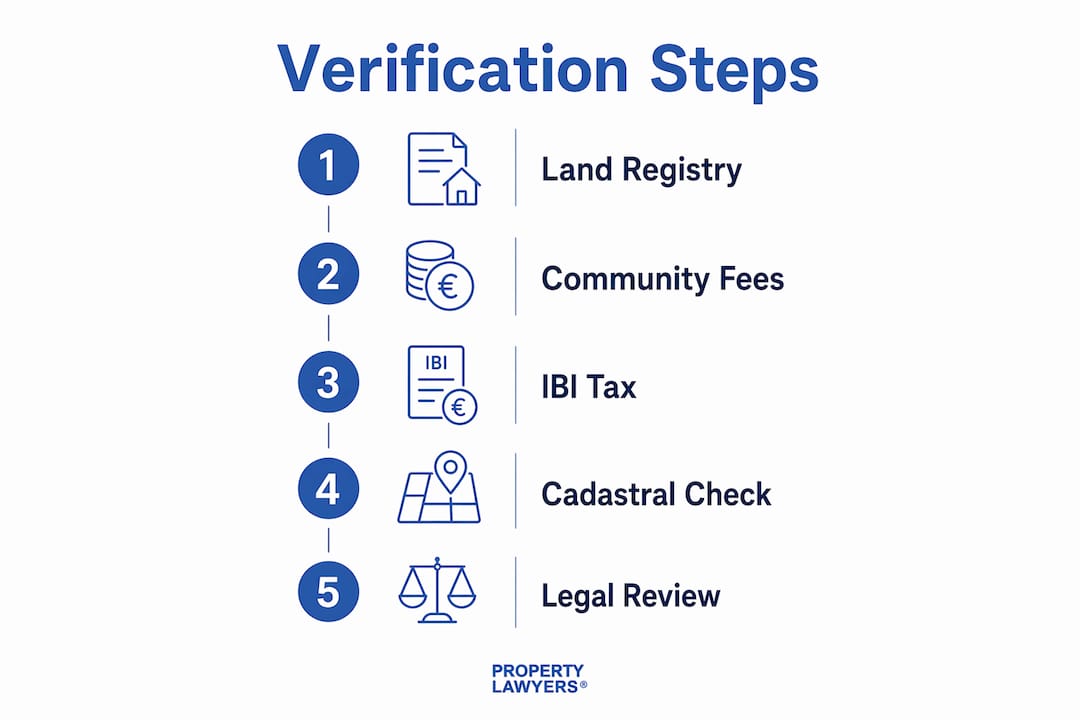
Verifying property debts in Spain before you sign anything is not optional. It is the single most important step in protecting your investment. Here is what you need to do:
- Obtain a Nota Simple from the Spanish Land Registry (Registro de la Propiedad). This document shows the registered owner, any mortgages, liens, embargoes, and legal restrictions attached to the property.
- Request a community fees certificate from the property administrator or the president of the Community of Owners. This confirms whether the seller owes any outstanding communal charges. Unpaid community fees transfer automatically to the new owner upon completion.
- Obtain an IBI clearance certificate from the local municipal treasury or a centralised platform such as SUMA (in Alicante province). IBI is the annual municipal property tax, and unpaid IBI debts attach to the property, not just the seller.
- Cross-check the cadastral reference against the Catastro (Spain’s official land register) to confirm the property’s boundaries, size, and legal use match what is being sold.
- Engage an independent Spanish property lawyer (abogado). The notary acts as a public official and does not represent you. Only an independent lawyer will perform thorough due diligence on your behalf.
Each of these steps addresses a different type of debt or encumbrance. Together, they give you a complete picture of the property’s legal and financial status before any money changes hands.
Table of Contents
- How to verify property debts in Spain using the Land Registry
- Community fees and IBI tax: the debts that catch buyers off guard
- Cadastral and urban planning checks: what the maps tell you
- Legal due diligence before signing: what your lawyer should do
- Common pitfalls and how to avoid them
- How to use the Registro de la Propiedad to check charges and liens
- Verifying mortgage charges: what to check and why it matters
- Key takeaways
- FAQ
How to verify property debts in Spain using the Land Registry
The Registro de la Propiedad is your starting point for any property debt verification in Spain. It is the official public registry where ownership, mortgages, liens, embargoes, and legal restrictions are recorded against a property.

The primary document you need is the Nota Simple. This is an official extract from the Land Registry that shows the current registered owner, any mortgages or charges, active embargoes, and pending legal proceedings. It is not a legal guarantee, but it is the clearest snapshot available of a property’s registered status. A fresh Nota Simple should always be obtained shortly before completion, not just at the start of the process, because new charges can appear at any time.
How to obtain a Nota Simple:
- Order it online via registradores.org, the official portal of Spain’s Land Registrars. You can search by property reference, owner name, or cadastral code.
- It has a nominal cost and is typically delivered by email within a few days.
- It is a public document. You do not need the seller’s permission to request it, which means you can begin checks early, before committing to anything.
- Alternatively, request it in person at the local Land Registry office covering the property’s municipality.
What to look for in the Nota Simple:
- Confirm the seller’s name matches the registered owner exactly. If there is a discrepancy, this could indicate an inheritance issue, a divorce settlement, or even fraud.
- Check for any active mortgages. These must be cancelled or formally discharged before or at the point of sale.
- Look for embargoes (court-ordered charges) or annotations from creditors. These are serious and must be resolved before transfer.
- Note any easements, rights of way, or use restrictions that could affect how you use the property.
- Check the marriage regime of the owner if relevant, as this can affect whether both spouses must consent to the sale.
There is also a more formal document called the Certificación Registral. Unlike the Nota Simple, this carries full legal evidentiary weight and can be used in court proceedings. For most buyers, the Nota Simple is sufficient for due diligence, but your lawyer may recommend the Certificación Registral if any disputes or complications arise.
Community fees and IBI tax: the debts that catch buyers off guard
Two categories of debt consistently catch buyers by surprise: unpaid community fees and outstanding IBI property tax. Neither necessarily appears on the Nota Simple, which is precisely why they require separate verification.

Community fees
If the property is part of a residential complex, urbanisation, or apartment block, it will belong to a Community of Owners (Comunidad de Propietarios). Each owner pays regular community fees covering shared maintenance, insurance, and communal services. When a seller falls behind on these payments, the debt does not disappear at the point of sale. Community fees become the responsibility of the new owner upon transfer, and the community can pursue the new owner for arrears.
Steps to verify community fee status:
- Request a certificate of being up-to-date with community payments (certificado de estar al corriente de pago de la comunidad). This must be signed by the community administrator or the president of the Community of Owners.
- Do not accept verbal assurances from the seller or the estate agent. Only a signed, official certificate counts.
- Ask for the certificate to be dated as close to the signing date as possible.
- If there are outstanding fees, negotiate for them to be deducted from the purchase price or settled by the seller before completion.
Community debts exist entirely outside the Land Registry records. Direct verification with the community administrator is the only reliable way to confirm the seller’s payment status.
IBI property tax
IBI (Impuesto sobre Bienes Inmuebles) is the annual municipal property tax levied by local councils. It is attached to the property itself, not to the individual owner. If the seller has not paid IBI for several years, those arrears follow the property to you.
Municipal authorities can claim unpaid IBI for several years prior to the purchase date. This means you could inherit a significant tax liability even if the seller assures you everything is in order.
Steps to verify IBI status:
- Request a Certificado de estar al Corriente de Pago del IBI from the local municipal treasury (Ayuntamiento) or, in Alicante province, from SUMA Gestió Tributària, which offers an online verification system covering multiple municipalities and can provide proof of zero debt status, often within 24–48 hours.
- Ask the seller to provide IBI receipts for the past four years as a minimum.
- Ensure your purchase contract includes a clause requiring the seller to provide formal IBI clearance certificates before completion.
- If any unpaid IBI is discovered, insist it is settled before signing the sale deed (escritura).
Cadastral and urban planning checks: what the maps tell you
The Catastro is Spain’s official land and property register, maintained for tax and administrative purposes. It holds physical information about every property: its surface area, boundaries, location, use, type of construction, and cadastral value. Crucially, it is separate from the Land Registry, and the two do not always agree.
Checking the cadastral reference is not just a formality. Discrepancies between the Land Registry and the Catastro can indicate illegal construction, extensions built without planning permission, or incorrect property data that could expose you to fines or legal disputes after purchase. The Spanish Catastro holds data on more than 32 million urban properties and more than 40 million rural properties, and its electronic office allows anyone to search by address, cadastral reference, or owner identification.
Practical steps for cadastral and urban planning checks:
- Access the Catastro’s electronic office at sede.catastro.gob.es and search by the property’s address or cadastral reference number.
- Confirm that the cadastral reference on the Nota Simple matches the reference on the Catastro record.
- Compare the registered surface area and boundaries with what the seller is claiming. Even small discrepancies are worth investigating.
- Check the declared use of the property (residential, commercial, agricultural). If the actual use differs from the cadastral classification, this can create tax and planning complications.
- Contact the local municipal urban planning department (Departamento de Urbanismo) to check whether any planning violations, outstanding fines, or demolition orders are registered against the property.
- Ask whether any extensions or structural changes have been properly declared and legalised. Undeclared works are common in rural and coastal areas.
- Verify that the property is not located within a protected zone (coastal protection, natural park, heritage area) that could restrict future development or use.
These checks are particularly important in popular areas for international buyers such as the Costa del Sol, Mallorca, and the Costa Blanca, where illegal extensions and undeclared pools are not uncommon.
Legal due diligence before signing: what your lawyer should do
Signing a property purchase contract in Spain without completing full due diligence is a serious risk. The legal process involves several distinct steps, and your independent lawyer (abogado) is the person who should coordinate all of them.
The notary’s role in a Spanish property transaction is to verify the legality of the deed and authenticate signatures. The notary does not represent the buyer and does not perform comprehensive debt verification. Buyers should employ an independent lawyer for thorough due diligence, including checking Land Registry records and local tax obligations. Understanding why you need a lawyer before you commit to a purchase can save you from costly surprises.
Key steps in the legal due diligence process:
- Review the Nota Simple for ownership, charges, and encumbrances. Obtain a fresh copy close to the completion date.
- Obtain community fee and IBI clearance certificates and confirm they are current and officially signed.
- Check the cadastral reference and compare it with Land Registry data and the physical property.
- Verify urban planning status with the local municipality to rule out illegal constructions or outstanding violations.
- Review the arras contract (deposit agreement). This is a legally binding document. Contract deposits (arras) should specify how outstanding debts will be handled and what happens if debts emerge before completion.
- Negotiate debt settlement clauses into the purchase contract. Any known debts should either be settled by the seller before signing or formally deducted from the agreed purchase price.
- Ensure the sale deed (escritura) includes protective clauses confirming the property is sold free of charges, debts, and encumbrances, or specifying any exceptions.
- Request updated documents immediately before completion. New embargoes or charges can appear between the initial checks and the signing date.
Your lawyer should also verify the seller’s identity and confirm they have the legal capacity to sell. If the property has passed through an inheritance, all heirs must be in agreement and the inheritance must be properly registered before the sale can proceed.
Common pitfalls and how to avoid them
Even buyers who follow the correct process can run into problems if they overlook a few less obvious risks. Here is what experienced property lawyers consistently flag as the most common mistakes.
The Nota Simple is a snapshot, not a guarantee. It reflects the state of the registry at the moment it was issued. A new embargo or charge lodged the following day will not appear on it. This is why your lawyer should request a final updated Nota Simple on the day of, or immediately before, the signing at the notary.
Relying on the seller’s word or the agent’s assurances about debts is one of the most common and costly mistakes. Agents represent the seller’s interests. Always obtain official, signed certificates directly from the relevant authorities.
Unpaid community debts are the most frequently missed liability. They do not appear in the Land Registry, and sellers do not always disclose them voluntarily. The only protection is an official certificate from the community administrator.
Pro Tip: Contact the community administrator directly, rather than going through the seller, to request the community fees certificate. This removes any possibility of the document being altered or withheld.
Common mistakes to avoid:
- Accepting photocopies or undated certificates as proof of payment.
- Failing to check IBI receipts for the full four-year exposure window.
- Overlooking small community debts because the amounts seem minor. These can grow with interest and legal costs.
- Not verifying whether the property has any outstanding mortgage that the seller has not disclosed.
- Signing the arras contract before all debt checks are complete.
- Assuming the notary will catch all problems. The notary’s role is limited and does not include comprehensive debt verification on the buyer’s behalf.
- Skipping urban planning checks on rural or coastal properties where illegal constructions are more prevalent.
If you are buying remotely, a power of attorney allows your lawyer to act on your behalf throughout the process, including requesting documents and attending the signing.
How to use the Registro de la Propiedad to check charges and liens
The Registro de la Propiedad (Official Property Registry) is the definitive public record for all legal charges and encumbrances registered against a property in Spain. Every mortgage, lien, embargo, easement, and legal restriction that has been formally lodged must appear here. If it is not in the registry, it has no legal effect against third-party buyers who act in good faith.
This principle, known as the principle of public faith (fe pública registral), is one of the most important protections available to buyers in Spain. Provided you purchase in good faith and the transaction is registered, you are protected against claims that were not recorded in the registry at the time of purchase. However, this protection only applies to registered charges. Community debts and certain tax liabilities can still affect you even if they do not appear in the registry, which is why the additional checks described above remain essential.
To consult the registry directly, you can visit the Land Registry office covering the property’s municipality, or use the online services at registradores.org. Your lawyer can also request a full registry search on your behalf, which is standard practice in any properly conducted due diligence process.
Verifying mortgage charges: what to check and why it matters
If the property you are buying has an existing mortgage, that mortgage must be formally cancelled before or at the point of sale. An uncancelled mortgage remains registered against the property and becomes your problem the moment the deed is signed in your name.
There are two distinct steps to mortgage cancellation in Spain. The first is financial: the seller pays off the outstanding loan balance. The second is legal: the bank issues a formal cancellation deed (escritura de cancelación de hipoteca), which must then be presented to the Land Registry to remove the charge from the record. Both steps must be completed. A mortgage that has been paid off financially but not removed from the registry is still a registered charge.
Your lawyer should confirm the following before completion:
- The Nota Simple shows the mortgage and its details, including the lending bank and the registered amount.
- The seller has obtained a formal zero-balance certificate (certificado de saldo cero) from the bank confirming the loan is fully repaid.
- The cancellation deed has been signed before a notary and submitted to the Land Registry for removal.
- If the mortgage is being cancelled simultaneously at the signing of the sale deed, the funds to discharge it are held in escrow or paid directly to the bank on the day.
In some transactions, particularly where the seller is using the sale proceeds to pay off the mortgage, the cancellation happens simultaneously at the notary. This is legally valid, but your lawyer must coordinate it carefully to confirm the charge is removed before the title transfers to you. Never assume a mortgage has been cancelled simply because the seller says so. Verify it in the registry.
Key takeaways
Verifying property debts in Spain requires official documents from multiple sources: the Land Registry, the Catastro, the municipal treasury, and the Community of Owners, all reviewed by an independent lawyer before any contract is signed.
| Point | Details |
|---|---|
| Nota Simple is your first step | Order it via registradores.org; it shows mortgages, liens, and embargoes registered against the property. The fee for a Nota Simple is public and generally around €9, payable online or in person. |
| Community fees need a separate certificate | Unpaid fees transfer to the new owner and do not appear in the Land Registry; request a signed certificate from the community administrator. |
| IBI arrears can go back four years | Municipal authorities can claim up to four years of unpaid IBI from the new owner; obtain clearance certificates covering this full period. |
| Cadastral checks prevent planning surprises | Cross-reference the Catastro with Land Registry data to detect illegal constructions or boundary discrepancies before purchase. |
| Independent lawyer is non-negotiable | The notary does not represent the buyer; only an independent abogado will perform comprehensive due diligence on your behalf. |
FAQ
How can I find out if a property has debts in Spain?
Order a Nota Simple from the Land Registry via registradores.org to check registered mortgages and charges, then request separate certificates for community fees and IBI tax from the community administrator and local municipal treasury respectively.
How far back can IBI debts be claimed against a new owner in Spain?
Municipal authorities can pursue unpaid IBI for up to four years prior to the purchase date, so buyers should obtain IBI payment receipts and clearance certificates covering at least that period.
What happens if I buy a property with undisclosed debts in Spain?
If debts were not disclosed and your purchase contract included protective clauses, you may have legal recourse against the seller. An independent lawyer can advise on recovery options, including claims under the arras contract terms.
How do I check property ownership in Spain online?
You can order a Nota Simple online via registradores.org using the property’s address, cadastral reference, or the owner’s name. The document is delivered by email, typically within 48 hours.
Do I need a lawyer to verify property debts in Spain, or can I do it myself?
You can obtain a Nota Simple and some certificates independently, but an independent Spanish property lawyer is strongly recommended. Community debts, urban planning violations, and mortgage cancellation issues require legal expertise to identify and resolve before completion.
Recommended
- Property law in Spain: a 2026 guide for buyers
- Legal checks before buying property in Spain
- How to avoid property scams in spain (2026)
- Spanish real estate law: a buyer’s guide for 2026

Sophie Gutenberg is a legal content specialist focused on Spanish property law, real estate transactions, conveyancing, due diligence and tax issues affecting international property buyers in Spain. She works alongside qualified Spanish property lawyers .
