

How to avoid property scams in spain (2026)
TL;DR:
- Property fraud in Spain involves deception that causes buyers to transfer money or sign documents based on false or manipulated information about properties. To prevent scams, buyers must verify legal status through the Land Registry, obtain current documents, and engage independent legal advice before making payments. Common red flags include unusually low prices, pressure to act quickly, discrepancies in official records, and unverifiable seller identities.
Property fraud in Spain is defined as any deliberate deception that causes a buyer to transfer money or sign legal documents based on false, incomplete, or manipulated information about a property’s ownership, legal status, or physical condition. Spanish police dismantled multiple criminal networks in May and June 2026, with single operations involving fraud values of €800,000, €1.2 million, and €1.3 million. These are not isolated incidents. To avoid property scams in Spain, you must verify the property’s legal status through the Land Registry, obtain a current Nota Simple, and appoint an independent bilingual lawyer before any money changes hands. The verification steps below are not optional extras. They are the difference between a secure purchase and a devastating financial loss.
What legal documents must buyers verify before paying?

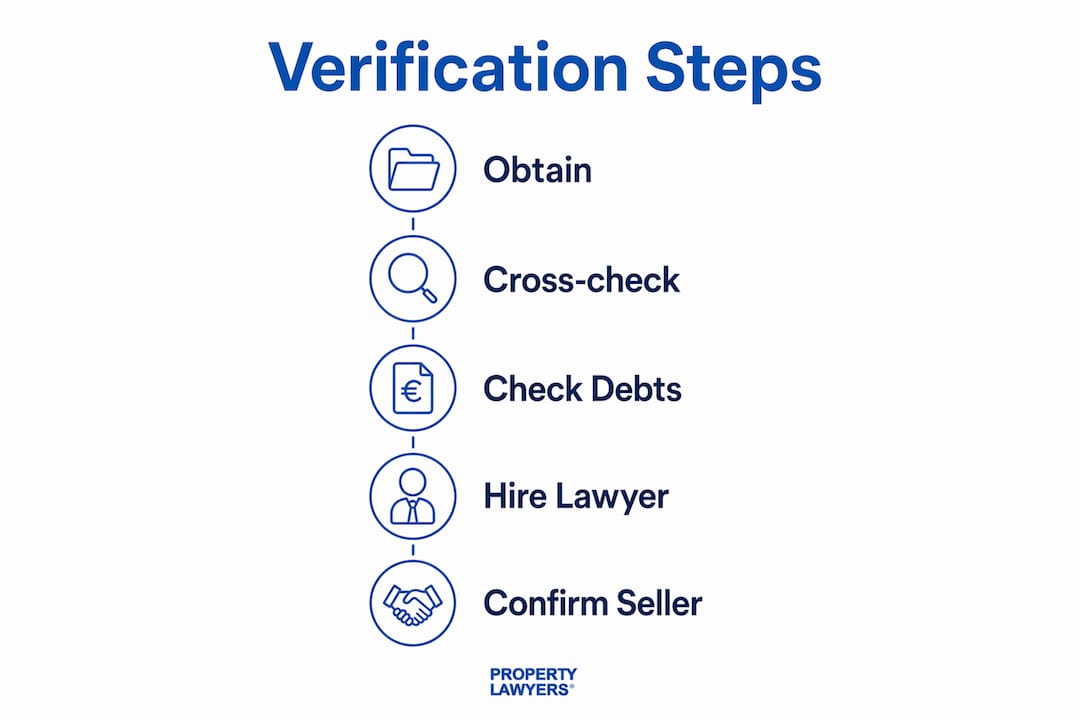
The Nota Simple is the single most important document in any Spanish property transaction. It is an official extract from the Land Registry, known as the Registro de la Propiedad, confirming the current owner, any mortgages, embargoes, or seizures attached to the property. Crucially, you must obtain a Nota Simple issued within the last 24–48 hours before signing or making any payment, because registration status can change rapidly due to new seizures or prior sales completing overnight.
The Nota Simple alone is not sufficient. You must also cross-reference the Land Registry entry with the Catastro, which is Spain’s cadastral register recording the physical boundaries and surface area of the property. Discrepancies between the two registers are common and can signal illegal extensions, undeclared structures, or boundary disputes that will become your legal problem after purchase.
Debt is another critical area. In Spain, community debts remain attached to the property even after it is sold. This means you can inherit unpaid community fees, property tax arrears, and liens covering the year of purchase and the preceding three years. Always demand a zero debt certificate from the community administrator and a certificate confirming no outstanding property tax before completion.
The table below summarises the core documents and where to obtain them:
| Document | Purpose | Source |
|---|---|---|
| Nota Simple (max 48 hours old) | Confirms ownership, charges, and encumbrances | Land Registry (Registro de la Propiedad) |
| Cadastral certificate | Verifies physical boundaries and surface area | Catastro (Spanish Cadastre) |
| Zero debt certificate | Confirms no community fee arrears | Community administrator |
| IBI tax certificate | Confirms no outstanding property tax | Local town hall |
| First Occupation Licence | Confirms legal habitability | Local town hall |
Pro Tip: Ask your lawyer to obtain the Nota Simple directly rather than accepting a copy provided by the seller or agent. A seller-supplied copy may be days or weeks old and will not reflect recent changes to the property’s legal status.
What are the red flags of spanish property scams?
Detecting real estate scams in Spain requires recognising specific behavioural and documentary warning signs, not just a general sense that something feels wrong. The following are the most reliable indicators that a transaction carries serious fraud risk.
- Price significantly below market value. A property priced well below comparable listings without a clear, documented legal justification almost always conceals hidden encumbrances, structural defects, or active legal disputes. As experienced property lawyers advise, cheap price is a question, not a strategy. If the seller cannot explain the discount in writing, treat it as a serious warning.
- Pressure to transfer funds quickly. Scammers routinely construct stories of urgent forced sales, inheritance deadlines, or competing buyers to prevent you from completing proper checks. Any seller or agent who discourages independent lawyers or pushes for rapid payment is exhibiting the primary tactic used in documented fraud cases.
- Reluctance to provide fresh documentation. A legitimate seller has nothing to hide in the Land Registry. If the seller delays providing a current Nota Simple, refuses to supply a zero debt certificate, or offers only photocopies of older documents, the transaction requires immediate legal scrutiny.
- Discrepancies between descriptions and official records. If the property’s advertised size, boundaries, or permitted use do not match the Catastro or Land Registry data, the discrepancy may indicate illegal construction, undeclared extensions, or planning violations that could result in demolition orders or fines.
- Unverifiable seller identity or authority. Inheritance sales, company-owned properties, and power of attorney situations all carry elevated fraud risk. Confirm that the person signing has the legal authority to sell, and verify their identity against the Land Registry entry independently.
Pro Tip: If an agent or seller tells you that hiring your own lawyer will slow the process or upset the deal, treat that statement as a red flag in itself. Independent legal representation is your right and your primary protection.
How should buyers handle payments and contracts safely?
Safe payment practices are the foundation of protecting your funds during a Spanish property purchase. The rules here are straightforward and non-negotiable.
- Never pay in cash. Cash payments for reservation fees, administrative charges, or deposits are illegal and unrecoverable if the transaction is fraudulent. Legitimate transactions use traceable bank transfers only.
- Ensure all payments appear in the public deed. Every euro paid must be reflected in the escritura pública, the public deed signed before a notary. Payments made off the books offer no legal protection and may constitute tax fraud.
- Review every contract with your lawyer before signing. The reservation contract and the private purchase contract both create legally binding obligations. Your lawyer must review these documents in full before you sign anything or transfer any funds.
- Choose your own notary. In Spain, the buyer has the right to select the notary. Exercising this right gives you greater control over the process and reduces the risk of a notary with conflicting loyalties to the seller or developer.
For off-plan purchases, Spanish law provides a specific protection. Developers are legally required to provide bank guarantees covering all advance payments made by buyers. Without a valid bank guarantee or insurance policy in place, your deposit is at serious risk if the developer fails to complete the build or enters insolvency.
Legal note: If a developer or their agent cannot produce a valid bank guarantee for your off-plan deposit before you transfer funds, do not proceed. The absence of this guarantee has left buyers unprotected in numerous historical cases across Spain.
How do you verify property status and seller legitimacy?
A structured due diligence process covers four distinct areas: registry verification, urban planning compliance, financial and tax standing, and technical inspection. Skipping any one of these areas creates a gap that fraud or legal problems can exploit.
Follow these steps in order before committing to any purchase:
- Obtain a fresh Nota Simple. Request it directly from the Land Registry or through your lawyer. Confirm the seller’s name matches the registered owner exactly.
- Check urban planning status. Contact the local town hall to confirm the property has all required building licences and that no planning violations or demolition orders are registered against it.
- Verify the First Occupation Licence. The largest buyer mistake in Spanish property purchases is failing to check the First Occupation Licence, known as the Licencia de Primera Ocupación. Without it, the property may not be legally habitable and utility connections can be refused.
- Confirm seller identity and authority. For company-owned properties, request the company’s registration documents and confirm the signatory has authority to sell. For inheritance sales, verify the grant of probate and that all heirs have consented.
- Obtain community and tax clearance certificates. Collect the zero debt certificate from the community administrator and the IBI tax certificate from the town hall before completion.
- Document all communications. Use written channels for all negotiations and instructions. Verbal agreements carry no legal weight in Spanish property transactions.
The table below maps each verification step to the risk it addresses:
| Verification Step | Risk Addressed |
|---|---|
| Fresh Nota Simple | Ownership fraud, undisclosed mortgages, embargoes |
| Urban planning check | Illegal construction, demolition orders |
| First Occupation Licence | Uninhabitable property, utility refusal |
| Seller identity confirmation | Unauthorised sale, power of attorney fraud |
| Community and tax certificates | Inherited debt liability |
Appointing a lawyer with bilingual legal expertise in Spanish property law is not a luxury at this stage. It is the most reliable way to interpret these documents correctly and identify issues that are not immediately obvious to a buyer unfamiliar with Spanish legal conventions.
Key takeaways
Avoiding real estate fraud in Spain requires structured verification of ownership, legal status, debts, and planning compliance before any payment is made.
| Point | Details |
|---|---|
| Obtain a current Nota Simple | Request a Land Registry extract issued within 24–48 hours before signing or paying. |
| Demand a zero debt certificate | Confirm no community fees, tax arrears, or liens are attached to the property. |
| Appoint an independent lawyer | Hire a bilingual lawyer with no connection to the seller, agent, or developer. |
| Insist on traceable payments | Use bank transfers only; never pay cash or off the books for any stage of the purchase. |
| Verify off-plan bank guarantees | Confirm a valid bank guarantee exists before transferring any deposit on a new-build. |
Why structured verification beats gut instinct every time
I have reviewed hundreds of Spanish property transactions over the years, and the pattern in fraud cases is almost always the same. The buyer felt something was slightly off but proceeded anyway because the price was attractive or the seller seemed credible. Gut instinct is not a legal defence, and it does not recover lost deposits.
The safest buying approach is structured verification at every stage, not suspicion for its own sake. What that means in practice is following a fixed checklist regardless of how trustworthy the agent appears, how competitive the market feels, or how urgent the seller claims the situation is. Urgency is a tactic. Verification is a process.
The buyers I have seen lose money in Spain share one common factor: they skipped at least one verification step because they were told it was unnecessary or would slow things down. The First Occupation Licence check is the most frequently skipped. The consequences range from being unable to register for utilities to facing demolition orders on properties that were never legally habitable.
My strongest recommendation is to engage a specialist, independent lawyer before you view a single property, not after you have fallen in love with one. Emotional investment in a property makes it harder to walk away when the documents do not stack up. A lawyer engaged early sets the verification standard from the outset and removes that pressure entirely.
— Sophie
Find a trusted property lawyer in spain
Protecting your investment starts with the right legal support. Property-lawyers connects international buyers with vetted, independent property lawyers across Spain who specialise in exactly this kind of transaction. Every lawyer in the directory works independently from sellers and agents, speaks English, and understands the specific legal checks required to keep your purchase secure.

Whether you are buying a resale apartment in Madrid, a villa on the Costa del Sol, or an off-plan property in Valencia, the legal process is the same. You need a qualified professional who can obtain the correct documents, interpret them accurately, and advise you before you commit. Property-lawyers makes finding that professional straightforward, with no obligation to proceed until you are satisfied with the match.
FAQ
What is a nota simple and why does it matter?
A Nota Simple is an official Land Registry extract confirming the current owner, any mortgages, and any embargoes on a property. It must be issued within 24–48 hours of signing or payment to reflect the property’s current legal status accurately.
How do i spot a property scam in spain?
The clearest warning signs are prices significantly below market value without written justification, pressure to transfer funds quickly, and any resistance to you appointing an independent lawyer. These are the primary tactics documented in real estate fraud cases across Spain.
Are cash payments legal in spanish property transactions?
Cash payments for property in Spain are illegal and offer no legal recourse if the transaction is fraudulent. All payments must be made by traceable bank transfer and reflected in the public deed signed before a notary.
What protection do i have when buying off-plan in spain?
Spanish law requires developers to provide bank guarantees or insurance covering all advance payments made by buyers. Without a valid guarantee in place, your deposit is unprotected if the developer fails to complete the build or becomes insolvent.
Do i need a lawyer to buy property in spain as a foreigner?
Appointing an independent bilingual lawyer is not a legal requirement, but it is the most effective protection against property fraud. A lawyer verifies ownership, checks for debts and planning violations, and reviews all contracts before you sign or pay anything.
Recommended
- Property law in Spain: a 2026 guide for buyers
- Spanish real estate law: a buyer’s guide for 2026
- How to Buy a Property in Spain With 100% Confidence |
- Gazumping in Spain: what property buyers must know

Sophie Gutenberg is a legal content specialist focused on Spanish property law, real estate transactions, conveyancing, due diligence and tax issues affecting international property buyers in Spain. She works alongside qualified Spanish property lawyers .
