

Spanish property registry: what UK buyers must check
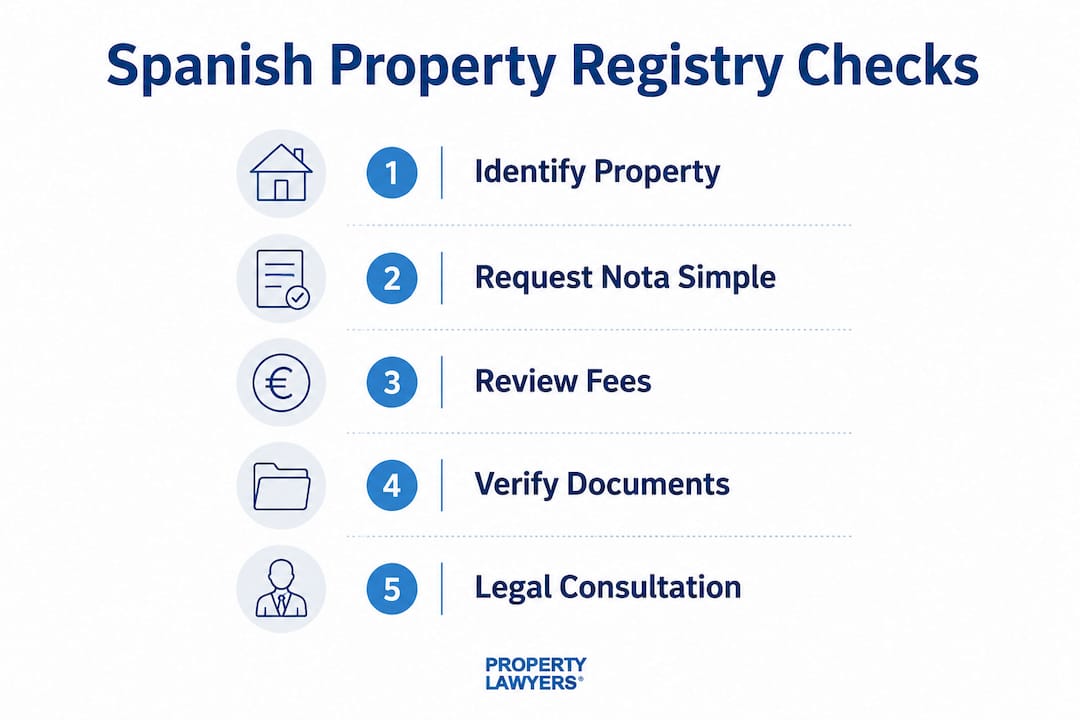
Order a fresh nota simple from the Registro de la Propiedad before you exchange contracts. Have a vetted Spanish property lawyer verify it. Those two steps protect you from the most common title problems buyers face in Spain.
The single most important action: Request an up-to-date nota simple as soon as you agree a price, then instruct an independent lawyer to check it. Do not rely on documents supplied by the seller or agent.
Here is what to check and who to involve:
- Owner (titular): Confirm the seller’s name matches the registry exactly, including their DNI or NIE number.
- Finca reference: Every property has a unique registry reference. Verify it matches the property you are buying.
- Cargas (charges): Look for mortgages (hipoteca), court seizures (embargos), easements (servidumbres) and usufructs.
- Certificación registral: If you need a legally certified title record for completion, request this instead of, or alongside, the nota simple.
- Professional help: The Colegio de Registradores runs the official online portal. Property-lawyers.com connects you with vetted English-speaking lawyers across Spain.
Table of Contents
- What does the Spanish property registry actually record?
- What the registry often does not show
- How to get a nota simple or certificación registral
- A step-by-step due diligence checklist for UK buyers
- Red flags in registry entries and what your lawyer can do
- Typical costs and timeline for registry checks
- How Property-lawyers.com helps UK buyers with registry checks
- Key takeaways
- A practical perspective on registry checks
- Useful sources
- FAQ
What does the Spanish property registry actually record?
Spain’s Registro de la Propiedad is the official public record of property ownership and legal charges. It is not the same as the Catastro, which is a fiscal and planning database. The registry is what matters for title.
A nota simple is an informative extract from the registry. It shows:
| Entry | What it tells you |
|---|---|
| Titular (owner) | Full name, DNI/NIE or company CIF, and ownership share |
| Finca reference | Unique registry number, registered surface area, boundaries and annexes |
| Hipoteca (mortgage) | Lender name, outstanding capital and any guarantees |
| Embargo | Court-ordered seizure or creditor claim against the property |
| Servidumbre | Easement or right of way that burdens the property |
| Usufruct | Third-party right to use or benefit from the property |
Know the difference: A nota simple is informative only. It is not a legal guarantee of title. For formal, legally binding certification, you need a certificación registral, which the registry issues as an official certified document. Banks and notaries may require this for mortgage or completion purposes.
The registry also records the property’s annexes, such as a parking space or storage room, under the same or a linked finca reference. Always check these are included.
What the registry often does not show
The nota simple captures what has been formally filed. It does not capture everything that can affect your purchase.
Common blind spots include:
- Communal charges: Outstanding fees owed to the residents’ community (comunidad de propietarios) may not appear in the registry but legally transfer to the new owner.
- Off-register agreements: Private contracts between the seller and a third party that have never been filed.
- Municipal charges: Unpaid IBI (council tax) or local improvement levies.
- Recent filings: A new charge can be registered after your nota simple is issued. A document that was accurate on Monday may be out of date by Friday.
Registry timing matters: Legal professionals stress that registry extracts can change quickly and that trusting seller-supplied documentation is a leading cause of transaction disputes in Spain.
Pro Tip: Ask your lawyer to request community fee statements and the last three IBI receipts directly from the seller. These sit outside the registry but are just as binding on you as a buyer.
A thorough lawyer goes well beyond the nota simple. They will check community accounts, verify planning and rental licences, confirm seller identity and marital status, and contact the bank directly for payoff certificates.
How to get a nota simple or certificación registral
You do not need the seller’s permission to order a nota simple. Anyone with the property’s registry reference, address or owner name can request one, which is particularly useful for international buyers who are not yet in Spain.
Three practical routes
Online via the Colegio de Registradores portal: Submit a request using the finca reference, catastral reference or owner name. Delivery is typically by email within minutes to a few hours. The official portal also offers an English translation of the extract on request.
In person at the local Registro de la Propiedad: Many registries issue a printed copy the same day. Fees are lower than online, though availability varies by office.
Via your lawyer: The most practical route for UK buyers. Your lawyer requests the extract, interprets the entries and flags anything that needs further investigation. If a certificación registral is needed for completion, they handle that too.
| Method | Typical fee | Delivery time |
|---|---|---|
| Online (registradores portal) | Around €9–€10 | Minutes to a few hours |
| In person at registry | Around €3.64 | Same day in most offices |
| Via lawyer | Lawyer fee applies | Same day |
| Certificación registral | Higher (varies by registry) | Several days |
Statistic: Online nota simple fees cited in practice run from approximately €9.02 via the registradores portal, compared with around €3.64 for an in-person request at the registry office.
A step-by-step due diligence checklist for UK buyers
Follow this sequence from offer to completion. For a fuller breakdown of legal checks before buying property in Spain, your lawyer will work through each stage with you.
- Order a fresh nota simple as soon as you agree a price. Do not rely on one supplied by the agent.
- Verify the owner. Confirm the seller’s full name and DNI/NIE match the registry entry. Check for multiple owners or unadjudicated inheritances.
- Check marital status. If the seller is married under Spanish community property rules, both spouses must consent to the sale.
- Request from the seller: original title deed (escritura), mortgage payoff letters (carta de pago or certificado de saldo cero), community fee statements and recent IBI receipts.
- Examine all cargas. Note the mortgage lender and outstanding amount. Check for any embargos, easements or usufructs and confirm whether they will be cancelled at completion.
- Check planning and licensing. Confirm permitted use, any rental licence and that the finca boundaries match the physical property.
- Order a certificación registral before completion where legal certainty is required.
- Instruct your lawyer to obtain bank payoff letters and community certificates, and to confirm deed wording at the notary.
Pro Tip: Practitioners recommend ordering a fresh nota simple within days of exchange. A nota simple issued weeks earlier may no longer reflect the current position.
Red flags in registry entries and what your lawyer can do
Some registry entries require immediate attention before you proceed.
Pause the purchase if you see: an open embargo, multiple owners with no clear agreement, a large uncancelled mortgage, or a missing spouse’s consent where marital property rules apply.
Common red flags and responses:
- Open embargo: Your lawyer checks the court record, identifies the creditor and demands written clearance before exchange.
- Mortgage shown as paid but not deregistered: This appears as cancelada económicamente. Obtain a carta de pago or certificado de saldo cero from the lender and ensure the cancellation is filed at the registry before or at completion.
- Multiple or inconsistent owners: Instruct your lawyer to obtain written consent from all parties and verify any inheritance has been properly adjudicated.
- Large uncancelled mortgage: Negotiate for the seller to repay it from sale proceeds at the notary, with funds escrowed until cancellation is confirmed.
Some problems are solvable. An uncancelled mortgage that the seller agrees to clear at completion is routine. An embargo linked to an ongoing criminal case is a different matter entirely. Your lawyer’s job is to tell you which is which.
Pro Tip: Ask your lawyer to include a clause in the purchase deed that retains seller liability for any undisclosed charges that emerge after completion.
Typical costs and timeline for registry checks
Budget for the following when planning your purchase in Spain.
| Item | Typical cost | Typical timeline |
|---|---|---|
| Nota simple (online) | ~€9–€10 | Same day |
| Nota simple (in person) | ~€3.64 | Same day |
| Certificación registral | Higher (varies) | Several working days |
| Lawyer title check | Varies by firm and region | 3–7 working days |
| Full conveyancing | Typically 1–2% of purchase price | 4 weeks |
| Translation and notarisation | Varies | Allow 5–10 working days |
Budget note: Allow additional funds for unexpected clearance tasks, such as resolving community debts or registering mortgage cancellations after completion. These are common and add notary and registry fees.
For buyers acting remotely, a power of attorney allows your lawyer to sign at the notary on your behalf, which removes the need to travel to Spain for completion.
How Property-lawyers.com helps UK buyers with registry checks
Property-lawyers.com connects international buyers with vetted, English-speaking property lawyers based across Spain. Whether you are buying in Marbella, Mallorca, Ibiza, Málaga or Barcelona, the directory lists specialists who handle nota simple checks, certificación requests and remedial work on title defects.
Lawyers listed on the platform can act remotely, request official registry extracts on your behalf and advise on contract wording to protect your position. For buyers who want broader legal support, the Spanish real estate law guide for buyers covers conveyancing, taxes and the full purchase process.
For a practical overview of the buying process from a real estate perspective, Ben Cook Real Estate’s 2026 buying guide is a useful companion read.
Key takeaways
A nota simple from the Registro de la Propiedad is the essential first check for any buyer in Spain, but it must be recent, professionally verified, and supplemented by community and bank checks before you exchange.
| Point | Details |
|---|---|
| Order a fresh nota simple | Request it as soon as you agree a price — do not use one supplied by the seller or agent. |
| Know what it shows | The nota simple records the owner, finca reference, surface area and all registered charges. |
| Know its limits | Communal debts and off-register agreements do not appear — request community statements separately. |
| Upgrade to certificación registral | Use this certified extract when legal certainty is required at completion or for mortgage purposes. |
| Pause for red flags | Open embargos, multiple owners or uncancelled mortgages require lawyer intervention before exchange. |
A practical perspective on registry checks
The registry is a powerful tool, but buyers sometimes treat the nota simple as a final answer when it is really a starting point. The document tells you what has been formally filed. It does not tell you what the seller owes the community, whether the rental licence is current, or whether a charge was registered the morning after you ordered the extract.
Experienced advisers time their registry orders carefully. Ordering too early means the extract may be stale by exchange. Ordering too late leaves no time to resolve problems. The practical approach is to order a nota simple at the point of agreeing a price, then request a fresh one within days of exchange. If anything has changed between the two, that gap is exactly where problems hide.
The fixes most lawyers reach for are straightforward: escrow funds at the notary to cover cancellation of a mortgage, insert a clause retaining seller liability for undisclosed charges, or require written creditor clearances before signing. What makes these work is having a local, English-speaking lawyer who knows the registry, the notary and the local court system. A lawyer who works in Marbella or Palma de Mallorca regularly will spot a problematic entry that a generalist might miss.
The cases where buyers should walk away are rarer than people fear, but they do exist. An embargo tied to an unresolved criminal investigation, an inheritance that has never been formally adjudicated, or a property with no legal access to the road are problems that cannot be papered over with clever deed wording. A good lawyer tells you this early, before you have committed funds you cannot recover.
Useful sources
- Registro de la Propiedad — Ministerio de Justicia: Official Spanish government page explaining what the property registry records and how it operates.
- Colegio de Registradores — online request portal: The official portal for submitting nota simple and certificación registral requests, with English-language options.
- Land Registry online seat (registradores.org): Direct access to the online registry service, including English translation of extracts.
- Property-lawyers.com: Land Registry Spain guide: Practical guide to how the Registro de la Propiedad works for international buyers.
- Property-lawyers.com: Nota Simple Spain: Dedicated guide to reading a nota simple and understanding registry entries.
- Property-lawyers.com: Legal checks before buying in Spain: Step-by-step legal due diligence checklist for buyers.
- Property-lawyers.com: Role of the registrador de la propiedad: Explains the registrar’s role and how lawyers interact with the registry.
FAQ
What is a nota simple and why do buyers need one?
A nota simple is an informative extract from Spain’s Registro de la Propiedad. It shows the registered owner, property description, finca reference and any charges such as mortgages, embargos or easements.
How much does a nota simple cost in Spain?
Online requests via the Colegio de Registradores portal cost €9.02. In-person requests at the local registry office typically cost €3.64, though fees vary by registry.
What is the difference between a nota simple and a certificación registral?
A nota simple is an informative extract with no legal guarantee. A certificación registral is an officially certified document issued by the registrar, which banks and notaries may require for mortgage or completion purposes.
Can a UK buyer order a nota simple without being in Spain?
Yes. Anyone with the property’s registry reference, address or owner name can request a nota simple online via the registradores portal, or instruct a Spanish lawyer to obtain it remotely.
What should I do if the nota simple shows an embargo or unpaid mortgage?
Pause the purchase and instruct your lawyer immediately. They will check the court record, obtain bank payoff certificates and advise whether the issue can be resolved before exchange or whether it is a reason to withdraw.
Recommended
- Legal checks before buying property in Spain
- How to verify property debts in Spain: a buyer’s guide
- Due Diligence Spain: Property Buying Checklist (2026)| Property Lawyers
- Land Registry Spain — Registro de la Propiedad Guide for Buyers | Property Lawyers

Sophie Gutenberg is a legal content specialist focused on Spanish property law, real estate transactions, conveyancing, due diligence and tax issues affecting international property buyers in Spain. She works alongside qualified Spanish property lawyers .
