

Título de propiedad: what it means for UK buyers
“Título de propiedad” is the Spanish term for a property title deed — the legal document that proves someone owns a piece of real estate. The closest everyday English equivalents are title deed, property title, or ownership title. If you are buying property in Spain and someone asks you for your título de propiedad, they are asking for the document that establishes your legal right to own that property.
Two quick examples of how the phrase is used:
- A Spanish estate agent might say: “The seller has the título de propiedad ready for inspection” — meaning the title deed is available to review.
- When buying a car in Spain, you also receive a título de propiedad, but in property, the term almost always refers to the escritura pública, the notarised deed of sale and its entry in the official land registry.
Understanding what this document is, which papers support it, and how to verify it properly can save you from serious legal and financial problems — particularly if you are buying in popular areas such as Marbella, Mallorca, Ibiza, Málaga, or Barcelona.
Key takeaways
A título de propiedad is only as secure as its entry in the Registro de la Propiedad — without registration, even a signed escritura leaves the buyer’s ownership legally exposed.
| Point | Details |
|---|---|
| Translation | Título de propiedad means “title deed” or “property title” in English. |
| Registration is decisive | Signing the escritura transfers ownership; registering it at the Registro de la Propiedad protects it against third-party claims. |
| First document to request | Order a nota simple before paying any deposit — it reveals the registered owner and any charges. |
| Key due-diligence checks | Confirm the finca number, check for mortgages or embargoes, verify IBI and community fee payments. |
| Property-lawyers | Use Property-lawyers to find a vetted, English-speaking Spanish property lawyer by region for title checks and conveyancing. |
Table of Contents
- What does “title” actually mean in property law?
- Which Spanish documents prove ownership, and what are their UK equivalents?
- How is ownership created and transferred in Spain?
- What should UK buyers check before committing to a purchase?
- What are the biggest red flags in a Spanish title?
- How do you change ownership? A practical step-by-step guide
- When does an English-speaking Spanish property lawyer make a real difference?
- Find a vetted Spanish property lawyer through Property-lawyers
- Sources
- FAQ
What does “title” actually mean in property law?
Title, as defined by Cornell Law School, is the aggregate of legal rights a person holds toward ownership and possession of property. It is not simply a piece of paper. Title is a legal concept — a bundle of rights that includes the right to possess the property, sell it, mortgage it, and exclude others from it.
That distinction matters in practice. According to FindLaw, a title is the legal concept of ownership, while a deed is the instrument that provides evidence of it. The deed names the seller, the buyer, and the property — but the underlying title is what you are actually acquiring.
Legal title versus equitable title
Wikipedia’s property law entry) draws a clear line between the two: legal title is formal ownership recognised by registration in an official record. Equitable title is a beneficial interest that can arise before legal title formally transfers.
A UK example makes this concrete. When you exchange contracts on a property in England, you acquire an equitable interest immediately — you have a right to the property even though legal title has not yet passed. The same principle applies in Spain. Once you sign a private purchase contract (contrato privado de compraventa), you have a contractual right to the property. Legal title only transfers fully when the escritura is signed before a notary and then registered at the Registro de la Propiedad.
Which Spanish documents prove ownership, and what are their UK equivalents?
UK buyers often arrive in Spain expecting one document that works like the English title register. In practice, Spanish ownership is evidenced by several documents, each serving a different purpose. The Cambridge Dictionary confirms that “title deed” translates directly to título de propiedad or escritura de propiedad in Spanish.
| Spanish document | What it shows | Closest UK equivalent | When you need it |
|---|---|---|---|
| Escritura pública | The notarised deed of sale; the primary proof of ownership | Title deed / deed of transfer | At completion and for any future sale |
| Nota simple | A current summary from the land registry: owner, description, charges | Official copy of the title register | Before making an offer; during due diligence |
| Certificado de dominio y cargas | Full certified extract: ownership history and all charges | Official search of the title register | Before exchange; for mortgage applications |
| Finca number | The unique property reference in the Registro | Title number | Needed to order any registry search |
| Registro de la Propiedad entry | The official registered record of ownership | HM Land Registry title register | Confirms registration is complete |
Pro Tip: The nota simple is the single most useful document to request first. It costs only a few euros, can be ordered online through the Registro de la Propiedad, and immediately tells you who the registered owner is, whether there is a mortgage, and whether any charges or embargoes exist. Order it before paying any deposit.
Most UK buyers ask for the escritura and assume that is enough. The escritura proves a sale took place, but only the Registro entry confirms that the transfer was actually registered and is protected against third-party claims.
How is ownership created and transferred in Spain?
Ownership in Spain is created by signing the escritura before a notary and then registering that escritura at the Registro de la Propiedad. Registration is what gives the transfer full legal effect against third parties — without it, the buyer’s ownership is vulnerable.
The process follows a clear sequence:
Offer and reservation. The buyer pays a small reservation deposit to take the property off the market. This is not legally binding in the same way as UK exchange of contracts.
At this stage, equitable interest passes but legal title does not.
Notary signing. Buyer and seller appear before a Spanish notary (or send a representative with a power of attorney). The notary reads and authenticates the escritura, verifies identities, and confirms the property details. The balance of the purchase price is paid at this stage.

Registration. The notary’s office submits the escritura to the Registro de la Propiedad. The registrador reviews the deed, checks for legal issues, and enters the new ownership on the register. This step typically takes several weeks, depending on the registry’s workload.
Cost elements include notary fees, land registry fees, and transfer taxes. For resale properties, buyers pay Impuesto sobre Transmisiones Patrimoniales (ITP), which varies by region. New-build purchases attract VAT (IVA) plus stamp duty (Actos Jurídicos Documentados). These taxes are due at or shortly after the notary signing. For non-residents selling later, capital gains tax obligations also apply.
What should UK buyers check before committing to a purchase?
A thorough title check before paying any significant sum is the single most protective action a buyer can take. The Registro de la Propiedad is the most reliable source for this information, revealing the registered owner, mortgages, charges, and any embargoes.
Request and review these documents before exchange:
- Nota simple — confirms the registered owner, property description, and any charges.
- Certificado de dominio y cargas — a certified, more detailed version; use this for mortgage applications or complex purchases.
- Escritura pública — review the full chain of ownership, not just the most recent deed.
- IBI receipts — the Spanish equivalent of council tax; confirm payments are up to date, as arrears transfer with the property.
- Community of owners minutes and fee receipts — if buying an apartment or property on a development, unpaid community fees can become the buyer’s liability.
- NIE number — you must have a Spanish tax identification number (Número de Identificación de Extranjero) before signing the escritura.
Concrete checks to carry out:
- Match the seller’s name and ID exactly against the Registro entry.
- Confirm the finca number on the nota simple matches the escritura.
- Check for mortgages, charges, or embargoes — these must be cleared before or at completion.
- Verify the planning and urban status of the property (particularly important for rural properties in Andalucía and the Balearics).
- Confirm no outstanding debts to the community of owners or local authority.
Pro Tip: The single check UK buyers most often miss is confirming that the seller’s name on the escritura matches the name currently registered at the Registro. Sellers occasionally present an old escritura while the registered owner is actually a different person — a situation that can arise after inheritance or divorce. The nota simple resolves this in minutes.
Red flag: An escritura that has never been registered at the Registro de la Propiedad is a serious warning sign. The buyer would not receive full legal protection, and any subsequent mortgage or sale would be complicated.
What are the biggest red flags in a Spanish title?
Most title problems in Spain fall into a small number of recognisable patterns. Spotting them early gives you the option to negotiate, request remediation, or walk away before losing money.
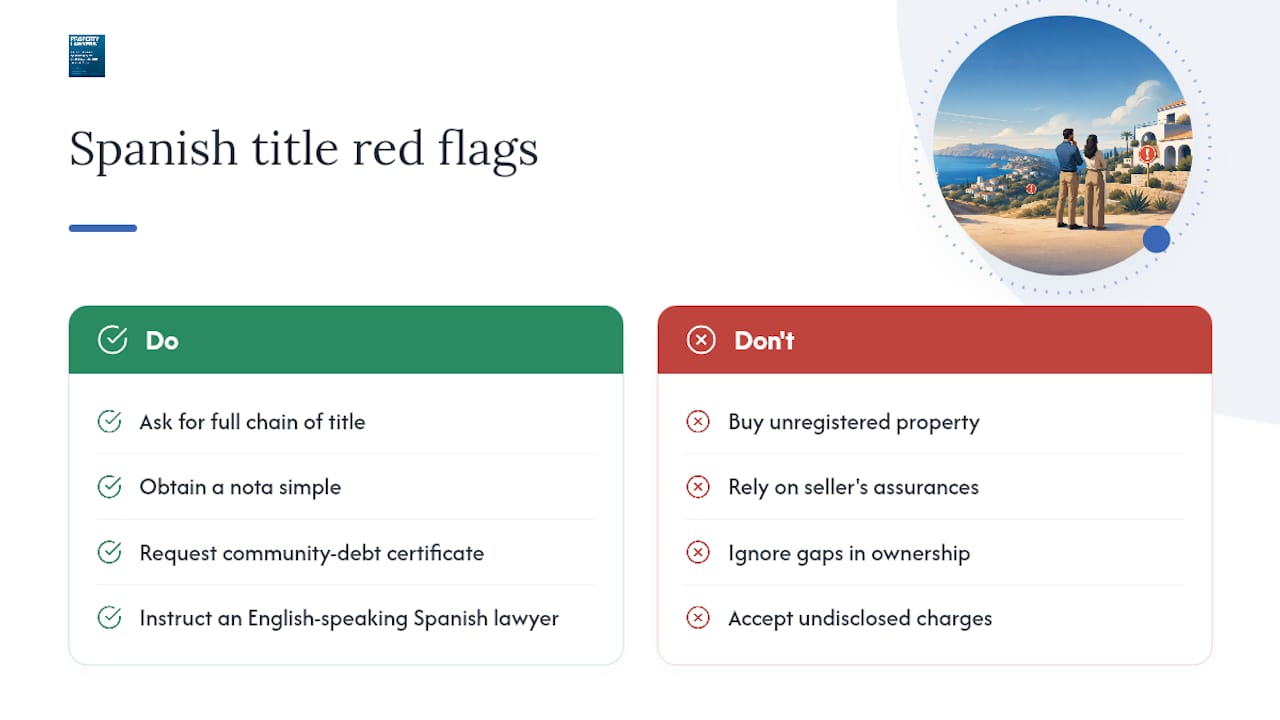
No entry in the Registro de la Propiedad. The property exists but ownership has never been formally registered. This leaves the buyer exposed to competing claims and makes mortgage finance almost impossible.
Conflicting names or identity details. The name on the escritura does not match the Registro entry. This often signals an inheritance that was never formalised, or a sale that was never properly registered. Pause and ask for a full chain of title before proceeding.
Long gaps in the ownership chain. Missing deeds between registered owners suggest informal transfers. Each gap is a potential legal dispute waiting to surface.
Mortgages or charges not disclosed by the seller. A nota simple will reveal these. Charges do not automatically disappear on sale — they must be formally cancelled (cancelación registral) before or at completion.
Unresolved community debts. In Spain, unpaid community fees can in some circumstances be recovered from the new owner. Always request a certificate from the community administrator confirming the account is clear.
Ongoing planning disputes or expropriation proceedings. Properties in certain coastal or rural zones may be subject to urban planning challenges. Check the local authority’s urban planning register (catastro) as well as the Registro.
If you encounter any of these issues, the right response is to instruct an English-speaking Spanish property lawyer immediately rather than relying on the seller’s assurances.
How do you change ownership? A practical step-by-step guide
Transferring a Spanish property title follows a defined sequence. Here is the standard process for a buyer:
- Agree the price and sign a reservation contract. Pay a small reservation deposit to secure the property while due diligence is completed.
- Instruct a lawyer and order a nota simple. Your lawyer orders the nota simple and certificado de cargas immediately.
- Obtain your NIE number. Without this Spanish tax ID, you cannot sign the escritura. Apply at a Spanish consulate in the UK or at a police station in Spain.
- Sign the private purchase contract. Pay a deposit portion of the purchase price. Your lawyer reviews all contract clauses before you sign.
- Arrange funds. Transfer the balance to a Spanish bank account or arrange a Spanish mortgage. Non-resident buyers often use a power of attorney if they cannot attend in person.
- Attend the notary signing. Both parties (or their representatives) sign the escritura. The buyer pays the balance, and the notary authenticates the deed.
- Pay transfer taxes. ITP or IVA plus stamp duty is due within 30 days of signing in most regions.
- Register the escritura. The notary’s office submits the deed to the Registro de la Propiedad. Registration typically takes 4–8 weeks.
The full process from reservation to registered title usually takes a few months for a straightforward resale, though complex chains or registry backlogs can extend this. A full overview of the conveyancing process in Spain covers each stage in detail.
When does an English-speaking Spanish property lawyer make a real difference?
A specialist lawyer runs the registry searches, reviews the full escritura chain, identifies hidden charges, and manages the notary and registration steps on your behalf. For UK buyers unfamiliar with Spanish legal procedures, this is not a luxury — it is the most reliable way to avoid the problems described above.
Core services a Spanish property lawyer provides:
- Ordering and interpreting the nota simple and certificado de cargas.
- Reviewing the full chain of title in the escritura.
- Checking planning status and catastro records.
- Drafting and negotiating private purchase contract clauses.
- Supervising the transfer of funds.
- Attending the notary signing or arranging a power of attorney.
- Submitting the escritura for registration and following up with the Registro.
When choosing a lawyer in Spain, look for someone with local experience in the specific region (a lawyer based in Mallorca will know the Balearic planning rules; one in Marbella will know the Andalucían ITP rates), clear fixed-fee transparency, and fluency in English. Property-lawyers connects UK buyers with vetted, English-speaking lawyers across Spain, searchable by region and city.
Pro Tip: Order the nota simple and certificado de cargas as the very first legal action — before the private contract, before the notary appointment, and certainly before any significant payment. These two documents cost very little and reveal the majority of title problems that cause buyers to lose money.
One thing UK buyers should do before anything else
Get a nota simple and a short registry check before paying any deposit. That single action takes a day and costs almost nothing, yet it tells you who actually owns the property, whether there is a mortgage on it, and whether any legal proceedings are attached to it. In popular areas like Marbella, Mallorca, Ibiza, Málaga, and Barcelona, where demand moves fast and sellers sometimes pressure buyers to commit quickly, having that information in hand before you sign anything is the clearest protection available.
If the chain of title is complex, the seller is not Spanish, or there are any gaps in the registered ownership history, escalate to a qualified Spanish property lawyer straight away. The cost of legal advice at that stage is a fraction of what a disputed title can cost to resolve later.
Find a vetted Spanish property lawyer through Property-lawyers
Verifying a título de propiedad properly takes local knowledge, registry access, and fluency in both Spanish legal procedure and English. Property-lawyers is Spain’s leading directory of independent, English-speaking property lawyers, covering every major region from the Costa del Sol to the Balearics and Barcelona.
You can search by region, read lawyer profiles, and make contact directly — no intermediary, no delay. Whether you need a full title check, help with the notary process, or guidance on land registry searches in Spain, the directory puts you in touch with a specialist who knows your target area. Visit Property-lawyers to find your lawyer and request a registry check today.
Sources
The sources below cover the main areas this article draws on:
- Title (legal) — Cornell Law School Wex
- TITLE DEED in Spanish – Cambridge Dictionary
- What Does Title Mean? – FindLaw
Consult the Cambridge Dictionary first if you need a quick translation, the Registro de la Propiedad if you want to order a search directly, and Property-lawyers if you need to find a qualified English-speaking lawyer for your specific region.
This article is general information, not a substitute for advice from a qualified lawyer. Consult a qualified legal professional about your own circumstances before acting on anything here.
FAQ
What does título de propiedad mean in English?
Título de propiedad translates directly as “title deed” or “property title” in English. It refers to the legal document — primarily the escritura pública — that proves ownership of a property in Spain.
What are house deeds called in Spain?
The main ownership document in Spain is the escritura pública (or escritura de compraventa), which is the notarised deed of sale. The broader term título de propiedad covers all documents that together prove legal ownership.
How do you change ownership of a property in Spain?
Ownership transfers by signing a new escritura before a Spanish notary and then registering it at the Registro de la Propiedad. The process typically takes several weeks from reservation to completed registration, including payment of transfer taxes.
What do Spanish property deeds look like?
An escritura pública is a formal, multi-page notarised document stamped and signed by a Spanish notary. It includes the full names and ID details of buyer and seller, a legal description of the property, the purchase price, and the notary’s authentication seal.
What is the difference between a nota simple and an escritura?
A nota simple is a summary extract from the land registry showing the current registered owner, property description, and any charges. The escritura is the actual deed of sale. The nota simple tells you the current legal position; the escritura is the document that created it.
Recommended
- Spanish property title deed: a buyer’s guide
- Spanish property registry: what UK buyers must check
- Spanish bank repossession property types: a UK buyer’s guide
- Escritura Spain — The Spanish Property Title Deed Explained | Property Lawyers

Sophie Gutenberg is a legal content specialist focused on Spanish property law, real estate transactions, conveyancing, due diligence and tax issues affecting international property buyers in Spain. She works alongside qualified Spanish property lawyers .
