

What superficie registral means: a clear guide for buyers
Superficie registral is the official surface, in square metres, recorded in Spain’s Land Registry, and it is the legally authoritative figure for ownership and mortgages. If a number on a property listing does not match what you see in a legal document, this is the one that carries weight in court, at the notary and with your bank.
The immediate next step is simple: order a nota simple (Land Registry excerpt) and compare it against the deed and the cadastral entry before you sign anything.
- The registered surface is what the Property Registry holds on file, not what an estate agent measured with a tape.
- Buyers commonly find a gap of a few square metres between the registry, the cadastre and the physical property.
- Differences of 10% or less are generally straightforward to correct; larger gaps require a formal procedure.
Key Takeaways
The registered surface in the Property Registry, not the cadastral or advertised figure, is the legally binding measurement for ownership, mortgages and sale contracts in Spain.
| Point | Details |
|---|---|
| Registry figure is legally binding | Superficie registral, not the cadastral or brochure figure, governs ownership and mortgage decisions. |
| Four measurements, four purposes | Registered, cadastral, built and usable areas naturally differ; compare like with like. |
| 10% is the practical threshold | Gaps up to 10% are usually simple to correct; above that, expect a formal expediente hipotecario. |
| Check early, not at completion | Order a nota simple and cadastral record during due diligence, well before signing. |
| Lawyers manage the formal process | A specialist instructs surveyors and lodges corrections with the registrador on your behalf. |
Table of Contents
- What does superficie registral mean in Spain?
- How does registered surface compare to cadastral, built and usable area?
- Why the registered surface matters for buyers, sellers and lenders
- Common discrepancies and the 10% rule for diferencia de cabida
- How to check the superficie registral step by step
- What to do when the registered surface does not match
- What buyers get wrong about superficie registral
- Sources
- FAQ
What does superficie registral mean in Spain?
The Property Registry, or Registro de la Propiedad, is the government body that records who owns a property, what debts sit against it, and its legal boundaries and surface. This is separate from the cadastre, which is a tax and mapping database. The registry is the one that determines legal ownership.
Since the 2015 reform of the Ley Hipotecaria (Law 13/2015), surface has become what registradores call an “essential registral element”. Spanish courts and registry practice increasingly expect the surface to be precisely expressed and evidenced, rather than described loosely in a paragraph of text. A vague sentence describing a plot no longer satisfies the standard many registrars now apply.
When you request a registry excerpt, look for these fields:
- CRU (Código Registral Único): the unique registry code identifying the property.
- Surface: the plot or built area figure the registry has on record.
- Encumbrances: mortgages, liens or embargoes attached to the property.
Some registry entries record plot surface, others record constructed area, and older entries sometimes lack a clear figure altogether. Reading the entry correctly is the first job, and it is one an English-speaking lawyer familiar with the role of the registrador de la propiedad handles routinely.
How does registered surface compare to cadastral, built and usable area?
Four different numbers can appear across four different documents for the same property, and none of them is wrong. They simply measure different things.
- Registered surface (superficie registral): the legal figure held by the Property Registry, used for ownership and mortgage purposes.
- Cadastral surface: recorded by the tax authority at sede.catastro for tax and topographic purposes, not proof of ownership.
- Built area (superficie construida): the total floor area including internal walls, sometimes a share of common areas in an apartment block.
- Usable area (superficie útil): the floor space you can actually walk on, excluding walls and structural elements, often 10 to 15% smaller than the built figure.
A terrace, storage room or garage might be included in one measurement and excluded from another. Comparing four figures without knowing which measurement each one represents is how buyers convince themselves a property has shrunk overnight, when nothing has actually changed. The fix is simple: always ask which type of surface a figure refers to before comparing it against another document.
Why the registered surface matters for buyers, sellers and lenders
The notary and the bank both work from the registry figure at completion, not from the agent’s brochure. Your mortgage valuation, loan-to-value calculation and even the final purchase price can shift if the registered surface turns out smaller than expected.
- Lenders base loan amounts partly on registered surface, so a lower figure can mean a lower mortgage offer.
- Notaries check the registry entry against the deed before authorising a sale.
- A significant mismatch can delay or even block completion until it is resolved.
- Sellers who have never queried their own registry entry are more common than you would expect, especially with older properties.
Pro Tip: Ask your lawyer to pull the nota simple in the due diligence phase, not the week before completion. A discrepancy found early is a negotiating point; one found late is a delay.
Common discrepancies and the 10% rule for diferencia de cabida
Spanish property law recognises two types of mismatch, known together as diferencia de cabida: an exceso de cabida (the actual property is larger than the registered figure) and a defecto de cabida (it is smaller).
How much this matters depends heavily on the size of the gap:
- Up to 10% difference: correction is often straightforward, using an available administrative process without a full formal procedure.
- Above 10% difference: registry practice typically requires an expediente hipotecario, along with a georeferenced plan produced by a licensed surveyor.
The 10% threshold exists because larger discrepancies raise the risk of boundary disputes with neighbouring plots, which is why the reforms tied to art. 199 and 201 of the Ley Hipotecaria require formal notification to adjoining owners once that line is crossed. Buyers can use a confirmed discrepancy as grounds to renegotiate price, request the seller correct the registry before completion, or in some cases walk away from the deal entirely.
How to check the superficie registral step by step
Checking this yourself takes under an hour if the documents are in order.
- Order a nota simple through the Land Registry’s public services and read the CRU, surface and encumbrances sections carefully.
- Cross-check the cadastral record at sede.catastro, noting the cadastral reference and comparing its surface figure against the registry.
- Compare both against the deed (escritura) and any floor plans the seller can provide.
- Instruct a surveyor if the figures disagree by a noticeable margin, or if you have any doubt about boundaries.
- Bring in a property lawyer once a discrepancy is confirmed, particularly if it looks close to or above the 10% threshold.
Our guide to ordering and reading a Land Registry excerpt walks through each field in more detail if this is your first Spanish purchase.
What to do when the registered surface does not match
Finding a mismatch is not a reason to panic. It is common, particularly with older properties, and there is a clear path to resolve it.
- Flag it immediately in your pre-contract due diligence. Ask the seller for any existing plans, previous surveys or building permits.
- For small gaps (10% or under), your lawyer can usually pursue a straightforward correction with the registry, often completed alongside the sale itself.
- For larger gaps, the seller (or you, post purchase, depending on how the contract is drafted) will need to open an expediente hipotecario, commission a georeferenced survey, and notify adjoining owners as required under the LH.
- Budget for delay and cost. Formal corrections involving a surveyor, notary fees and registry processing typically add weeks, sometimes months, to a transaction.
Pro Tip: Never assume a small discrepancy is “not worth mentioning” to your lawyer. What looks minor on paper can affect mortgage valuation, and it is far cheaper to resolve before completion than after.
A lawyer handling this for you will typically negotiate who pays for the correction, instruct the surveyor, and lodge the paperwork with the registrador directly, saving you from chasing three separate professionals yourself.
Checklist and red flags before you commit
Before signing a reservation contract or deposit agreement, run through this checklist:
- Obtain the nota simple and compare it line by line with the deed and the cadastral entry.
- Request a georeferenced plan if the registry entry has no surface figure recorded at all.
- Instruct an independent surveyor if the figures disagree by more than a few square metres.
Treat these as red flags requiring immediate legal advice: no surface recorded on the registry at all, a diferencia de cabida above 10%, renovations or extensions that were never registered, or conflicting CRU references across documents. Any one of these is a reason to instruct a specialist before you go further, and the Property-lawyers directory connects international buyers with English-speaking, independent lawyers across Spain who handle exactly this kind of registry discrepancy.
| Check | Where to find it |
|---|---|
| Registered surface | Nota simple, via sede.registradores |
| Cadastral surface | sede.catastro.gob.es |
| Built vs usable area | Deed, floor plans, seller’s documents |
| Encumbrances | Nota simple |
If you are moving toward completion and want a specialist to run these checks for you, our due diligence checklist for property buyers in Spain sets out exactly what a good lawyer verifies before you sign, and you can find a vetted, English-speaking property lawyer through the Property-lawyers directory to handle the registry check on your behalf.
What buyers get wrong about superficie registral
Most guides treat superficie registral as a dry technicality, something to skim past on the way to the “real” questions about price and location. That undersells it. In my view, this is one of the few checks that can genuinely change the economics of a purchase, because it feeds directly into what a bank will lend against the property.
The conventional advice, “just get a survey”, misses the sequencing problem. A survey tells you the physical reality, but it is the registry entry that a notary and a bank actually rely on. Buyers who order a survey but skip the nota simple often end up negotiating against the wrong number.
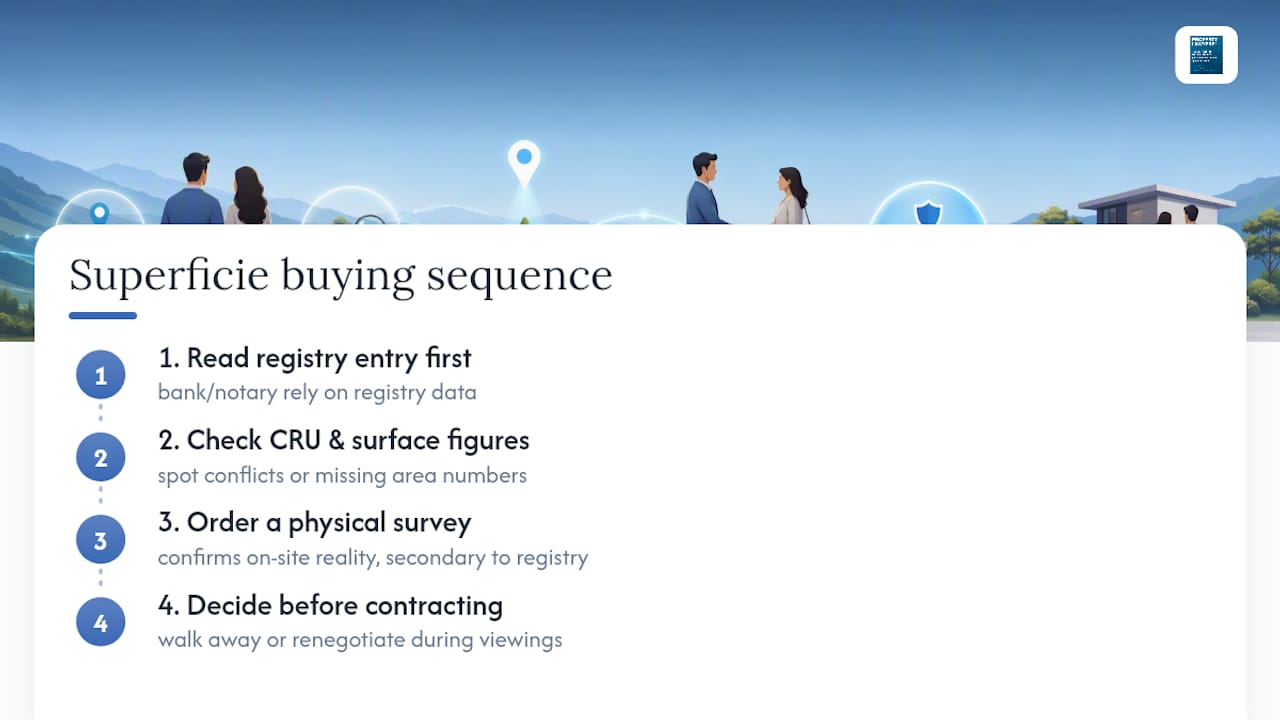
What I would prioritise first: read the registry entry before falling in love with a property, not after. A conflicting CRU reference or a missing surface figure is far easier to walk away from during viewings than during a signed reservation contract. The buyers who handle this well treat the registry check as step one, not paperwork to tidy up later.
Sources
- La expresión superficial de las fincas como elemento esencial – Revista Registradores de España
- Land Registry public services – registradores
- Sede Catastro
- Código de Legislación Registral (BOE)
FAQ
What Does Cadastral Reference Mean?
A cadastral reference is the unique identifier the Spanish tax authority assigns to a property for taxation and mapping, held separately from the Property Registry and searchable at sede.catastro.
How Can You Avoid Capital Gains Tax When Selling Property in Spain?
Certain exemptions and reductions apply depending on residency status and reinvestment plans; the rules are specific to each seller’s circumstances, so check our guide to capital gains tax for non-residents before assuming a general rate applies to you.
What Happens to a Jointly Owned Property When One Owner Dies in Spain?
The deceased’s share passes according to Spanish inheritance rules or an applicable will, and the registry entry must be updated to reflect the new ownership before the property can be sold or mortgaged.
What Are the Current Rules for Renting Property in Spain?
Rental rules vary by region and property type, covering matters such as tourist licences and tenancy protections; check rental licence requirements for your specific area before listing a property.
Is a 10% Surface Discrepancy Always a Problem?
Not necessarily. Differences of 10% or less are usually correctable through a simpler registry process, while larger gaps trigger a formal procedure with added cost and time.
Recommended
- Spanish land registry search: a guide for international buyers
- Land Registry Spain — Registro de la Propiedad Guide for Buyers | Property Lawyers
- Spanish property registry: what UK buyers must check
- Role of registrador de la propiedad in Spain

Sophie Gutenberg is a legal content specialist focused on Spanish property law, real estate transactions, conveyancing, due diligence and tax issues affecting international property buyers in Spain. She works alongside qualified Spanish property lawyers .
