

Recover €1,500–€15,000 From Spanish Abusive Mortgage Clauses for Expats
Yes, many clauses banks wrote into Spanish mortgages can be declared void, and borrowers often recover the money they paid because of them. The two most common wins involve the cláusula suelo (floor clause) and mortgage formalisation costs wrongly billed to the buyer. Start by gathering your deed and receipts, then send a written complaint to your bank before anything else.
TL;DR:
- Courts often declare floor clauses void if banks did not clearly explain their financial impact, with refunds depending on the number of active years.
- Notarial costs and formalization fees charged entirely to borrowers are often deemed illegal and can lead to claims worth several thousand euros.
- Checking your mortgage deed, pre-contractual information, and payment history allows you to estimate potential recoveries before legal action.
- Filing an extrajudicial complaint first can prompt settlements, but court claims are necessary if the bank refuses resolution or if foreclosure proceedings are active.
- Engaging a qualified, English-speaking lawyer for a document review improves the chances of successful claims, especially for complex or large cases.
Table of Contents
- What counts as a cláusula abusiva under Spanish law?
- Which mortgage clauses are most often ruled abusive?
- How do you check your own contract for abusive terms?
- What is the step-by-step process for reclaiming money?
- What can you actually recover, and by when must you claim?
- When does it make sense to bring in a specialist lawyer?
- What most borrowers get wrong
- Get a vetted lawyer to review your mortgage clauses
- Sources
- FAQ
What counts as a cláusula abusiva under Spanish law?
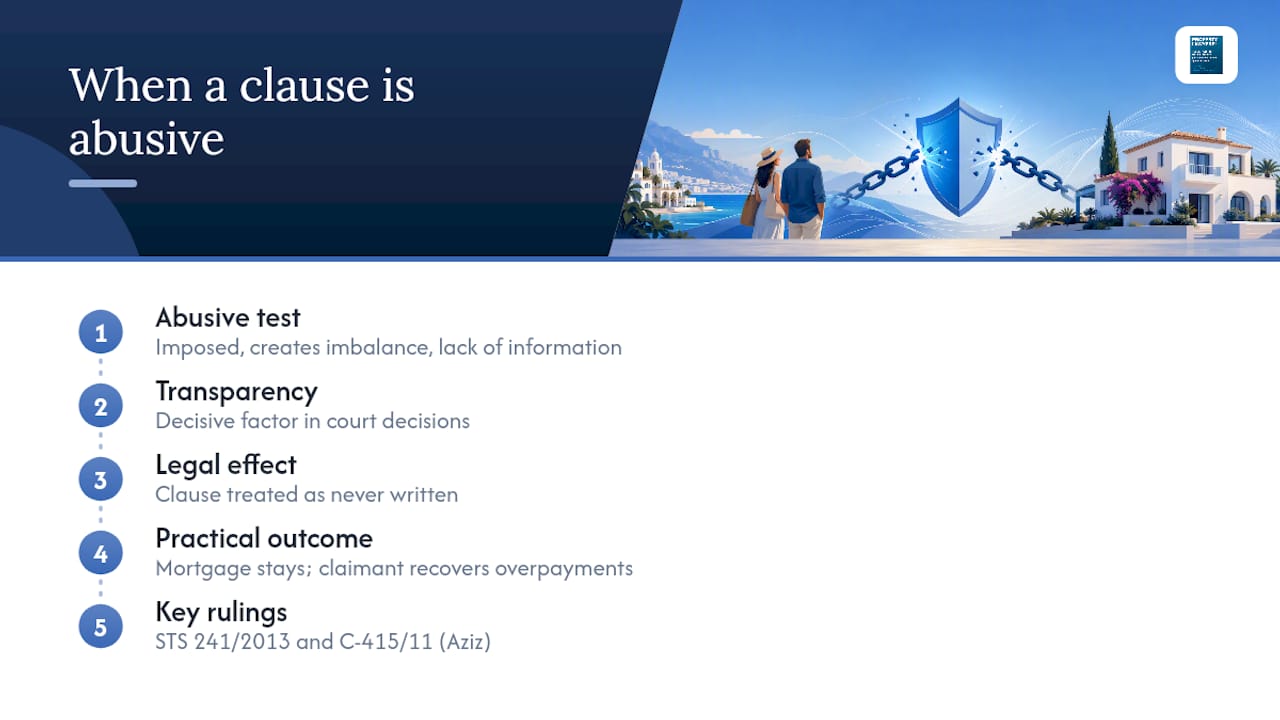
A clause becomes abusive when the bank imposed it without genuine negotiation, it created a significant imbalance between the parties, and the borrower never received clear, honest information about what it meant for their finances. That three-part test comes from EU Directive 93/13/CEE and Spain’s consumer protection law, the Real Decreto Legislativo 1/2007 (TRLGDCU). Transparency is the decisive factor courts return to again and again: a clause can be legal in principle and still fall if the bank buried it in small print or failed to explain its real cost.
When a Spanish court declares a clause abusive, the consequence is specific. The clause is treated as if it had never been written into the contract. The mortgage itself survives, minus that clause, and the borrower can usually claim back whatever they overpaid because of it.
Two rulings shaped how this works in practice. The Supreme Court’s STS 241/2013 on the cláusula suelo confirmed that a floor clause is void when the bank failed to make its financial impact genuinely understandable, even where the wording itself was not hidden. The Court of Justice of the European Union’s Aziz ruling (C‑415/11) went further, requiring Spanish judges to review mortgage contracts for abusive terms on their own initiative, even in cases where the borrower never raised the issue. That duty, known as control de oficio, is now built into article 552 of the Ley de Enjuiciamiento Civil (LEC).
Which mortgage clauses are most often ruled abusive?
Spanish courts have built up a fairly consistent list over the past decade. If your mortgage was signed before 2019, in particular, it’s worth checking your deed against each of these.
- Cláusula suelo: sets a minimum interest rate the bank will always charge, even if the reference index (usually Euríbor) falls below it. Courts strike these down when the bank never made the practical cost clear at signing, and refunds for long-running floor clauses have run into thousands of euros depending on how many years the clause was active.
- Gastos de formalización: notary fees, land registry costs and, in many cases, the property valuation (tasación) were routinely charged entirely to the borrower. Case law and specialist practice notes now treat several of these as costs the bank should share or bear, and refunds typically fall in the low thousands of euros.
- Intereses de demora desproporcionados: penalty interest for missed payments that exceeded what courts consider reasonable, generally judged against a “two-point” benchmark above the ordinary interest rate.
- Comisión de apertura: an opening fee charged simply for arranging the loan, contestable when the bank cannot show it corresponds to any real service performed, a standard tied to fee transparency rules under Law 2/2009.
- Redondeos al alza: automatic upward rounding of the interest rate, which quietly inflated payments over the life of the loan.
- Vencimiento anticipado: early termination clauses letting the bank call in the whole loan after a single missed instalment, often judged too aggressive relative to the borrower’s actual default.
- IRPH: a reference index used instead of Euríbor, contested where borrowers were never shown how it compared to alternatives.
- Cláusulas multidivisa: foreign currency mortgages that exposed Spanish borrowers to exchange rate swings they were rarely warned about in plain terms.
How do you check your own contract for abusive terms?
Before contacting anyone, you need paper. Spanish claims live or die on documentation, and the good news is most of it is easy to obtain.
- Get your notary copy of the mortgage deed (escritura), either from the notary who signed it or the Colegio Notarial if you’ve lost track of the original.
- Request the FEIN and the binding offer your bank issued before signing. The FEIN sets out the pre-contractual information the bank was legally required to give you, and comparing it against the final deed often reveals where terms shifted.
- Pull a registral note from the Land Registry showing the mortgage as recorded.
- Collect invoices for the notary, registry and tasación, since these show exactly who paid what.
- Assemble your full payment history from the bank, ideally as a downloadable statement covering the whole term of the loan.
Read your deed looking for blanket phrases like “all costs and expenses shall be borne by the borrower” with no breakdown of what those costs actually cover. That kind of catch-all language, offered with no itemised explanation, is a strong transparency red flag.
A rough calculation helps before you commit time to a claim. If your floor clause held your rate at, say, 3% while Euríbor sat near zero for several years, multiply the rate difference by your outstanding balance across those years to get a ballpark recoverable figure. It won’t be exact, but it tells you whether pursuing the claim is worth it.
Pro Tip: Note the exact date you signed the deed and the date, if any, you signed a later novation or restructuring. Those two dates often decide which prescription rules apply to your claim, so get them right before you approach anyone.
What is the step-by-step process for reclaiming money?
Spanish claims follow a fairly fixed sequence, and skipping the first step usually counts against you later.
- Send a written extrajudicial complaint to your bank. State which clause you consider abusive, cite the relevant law, and request restitution of a specific amount. Banks are required to respond, and a well-drafted letter often triggers a settlement offer without ever reaching court.
- Escalate to the Banco de España or file a judicial claim if the bank refuses or stays silent. The Bank of Spain’s complaints service reviews banking conduct and can pressure a resolution, though it cannot itself declare a clause void, only a court can do that.
- File a judicial claim for nullity and restitution if the extrajudicial route fails. The court will examine your deed, the FEIN, and your payment history to decide whether the clause meets the abusive-clause test and what sum should be returned.
- If a foreclosure (ejecución) is already underway, act immediately. You can oppose the enforcement under article 695.1.4 LEC specifically on the grounds of an abusive clause, and the judge has an independent duty under article 552 LEC to review the contract’s terms even without your opposition.
A few practical points worth weighing before you commit to litigation:
- Banks often propose a novation (renegotiated terms) rather than admit the clause was abusive. Read any novation carefully. If it makes you waive future claims in exchange for a modest rate change, that waiver can itself be challenged if it was signed without proper explanation.
- Court costs in Spain generally follow the losing party, so a well-evidenced claim carries less financial risk than borrowers often assume.
- Outcomes vary: some cases settle for a negotiated partial sum, others reach judgment for full restitution, and a minority are dismissed where the clause was found genuinely transparent.
What can you actually recover, and by when must you claim?
Illustrative figures from published cases show mid-size mortgages recovering between roughly €1,500 and €15,000, depending on the clause and how many years it was in force. A long-running floor clause on a larger loan tends to sit at the higher end; a single overcharged formalisation cost sits nearer the lower end.
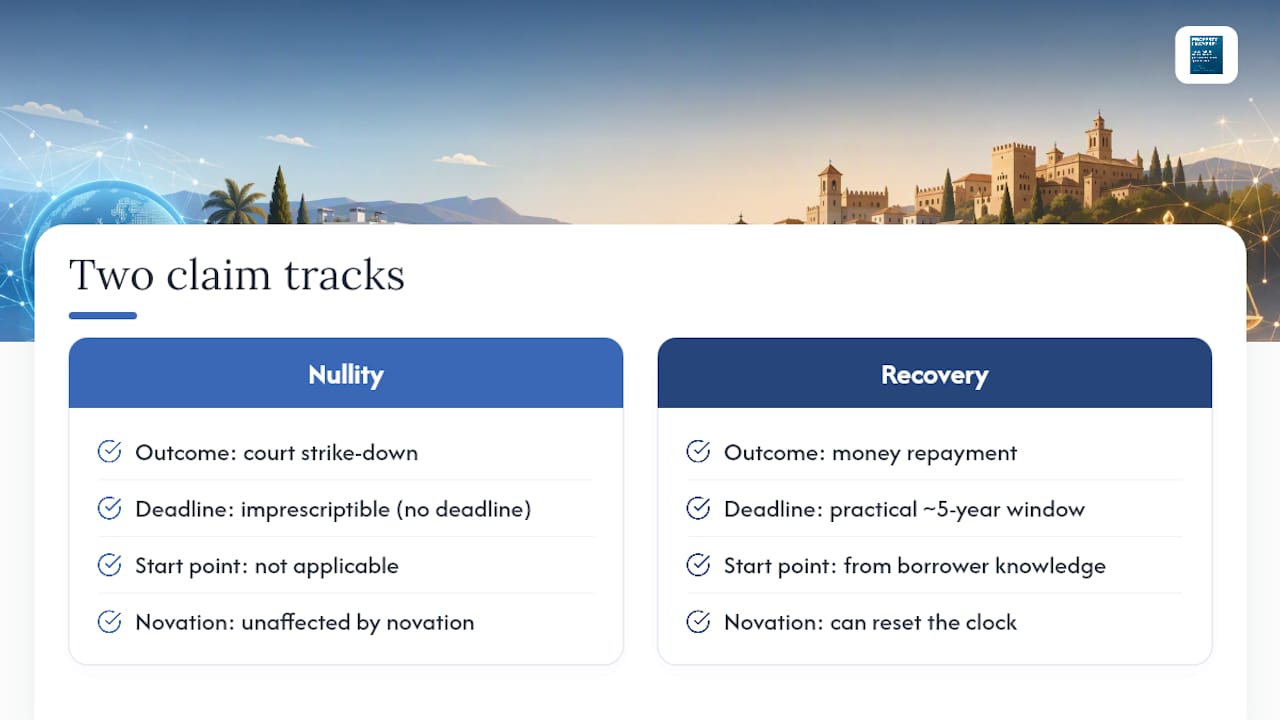
Timing matters, and it works differently for two separate actions. The right to have a clause declared null is generally treated as imprescriptible, meaning there’s no deadline to ask a court to strike it down. Recovering the money already paid is a different action, and Spanish courts have applied practical limitation periods, often discussed around a five-year window, calculated from when the borrower could reasonably have known the clause was abusive. That’s why the date on your novation or restructuring can matter so much: signing one sometimes resets the clock, and a poorly explained waiver inside it can be challenged in its own right.
When does it make sense to bring in a specialist lawyer?
A professional audit typically checks your FEIN, the signed offer, every clause in the deed, your cost invoices and your full payment history side by side, looking for the gaps between what you were told and what you actually paid. That cross-check is where most viable claims get discovered.
Hiring a lawyer becomes genuinely cost-effective once a foreclosure is active, the sums involved run into several thousand euros, or key documents are missing and need to be sourced from notaries or the registry. There are directories of English-speaking property lawyers across Spain, searchable by region, to help international buyers find someone who understands both the legal detail and the practical reality of dealing with Spanish banks.
What most borrowers get wrong
The most common mistake is not gathering documents early. Borrowers often wait years, misplace the deed, or sign a bank’s novation without reading the waiver clause buried inside it. That single signature can quietly close a door that was otherwise open.
Realistically, many cases settle before reaching a judge, and the ones that do go to court succeed largely on the strength of the paperwork behind them, not on how compelling the borrower’s story sounds. If there’s one action worth taking today, it’s requesting your deed and your cost invoices. Everything else in a claim builds from those two documents.
— Sophie
Get a vetted lawyer to review your mortgage clauses
Directories like this offer an alternative to guessing your way through a bank complaint alone: instead of drafting a claim letter with no legal backing, you can find an independent, English-speaking property lawyer who handles these disputes in your region.
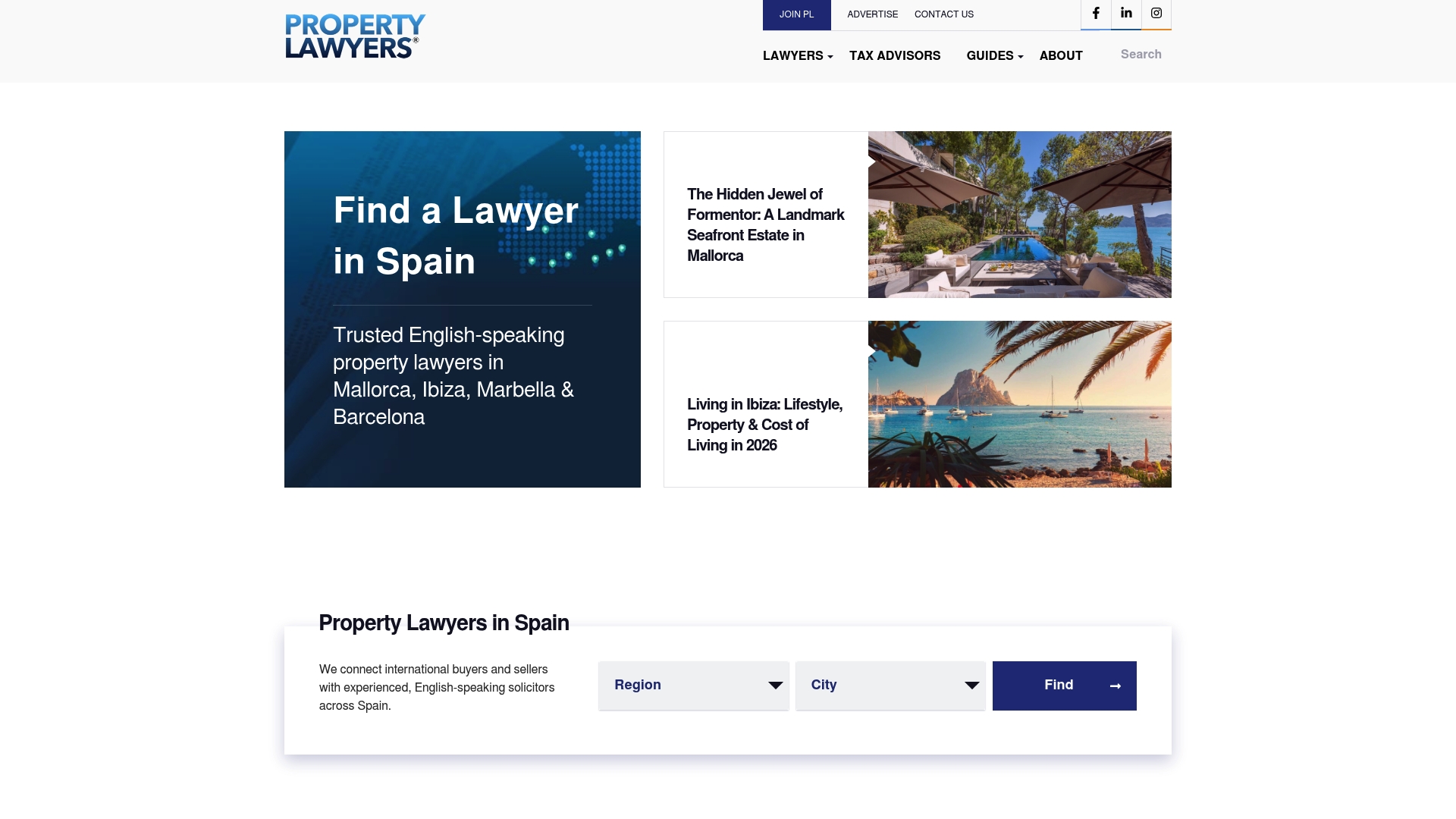
The directory lets you search by area, so if your mortgage is with a bank branch in the capital, the Madrid solicitors and lawyers listing is a sensible starting point, and the broader directory of property lawyers across Spain covers other regions including Marbella, Málaga and the Balearics. A first consultation typically involves sending over your deed, FEIN and payment history so the lawyer can tell you, before you commit to anything, whether your clauses are worth pursuing and what sum is realistically recoverable. For non-resident buyers in particular, working with a lawyer who already understands non-resident Spanish mortgages reduces the risk of losing a valid claim to a procedural error or a missed deadline. Search the directory now and request an introduction to a lawyer in your area.
Sources
Aziz preliminary ruling dossier · Abogacía Española on abusive clauses · Orozco y Asociados catalogue · Rastreator claim guide · Interforo Abogados procedural guide
This article is general information, not a substitute for advice from a qualified lawyer. Consult a qualified legal professional about your own circumstances before acting on anything here.
- Court of Justice preliminary ruling dossier (Aziz and follow‑ups)
- Orozco y Asociados: catalogue and defence of abusive mortgage clauses
FAQ
What clauses are considered abusive in a Spanish mortgage?
The most commonly challenged clauses are the cláusula suelo, gastos de formalización wrongly billed to the borrower, disproportionate default interest, the comisión de apertura, upward-only rate rounding, aggressive early termination terms, IRPH-linked rates and foreign currency (multidivisa) clauses.
What counts as an abusive interest rate on a mortgage?
Default interest is generally considered abusive when it exceeds around two percentage points above the loan’s ordinary interest rate, a benchmark Spanish courts have applied consistently in recent rulings.
When exactly is a clause classed as abusive?
A clause is abusive when it was imposed without genuine negotiation, creates a significant imbalance against the borrower, and was not explained clearly enough for the borrower to understand its real financial impact before signing.
How do I reclaim an abusive clause in my mortgage?
Start with a written extrajudicial complaint to your bank citing the specific clause and the amount you want refunded; if the bank refuses or stays silent, you can escalate to the Banco de España or file a judicial claim for nullity and restitution, and a specialist lawyer found through a directory like Property-lawyers.com can review your documents first to confirm the claim is worth pursuing.
Recommended
- Avoid a €1,500–€4,000 Eviction Bill When Buying a Rented Flat in Spain
- 50–70% LTV: Non Resident Spanish Mortgages and When to Hire a Lawyer
- Spanish off-plan property law explained for buyers

Sophie Gutenberg is a legal content specialist focused on Spanish property law, real estate transactions, conveyancing, due diligence and tax issues affecting international property buyers in Spain. She works alongside qualified Spanish property lawyers .
