
Buying property in Spain remotely using power of attorney
Purchasing property in Spain from abroad is entirely achievable, but the process involves multiple notary appointments, document signings, and legal formalities spread over weeks. Most international buyers simply cannot fly to Spain each time a signature is required. This is precisely where the option to buy property in Spain remotely using power of attorney becomes not just convenient, but necessary. A properly drafted power of attorney allows a trusted legal representative to act on your behalf throughout the entire transaction, from signing the initial deposit contract to collecting the keys, without you needing to be present at every stage.
Table of Contents
- Understanding the role of power of attorney in remote property purchases
- Preparing to buy property remotely: key documents and prerequisites
- Executing the property purchase remotely using power of attorney
- Troubleshooting common pitfalls and mistakes with power of attorney
- What to expect after completing the purchase with power of attorney
- Fresh perspective: why special power of attorney is your best safeguard for remote property purchases
- How property lawyers can help you buy in Spain remotely with power of attorney
- Frequently asked questions
Key Takeaways
| Point | Details |
|---|---|
| Power of attorney essentials | A special power of attorney limited to the property transaction is crucial for safe remote purchases in Spain. |
| Pre-purchase preparation | Obtain NIE, open a bank account, and execute the power of attorney early to avoid delays. |
| Step-by-step remote process | Your lawyer can sign documents, pay taxes, register the property, and set up utilities using the power of attorney. |
| Avoid common pitfalls | Ensure the PoA is in Spanish or properly translated and includes all necessary powers like bank transactions and mortgage signing. |
| Post-purchase verification | Lawyer handles tax payments and Land Registry registration to secure your ownership after purchase completion. |
Understanding the role of power of attorney in remote property purchases
A power of attorney (known in Spanish as a poder notarial) is a legally binding document that authorises another person to act on your behalf in specific legal and financial matters. In the context of Spanish property law, it carries considerable weight because all property transactions must pass through a notary, who requires the physical presence of the parties or their duly authorised representatives.
There are three main types of power of attorney relevant to Spanish property purchases:
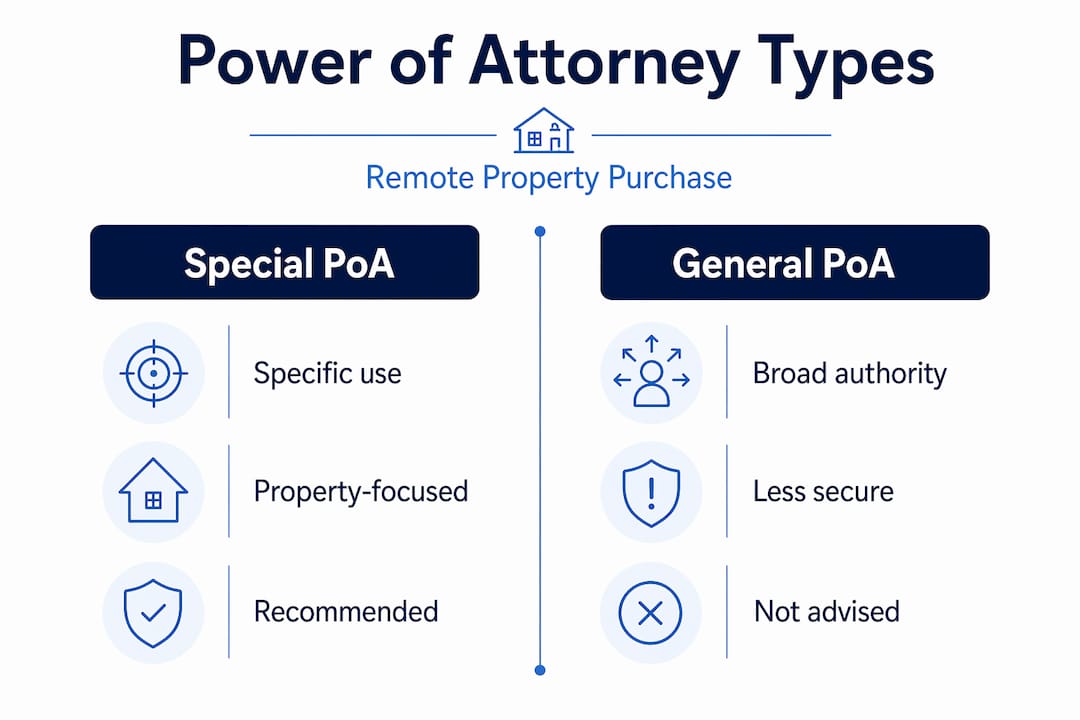
- Special power of attorney (poder especial): Limited to a specific transaction or set of tasks. This is the recommended option for property buyers.
- General power of attorney (poder general): Grants broad authority across many areas of your legal and financial life. This is rarely appropriate for a property purchase.
- Preventive power of attorney (poder preventivo): Used in cases of anticipated incapacity. Not relevant for most buyers.
For remote property purchases, a special power of attorney is strongly preferred. As confirmed by legal specialists, a special PoA limits authority to a specific transaction, providing considerably better protection than a general power of attorney. This matters because it prevents your representative from taking actions beyond what you have explicitly authorised.
| Type of PoA | Scope of authority | Recommended for property purchase? |
|---|---|---|
| Special (poder especial) | Limited to named transaction | Yes |
| General (poder general) | Broad, covers many matters | No |
| Preventive (poder preventivo) | Covers incapacity scenarios | No |
The document must be signed before a notary, either in Spain, at a Spanish consulate abroad, or before a local notary with an apostille stamp attached. Spanish notaries will only accept a power of attorney that is in Spanish or accompanied by an official sworn translation.
Preparing to buy property remotely: key documents and prerequisites
Before your representative can act on your behalf, several preparatory steps must be completed. Skipping any of these will cause delays, and some cannot be done after the fact.
Here is what you need to arrange before or alongside granting your power of attorney:
- NIE number (Número de Identificación de Extranjero): This is the foreigner identification number required for all property transactions in Spain. Your lawyer can obtain this on your behalf if the PoA includes this authority.
- Spanish bank account: Most purchases require payment via a Spanish bank draft. Your PoA should authorise your lawyer to open an account if you do not already have one.
- Anti-money laundering (AML) documents: These include proof of identity, proof of address, and evidence of the source of funds.
- Modelo 720 declaration: Non-EU buyers holding assets above a certain threshold must declare overseas assets to Spanish tax authorities.
- Arras contract (contrato de arras): This is the preliminary deposit contract, typically requiring a deposit of 10% of the purchase price. It is legally binding on both parties.
The arras contract and NIE steps should be coordinated carefully; the PoA should ideally be executed before or at the same time as the arras signing to avoid any gap in authority.
| Buyer type | Additional requirements |
|---|---|
| EU individual | NIE, bank account, AML documents |
| Non-EU individual | NIE, bank account, AML documents, Modelo 720 |
| Corporate buyer | CIF number, company registration, director authorisation |
Pro Tip: Appoint your Spanish lawyer before you even make an offer. An independent legal adviser will conduct due diligence on the property, flag any debts or embargoes registered against it, and ensure the PoA is drafted correctly from the outset.
Your lawyer should be independent of the estate agent and the developer. This is not optional advice. It is the single most important decision you will make in the entire process. You can find qualified Spanish property lawyers who specialise in remote purchases through a trusted legal directory.
Executing the property purchase remotely using power of attorney
With your PoA in place and prerequisites sorted, the purchase process follows a clear sequence. Understanding each step helps you monitor progress and ask the right questions.
- Sign the arras contract. This can be done remotely if your PoA is already in place, or in person during an initial visit to Spain.
- Grant the power of attorney. Execute the PoA at a Spanish notary, a Spanish consulate in your country, or before a local notary with an apostille. The purchase timeline from arras to escritura is typically 6 to 12 weeks, so act early.
- NIE and bank account. Your lawyer obtains your NIE and opens a Spanish bank account on your behalf, if authorised to do so in the PoA.
- Sign the escritura. Your lawyer attends the notary and signs the public deed of purchase (escritura pública de compraventa) using the PoA. This is the moment legal ownership transfers.
- Payment. The purchase price is paid via bank draft or transfer, managed by your lawyer according to the PoA authority.
- Tax payment. Your lawyer pays applicable taxes within 30 days of signing. For resale properties this is Transfer Tax (ITP); for new builds it is VAT (IVA) plus stamp duty.
- Land Registry registration. The deed is submitted to the Registro de la Propiedad. Full registration typically takes 1 to 3 months.
- Utility contracts and community registration. If included in the PoA, your lawyer arranges transfer of utilities and registers you with the community of owners.
| PoA signing location | Approximate cost | Additional requirement |
|---|---|---|
| Spanish notary in Spain | €50 to €150 | None |
| Spanish consulate abroad | €50 to €150 | Consulate appointment |
| Local notary abroad | €200 to €400 | Apostille and sworn translation |
Pro Tip: Book your consulate appointment as early as possible. In many countries, waiting times run to several weeks. A delayed PoA can cost you the property if another buyer is ready to move faster.
You can review the full step-by-step property purchase process to understand exactly what your lawyer will be handling on your behalf.
Troubleshooting common pitfalls and mistakes with power of attorney
Even well-prepared buyers run into problems. Most of these are avoidable with the right guidance.
Common mistakes include English-only PoA rejected by a notary, missing bank account or mortgage clauses, expired consulate appointments, and failing to name the specific property in the document. Each of these can halt a transaction entirely.
Here is what to watch for:
- Language: The PoA must be in Spanish or have an official sworn translation. A document in English alone will be rejected by the Spanish notary.
- Specificity: The PoA should name the specific property (by cadastral reference if possible) and state the maximum purchase price. Vague PoA documents create disputes.
- Bank account authority: If you do not already have a Spanish bank account, your PoA must explicitly authorise your lawyer to open one. Without this, payment at the notary becomes impossible.
- Mortgage clause: If you are financing the purchase, the PoA must include authority to sign the mortgage deed. Omitting this forces you to travel to Spain.
- Expiry: Most PoA documents do not expire, but some consulate-issued versions may have time limits. Confirm this with your lawyer.
Important: Never grant a general power of attorney for a property purchase. A general PoA gives your representative unchecked authority over your finances and legal affairs. A special PoA limited to the transaction is the only appropriate tool for this purpose.
Pro Tip: Prepare the PoA at the same time as signing the arras contract. This allows your lawyer to act immediately if circumstances change or the seller requests an earlier completion date.
What to expect after completing the purchase with power of attorney
Signing the escritura is not the end of the process. Several important steps follow, most of which your lawyer can manage using the PoA.
- Tax payment: Transfer Tax (ITP) or VAT must be paid within 30 days of signing. Your lawyer handles this directly. Failure to pay on time results in penalties.
- Land Registry entry: The escritura is submitted to the Registro de la Propiedad. Once registered, your ownership is protected against third-party claims. Registration typically completes within 1 to 3 months.
- Nota simple: Once registered, you will receive a nota simple, a Land Registry extract confirming your ownership, the property description, and any charges against it.
- Utility contracts: Electricity, water, and gas contracts are transferred to your name. If your PoA includes this authority, your lawyer arranges this without you travelling.
- Community of owners: If the property is within a development or apartment block, you must be registered as the new owner with the community (comunidad de propietarios).
- Ongoing tax obligations: Non-resident owners must file annual income tax declarations in Spain, even if they do not rent the property. Your lawyer or tax adviser can assist with this.
For a clear view of your obligations after purchase, review the property registration process and consider arranging tax and legal follow-up support from the outset.
Fresh perspective: why special power of attorney is your best safeguard for remote property purchases
There is a common misconception among first-time international buyers that the Spanish notary will protect their interests during the purchase. This is not the case. Spanish notaries verify legal validity of documents but do not act as advisers to the buyer. They are impartial officials, not advocates.
This is why the combination of an independent lawyer and a carefully drafted special PoA is so important. The lawyer conducts due diligence before the purchase, checks for debts and planning violations, negotiates on your behalf, and then executes the transaction using the PoA. The PoA is the mechanism. The lawyer is the safeguard.
A general PoA, by contrast, creates unnecessary risk. It grants authority that extends far beyond the transaction, and examples of power of attorney misuse in Spain, while not common, do occur when buyers grant overly broad authority without proper legal oversight. Limiting the PoA to the specific property, the specific price, and the specific tasks removes this risk almost entirely.
There is also a practical argument for acting quickly. Spanish property markets in popular areas move fast. A buyer who has a PoA already in place can authorise their lawyer to sign a reservation or arras contract within hours of identifying a property. A buyer who has not yet arranged a PoA may lose the property while waiting for a consulate appointment.
Using a special power of attorney, drafted by an independent legal representative who specialises in Spanish property law, is not a shortcut. It is the most secure and efficient way to complete a remote purchase in Spain.
The time and cost savings are real. Avoiding even one return flight to Spain for a notary appointment more than covers the cost of the PoA itself.
How property lawyers can help you buy in Spain remotely with power of attorney
Buying property in Spain from abroad is manageable when you have the right legal support in place from the beginning.
At Property-lawyers.com, we connect international buyers with trusted, independent real estate lawyers in Spain who specialise in remote purchases. Our network of lawyers handles every stage of the process: drafting and executing the special power of attorney, conducting due diligence, signing the escritura, paying taxes, and registering your ownership. They also provide tax advice for non-resident buyers and can manage utility transfers and community registrations. Whether you are purchasing a resale apartment on the Costa del Sol or a new-build villa in Valencia, our lawyers for property buyers ensure your transaction is legally sound and properly protected. Engage your lawyer early, and the entire process becomes far more straightforward than you might expect.
Frequently asked questions
Is it mandatory to have a power of attorney to buy property in Spain remotely?
While not legally mandatory, a power of attorney is essential for remote buyers who cannot attend the notary in person, as it authorises a representative to sign the escritura and manage the full purchase process on your behalf.
How much does a special power of attorney for property purchase in Spain typically cost?
Costs range from €50 to €150 when signed at a Spanish notary or consulate; if processed abroad with an apostille and sworn translation, the total cost is typically €200 to €400.
Can I give a general power of attorney instead of a special one for my property purchase?
It is strongly recommended to use a special PoA limited to the specific property transaction, as a general power of attorney grants unnecessarily broad authority and exposes you to greater risk.
How long does the property purchase process take when buying remotely with power of attorney?
The timeline from arras to escritura is typically 6 to 12 weeks, with Land Registry registration and tax payment taking a further 1 to 3 months before full legal ownership is confirmed.
Recommended
- How to Buy a Property in Spain With 100% Confidence |
- Property Buying Guide Spain: Legal Advice for Foreign Buyers
- Buying Property in Europe as a Foreigner: Legal Guide 2026 | Property Lawyers
- Taxes for Foreign Buyers in Spain
- Legal Glossary – Buying Property in Spain | Property Lawyers

Sophie Gutenberg is a legal content specialist focused on Spanish property law, real estate transactions, conveyancing, due diligence and tax issues affecting international property buyers in Spain. She works alongside qualified Spanish property lawyers .
